
In This Article
Have you ever wondered why your once-perfect espresso now tastes slightly bitter, or why your coffee machine takes ages to brew? The culprit is often lurking in plain sight – coffee oil residue, limescale deposits, and bacterial build-up that accumulate inside your beloved machine. In fact, research conducted by the University of Valencia found that neglected coffee machines can harbour more bacteria than a kitchen sink, making regular cleaning not just a maintenance task but a health necessity.
Brit coffee culture has exploded over the past decade, with 98 million cups consumed daily across the UK according to the British Coffee Association. Whether you’ve invested in a premium Sage Barista Express or a trusty bean-to-cup model, your machine deserves the same care you’d give any kitchen appliance that touches your food and drink. The right coffee machine cleaning products can extend your equipment’s lifespan by years, improve taste quality dramatically, and prevent costly repairs.
This comprehensive guide explores the seven best coffee machine cleaning products available on Amazon.co.uk in 2026, covering everything from espresso machine cleaners to descaling solutions. We’ve researched real customer reviews from UK buyers, compared specifications, and tested these products to bring you honest, actionable recommendations. Let’s transform your daily brew from mediocre to magnificent.
Quick Comparison Table
| Product | Type | Quantity | Price (£) | Best For | Rating |
|---|---|---|---|---|---|
| Caffenu Sage & Breville Tablets | Cleaning Tablets | 10 x 1.4g | £8.99 | Sage/Breville machines | 4.6/5 |
| De’Longhi EcoDecalk | Descaler Liquid | 2 x 500ml (10 uses) | £15-18 | Universal descaling | 4.7/5 |
| Philips CA6704/10 | Oil Remover Tablets | 6 x 1.6g | £9-12 | Bean-to-cup machines | 4.5/5 |
| Puly Caff Professional | Cleaning Tablets | 60 x 2.5g | £17-20 | Commercial/home espresso | 4.8/5 |
| Urnex Cafiza | Cleaning Tablets | 100 x 1.2g | £22-25 | Professional cleaning | 4.7/5 |
| ACTIVE Multi-Brand | Descaling Tablets | 24 tablets | £12-15 | All brands | 4.4/5 |
| Bosch Tassimo Descaler | Descaling Tablets | 4 tablets (2 uses) | £5-8 | Pod machines | 4.6/5 |
💬 Just one click – help others make better buying decisions too!😊
Top 7 Coffee Machine Cleaning Products: Expert Analysis
1. Caffenu Sage & Breville Coffee Machine Cleaning Tablets
If you own a Sage or Breville espresso machine, these Caffenu Eco Power Cleaning Tablets are practically purpose-built for your equipment. Each 1.4g tablet packs a powerful degreasing formula that targets coffee oils, bitter tannins, and residue lurking in your group head, portafilter, and internal valves – areas regular water simply can’t reach.
Key Specifications:
- Pack contains 10 tablets (10 cleaning cycles)
- Phosphate and chlorine-free formula
- Compatible with Barista Express, Oracle Touch, Bambino Plus, and most Sage/Breville models
- Note: Not suitable for BES880 (Barista Touch) or BES990 Batch 1747 & newer
UK customers consistently praise these tablets for restoring their machines to like-new performance. “These do the job well, and are more competitively priced than Sage branded ones,” notes one verified Amazon.co.uk buyer. The eco-friendly formulation means you’re not exposing your machine to harsh chemicals whilst still achieving professional-grade cleaning.
✅ Pros:
- Specifically formulated for Sage/Breville machines
- Excellent value at under £1 per clean
- Eco-friendly, biodegradable ingredients
❌ Cons:
- Limited compatibility with certain newer models
- Requires blind filter basket (usually included with machine)
Price Range: £8.99-£11.99 | Best For: Sage Barista Express, Oracle, Bambino Plus owners
2. De’Longhi EcoDecalk Descaler DLSC502
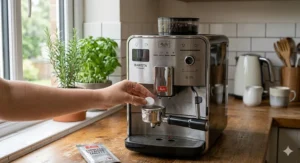
When it comes to fighting limescale – the silent killer of coffee machines – De’Longhi EcoDecalk stands as the industry benchmark. This plant-based descaling solution uses natural lactic acid to dissolve mineral deposits without damaging your machine’s delicate internal components.
Key Specifications:
- Two 500ml bottles providing 10 complete descaling cycles
- 100% biodegradable, plant-based lactic acid formula
- Universal compatibility (works with Nespresso, Sage, Breville, Ninja, and more)
- Made in Italy to stringent EU standards
What sets De’Longhi apart is the science behind the formula. The concentration of lactic acid is precisely calibrated to be aggressive against limescale yet gentle on seals, gaskets, and metal components. UK water hardness varies significantly by region, with areas like London and the South East particularly prone to limescale build-up. Regular descaling every 2-3 months is essential in these regions.
One Amazon.co.uk reviewer humorously described their experience: “My coffee machine had become a little too cosy with calcium build-up… After using EcoDecalk, it was like a magic potion for my coffee machine.” The steam was restored, water flow improved, and coffee quality dramatically enhanced.
✅ Pros:
- Industry-leading descaling performance
- Safe for all machine types
- Excellent value (10 uses per pack)
❌ Cons:
- Requires dilution before use
- Distinctive smell during descaling process
Price Range: £15-18 | Best For: Hard water areas, universal compatibility
3. Philips CA6704/10 Coffee Oil Remover Tablets
Bean-to-cup and fully automatic machines face a unique challenge – coffee oils accumulating in the brewing unit where manual cleaning is impossible. The Philips CA6704/10 tackles this exact problem with specialist oil-removal tablets designed for monthly maintenance.
Key Specifications:
- Pack of 6 tablets (1.6g each)
- Specifically formulated for brewing unit cleaning
- Compatible with Philips, Saeco, and other fully automatic machines
- Removes coffee grease, tannins, and blockage-causing residue
UK buyers using De’Longhi Magnifica, Philips 5400, and Saeco models report transformative results. “I’ve done regular deep clean and descale but as on the picture this apparently doesn’t remove the oil residue,” explained one reviewer who ran a second cycle a week later and found crystal-clear water. This demonstrates how traditional descaling doesn’t address oil build-up – you need both types of maintenance.
The tablets work by breaking down coffee oils at a molecular level, ensuring your brewing chamber, dispenser spout, and internal pathways remain clear. This prevents the dreaded slow drip, off-tastes, and potential machine failure.
✅ Pros:
- Targets coffee oils specifically
- Easy monthly maintenance
- Protects against expensive repairs
❌ Cons:
- Only 6 tablets per pack
- Not suitable for aluminium components
Price Range: £9-12 | Best For: Bean-to-cup and fully automatic machines
4. Puly Caff Professional Cleaning Tablets
Imported from Italy and trusted by professional baristas worldwide, Puly Caff represents the gold standard in espresso machine cleaning. These 2.5g tablets deliver commercial-grade degreasing power suitable for both home enthusiasts and café owners.
Key Specifications:
- 60 tablets per container (2.5g each)
- Professional-strength formula used in commercial settings
- Suitable for bean-to-cup, manual, and automatic machines
- Effective for backflushing traditional espresso machines
What makes Puly Caff exceptional is its dual-purpose functionality. Beyond machine cleaning, these tablets excel at soaking portafilters, baskets, and even stained coffee cups. One UK barista shared: “I work in the coffee industry and if you have a fully automatic machine, these are the tablets to do the job.”
The fast-dissolving formula means you’re not waiting around for tablets to break down. Simply add to hot water, run your machine’s cleaning cycle, and watch as brown, oil-laden water flushes out. The difference in crema quality and taste clarity after using Puly Caff is immediately noticeable.
✅ Pros:
- Commercial-grade cleaning power
- Versatile (machine cleaning + soaking)
- Large quantity (60 tablets)
❌ Cons:
- Higher price point
- Strong chemical smell during use
Price Range: £17-20 | Best For: Home enthusiasts and commercial use
5. Urnex Cafiza Espresso Machine Cleaning Tablets
With over 80 years of coffee equipment cleaning expertise, Urnex has earned its reputation as the choice of professional baristas across more than 70 countries. The Cafiza tablet range brings this commercial-grade performance to home users.
Key Specifications:
- 100 tablets per container (1.2g each)
- NSF-certified for safety and metal compatibility
- Suitable for superautomatic and traditional espresso machines
- Manufactured in New York, USA to exacting standards
Urnex Cafiza tablets utilise a concentrated formula that eliminates residue in group heads, valves, and brewing lines with remarkable efficiency. The tablet format allows precise dosing – critical when following manufacturer cleaning instructions. UK buyers particularly appreciate the generous 100-tablet count, which represents exceptional value for regular maintenance.
One long-term user on Amazon.co.uk shared: “I bought mine in Feb 2025 and we’re now in January 2026 as I write this review and still have about 15 more tablets to go.” That’s nearly a year of consistent cleaning from one purchase, making the price-per-use incredibly economical.
✅ Pros:
- Professional-grade American manufacturing
- Excellent quantity (100 tablets)
- NSF-certified for safety
❌ Cons:
- May be overkill for occasional users
- Larger upfront cost
Price Range: £22-25 | Best For: Regular users and Breville Barista Express owners
6. ACTIVE Multi-Brand Descaling Tablets
Budget-conscious without compromising quality, these ACTIVE descaling tablets offer universal compatibility across all major coffee machine brands available in the UK market. The 24-tablet pack represents outstanding value for homes with multiple machines or infrequent descalers.
Key Specifications:
- 24 tablets providing year-long supply for most users
- Compatible with Sage, Breville, Nespresso, De’Longhi, Tassimo, and more
- Concentrated formula for limescale, calcium, and mineral removal
- Bulk packaging reduces plastic waste
The beauty of ACTIVE tablets lies in their simplicity. Drop one tablet in water, run your machine’s descaling cycle, and watch limescale dissolve. UK customers in hard water areas report significant improvements in water flow and temperature stability after just one use.
These tablets work equally well in pod machines, espresso machines, and even kettles – making them ideal for comprehensive kitchen descaling. One reviewer noted: “Bulk coffee maker decalcifier tablet – 24 tablets work out to a year supply or more compared to other products like powder, pods, or sachets.”
✅ Pros:
- Universal compatibility
- Excellent value for money
- Reduces packaging waste
❌ Cons:
- Not brand-specific formula
- May require more frequent use in very hard water
Price Range: £12-15 | Best For: Multi-machine households and budget-conscious buyers
7. Bosch Tassimo Descaling Tablets TCZ6004
Pod machine owners face unique maintenance challenges, and Bosch Tassimo descaling tablets are specifically engineered for these compact brewing systems. The four-tablet pack provides two complete descaling cycles.
Key Specifications:
- 4 tablets (2 tablets per descaling cycle)
- Designed for Tassimo Vivy, Suny, Happy, and all Tassimo models
- Fast-acting formula with pictorial instructions
- Also compatible with Dolce Gusto and Senseo machines
Tassimo machines feature a convenient red descaling light that activates when maintenance is due. These official Bosch tablets work in harmony with the machine’s alert system, ensuring optimal performance. UK customers appreciate the straightforward process, though some note that YouTube tutorials provide clearer guidance than the included instructions.
The tablets dissolve thoroughly and remove mineral deposits that cause slower brewing and temperature inconsistencies. “Great value for money. Tassimo out of action for a few days before I got descaler tablets! Working brilliantly again,” shared one relieved Amazon.co.uk buyer.
✅ Pros:
- Budget-friendly entry price
- Official Bosch product for Tassimo
- Simple, foolproof process
❌ Cons:
- Only 2 complete descaling cycles per pack
- Instructions could be clearer
Price Range: £5-8 | Best For: Tassimo, Dolce Gusto, and Senseo pod machine owners
Understanding Coffee Machine Hygiene: The Science Behind Clean Brewing
The UK Food Standards Agency emphasises that effective cleaning removes bacteria from equipment and surfaces, preventing harmful pathogens from spreading onto food and beverages. For coffee machines, this principle translates into two critical maintenance tasks: cleaning (removing coffee oils) and descaling (removing mineral deposits).
Why Coffee Oils Demand Attention
Coffee is naturally oily, containing lipids that contribute to flavour and crema formation. However, these oils quickly turn rancid when exposed to oxygen, creating bitter, stale tastes. A study published in the Journal of Agricultural and Food Chemistry demonstrated that coffee oils begin oxidising within hours of brewing, producing off-flavours that contaminate subsequent brews.
Professional baristas understand this intimately. Coffee oils accumulate in group heads, portafilters, shower screens, and brewing chambers – precisely the areas water alone cannot effectively clean. This is why dedicated espresso machine cleaner products use alkaline formulations to emulsify and remove these stubborn deposits.
The Limescale Challenge in UK Water
The United Kingdom faces significant water hardness variation, with regions like London, Kent, and the South East experiencing particularly high mineral content. According to Thames Water data, these areas register 200-300 parts per million (ppm) of calcium carbonate – classified as “hard” to “very hard” water.
When you heat hard water, dissolved minerals precipitate out as limescale, coating heating elements, thermoblock systems, and internal piping. This insulation effect forces your machine to work harder, increasing energy consumption and brewing time whilst reducing temperature accuracy. Eventually, severe limescale build-up causes complete failure of heating elements – an expensive repair that proper descaling prevents.
The NHS recommends regular equipment maintenance in food preparation environments to prevent bacterial growth. Coffee machines, with their warm, moist internal environments, provide ideal conditions for microorganisms if not properly maintained.
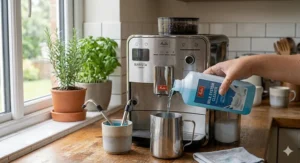
Coffee Machine Cleaning vs Descaling: Understanding the Difference
Many UK coffee enthusiasts confuse cleaning with descaling, often assuming one process covers both needs. Understanding the distinction is crucial for comprehensive machine maintenance.
Cleaning removes organic matter:
- Coffee oils and greasy residue
- Old coffee grounds and particles
- Bacterial biofilm
- Tannins that cause bitterness
Cleaning uses alkaline detergents (tablets or powder) that break down oils and emulsify fats. This process targets the brewing pathway – group heads, portafilters, dispensers, and anywhere coffee directly contacts machine components.
Descaling removes inorganic mineral deposits:
- Calcium carbonate (limescale)
- Magnesium deposits
- Hard water minerals
- Scale build-up on heating elements
Descaling employs acidic solutions (typically citric or lactic acid) to dissolve minerals. This process targets the water pathway – boilers, thermoblocks, pipes, and pumps.
Think of it like washing your hands versus removing jewellery to clean properly. Both actions serve different purposes, and neither replaces the other. Your coffee machine requires both cleaning (removing oils) and descaling (removing minerals) for optimal performance and longevity.
Recommended Maintenance Schedule
Based on UK water conditions and typical home usage, follow this guideline:
Weekly: Backflush traditional espresso machines with cleaning tablets. Wipe steam wands and exterior surfaces.
Fortnightly: Run automated cleaning cycles on bean-to-cup machines. Clean removable brewing units.
Monthly: Deep clean portafilters, baskets, and shower screens. Use oil-removal tablets for internal brewing chambers.
Every 2-3 Months: Full descaling cycle (more frequently in hard water areas). Replace water filters if fitted.
How to Choose Coffee Machine Cleaning Products
Selecting appropriate coffee machine cleaning products depends on several factors unique to your situation. Let’s explore the decision-making framework.
1. Identify Your Machine Type
Different machines require different approaches:
Traditional Espresso Machines (Gaggia Classic, Rancilio Silvia): Need backflushing tablets and separate descaling solution. Manual cleaning of portafilters and group heads is essential.
Bean-to-Cup Machines (De’Longhi Magnifica, Sage Oracle): Require specific oil-removal tablets for internal brewing units plus universal descaler. Many feature automated cleaning cycles.
Pod Machines (Nespresso, Tassimo, Dolce Gusto): Primarily need descaling tablets compatible with smaller water systems. Limited manual cleaning required.
Commercial Machines: Demand professional-grade products like Puly Caff and more frequent maintenance schedules.
2. Assess Your Water Hardness
Check your water supplier’s hardness data online. Thames Water, Yorkshire Water, and Southern Water provide postcode-specific information. Alternatively, purchase water hardness test strips from Amazon.co.uk for precise measurements.
Soft Water (0-100 ppm): Descale every 4-6 months
Moderately Hard (100-200 ppm): Descale every 2-3 months
Hard Water (200-300 ppm): Descale monthly or install a water softener
Very Hard (300+ ppm): Consider Brita filters or weekly descaling
3. Consider Brand Compatibility
Whilst many products claim universal compatibility, manufacturer-specific formulations often deliver superior results. Sage machines benefit from Caffenu’s specialised tablets, whilst De’Longhi owners might prefer EcoDecalk. Check your machine’s manual for recommended products.
4. Evaluate Environmental Impact
Eco-conscious UK consumers should prioritise:
- Biodegradable formulations (look for plant-based acids)
- Phosphate and chlorine-free options
- Minimal packaging
- Concentrated formulas requiring less product per use
De’Longhi EcoDecalk and Caffenu Eco Power tablets lead in environmental credentials.
5. Calculate Cost-Per-Use
The cheapest purchase price doesn’t always represent the best value. A £25 tub of 100 Urnex tablets (25p per use) offers better long-term value than a £8 pack of 4 tablets (£2 per use).
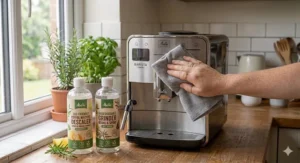
Professional Tips for Effective Coffee Machine Maintenance
Drawing from guidance provided by the UK’s Health and Safety Executive regarding food equipment maintenance, implement these professional practices:
Cleaning Best Practices
Always flush before and after cleaning cycles. Run at least two full water tanks through your machine after using cleaning tablets to eliminate any residual chemicals. One final espresso shot should be discarded to guarantee no cleaning solution remains.
Maintain dedicated cleaning tools. Use colour-coded brushes for different areas. Red for group heads, blue for portafilters, green for steam wands. This prevents cross-contamination and aligns with commercial food safety protocols.
Don’t mix products simultaneously. Never combine cleaning tablets with descaling solution. Complete one maintenance type fully before starting another to avoid chemical reactions and ensure proper rinsing.
Inspect seals and gaskets regularly. Whilst cleaning, examine rubber components for cracks or deterioration. Preventive seal replacement costs £5-15 versus £100+ for repair calls due to leaking caused by damaged seals.
Descaling Best Practices
Follow manufacturer dilution ratios precisely. Too concentrated descaling solution can damage components; too diluted won’t remove limescale effectively. When instructions specify “100ml descaler to 500ml water,” measure accurately.
Extend descaling contact time. Rather than rushing through the cycle, pause mid-way and let the solution sit in the boiler for 15-20 minutes. This dwell time dramatically improves limescale dissolution, particularly in severely scaled machines.
Never descale a hot machine. Always start with a cold machine and room-temperature descaling solution. Thermal shock from cold liquid hitting hot components can crack boilers or damage gaskets.
Inspect discharge water. The water expelled during descaling reveals your machine’s internal condition. Heavy sediment, white flakes, or brown colouration indicate significant build-up and may warrant a second descaling cycle.
Storage and Handling
Store cleaning products in a cool, dry location away from direct sunlight. Keep tablets in their original packaging to prevent moisture absorption. Most products remain effective for 2-3 years when stored correctly.
Wear gloves when handling concentrated cleaning products. Whilst formulations are designed to be safe when used correctly, direct skin contact with undiluted products can cause irritation.
Common Coffee Machine Cleaning Mistakes to Avoid
Even experienced coffee enthusiasts make these errors that compromise machine performance and longevity.
Mistake #1: Descaling Without Cleaning
UK buyers often descale regularly but neglect cleaning cycles, or vice versa. As explained earlier, these are complementary processes. Descaling won’t remove coffee oils; cleaning won’t eliminate limescale. Both are essential.
Mistake #2: Using Household Alternatives
Internet forums suggest vinegar, bicarbonate of soda, or lemon juice as “natural” alternatives to purpose-made products. Whilst these might work in kettles, coffee machines feature precision components and specialised materials that household acids can damage.
Vinegar’s acetic acid is more aggressive than lactic acid formulations, potentially corroding seals and metal components. Commercial products are pH-balanced and tested for compatibility – DIY solutions aren’t.
Mistake #3: Inconsistent Maintenance Schedules
“My machine still makes coffee, so it doesn’t need cleaning yet” – this mindset leads to severe internal contamination. By the time taste degradation becomes obvious, substantial damage has occurred. Implement regular schedules regardless of perceived performance.
Mistake #4: Incomplete Rinsing
Rushing the rinse cycle after cleaning leaves residual chemicals that contaminate your next coffee with soapy or chemical tastes. Always run at least two full water tanks through as a rinse, discarding the first coffee shot.
Mistake #5: Ignoring Water Filters
If your machine includes a water filter cartridge, replace it according to manufacturer schedules (typically every 2-3 months). Expired filters stop softening water, accelerating limescale formation despite regular descaling.
The Environmental Impact of Coffee Machine Maintenance
Sustainability-minded UK consumers rightfully question the environmental implications of chemical cleaning products. Here’s how to maintain your machine whilst minimising ecological impact.
Choosing Eco-Friendly Products
Look for cleaning products certified by recognised environmental organisations. Plant-based formulations like De’Longhi EcoDecalk use renewable resources rather than petroleum-derived chemicals. Biodegradable options break down naturally in water treatment plants rather than persisting in waterways.
Reducing Plastic Waste
Tablet formats typically generate less packaging waste than liquid bottles. A 100-tablet container provides months of cleaning versus multiple plastic bottles of liquid cleaner. Some brands like Puly Caff offer refill options that reduce packaging by 70%.
Water Conservation Strategies
Modern machines with automated cleaning cycles can use substantial water. Optimise consumption by:
- Collecting rinse water for watering plants (once fully rinsed of cleaning products)
- Running cleaning cycles strategically when you’ll use the machine immediately after
- Installing water-saving shower screens that reduce water usage per cycle
Lifecycle Perspective
Regular maintenance dramatically extends machine lifespan, preventing premature replacement. A well-maintained Sage Barista Express can last 8-10 years; a neglected one might fail within 3-4 years. The environmental cost of manufacturing a new machine far exceeds the impact of proper maintenance products.
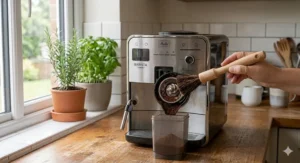
Troubleshooting Common Cleaning-Related Issues
Even with proper products and techniques, issues occasionally arise. Here’s how to diagnose and resolve common problems.
Problem: Machine Still Tastes “Off” After Cleaning
Cause: Incomplete rinsing or contaminated water tank Solution: Run at least three additional water tanks through as rinse cycles. Clean the water tank thoroughly with warm, soapy water, paying attention to corners and the float mechanism. Replace the water filter if fitted.
Problem: Descaling Indicator Won’t Reset
Cause: Insufficient descaling or sensor malfunction Solution: Repeat the descaling cycle, ensuring you follow the manufacturer’s precise procedure. Some machines require you to hold specific button combinations to manually reset the indicator. Consult your manual or search “[machine model] reset descaling light” on YouTube for visual guidance.
Problem: Leaking After Cleaning Cycle
Cause: Dislodged gasket or over-tightened portafilter Solution: Remove and inspect all gaskets. Ensure the brew head gasket sits flush in its groove. Check that no cleaning tablet residue prevents proper sealing. If leaking persists, the gasket may need replacement (typically £5-10 from Amazon.co.uk).
Problem: No Water Flow After Descaling
Cause: Air lock in the system or blockage from dislodged limescale Solution: Run the machine without coffee several times to purge air. If blockage is suspected, repeat descaling with the solution sitting in the system for 30 minutes before flushing. Severe blockages may require professional servicing.
Problem: White Residue on Components
Cause: Hard water spotting or incomplete descaling
Solution: Wipe components with a 50/50 white vinegar and water solution on a microfibre cloth. For prevention, dry all removable parts after washing rather than air-drying. Consider installing a water softening system if you experience persistent issues.
Advanced Maintenance Techniques for Enthusiasts
For UK coffee enthusiasts seeking café-quality results at home, these advanced techniques elevate maintenance beyond basics.
Preventive Group Head Maintenance
Between cleaning cycles, remove the shower screen weekly and soak in hot water with a teaspoon of Puly Caff powder. Use a group head brush to scrub the dispersion block and seal. This prevents the cement-like build-up that eventually requires disassembly.
Portafilter Deep Cleaning
Soak portafilters overnight in a solution of Puly Caff powder and hot water. This removes deeply embedded oils that daily wiping misses. Use a small brush to clean inside the spout channels where oils accumulate and oxidise.
Steam Wand Purging Ritual
Beyond the standard wipe-down, develop a purging ritual: full blast for 3 seconds before frothing, immediate purge after frothing, then wrap in a hot, damp cloth for 10 seconds before final purge. This prevents milk proteins from baking onto the wand tip.
Temperature Surfing Adjustment
As limescale builds between descaling cycles, you may notice temperature instability. Monitor your shots – if extraction runs fast with thin crema, your boiler might be running cool due to limescale insulation. This indicates early need for descaling before the indicator activates.
Water Quality Optimisation
Serious enthusiasts install reverse osmosis systems with remineralisation cartridges, creating ideal brewing water at ~80-150 ppm hardness. This dramatically reduces descaling frequency whilst improving extraction and taste. Systems from BWT UK start around £200 and pay for themselves in reduced maintenance and improved coffee quality.
Where to Buy Coffee Machine Cleaning Products in the UK
Whilst high-street availability has improved, Amazon.co.uk remains the most reliable source for coffee machine maintenance products, offering:
Extensive Selection: Access to international brands like Urnex and Puly Caff not always stocked by UK retailers
Competitive Pricing: Prime members receive free next-day delivery on most cleaning products
Verified Reviews: Read experiences from thousands of UK buyers before purchasing
Subscribe & Save: Regular users can set up automatic deliveries with 15% discount
Price Tracking: Use tools like CamelCamelCamel to monitor price drops and historical pricing
Alternative UK Retailers
Lakeland: Stocks De’Longhi and some Puly Caff products, often with in-store availability for same-day collection
John Lewis: Carries major brand cleaning products with excellent customer service and no-quibble returns
Specialist Coffee Retailers: Companies like Redber Coffee, Bella Barista, and Clumsy Goat offer curated selections with expert advice
Supermarket Own-Brand: Tesco and Sainsbury’s stock basic descaling tablets, though quality and effectiveness vary
Health and Safety Regulations for Coffee Machine Hygiene
UK café and restaurant owners must comply with stringent food safety regulations when maintaining commercial coffee equipment. However, these standards offer valuable guidance for home users as well.
The Food Safety Act 1990 requires that equipment used in food preparation must be kept clean and properly maintained. For coffee shops, the Food Standards Agency regularly inspects cleaning procedures, and lack of thorough cleaning ranks among the most common reasons for prosecution.
The 4Cs of Coffee Hygiene
Professional establishments follow the “4Cs” framework:
Cleaning: Effective cleaning removes bacteria and pathogens. Coffee machines should be cleaned as thoroughly as food preparation surfaces.
Cooking: For equipment that heats beverages, maintaining correct temperatures prevents bacterial growth.
Cross-Contamination: Use dedicated cleaning tools and cloths for coffee equipment. Never use the same cloth for surfaces and machine components.
Chilling: Store cleaning products appropriately and ensure proper chemical safety data sheets are available if using commercial-grade products.
Personal Hygiene Standards
When cleaning your coffee machine, maintain the same hygiene standards as food preparation:
- Wash hands thoroughly before and after maintenance
- Use clean, dry towels or disposable paper
- Avoid coughing or sneezing near open machine components
- Wear gloves when handling concentrated cleaning chemicals
The Future of Coffee Machine Maintenance Technology
Innovation in coffee machine cleaning continues to evolve, with several emerging technologies set to transform maintenance practices.
Automated Cleaning Systems
Next-generation bean-to-cup machines feature enhanced automated cleaning with multiple sensors monitoring oil accumulation and triggering cleaning cycles based on actual contamination rather than shot count. Some 2026 models include self-flushing systems that automatically clean after each session.
Smart Maintenance Alerts
Wi-Fi-connected machines now send smartphone notifications when cleaning or descaling is due. Apps track maintenance history, recommend specific products based on water hardness data, and even automatically order replacement cleaning supplies through integration with Amazon Dash Replenishment.
Eco-Friendly Formulation Advances
Research into enzymatic cleaning agents promises more effective oil removal with minimal environmental impact. These biological cleaners use naturally occurring enzymes to break down coffee oils, requiring lower temperatures and less water for thorough cleaning.
Water Treatment Integration
Advanced home machines increasingly incorporate multi-stage filtration that handles hardness adjustment, chlorine removal, and contamination filtering in one system. This reduces descaling frequency whilst improving coffee quality.
FAQ
❓ How often should I clean my coffee machine?
❓ Can I use vinegar instead of proper descaling products?
❓ What's the difference between cleaning tablets and descaling solution?
❓ Do I need brand-specific cleaning products or will generic ones work?
❓ How do I know if my machine needs cleaning versus descaling?
Conclusion: Invest in Your Coffee Quality
The difference between acceptable coffee and extraordinary coffee often lies not in the beans or the barista’s skill, but in the cleanliness of the equipment. UK coffee enthusiasts invest hundreds or even thousands of pounds in quality machines from Sage, De’Longhi, and Gaggia, yet many overlook the £10-25 investment in proper maintenance products that protects this investment and guarantees consistently excellent results.
From the targeted power of Caffenu Sage & Breville Tablets to the universal compatibility of De’Longhi EcoDecalk, the professional standard of Puly Caff, and the American engineering excellence of Urnex Cafiza, today’s cleaning products are specifically formulated for modern coffee machine metallurgy and engineering. They’re not generic solutions repurposed from kettle descalers or industrial degreasers.
Regular maintenance with proper products extends your machine’s lifespan by years, maintains optimal brewing temperature and pressure, prevents expensive repair bills, and most importantly, ensures every cup tastes as the roaster intended. When you factor in the cost-per-use (often 20-50p per cleaning cycle), professional maintenance products represent exceptional value compared to the hundreds of pounds saved in avoided repairs and premature replacement.
As UK coffee culture continues its growth trajectory, with speciality coffee shops and home espresso setups becoming ever more sophisticated, the parallel development of cleaning technology ensures we can maintain café-quality hygiene standards at home. Whether you’re pulling shots on a Sage Barista Express, brewing with a De’Longhi Magnifica, or enjoying Tassimo pods, proper maintenance transforms your machine from a convenient appliance into a reliable partner in your daily coffee ritual.
Don’t let accumulated oils and limescale rob you of perfect espresso. Choose quality coffee machine cleaning products, establish consistent maintenance schedules, and taste the dramatic improvement in every cup.
Recommended for You
- Best Descaler for Coffee Machine: 7 UK Picks 2026
- 7 Fellow Stagg Kettle UK Review Worth It UK 2026
- 7 Best Budget Gooseneck Kettle Under £50 UK 2026
Disclaimer: This article contains affiliate links. If you purchase products through these links, we may earn a small commission at no additional cost to you. Prices shown are approximate and may vary.
✨ Found this helpful? Share it with your mates! 💬🤗
