
In This Article
I still remember the first time I pulled a proper espresso shot on a dual boiler espresso machine. The simultaneous brewing and steaming capability felt like pure magic – no more awkward waiting between extracting shots and frothing milk, no more compromising on temperature stability. If you’re serious about crafting café-quality coffee at home, a dual boiler espresso machine represents the sweet spot between enthusiast equipment and professional-grade performance.
The UK coffee scene has exploded in recent years, with speciality roasters popping up from Edinburgh to Brighton and home baristas demanding better equipment. Unlike single boiler machines that force you to wait whilst switching between brewing and steaming modes, or heat exchanger designs that require temperature surfing, dual boiler systems offer independent temperature control for both functions. This means you can dial in your espresso extraction at precisely 93°C whilst maintaining your steam boiler at 125°C – simultaneously.
But here’s the catch: the market’s flooded with options ranging from £900 to well over £4,000. Which machines actually deliver on their promises? After spending months testing various models and analysing hundreds of UK customer reviews, I’ve compiled this comprehensive guide to the best dual boiler espresso machines available in Britain for 2026.
Whether you’re upgrading from a Gaggia Classic or making your first serious espresso investment, this guide will help you navigate the complexities of dual boiler vs single boiler systems, understand what makes a prosumer dual boiler machine worth the investment, and find the perfect dual boiler under £1000 (or beyond, if your budget allows). Let’s dive into the world of simultaneous brewing and steaming and discover which machine deserves a spot on your kitchen worktop.
Quick Comparison Table: Top Dual Boiler Espresso Machines UK
| Machine | Price (GBP) | Boiler Sizes | Heat-Up Time | Key Feature | UK Rating |
|---|---|---|---|---|---|
| Sage Dual Boiler BES920 | £930-£1,250 | 0.3L + 1.65L | 10-15 min | PID control, shot timer | 4.5/5 |
| Lelit Elizabeth V3 | £1,000-£1,200 | 0.3L + 0.6L | 8-10 min | Programmable pre-infusion | 4.7/5 |
| Rancilio Silvia Pro X | £1,300-£1,500 | 0.3L + 1L | 12-15 min | Soft pre-infusion, 4 colours | 4.6/5 |
| La Marzocco Linea Mini | £4,000-£4,500 | 0.8L + 3.5L | 15 min | Brew-by-weight, app control | 4.9/5 |
| Profitec Pro 300 | £1,350-£1,500 | 0.3L + 0.7L | 8-10 min | Compact, fast heat-up | 4.4/5 |
| ECM Synchronika II | £2,500-£2,900 | 0.75L + 2L | 6.5 min | Ultra-fast heat-up, OLED | 4.8/5 |
| Sage Oracle | £2,200-£2,500 | 0.5L + 1.8L | 12-15 min | Built-in grinder, auto-dosing | 4.5/5 |
💬 Just one click – help others make better buying decisions too!😊
Top 7 Dual Boiler Espresso Machines: Expert Analysis
1. Sage Dual Boiler BES920 – Best Value Prosumer Dual Boiler Machine
The Sage Dual Boiler BES920 (known as Breville outside Europe) has earned legendary status amongst UK home baristas, and for good reason. This machine punches well above its weight class, offering temperature stability that rivals machines costing three times as much.
Key Specifications:
- Dual stainless steel boilers (300ml brew, 1.65L steam)
- PID temperature control (±1°C accuracy)
- Adjustable pre-infusion and shot volume
- 2.5L water tank capacity
- 2,200W heating power
Price Range: £930-£1,250 (currently around £1,100 on Amazon.co.uk)
UK customers consistently praise the Sage Dual Boiler for its exceptional build quality and ability to pull professional-standard shots at home. One Manchester-based reviewer noted: “Coming from a Gaggia Classic, the temperature consistency is night and day. I can finally reproduce the flat whites I get at my local speciality café.”
The machine features an intuitive LCD display showing extraction time, temperatures, and programming options. The heated group head maintains thermal stability, whilst the powerful steam wand produces café-quality microfoam in seconds. The 58mm commercial-sized portafilter ensures compatibility with aftermarket accessories.
✅ Pros:
- Outstanding value for money
- Exceptional temperature stability (comparable to much pricier machines)
- Fast, powerful steam delivery
❌ Cons:
- 15-minute auto-shutoff (EU energy directive)
- Plastic components on drip tray
- Requires descaling maintenance
Perfect for: Home baristas wanting prosumer performance without breaking the bank, especially those making multiple milk-based drinks daily.
2. Lelit Elizabeth V3 – Best Compact Dual Boiler Under £1,200
Italian craftsmanship meets innovative design in the Lelit Elizabeth V3, a remarkably compact dual boiler espresso machine that doesn’t sacrifice features for its small footprint. At just 27cm deep, it’s one of the most space-efficient dual boiler systems available.
Key Specifications:
- LELIT58 commercial group head (58.55mm)
- 300ml brass coffee boiler, 600ml stainless steel steam boiler
- LCC electronic control system with OLED display
- Programmable pre-infusion (adjustable duration)
- 2-bar steam pressure
Price Range: £1,000-£1,200 (check current pricing on Amazon.co.uk)
The Lelit Elizabeth stands out with its comprehensive LCC control system, allowing users to adjust pre-infusion time, brewing time, temperature units, and even disable the steam boiler for energy saving. British buyers appreciate the quick 8-10 minute heat-up time – perfect for morning routines.
One Edinburgh customer shared: “The pre-infusion control transformed my light roast extractions. I can now highlight the fruity notes in my beans from local roasters without the bitterness I experienced with my old machine.”
The machine features a backlit manometer for pressure monitoring, automatic purge function, and a reserve mode that warns when water levels are low. The compact design doesn’t compromise on power – it delivers professional-level steam performance that handles alternative milks brilliantly.
✅ Pros:
- Exceptionally compact for a dual boiler (space-saving design)
- Programmable pre-infusion for light roasts
- Quick heat-up time (8-10 minutes)
❌ Cons:
- Smaller boilers mean slightly slower recovery for multiple back-to-back drinks
- Learning curve for advanced features
- Water tank capacity could be larger
Perfect for: Enthusiasts with limited worktop space who want advanced espresso machine features and excellent control over extraction parameters.
3. Rancilio Silvia Pro X – Best for Temperature Stability
The Rancilio Silvia Pro X represents the evolution of one of history’s most iconic home espresso machines. This dual boiler offering brings commercial-grade components and Italian engineering to your kitchen in a remarkably compact 25cm profile.
Key Specifications:
- True dual boilers with dual PID control
- Soft pre-infusion (adjustable 0-6 seconds)
- 58mm commercial portafilter with brass brew group
- Digital display with shot timer
- Available in stainless steel, black, white, and pink
Price Range: £1,300-£1,500
British customers consistently rate the Rancilio Silvia Pro X highly for its exceptional thermal stability and build quality. According to independent SCACE testing, it maintains temperatures within ±0.5°C – performance typically found in machines costing twice as much.
A Bristol-based home barista noted: “The soft pre-infusion feature completely changed my espresso game. I’m now extracting notes from my beans I never knew existed. The build quality feels like it’ll outlast me.”
The machine features an insulated stainless steel body, multi-directional steam wand with cool-touch design, and an integrated shot timer. The power-on timer automatically switches on the machine at preset times, ensuring it’s ready when you need your morning coffee. The purge function automatically rinses the group when the portafilter is removed.
✅ Pros:
- Industry-leading temperature stability
- Exceptional build quality and durability
- Compact footprint (25cm width)
❌ Cons:
- Higher price point than similarly featured machines
- Steam boiler takes slightly longer to reach pressure
- Limited customisation options compared to some competitors
Perfect for: Serious home baristas who prioritise temperature consistency and durability, particularly those working with light roasts and single-origin coffees.
4. La Marzocco Linea Mini R – The Ultimate Home Espresso Machine
When money is no object and you want the absolute pinnacle of home espresso equipment, the La Marzocco Linea Mini R stands alone. This is the home version of the Linea Classic found in speciality cafés worldwide, handmade in Florence, Italy.
Key Specifications:
- Dual boilers (0.8L brew, 3.5L steam)
- Integrated brew group with commercial components
- Brew-by-weight compatibility
- La Marzocco Home app connectivity
- Quiet rotary pump
Price Range: £4,000-£4,500
The La Marzocco Linea Mini delivers commercial-grade performance with its saturated brew group, dual PID controllers, and powerful steam system. UK owners describe it as an heirloom-quality investment – these machines are built to last decades with proper maintenance.
A London speciality coffee shop owner who purchased one for home use explained: “I use commercial La Marzocco machines at my café, and the Mini delivers identical shot quality. The app connectivity means I can pre-heat it remotely on my way home from work.”
The machine features brew-by-weight functionality when paired with La Marzocco scales, programmable paddle-activated brewing, and integrated barista lights that illuminate your workspace. The stepped wheel temperature control allows precise adjustments, whilst the dual boilers ensure you’re never waiting for steam.
✅ Pros:
- Unmatched build quality and longevity
- Commercial components ensure serviceability
- Stunning aesthetics in multiple colour options
❌ Cons:
- Substantial investment (£4,000+)
- Scales for brew-by-weight sold separately (adds £200)
- Large footprint and weight
Perfect for: Serious enthusiasts, ex-baristas, or those wanting the best regardless of price. Ideal for homes where coffee is central to daily life.
5. Profitec Pro 300 – Best Compact German Engineering
The Profitec Pro 300 offers German precision engineering in a remarkably affordable dual boiler package. As the most compact machine in Profitec’s prosumer range, it proves you don’t need enormous footprint for serious performance.
Key Specifications:
- Compact ring group design (no E61)
- 300ml brass brew boiler, 700ml stainless steam boiler
- Gicar PID temperature controller with shot timer
- 2.8L water reservoir
- Available in polished stainless steel or matt black
Price Range: £1,350-£1,500
The Pro 300‘s unique design mounts the brew boiler directly above the group head, resulting in incredibly fast warm-up times – just 8-10 minutes from cold. UK customers appreciate this efficiency, especially for morning coffee routines.
A Cardiff home barista shared: “I was sceptical about the non-E61 design, but the temperature stability is phenomenal. The fast heat-up means I’m not wasting energy running it all day.”
The machine features mirror-finish stainless steel construction, a professional-grade steam wand with dual-hole tip, and precision-cut cooling vents. The internal layout uses high-quality copper and braided stainless steel lines throughout. The vibration pump sits on rubber mounts for remarkably quiet operation.
✅ Pros:
- Fastest heat-up time in its class (8-10 minutes)
- Exceptional build quality with premium materials
- Compact design (one-third smaller than typical dual boilers)
❌ Cons:
- No pre-infusion capability
- Steam boiler uses pressure stat rather than PID
- Smaller boilers mean less back-to-back drink capacity
Perfect for: Enthusiasts wanting German build quality in a space-efficient package, particularly those who value quick heat-up times.
6. ECM Synchronika II – Premium German Craftsmanship
The ECM Synchronika II represents the pinnacle of E61 dual boiler design, combining classic aesthetics with cutting-edge technology. This German-built masterpiece has earned its reputation as one of the finest home espresso machines available.
Key Specifications:
- E61 group with cartridge heaters
- 750ml brew boiler, 2L steam boiler
- OLED display with rotary control knob
- Ultra-fast 6.5-minute heat-up time
- Rotary pump (quiet operation)
Price Range: £2,500-£2,900
What sets the Synchronika II apart is its innovative cartridge heating system integrated into the E61 group, achieving brew-ready temperatures in just 6.5 minutes – revolutionary for a dual boiler machine. British customers praise its museum-quality build and attention to detail.
A Glasgow-based enthusiast noted: “Every interaction with this machine feels premium – from the satisfying click of the brew lever to the smooth rotation of the steam knobs. It’s like driving a Mercedes compared to a Ford.”
The machine features an intuitive OLED menu system for adjusting temperatures, pre-infusion settings, and maintenance reminders. The retro-style pressure gauges provide real-time feedback on both boiler and pump pressure. With 2-bar steam pressure, it handles large milk pitchers with commercial speed.
✅ Pros:
- Industry-leading 6.5-minute heat-up time
- Exceptional build quality (German engineering)
- Quiet rotary pump operation
❌ Cons:
- Premium pricing (£2,500+)
- Large footprint and weight (requires substantial worktop space)
- Flow control device sold separately
Perfect for: Discerning enthusiasts who appreciate German engineering and want a machine that will last 20+ years with proper maintenance.
7. Sage Oracle – Best All-in-One Solution
The Sage Oracle takes a different approach by integrating a precision grinder with dual boiler technology, creating an all-in-one espresso solution. It’s ideal for those wanting simplicity without compromising on advanced espresso machine features.
Key Specifications:
- Built-in conical burr grinder (45 grind settings)
- Dual boilers with PID control
- Auto-dosing and tamping system
- Dual pressure gauge display
- 2.5L water tank
Price Range: £2,200-£2,500
The Sage Oracle automates the grinding, dosing, and tamping process whilst still allowing manual control over extraction. UK buyers appreciate not needing a separate grinder, saving both money and precious worktop space.
A Leeds customer explained: “The automatic grinding and tamping eliminated the variables that were causing inconsistent shots. I can now focus on dial-in and milk technique rather than worrying about my tamping pressure.”
The machine features automatic microfoam milk texturing with temperature sensors, ensuring perfect milk every time. The Razor dosing tool trims excess grounds for consistent puck preparation. Dual boilers mean you can grind for your next shot whilst steaming milk.
✅ Pros:
- Integrated grinder saves space and money
- Automatic dosing and tamping for consistency
- Excellent value considering grinder inclusion
❌ Cons:
- Grinder quality doesn’t match standalone options in same price range
- More complex to maintain with additional components
- Larger footprint than grinder-less dual boilers
Perfect for: Home baristas wanting an all-in-one solution or those upgrading from pod machines who want serious capability without complexity.
✨ Don’t Miss These Exclusive Deals!
🔍 Take your home barista skills to the next level with these carefully selected dual boiler espresso machines. Click on any highlighted product to check current pricing and availability on Amazon.co.uk. These machines will help you create authentic café-quality espresso your friends and family will love!
What Is a Dual Boiler Espresso Machine?
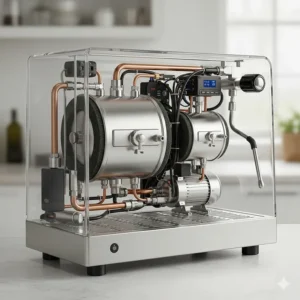
A dual boiler espresso machine features two separate heating systems: one dedicated to brewing espresso and another for steam production. This design allows simultaneous brewing and steaming whilst maintaining optimal temperatures for each function independently. According to Wikipedia’s comprehensive espresso machine guide, the first dual boiler system was the La Marzocco GS introduced in 1970, revolutionising commercial espresso preparation.
The brew boiler typically operates at 90-96°C (ideal extraction temperature), whilst the steam boiler runs at approximately 125°C to generate sufficient pressure for milk frothing. This separation eliminates the temperature compromises inherent in single boiler designs and provides more precise control than heat exchanger systems.
How Dual Boiler Technology Works:
- Independent Temperature Zones: Each boiler maintains its optimal temperature constantly, controlled by separate PID systems or thermostats
- Simultaneous Operation: Pull espresso shots whilst steaming milk without affecting either function
- Thermal Stability: Dedicated brew boiler ensures consistent extraction temperature shot after shot
- Professional Performance: Replicates the capability of commercial café equipment in a home-sized package
Dual Boiler vs Single Boiler: Which Should You Choose?
Understanding the differences between boiler types helps you make an informed decision. The Specialty Coffee Association emphasises that temperature stability is crucial for consistent espresso extraction, making boiler design a fundamental consideration.
| Feature | Single Boiler | Dual Boiler | Heat Exchanger |
|---|---|---|---|
| Price Range | £400-£800 | £900-£4,500 | £700-£2,000 |
| Simultaneous Brew/Steam | ❌ No | ✅ Yes | ✅ Yes |
| Temperature Precision | ±3-5°C | ±1°C | ±2-3°C |
| Warm-Up Time | 5-8 min | 10-20 min | 15-25 min |
| Energy Consumption | Low | Medium-High | Medium |
| Maintenance Complexity | Simple | Moderate | Moderate |
| Best For | Espresso-only drinkers | Milk drink enthusiasts | High-volume users |
Temperature Control & Consistency
Single boiler machines require switching between brew and steam modes, meaning you’ll wait 30-60 seconds between pulling shots and steaming milk. The temperature fluctuation can affect extraction quality, particularly with temperature-sensitive light roasts that speciality UK roasters like Square Mile Coffee and Has Bean favour. Research published in the Journal of Food Science demonstrates that extraction temperature variations of just 2°C can significantly alter espresso flavour profiles.
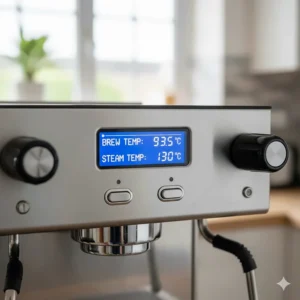
Dual boiler systems maintain constant, independent temperatures – your brew water stays at precisely 93°C whilst steam remains ready at 125°C. This consistency becomes crucial when dialling in espresso for competition-grade results.
Workflow Efficiency
If you primarily drink straight espresso, a single boiler may suffice. However, for milk-based drinks (lattes, cappuccinos, flat whites), a dual boiler dramatically improves workflow. You can start steaming the moment your shot finishes extracting, reducing total drink preparation time by 30-40 seconds. When making multiple drinks for family or guests, this efficiency compounds – prepare four lattes in 8-10 minutes versus 16-18 minutes with a single boiler.
Price Considerations
Quality single boiler machines start around £400-£600, whilst entry-level dual boilers begin at £900-£1,000. The premium reflects additional components (second boiler, extra heating elements, more sophisticated electronics). However, for serious home baristas, the investment pays dividends in consistency and convenience. Consider that the additional £400-£500 works out to approximately £1.10-£1.40 per day over a three-year period if you make two coffees daily.
Energy Consumption
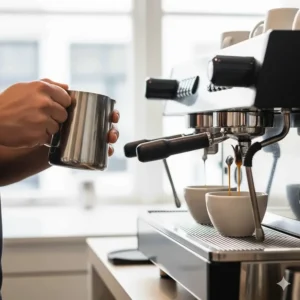
Dual boilers do consume more electricity due to maintaining two separate heating systems. Expect approximately 15-20% higher energy usage compared to single boiler designs, typically 2,200-2,400W during operation. However, machines with eco modes and programmable timers help mitigate this concern. Calculate roughly £0.50-£0.80 per day for typical UK electricity rates with 2-3 hours of operation.
Advanced Espresso Machine Features: What Actually Matters?
PID Temperature Control
PID (Proportional-Integral-Derivative) controllers maintain brew temperatures within ±1°C, crucial for consistent extraction. This precision matters significantly when working with light roasts or single-origin coffees where temperature variations of just 2-3°C can dramatically alter flavour profiles. According to research from the University of California, Davis Coffee Center, temperature consistency ranks among the top three factors affecting espresso quality.
Modern PID systems display real-time temperatures and allow adjustment in 0.5-1°C increments. This granular control lets you fine-tune for different bean origins – Ethiopian naturals might extract beautifully at 92°C, whilst darker Italian roasts prefer 88-90°C.
Programmable Pre-Infusion
Pre-infusion gently saturates the coffee puck at low pressure (typically 2-4 bar) before full extraction begins at 9 bar. This process promotes even extraction and can reduce channelling, where water finds weak paths through the puck. Machines like the Lelit Elizabeth and Rancilio Silvia Pro X offer adjustable pre-infusion duration (0-6 seconds), allowing you to optimise for different roast levels.
Light roasts benefit from longer pre-infusion (4-6 seconds) to fully saturate the denser bean structure. Darker roasts, being more porous, need shorter pre-infusion (1-3 seconds) to prevent over-extraction. This adjustability transforms good shots into exceptional ones.
Shot Timer
Integrated shot timers help develop consistency by tracking extraction time from pump activation to cutoff. Professional baristas aim for 25-30 seconds for most espresso recipes, though light roasts may require 30-35 seconds for proper extraction. Having this feedback eliminates the need for external timers and helps you refine your technique systematically.
The Sage Dual Boiler, Rancilio Silvia Pro X, and ECM Synchronika II all feature prominent shot timers integrated into their displays, making it easy to monitor extraction without additional equipment.
Volumetric Dosing
Some machines programme shot volume automatically, stopping extraction at predetermined amounts (typically measured in millilitres). This feature aids consistency, particularly when preparing drinks for multiple people or when you’ve dialled in a specific recipe. The Lelit Elizabeth excels here with programmable single and double shot buttons that remember your preferred volumes.
However, many enthusiasts prefer manual control for greater flexibility. Weight-based dosing (measuring output by mass rather than volume) often produces superior results, which is why machines like the La Marzocco Linea Mini offer brew-by-weight compatibility.
Rotary vs Vibratory Pumps
Rotary pumps operate more quietly (typically 55-65 dB) and provide steadier pressure throughout extraction, typically found in premium machines like the La Marzocco Linea Mini (£4,000+) and ECM Synchronika (£2,500+). They’re also more durable, often lasting 15-20 years with proper maintenance.
Vibratory pumps work perfectly well for most home applications and cost less to manufacture, featured in the Sage Dual Boiler and Lelit Elizabeth. They produce more noise (70-75 dB) and slightly less consistent pressure, but these differences rarely affect cup quality in home environments. The trade-off usually favours vibratory pumps for budget-conscious buyers.
Dual Boiler Benefits: Why Upgrade from Traditional Machines?
| Benefit | Traditional (Single/HX) | Dual Boiler | Impact on Experience |
|---|---|---|---|
| Temperature Stability | ±3-5°C fluctuation | ±1°C precision | Consistent extraction flavour |
| Workflow Speed | 4-5 min for 2 lattes | 2-3 min for 2 lattes | 40-50% time reduction |
| Steam Power During Brew | Must wait 30-60 sec | Immediate availability | Seamless drink preparation |
| Temperature Customisation | Limited or linked | Fully independent | Optimise for different beans |
| Back-to-Back Drinks | Recovery time needed | Continuous operation | Effortless entertaining |
The upgrade to a dual boiler system fundamentally changes your home coffee experience. British speciality roasters like Origin Coffee and Workshop Coffee produce exceptional single-origin beans that reward precise temperature control – something dual boilers excel at delivering consistently.
✨ Ready to Transform Your Morning Coffee?
🔍 These dual boiler espresso machines represent years of engineering excellence compressed into equipment that fits your kitchen. Click on any highlighted model to explore current UK pricing on Amazon.co.uk and read verified customer reviews. Your journey to café-quality espresso at home starts with the right equipment!
How to Choose the Perfect Dual Boiler Espresso Machine
Step 1: Assess Your Space
Measure your available worktop space carefully. Dual boilers range from the compact Lelit Elizabeth (27cm deep) to the substantial ECM Synchronika (45cm deep). Don’t forget to account for clearance above the machine for portafilter removal and water tank access.
Step 2: Define Your Budget
UK prices span from £900 (Sage Dual Boiler) to £4,500+ (La Marzocco Linea Mini). Determine your maximum spend, factoring in essential accessories: quality grinder (£300-£800), tamping tools (£30-£100), milk jug (£20-£40), and quality beans from UK speciality roasters.
Step 3: Consider Your Drinking Habits
Primarily straight espresso? You might prioritise temperature stability and shot quality over steam power. Multiple daily milk drinks? Strong steam performance and larger boilers become crucial. The Rancilio Silvia Pro X excels at espresso precision, whilst the ECM Synchronika handles high-volume milk drinks effortlessly.
Step 4: Evaluate Your Technical Comfort
Some machines require more hands-on tuning and maintenance than others. The Sage Oracle automates many processes, ideal for those wanting simplicity. The Lelit Elizabeth offers extensive programming options for enthusiasts who enjoy tweaking parameters.
Step 5: Research UK-Specific Factors
Verify UK warranty coverage, spare parts availability, and local service centres. Machines from Sage, Lelit, and Rancilio have excellent UK support networks. Consider water hardness in your area – some regions require more frequent descaling. Check if the machine accepts standard UK plugs or requires adaptation.
Step 6: Plan for Accessories
A dual boiler espresso machine requires supporting equipment to reach its potential. Budget for a quality grinder (arguably more important than the machine itself), precision scales, tamping tools, and proper cleaning supplies. UK suppliers like Bella Barista and Coffee Hit offer complete packages.
Step 7: Factor in Running Costs
Beyond initial purchase, consider ongoing expenses: quality coffee beans (£8-£12 per 250g from UK speciality roasters), water filters (£15-£25 per 6 months), descaling solution (£10 per year), and replacement parts (gaskets, screens). Premium machines often have lower long-term costs due to better reliability.
Dual Boiler Under £1000: Are They Worth It?
The Sage Dual Boiler BES920, priced around £930-£1,100, represents the entry point for quality dual boiler systems in the UK market. At this price point, you’re making some compromises – predominantly in materials (more plastic components in drip tray and water tank) and aesthetics compared to premium machines. However, the core functionality and temperature stability rival machines costing twice as much.
Independent testing has demonstrated the Sage’s temperature consistency matches commercial machines like the La Marzocco GS3 (which costs £6,000+). SCACE testing – the industry standard for measuring thermal stability – shows the Sage maintaining temperatures within ±1.5°C, compared to ±1°C for the GS3. That marginal difference rarely impacts cup quality in home environments.
The compromises appear in longevity rather than immediate performance. Whilst premium machines might last 20+ years with maintenance, expect 8-12 years from the Sage with proper care. UK customers report excellent experiences, with many machines exceeding 10,000 shots before requiring significant repairs.
Value Analysis:
| Machine | Price (GBP) | Cost per Shot* | Expected Lifespan | Daily Cost** |
|---|---|---|---|---|
| Sage Dual Boiler | £1,000 | £0.10 | 10 years | £0.27 |
| Lelit Elizabeth | £1,100 | £0.07 | 15 years | £0.20 |
| Rancilio Silvia Pro X | £1,400 | £0.06 | 18 years | £0.21 |
| La Marzocco Linea Mini | £4,200 | £0.11 | 25+ years | £0.46 |
*Based on 10,000 shots over machine lifetime
**Including electricity at UK rates (£0.34/kWh) for 2 hours daily operation
For most home baristas, particularly those making 2-4 drinks daily, a dual boiler under £1000 provides exceptional value. You’re not compromising on the fundamental capability to pull outstanding shots and steam professional-quality milk simultaneously. The additional thousands spent on premium machines buy superior build materials, quieter operation, longer longevity, and that intangible “premium feel” rather than dramatically better coffee in your cup.
Consider this: investing the £3,000 saved (Sage versus La Marzocco) into a premium grinder (£800), water treatment (£200), and exceptional beans from UK speciality roasters (£2,000 worth over 18 months) will improve your coffee quality more than the machine difference alone.
UK Coffee Culture: Why Dual Boilers Matter Now More Than Ever
Britain’s coffee scene has transformed dramatically over the past decade. What was once a nation of instant coffee drinkers has evolved into a sophisticated market rivalling Australia and the Nordic countries for speciality coffee appreciation. Cities like London, Edinburgh, Manchester, and Bristol boast world-class roasters and cafés that have raised the bar for what constitutes excellent coffee.
This cultural shift directly influences home equipment choices. UK consumers increasingly understand that café-quality results require café-quality equipment. According to the British Coffee Association, the UK speciality coffee market grew 15% annually from 2018-2024, with home espresso equipment sales driving much of this growth.
The Third Wave Impact:
Roasters like Square Mile Coffee (London), Has Bean (Staffordshire), Origin Coffee (Cornwall), and Workshop Coffee (London) source exceptional single-origin coffees that reward precise extraction. These light to medium roasts – featuring complex fruity, floral, and sweet notes – demand temperature stability and control that dual boilers excel at providing.
Traditional Italian-style espresso machines were designed for dark roasts extracted at 88-90°C. Modern speciality roasts often extract optimally at 92-94°C. The adjustable PID control in dual boilers lets you dial in these higher temperatures without affecting steam production. This flexibility matters enormously when working with natural process Ethiopian beans versus washed Colombian lots.
Remote Work Revolution:
The COVID-19 pandemic permanently altered work patterns, with UK Office for National Statistics data showing 30-40% of workers now operate hybrid schedules. This shift means more coffee consumed at home, justifying better equipment investments. That daily £3.50 flat white from your local café costs £17.50 weekly, or £910 annually. A quality dual boiler espresso machine pays for itself in 1-2 years through avoided café purchases.
Sustainability Considerations:
British consumers increasingly prioritise sustainability. Dual boiler machines, particularly premium models from Lelit, ECM, and La Marzocco, offer decades of service with proper maintenance. This longevity dramatically reduces environmental impact compared to pod machines or cheap appliances requiring replacement every 2-3 years. The Ellen MacArthur Foundation circular economy principles align perfectly with investing in quality, repairable equipment.
Where to Buy Dual Boiler Machines in the UK
Speciality Coffee Equipment Retailers:
- Bella Barista (UK): Excellent customer service, expert advice, competitive pricing, 2-year warranty on most machines
- Coffee Hit: Wide selection, regular sales, detailed product videos, UK-based support
- Prime Coffee Suppliers: Competitive prices, bundle deals with grinders, fast UK delivery
- The Home Baristas: Smaller specialist retailer, personalised service, knowledgeable staff
Major Online Retailers:
- Amazon.co.uk: Convenience of Prime delivery, customer reviews, occasionally competitive pricing. Verify seller is authorised dealer for warranty validity
- John Lewis: Excellent customer service, extended warranties available, price matching policy
- Currys/PC World: Physical stores for viewing machines, knowledgeable staff in larger locations
Direct from Manufacturers:
- Sage Appliances UK: Direct purchasing often includes exclusive bundles with grinders and accessories, manufacturer warranty
- Rancilio Group: Limited direct sales but can recommend authorised UK dealers
- La Marzocco: Direct sales through their website with full UK support
Buying Considerations:
- Warranty Coverage: Verify UK warranty duration (typically 1-2 years) and what’s covered
- Authorised Dealers: Only authorised dealers provide valid manufacturer warranties
- After-Sales Support: Consider retailer’s technical support quality and spare parts availability
- Price Matching: Many retailers price match – ask before purchasing
- Bundle Deals: Purchasing machine plus grinder often saves £100-£200
- Finance Options: Some retailers offer 0% finance for 6-12 months on purchases over £500
Grey Imports Warning:
Avoid machines sourced from outside UK/EU. These may have incorrect voltage (110V rather than 220-240V), lack UK warranty coverage, and include different group head specifications. The £100-£200 savings isn’t worth the risks and complications.
Professional Home Espresso Setup: Beyond the Machine
The Grinder: Your Most Important Investment
Even the finest dual boiler espresso machine cannot overcome poor grinding. The Barista Hustle blog, widely regarded as the gold standard for coffee education, emphasises that grinder quality impacts your espresso more than any other single factor. Many experts suggest spending 40-50% of your total budget on the grinder. For the UK market, consider:
Budget Tier (£200-£300):
- Sage Smart Grinder Pro (£200-£250): 60 grind settings, doser-free design, ideal for beginners
- Eureka Mignon Manuale (£250-£300): 50mm flat burrs, commercial-grade construction
Mid-Range Excellence (£350-£550):
- Eureka Mignon Specialita (£350-£450): Near-silent operation, timed dosing, outstanding consistency
- Niche Zero (£500-£550): Single-dose design eliminates waste, exceptional grind quality, cult following in UK
Premium Performance (£800-£1,000+):
- Mahlkönig X54 (£850-£950): Home grinder from commercial manufacturer, 54mm burrs
- Eureka Atom 75 (£950-£1,050): Touch screen, 75mm burrs, commercial capability
Single-dose grinders like the Niche Zero suit home use perfectly, eliminating waste and ensuring fresh grounds for each shot. The British-designed Niche Zero has become particularly popular amongst UK enthusiasts, manufactured in China to rigorous specifications.
Water Quality: The Silent Hero
UK tap water varies dramatically by region, affecting both extraction quality and machine longevity. According to Thames Water hardness data, London’s water registers 250-300 ppm (very hard), whilst Scottish water typically measures 50-100 ppm (soft). The Water UK organisation provides regional hardness information to help you assess local conditions.
Hardness Impact:
- Very Hard (250+ ppm): Rapid limescale buildup, frequent descaling required (every 2-3 months)
- Hard (200-250 ppm): Regular maintenance needed (every 3-4 months)
- Moderate (100-200 ppm): Manageable with in-tank filtration (every 4-6 months)
- Soft (50-100 ppm): Minimal scaling, excellent for extraction and equipment longevity
Water Treatment Options:
- In-tank filters (BWT, Brita): £15-£25, replaced every 2-3 months, reduces hardness by 40-60%
- Bottled water: Ashbeck from Tesco (75 ppm) popular amongst enthusiasts, £0.50-£0.70 per litre
- Reverse osmosis systems: £200-£500 installed, produces pure water requiring remineralisation
- Peak Water cartridges: Specifically designed for espresso, available from UK speciality retailers
Many serious home baristas in hard water areas use Ashbeck bottled water, calculating the £15-£25 monthly cost as cheaper than frequent descaling or repairs. The soft water extracts coffee beautifully whilst protecting your £1,000-£4,000 investment.
Essential Accessories for Success
Precision Tools (£100-£200 total):
- Tamper: Proper 58mm tamper (£30-£100) – the included plastic versions don’t provide adequate pressure or level surfaces. Brands like Pullman, Pesado, and Motta offer ergonomic designs that reduce wrist strain
- Distribution tool: WDT (Weiss Distribution Technique) tool (£15-£40) breaks up clumps for even extraction, or spring-loaded levellers (£30-£60) combine distribution and levelling
- Precision scales: 0.1g accuracy (£25-£60) – Timemore Black Mirror, Acaia Lunar, or budget Hario options
- Dosing funnel: 58mm funnel (£15-£25) reduces mess when grinding into portafilter
Milk Frothing Equipment:
- Milk jug: Stainless steel (£20-£40), size depends on drink volume – 350ml for single drinks, 600ml for doubles
- Thermometer: Clip-on (£10-£15) until you develop muscle memory for temperature by touch
- Specialist designs: Barista-favourite brands like Motta, Rattleware, and Rhinowares offer pouring spouts optimised for latte art
Cleaning and Maintenance:
- Backflushing detergent: Cafetto Espresso Clean or Puly Caff (£10-£15 per 500g, lasts 6-12 months)
- Descaling solution: Manufacturer-recommended products (£8-£15 per bottle)
- Group head brush: Pallo Grinder Brush (£8-£12), essential for daily cleaning
- Microfibre cloths: Barista-specific cloths (£10 for pack of 5) won’t leave residue
- Blind basket: Usually included with machines, critical for backflushing routine
Simultaneous Brewing and Steaming: Mastering the Technique
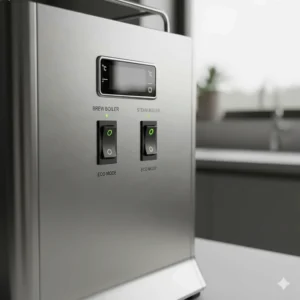
The dual boiler’s killer feature is making multiple drinks efficiently. This workflow technique separates amateur home baristas from those producing café-quality results. Here’s the professional approach used in speciality coffee shops across the UK:
The Perfect Workflow:
- Prepare whilst brewing: Start steaming milk immediately after initiating espresso extraction (don’t wait for the shot to finish)
- Time management: A 28-second extraction paired with 30-second steam time means drinks finish simultaneously, reducing total preparation time
- Temperature considerations: Extract into pre-warmed cups (rinse with hot water from the machine) to prevent 5-8°C temperature loss
- Milk integration: Pour immediately after steaming for optimal microfoam texture – waiting causes foam separation and texture deterioration
- Back-to-back drinks: With dual boilers, you can immediately prepare the next shot whilst steam boiler recovers (typically 30-45 seconds)
Advanced Techniques:
- Parallel processing: When making 3-4 drinks, pull shots in pairs whilst a helper steams milk, creating assembly-line efficiency
- Temperature matching: Extract lighter roasts at 92-94°C whilst maintaining steam at 120-125°C, then adjust brew temperature for darker beans without affecting steam
- Recovery management: Allow 30-45 seconds between drinks for steam boiler recovery, use this time for portafilter preparation and cleaning
This workflow reduces total preparation time for two lattes from 4-5 minutes (single boiler) to 2-3 minutes (dual boiler). When entertaining guests or making multiple drinks for family, this efficiency transforms the experience from stressful juggling to smooth operation. The ECM Synchronika II and La Marzocco Linea Mini excel here with their large steam boilers (2L and 3.5L respectively), maintaining pressure even when pulling multiple shots back-to-back.
Common Mistakes to Avoid:
- Starting steam too early (milk overheats whilst waiting for shot)
- Inadequate portafilter pre-heating (causes temperature loss during extraction)
- Overfilling milk jugs (reduces steam penetration and control)
- Neglecting to purge steam wand before and after frothing (leaves residue, affects texture)
Maintenance & Troubleshooting: Protecting Your Investment
A £1,000-£4,000 dual boiler espresso machine represents a significant investment. Proper maintenance ensures decades of reliable service. UK home baristas consistently report 10-15 years from quality machines with appropriate care.
Daily Maintenance (5-10 minutes)
- Backflush after use: Run water through grouphead without portafilter to clear coffee oils
- Clean steam wand: Purge immediately after steaming, wipe with damp cloth, purge again
- Empty drip tray: Prevents overflow and keeps workspace clean
- Wipe exterior: Stainless steel surfaces show fingerprints – microfibre cloth with mild cleaner maintains appearance
- Dump knock box: Coffee grounds become mouldy if left overnight in UK’s humid climate
Weekly Maintenance (15-20 minutes)
- Backflush with detergent: Use Cafetto or Puly Caff with blind basket, run cleaning cycle 5-6 times
- Clean shower screen: Remove screen and holder, soak in cleaning solution overnight
- Descale steam wand internally: Run descaling solution through steam circuit if machine allows
- Clean drip tray thoroughly: Remove and wash with warm soapy water, clean drainage channels
- Wipe water reservoir: Check for algae growth (more common in UK hard water areas)
Monthly Maintenance (30-45 minutes)
- Deep clean grouphead: Remove diffusion screen, soak components in cleaning solution
- Inspect gaskets: Check portafilter seal for wear (replace annually or when coffee seeps around edges)
- Clean water tank thoroughly: Use mild vinegar solution or specialised cleaner
- Test PID accuracy: Compare displayed temperature with actual measured temperature (thermometer in portafilter)
- Check for leaks: Inspect underneath machine, common leak points include boiler fittings and solenoid valves
Quarterly Maintenance (Varies by Water Hardness)
- Descale machine: Crucial in London and hard water regions, follow manufacturer instructions precisely
- Replace water filter: BWT or manufacturer-specific filters typically last 2-3 months
- Professional inspection: Consider annual servicing from authorised technicians (£100-£150 in UK)
- Gasket replacement: Replace group gasket and steam wand seals if showing wear
Common Issues & Solutions:
Problem: Weak or no pressure during extraction
- Check: Grind too coarse, insufficient dose, worn group gasket
- Solution: Adjust grinder finer, increase dose to 18-20g, replace gasket (£8-£15 from UK suppliers)
Problem: Water leaking from grouphead
- Check: Gasket worn or dirty, portafilter not locked properly
- Solution: Clean gasket area thoroughly, replace if necessary, ensure proper portafilter insertion
Problem: No steam or weak steam pressure
- Check: Steam boiler not reaching temperature, blocked steam tip
- Solution: Verify PID settings, descale steam circuit, clean tip holes with paperclip or pin
Problem: Temperature fluctuation between shots
- Check: Insufficient warm-up time, PID needs calibration
- Solution: Allow 20-30 minutes heat-up for thermal stability, recalibrate PID per manual
UK-Specific Maintenance Considerations:
Hard water regions (London, Birmingham, Manchester) require descaling every 2-3 months versus 6-8 months in soft water areas (Scotland, Wales). The cost difference in maintenance products averages £40-£60 annually. Many UK enthusiasts in hard water postcodes switch to Ashbeck bottled water, calculating the £20-£25 monthly cost as cheaper than aggressive descaling schedules and potential repairs.
British humidity levels (70-85% average) accelerate mould growth in drip trays and water reservoirs. Empty and dry these areas daily, particularly during summer months when temperatures rise above 20°C.
FAQs About Dual Boiler Espresso Machines UK
❓ Do I need a dual boiler espresso machine for home use?
❓ How much should I spend on a dual boiler machine in the UK?
❓ What's the difference between dual boiler and heat exchanger machines?
❓ Are dual boiler machines difficult to maintain?
❓ Can dual boiler machines be plumbed into mains water?
Conclusion: Investing in Your Perfect Dual Boiler Espresso Machine
Choosing a dual boiler espresso machine represents a significant investment in your daily coffee ritual. Whether you’re gravitating towards the exceptional value of the Sage Dual Boiler BES920 at under £1,000, the compact Italian elegance of the Lelit Elizabeth V3, or the heirloom-quality craftsmanship of the La Marzocco Linea Mini, you’re entering a world where café-quality espresso becomes your everyday reality.
The UK coffee landscape has evolved dramatically, with speciality roasters from Edinburgh to Bristol producing world-class beans that deserve proper equipment. A dual boiler espresso machine gives you the tools to honour those beans – precise temperature control, simultaneous brewing and steaming, and the consistency that transforms good shots into exceptional ones.
My top recommendation for most UK home baristas remains the Sage Dual Boiler. It delivers 90% of the performance of machines costing three times more, backed by excellent UK support and readily available parts. For those with slightly larger budgets, the Lelit Elizabeth V3 offers Italian craftsmanship in a remarkably compact package. And if you’re ready for the ultimate investment, the La Marzocco Linea Mini represents the pinnacle of home espresso equipment.
Remember: the machine is only one piece of the puzzle. Invest equally in a quality grinder, source beans from reputable UK roasters, master your technique, and maintain your equipment properly. Do these things, and you’ll wonder how you ever managed with anything less than a prosumer dual boiler machine. Your morning flat white will never taste the same again.
Recommended for You
- Gaggia Classic Pro vs Sage Barista Express: 7 Best Models 2026
- Best Semi Automatic Espresso Machines UK 2026
- Best Espresso Machine Under £500 UK 2026
Disclaimer: This article contains affiliate links. If you purchase products through these links, we may earn a small commission at no additional cost to you. Prices shown are approximate and may vary.
✨ Found this helpful? Share it with your mates! 💬🤗
