In This Article
Making the leap from instant coffee to proper espresso can feel overwhelming, can’t it? With hundreds of machines flooding the market, each promising café-quality results, finding the best espresso machine for beginners uk isn’t just about picking the shiniest model on the shelf. It’s about discovering a machine that grows with you, forgives your early mistakes, and still delivers that gorgeous crema you’re dreaming about.
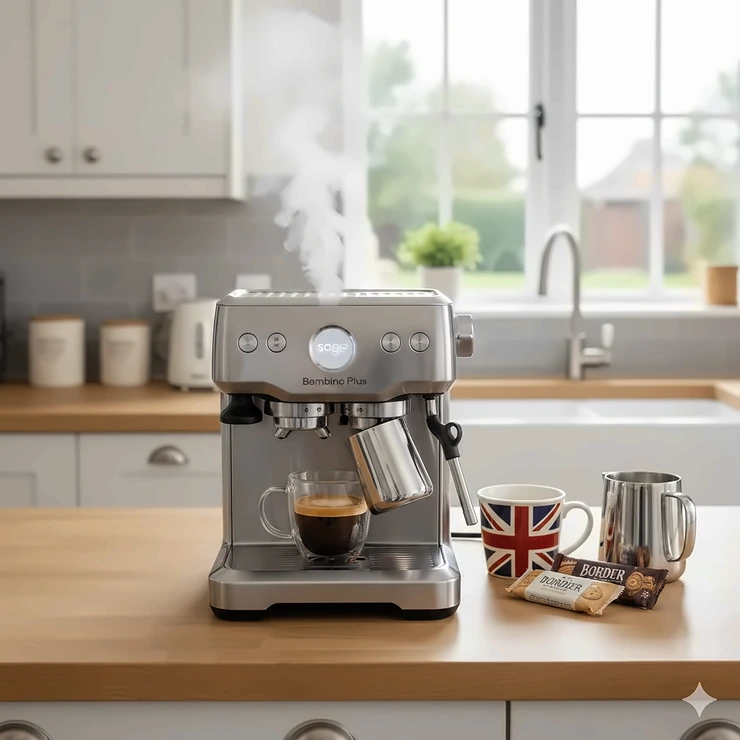
I remember my first espresso machine disaster—burnt coffee, weak shots, and a steam wand that seemed to have a personal vendetta against me. But here’s the brilliant news: today’s beginner-friendly machines are lightyears ahead of what was available even five years ago. Modern espresso machines combine intuitive controls with professional-grade components, meaning you can pull café-worthy shots within days, not months.
Whether you’re a complete novice wanting to save money on daily coffee shop visits, or someone ready to explore the fascinating world of home espresso, this guide breaks down everything you need. We’ll explore seven exceptional machines currently available on Amazon.co.uk, each carefully selected for beginner friendliness, reliability, and value for money. From ultra-compact models under £150 to feature-rich options around £600, there’s something here for every skill level and budget.
Quick Comparison Table
| Machine | Price Range | Key Feature | Best For | Rating |
|---|---|---|---|---|
| CASABREWS 3700 Essential | £129.99-£144.99 | Budget-friendly with milk frother | Absolute beginners on tight budget | 4.3/5 |
| De’Longhi Dedica EC685 | £134.90-£199.99 | Ultra-slim design (15cm wide) | Small kitchens | 4.2/5 |
| Breville One-Touch VCF107 | £109.45-£149 | Automatic milk drinks | Push-button simplicity | 4.0/5 |
| CASABREWS CM5418 | £139.99-£189.99 | Pressure gauge feedback | Learning proper technique | 4.2/5 |
| Sage Bambino Plus | £399-£629 | 3-second heat-up time | Speed & convenience | 4.5/5 |
| Sage Barista Express | £449-£475 | Built-in grinder | All-in-one solution | 4.4/5 |
| Gaggia Classic E24 Evo Pro | £549 | Commercial-grade components | Long-term investment | 4.4/5 |
💬 Just one click – help others make better buying decisions too!😊
✨ Don’t Miss These Exclusive Deals!
🔍 Take your home barista journey to the next level with these carefully selected products. Click on any highlighted item to check current pricing and availability on Amazon.co.uk. These machines will help you create authentic café-quality espresso your family will love!
Top 7 Espresso Machines for Beginners – Expert Analysis
1. CASABREWS 3700 Essential Espresso Machine
The CASABREWS 3700 Essential represents extraordinary value at £129.99-£144.99, making it one of the most accessible entry points into proper espresso brewing. This compact machine punches well above its weight class, featuring a professional 20-bar pump system and a surprisingly capable steam wand.
Key Specifications:
- 20-bar Italian pump with 9-bar extraction optimisation
- 1.3L removable water tank
- Stainless steel construction
What makes this machine particularly beginner-friendly is its straightforward button interface and included dual-wall filter baskets, which are far more forgiving than standard baskets. UK buyers consistently praise its ability to produce decent crema even with supermarket pre-ground coffee, though investing in a basic grinder unlocks significantly better results.
Customer Feedback (UK): Tom’s Guide awarded it strong marks for value, noting it’s “perfect for beginners and great value for money, but seasoned coffee lovers might prefer to spend a bit more on something built to last.” Many UK users appreciate the responsive customer service from CASABREWS.
✅ Pros:
- Exceptional price-to-performance ratio
- Surprisingly capable milk steaming
- Compact footprint ideal for student flats
❌ Cons:
- Build quality feels budget (because it is)
- Plastic components won’t last decades
2. De’Longhi Dedica EC685 Style
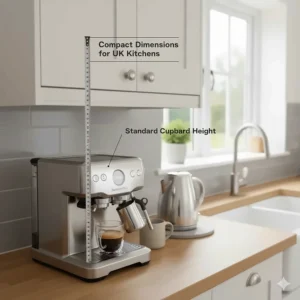
The De’Longhi Dedica EC685 has become a cult favourite among UK beginners, and at £134.90-£199.99, it’s easy to understand why. This sleek Italian-designed machine measures just 15cm wide, making it perfect for cramped London kitchens or compact worktops.
Key Specifications:
- 15-bar pressure pump
- Thermoblock heating system (40-second warm-up)
- Three programmable buttons for shot volume
- Available in multiple colours (silver, black, white, red)
The Dedica excels at consistency. Its programmable settings let you dial in your perfect shot volume, whilst the adjustable cappuccino system creates surprisingly good microfoam for latte art practice. UK reviewers on Amazon consistently mention the quick heat-up time—crucial for busy mornings.
Customer Feedback (UK): One verified UK buyer noted: “Great little starter machine. It needs modding with a 51mm bottomless portafilter and non-pressurised filter baskets to get the best out of it though.” Another praised: “I’ve had this for nearly 2 years making a few coffees weekly and it’s going very strong.”
✅ Pros:
- Ultra-compact design (narrowest on this list)
- Fast heat-up time
- Widely moddable and upgradeable
❌ Cons:
- Small drip tray fills quickly
- Milk frother learning curve steeper than auto versions
3. Breville One-Touch CoffeeHouse VCF107
If you want café-style drinks without the faff, the Breville One-Touch CoffeeHouse VCF107 delivers exactly that at £109.45-£149. This machine automates the entire milk-based drink process with dedicated buttons for espresso, cappuccino, and latte.
Key Specifications:
- 19-bar Italian pump
- Automatic milk frother
- Compatible with both ground coffee and ESE pods
- Adjustable cup tray for different mug sizes
The One-Touch shines for households where different people want different drinks. Press the latte button, and it automatically steams milk, adds espresso, and stops at the perfect ratio. It’s genuinely foolproof, making it brilliant for beginners who find manual milk steaming intimidating.
Customer Feedback (UK): UK buyers love the simplicity. One Amazon review states: “Very easy to use and makes lovely hot coffee, latte, cappuccino, espresso and Americano.” However, some note that achieving professional-quality espresso requires switching to ESE pods rather than ground coffee.
✅ Pros:
- Truly automatic milk drinks
- ESE pod compatibility for consistent results
- Excellent value (was £399 at launch)
❌ Cons:
- Limited manual control for enthusiasts
- Not true espresso with dual-wall baskets
4. CASABREWS CM5418 Espresso Machine
The CASABREWS CM5418 at £139.99-£189.99 represents a sweet spot for beginners who want to learn proper technique. Its standout feature is the built-in pressure gauge, providing real-time feedback as you learn to dial in grind size, dose, and tamping pressure.
Key Specifications:
- 20-bar pump with pressure gauge
- Pre-infusion function
- 1L removable water tank
- 51mm aluminium portafilter
This machine encourages proper espresso fundamentals. The pressure gauge teaches you to recognise when your grind is too fine (gauge maxes out) or too coarse (pressure stays low). UK users appreciate this educational aspect, though it does require more involvement than fully automatic options.
Customer Feedback (UK): The machine enjoys strong ratings on Amazon.co.uk, with users praising the “great value and easy enough to use as a beginner.” The stainless steel construction feels more premium than its price suggests.
✅ Pros:
- Pressure gauge aids learning
- Pre-infusion for better extraction
- Responsive UK-friendly customer service
❌ Cons:
- Requires separate grinder investment
- 51mm portafilter less common than 58mm
5. Sage Bambino Plus SES500
Jumping to £399-£629, the Sage Bambino Plus SES500 represents a significant step up in capability and convenience. This Australian brand (known as Breville elsewhere) has revolutionised beginner espresso with its ThermoJet heating system that reaches optimal temperature in just three seconds.
Key Specifications:
- 54mm stainless steel portafilter
- ThermoJet heating (3-second heat-up)
- Automatic milk texturing with 3 temperature and 3 texture settings
- PID temperature control
The Bambino Plus excels at milk-based drinks. Its automatic steam wand creates café-quality microfoam whilst you focus on espresso extraction. UK coffee expert Kevin (CoffeeBlog.co.uk) notes: “The Bambino Plus is ideal for anyone who mostly drinks milk-based espresso drinks and wants a fast, repeatable workflow.”
Customer Feedback (UK): Amazon UK reviewers consistently praise the automatic milk function. One buyer shared: “The Bambino auto-milk function was a doddle. It took me a couple of coffees and a few YouTube videos, but I managed a tiny heart! In 18 months of having my old machine, I never got anywhere near that!”
✅ Pros:
- Professional 54mm portafilter
- Incredibly fast heat-up
- Automatic milk texturing that actually works
❌ Cons:
- Small drip tray (3-way solenoid fills it quickly)
- Higher price point
6. Sage Barista Express BES875
The Sage Barista Express BES875 at £449-£475 remains the UK’s best-selling all-in-one solution for beginners. By integrating a conical burr grinder, this machine eliminates the need for a separate grinder investment whilst delivering genuinely impressive espresso.
Key Specifications:
- Integrated conical burr grinder (16 grind settings)
- PID temperature control (93°C precision)
- Low-pressure pre-infusion
- 2L water tank
- Pressure gauge
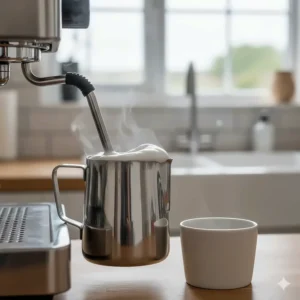
What makes the Barista Express special is its complete package approach. The built-in grinder doses directly into the portafilter, the razor dosing tool ensures consistent puck preparation, and the manual steam wand teaches proper milk texturing. It’s essentially a coffee school in a machine.
Customer Feedback (UK): Kevin from CoffeeBlog.co.uk used his Barista Express for years: “I bought mine in August 2019 from Amazon for £415. The machine is much easier to clean with no coffee grounds everywhere.” UK buyers particularly appreciate the included accessories and the fact that Sage offers excellent UK-based support.
✅ Pros:
- Complete bean-to-cup solution
- Excellent grinder for the price
- Strong UK warranty and support
❌ Cons:
- Grinder gears can fail (parts now available)
- Single-hole steam tip slower than 4-hole versions
7. Gaggia Classic E24 Evo Pro
At £549, the Gaggia Classic E24 Evo Pro represents the pinnacle of beginner-friendly traditional espresso machines. This Italian-made workhorse has earned legendary status in home barista circles, with some machines running strong after 15+ years.
Key Specifications:
- All-new brass boiler (25% larger capacity)
- Commercial 58mm portafilter
- Lead-free brass brew group
- 9-bar extraction pressure
- Made in Italy
The Gaggia Classic teaches proper espresso fundamentals with commercial-grade components. Its 58mm portafilter means access to the entire aftermarket ecosystem of precision baskets, distribution tools, and tampers. The brass boiler provides superior temperature stability compared to aluminium alternatives.
Customer Feedback (UK): UK Amazon buyers love its longevity. One review states: “I bought this to replace an earlier version of this machine which I’ve had for about 15+ years. Personally I think the Gaggia Classic is excellent for my needs and highly recommend it.” Another notes: “Makes a great coffee and it’s super easy to use.”
✅ Pros:
- Commercial-grade 58mm portafilter
- Legendary durability and repairability
- Made in Italy with 2-year labour, 5-year parts warranty
❌ Cons:
- No PID (temperature surfing required)
- Single boiler (wait between brewing and steaming)
- Included tamper doesn’t fit 58mm basket
Understanding Espresso Machine Types for Beginners
Manual vs Semi-Automatic vs Automatic
When researching the best espresso machine for beginners uk, you’ll encounter confusing terminology. Let’s demystify it.
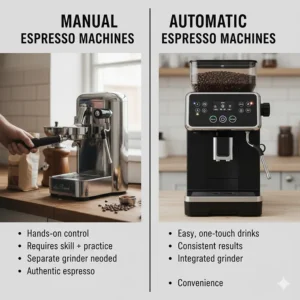
Manual machines require you to control water flow with a lever. They’re romantic but utterly impractical for beginners. Skip these unless you’re genuinely fascinated by the ritual.
Semi-automatic machines (like most on our list) let you start and stop extraction, but automate water pressure. This category offers the best balance of control and convenience for learning espresso craft.
Automatic machines include volumetric controls—you programme shot volume, and the machine stops automatically. The Dedica and Bambino Plus offer this feature.
Super-automatic machines (bean-to-cup) grind, tamp, brew, and froth at button press. They’re convenient but teach you nothing about espresso. The Barista Express sits between categories by including a grinder whilst maintaining manual control.
☕ Transform Your Morning Routine Today!
💫 Every espresso machine featured in this guide is available now on Amazon.co.uk with free delivery options. Click through to compare prices, read verified UK customer reviews, and discover current promotions. Your perfect home café setup is just one click away!
Essential Features Every Beginner Should Consider
Pressure Systems: Understanding Bars
Here’s something manufacturers won’t tell you straight: a 20-bar pump doesn’t make better espresso than a 15-bar pump. Proper espresso extraction occurs at 9 bars of pressure. Higher ratings simply indicate the pump’s maximum capacity, not brewing pressure.
Quality machines (like the Bambino Plus and Gaggia Classic) include pressure regulation to maintain 9-bar extraction regardless of pump rating. Budget machines often run at excessive pressure (12-15 bars), which over-extracts coffee and creates bitter flavours. Look for machines specifically mentioning “9-bar extraction” or “overpressure valve.”
The Specialty Coffee Association recommends 9 bars as the global standard for espresso brewing, based on decades of research into optimal extraction. The University of Bath’s Centre for Sustainable Chemical Technologies has conducted extensive research showing that extraction pressure significantly affects the chemical composition and flavour profile of espresso.
Heating Systems: Thermoblock vs Boiler
Thermoblock systems (Dedica, CASABREWS) heat water on-demand by passing it through heated metal tubes. They’re fast, energy-efficient, and perfect for beginners making 1-3 drinks daily. However, temperature stability can vary slightly between shots.
Boiler systems (Gaggia Classic, Bambino Plus) heat and store water in a chamber. They provide superior temperature stability but take longer to warm up. Single-boiler machines require waiting between brewing coffee and steaming milk.
For beginners, thermoblocks offer the best compromise—they’re ready quickly and maintain adequate stability for learning proper technique.
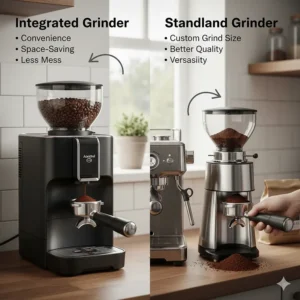
The Grinder Question: Do You Really Need One?
Here’s uncomfortable truth: your grinder matters more than your espresso machine. A £150 machine with a £100 grinder will outperform a £500 machine using pre-ground supermarket coffee.
Grinder Options for Beginners
Entry-level grinders (£60-£150):
- Sage Dose Control Pro (£120-£150)
- Baratza Encore ESP (£150-£170)
- Timemore Chestnut C3 ESP Pro (manual, £80-£100)
These provide adequate grind consistency for learning espresso basics. They won’t deliver competition-level precision, but they’ll highlight the difference between good and great espresso.
Mid-range grinders (£150-£250):
- Sage Smart Grinder Pro (£189-£210)
- Eureka Mignon Filtro (£220-£250)
These offer step-change improvements in consistency and particle size distribution, unlocking your machine’s full potential.
Integrated solutions: The Barista Express includes a perfectly adequate grinder, making it exceptional value for beginners unsure about separate grinder investment.
Milk Frothing: Automatic vs Manual
Automatic Milk Systems
Machines like the Bambino Plus and Breville One-Touch automate milk texturing, creating café-quality microfoam whilst you focus on espresso. They’re brilliant for:
- Busy mornings when you need reliable results fast
- Households where multiple people make coffee
- Beginners intimidated by manual steaming
However, automatic systems limit your learning. You’ll create consistent results without understanding why, making it harder to troubleshoot issues or improve technique.
Manual Steam Wands
Traditional steam wands (Gaggia Classic, Dedica) require technique but offer complete control. Learning to steam milk manually takes practice—expect 2-3 weeks of wobbly attempts before achieving velvety microfoam.
UK barista training courses emphasise manual steaming because it teaches:
- Temperature management by touch
- Microfoam texture recognition
- Air incorporation timing
- Wand positioning for proper vortex
The payoff? Once mastered, you can create any texture from cappuccino foam to flat white microfoam, something automatic systems can’t match.
Budget Breakdown: What Can You Expect at Each Price Point?
Under £150: Entry-Level Excellence
The CASABREWS 3700 Essential, Breville One-Touch, and Dedica all live here. Expect:
- Thermoblock heating
- Pressurised filter baskets (more forgiving)
- Basic but functional milk frothing
- 1-2 year typical lifespan with regular use
These machines teach fundamentals without financial terror. Perfect for testing whether home espresso suits you.
£150-£300: Sweet Spot Territory
The CASABREWS CM5418 represents this category well. You gain:
- Better build quality
- Pressure gauges for feedback
- Pre-infusion capabilities
- Non-pressurised basket compatibility
Machines here bridge learning and mastery, growing with your skills.
£300-£500: Serious Commitment
The Bambino Plus and Barista Express dominate this range. Benefits include:
- PID temperature control
- Professional-sized portafilters (54-58mm)
- Integrated grinders (Barista Express)
- Commercial-grade components
- 3-5 year expected lifespan
This is “buy once, cry once” territory—invest properly now, enjoy years of excellent coffee.
£500+: Prosumer Quality
The Gaggia Classic represents true prosumer equipment. You’re paying for:
- Italian manufacturing
- Commercial components (brass boiler, 58mm group)
- Decades of potential lifespan
- Complete repairability
- Aftermarket modification potential
These machines appreciate with knowledge—they’ll still be relevant when you’re pulling god shots in five years.
Benefits vs Traditional Alternatives
| Feature | Home Espresso Machine | Instant Coffee | Cafetière | Pod Machine |
|---|---|---|---|---|
| Upfront Cost | £109-£549 | £3-£8 | £15-£40 | £50-£200 |
| Cost Per Cup | £0.20-£0.40 | £0.05-£0.15 | £0.10-£0.20 | £0.25-£0.40 |
| Learning Curve | Moderate-High | None | Low | None |
| Quality Potential | Excellent | Poor | Good | Moderate |
| Customisation | Complete | None | Limited | Limited |
| Maintenance | Regular | Minimal | Minimal | Moderate |
Setting Up Your First Espresso Machine: Step-by-Step
Initial Setup (Day 1)
Step 1: Unbox and inventory. Check you have portafilter, filter baskets, tamper, and water tank.
Step 2: Flush the system. Run 3-4 blank shots (no coffee) to remove manufacturing residues and prime the pump.
Step 3: Descale the water tank using filtered water. Hard UK water causes limescale buildup—crucial for longevity.
Step 4: Season your portafilter. Pull 5-6 throwaway shots to coat the basket and group head with coffee oils.
Step 5: Dial in your first shot. Start with manufacturer recommendations (14-18g dose, 30-second extraction for 30-40ml output).
First Week: Building Consistency
Don’t chase perfection immediately. Focus on:
- Consistent dosing (use a £10 scale)
- Level tamping technique
- Identifying under vs over-extraction by taste
- Basic milk steaming (if applicable)
Keep a simple log: dose, grind setting, extraction time, taste notes. You’ll spot patterns quickly.
✨ Ready to Begin Your Coffee Journey?
🎯 Click any highlighted espresso machine above to view current deals on Amazon.co.uk! Each machine we’ve featured has been carefully selected to help beginners achieve café-quality results at home. Don’t wait—start brewing exceptional espresso today!
Maintenance and Cleaning: Keeping Your Machine Healthy
Daily Tasks (2-3 minutes)
Backflushing: After your last coffee, run a blank shot to clear residual grounds from the group head.
Wipe steam wand: Purge and wipe immediately after steaming. Milk residue becomes cement-like when dry.
Empty drip tray: UK water is hard—stagnant water promotes limescale growth.
Rinse portafilter: Remove and rinse the basket. Let it air-dry to prevent mould.
Weekly Tasks (10-15 minutes)
Deep clean steam wand: Soak the tip in hot water with descaler solution.
Clean shower screen: Remove and scrub the group head screen. Coffee oils build up here.
Wipe machine exterior: Coffee dust settles everywhere. A quick wipe maintains appearance.
Monthly Tasks (20-30 minutes)
Descale: UK tap water necessitates monthly descaling. Use manufacturer-recommended solutions (typically £8-£12 for 500ml).
Backflush with cleaner: Use espresso cleaning powder (£5-£8) to remove coffee oils from internal pathways.
Check water filter: Replace every 2-3 months (approximately £10-£15 for 6-pack).
According to Which? research, regular maintenance extends machine lifespan by 40-60%. It’s genuinely worth the minimal effort. The NHS also notes that proper appliance maintenance reduces household accidents and promotes better hygiene standards in food and beverage preparation.
Common Beginner Mistakes (And How to Avoid Them)
Mistake #1: Using Stale Coffee
Supermarket beans sitting for months won’t produce good espresso regardless of your machine. Coffee degrades rapidly after roasting—oils oxidise, CO2 escapes, flavours flatten.
Solution: Buy fresh-roasted beans from UK roasters like Has Bean, Nude Espresso, or Square Mile. Look for roast dates within 2-4 weeks. Store in an airtight container away from light and heat.
Mistake #2: Skipping the Scale
Eyeballing dose creates inconsistency. 1-2g variation dramatically affects extraction.
Solution: Invest £10-£15 in a basic 0.1g precision scale. Dose to the same weight every single time. This alone improves consistency more than expensive upgrades.
Mistake #3: Grinding Too Fine (Or Too Coarse)
Beginners often grind espresso-fine for everything or use the same setting forever.
Solution: Adjust grind based on extraction time. Aim for 25-30 seconds for a double shot. Too fast? Grind finer. Too slow? Grind coarser. The pressure gauge (on equipped machines) provides instant feedback.
Mistake #4: Forgetting Puck Preparation
Channeling—when water finds easy paths through your puck—ruins extraction.
Solution: Use WDT (Weiss Distribution Technique) with a thin needle to break clumps. Level the grounds before tamping. Tamp straight and consistently (about 15kg pressure).
Mistake #5: Neglecting Machine Maintenance
Limescale buildup reduces heating efficiency and eventually kills your machine.
Solution: Follow the maintenance schedule religiously. Set phone reminders. Descaling takes 20 minutes and costs £2 per month—replacing a dead machine costs hundreds.
FAQ
❓ What is the best espresso machine for complete beginners in the UK?
❓ Do I need to buy a separate grinder for my first espresso machine?
❓ How long does it take to learn to make good espresso at home?
❓ Are expensive espresso machines worth it for beginners, or should I start cheap?
❓ What's the difference between a 15-bar and 20-bar espresso machine?
Conclusion: Starting Your Home Barista Journey
Choosing the best espresso machine for beginners uk comes down to honest self-assessment. Will you commit to daily practice, or do you need foolproof automation? Does your kitchen suit a compact 15cm Dedica, or can you accommodate the Barista Express?
For absolute beginners on tight budgets, the CASABREWS 3700 Essential (£129.99) represents extraordinary value. It’s forgiving enough for learning whilst producing respectable results.
If you’re serious about developing proper technique, the Sage Bambino Plus (£399) balances beginner-friendliness with professional capability. Its automatic milk function and rapid heat-up remove frustration whilst maintaining learning opportunities.
For those wanting an all-in-one solution, the Sage Barista Express (£449) remains unbeatable. Built-in grinder, excellent support, and years of satisfied UK users prove its worth.
And if you’re certain this hobby is for life, the Gaggia Classic E24 Evo Pro (£549) will still be pulling brilliant shots when cheaper machines are landfill. Its commercial components and repairability make it a genuine buy-it-for-life investment.
Remember: the best espresso machine is the one you’ll actually use daily. Start somewhere, commit to learning, and enjoy the journey from wobbly first shots to Instagram-worthy latte art. Your future self—saving £3-£5 daily on coffee shop visits—will thank you.
Recommended for You
- 7 Best Small Bean to Cup Coffee Machine UK 2026
- DeLonghi vs Sage Bean to Cup: 7 Best Models Tested 2026
- 7 Best Bean to Cup Coffee Machine Over £700 UK (Tested 2026)
Disclaimer: This article contains affiliate links. If you purchase products through these links, we may earn a small commission at no additional cost to you. Prices shown are approximate and may vary.
✨ Found this helpful? Share it with your mates! 💬🤗
