
In This Article
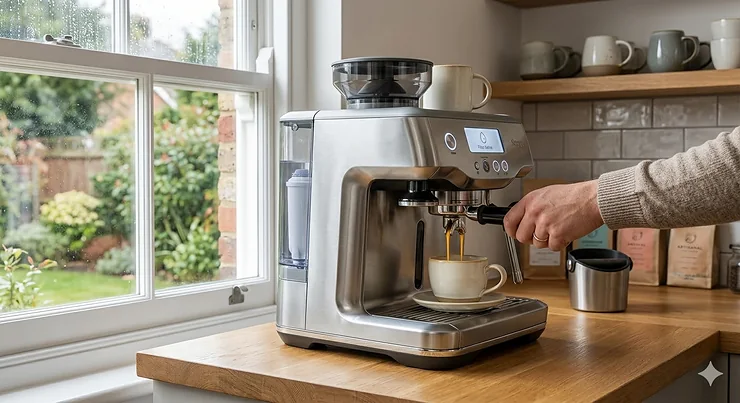
Picture this: you’ve just invested £500 in a brilliant coffee machine, sourced the finest beans from your local roastery, and yet your morning brew tastes… flat. The culprit? Your water. It’s a sobering reality that water constitutes roughly 98% of your cup of coffee, yet most of us give it barely a second thought.
Here in the UK, we’re blessed with safe drinking water, but “safe” doesn’t automatically translate to “ideal for coffee”. London’s tap water typically registers around 370 ppm of dissolved solids, whilst Edinburgh’s comes in at a mere 25 ppm – and this dramatic difference doesn’t just affect flavour; it fundamentally changes how your coffee machine operates and how long it’ll last.
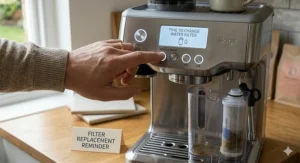
A proper water filter for coffee machine does two essential jobs: it protects your expensive equipment from limescale buildup whilst optimising mineral content for superior extraction. The Specialty Coffee Association recommends water with 75-250 ppm total dissolved solids, 50-175 ppm total hardness, 40-70 ppm alkalinity, and a neutral pH around 7.0 – parameters that UK tap water rarely meets without intervention.
In this comprehensive guide, I’ll walk you through seven outstanding water filter options available on Amazon.co.uk, explain the science behind water quality, and help you choose the perfect solution for your brewing setup. Whether you’re running a basic filter coffee machine or a sophisticated espresso setup, there’s a filtration solution that’ll transform your daily ritual.
Quick Comparison Table
| Water Filter | Price Range | Lifespan | Best For | Rating |
|---|---|---|---|---|
| DeLonghi DLSC002 | £7.79-£15.29 | 2-3 months | DeLonghi machines, budget-conscious | 4.7/5 ⭐ |
| Philips AquaClean CA6903/10 | £24.50-£29.18 | Up to 5,000 cups | Philips/Saeco machines, longevity | 4.6/5 ⭐ |
| Brita INTENZA (3-pack) | £16.99 | 2 months each | Universal compatibility, value | 4.5/5 ⭐ |
| Waterdrop for Sage (6-pack) | £35.99 | 3 months each | Sage machines, premium quality | 4.7/5 ⭐ |
| ICEPURE Compatible (6-pack) | £18.99-£22.99 | 2 months each | Multi-brand, budget option | 4.4/5 ⭐ |
| Filswa Replacement Filters (3-pack) | £13.59-£15.99 | 2-3 months | Sage models, mid-range | 4.5/5 ⭐ |
| Mutital for Sage (3-pack) | £14.99-£17.49 | 3 months each | Sage Express/Pro, quality | 4.6/5 ⭐ |
💬 Just one click – help others make better buying decisions too!😊
Top 7 Water Filter for Coffee Machine: Expert Analysis
1. DeLonghi DLSC002 Water Filter – Best Value for DeLonghi Owners
The DeLonghi DLSC002 represents exceptional value for money, especially if you’re running any machine from DeLonghi’s ECAM, ESAM, or ETAM series. At just £7.79-£15.29 depending on pack size, it’s the most affordable option on our list.
Key Specifications:
- Compatible with DeLonghi ECAM, ESAM, ETAM, and EX series
- Ion-exchange resin with activated carbon filtration
- Filters 99.99% chlorine and odours
- 2-3 month lifespan under normal use
UK buyers consistently praise this filter’s effectiveness in hard water areas. One customer from Manchester noted, “Living in the UK we have hard water and without replacement filters we’re doomed to replace our appliances sooner than expected. Coffee tastes better, water runs smoothly.”
✅ Pros:
- Budget-friendly pricing
- Excellent chlorine removal
- Perfect fit for DeLonghi machines
❌ Cons:
- Shorter lifespan than premium options
- Brand-specific compatibility
Price: £7.79-£15.29
2. Philips AquaClean CA6903/10 – Best for Longevity
If you’re tired of constantly replacing filters, the Philips AquaClean CA6903/10 is your answer. This ingenious filter delivers up to 5,000 cups before descaling becomes necessary – that’s roughly 18 months of daily coffee for most households.
Key Specifications:
- Micro-porous filtration technology
- Ion-exchange system for calcium removal
- Click & Go installation system
- Compatible with Philips and Saeco machines (Series 1200/2200/3200/5400)
The AquaClean uses a sophisticated micro-porous filter that captures even microscopic impurities whilst the ion-exchange technology naturally removes calcium without clogging. UK customers report noticeable improvements in both coffee flavour and machine performance, with one reviewer stating, “Getting up to 5,000 cups from a single filter is incredible value.”
✅ Pros:
- Exceptional lifespan (up to 5,000 cups)
- TÜV SÜD certified quality
- Reduces descaling frequency dramatically
❌ Cons:
- Higher upfront cost
- Limited to Philips/Saeco machines
Price: £24.50-£29.18 (2-pack)
3. Brita INTENZA Filter Cartridge (3-Pack) – Best Universal Option
For those seeking versatility, the Brita INTENZA 3-pack offers excellent value with broader compatibility across multiple coffee machine brands. Brita’s reputation for water filtration excellence translates beautifully to coffee applications.
Key Specifications:
- Aroma Ring technology for customisable filtration
- Reduces limescale and improves taste
- Compatible with numerous bean-to-cup machines
- 2-month lifespan per filter
The INTENZA’s unique Aroma Ring lets you adjust filtration intensity based on your local water hardness – particularly useful given the UK’s varying water quality. UK users can check their local water hardness online, with most Brita filters needing replacement every other month.
✅ Pros:
- Adjustable filtration settings
- Multi-brand compatibility
- Good value 3-pack
❌ Cons:
- Requires checking machine compatibility
- Shorter lifespan than AquaClean
Price: £16.99 (3-pack)
4. Waterdrop Water Filter for Sage Machines (6-Pack) – Premium Choice
Sage machine owners should seriously consider the Waterdrop 6-pack – it’s TÜV SÜD certified and delivers premium filtration at a reasonable cost per filter. At £35.99 for six filters, you’re looking at roughly £6 per filter for 18 months of protection.
Key Specifications:
- TÜV SÜD certified for safety and performance
- Coconut shell activated carbon from Sri Lanka
- BPA-free construction
- Compatible with Sage SES008/BES810/SES875/SES878/SES880/SES920/SES980/SES990
UK users particularly appreciate the quality-to-price ratio. A Birmingham buyer noted, “These filters are much more affordable than Sage-branded ones – at around £35.99 for 6, they’re a fraction of the cost whilst working seamlessly.”
✅ Pros:
- Excellent value for 6-pack
- High-quality coconut shell carbon
- Perfect fit for Sage Bambino, Barista Express, Oracle
❌ Cons:
- Sage-specific only
- Requires 10-minute pre-soaking
Price: £35.99 (6-pack)
5. ICEPURE Compatible Water Filter (6-Pack) – Best Budget Multi-Pack
The ICEPURE 6-pack brings certified quality at budget pricing. Whilst designed as compatible replacements for Philips AquaClean filters, these IAPMO-certified filters punch well above their weight.
Key Specifications:
- IAPMO certified manufacturing
- Multi-layer activated carbon and resin filtration
- Food-grade, BPA-free materials
- Removes chlorine, calcium, and microplastics
These filters use innovative multi-layer technology combining activated carbon with ion-exchange resins. Hard water with minerals above 100 ppm leads to rapid limescale formation, particularly in UK regions with high mineral content – making proper filtration essential.
✅ Pros:
- Excellent budget option
- Certified quality standards
- Filters microplastics
❌ Cons:
- Compatibility verification needed
- Some users report shorter lifespan
Price: £18.99-£22.99 (6-pack)
6. Filswa Replacement Water Filters (3-Pack) – Mid-Range Quality
The Filswa 3-pack sits comfortably in the mid-range bracket, offering solid performance for Sage machine owners who want quality without premium pricing.
Key Specifications:
- Compatible with Sage SES 990/980/500/878/875/880/920/810
- BES008 compatible
- Natural filtration materials
- 2-3 month replacement cycle
UK customers report consistent performance across various water hardness levels. The filters effectively reduce limescale whilst maintaining the mineral balance needed for proper extraction.
✅ Pros:
- Good mid-range value
- Reliable performance
- Wide Sage compatibility
❌ Cons:
- Less certifications than premium options
- Standard lifespan
Price: £13.59-£15.99 (3-pack)
7. Mutital Filter Replacement for Sage (3-Pack) – Best for Barista Pro/Express
Designed specifically for Sage’s Barista range, the Mutital 3-pack delivers professional-grade filtration for demanding home baristas.
Key Specifications:
- Optimised for Sage Barista Express Pro
- Compatible with SES810/SES880/SES920/SES980/SES990
- High-efficiency filtration
- 3-month lifespan
These filters are particularly popular amongst UK specialty coffee enthusiasts who’ve invested in Sage’s higher-end models. The filtration quality helps maintain consistent extraction temperatures and pressures.
✅ Pros:
- Barista-focused design
- Longer 3-month lifespan
- Maintains extraction consistency
❌ Cons:
- Sage Barista-specific
- Slightly higher cost per filter
Price: £14.99-£17.49 (3-pack)
Understanding Water Chemistry for Coffee
Why UK Water Quality Matters
The United Kingdom’s water hardness varies dramatically by region. London’s untreated tap water registers around 370 ppm at roasteries, whilst Edinburgh’s comes in at approximately 25 ppm – essentially the difference between very hard and very soft water.
This matters because the Specialty Coffee Association established parameters of 75-250 ppm total dissolved solids and 50-175 ppm total hardness based on decades of consumer preference research. These aren’t arbitrary numbers; they represent the sweet spot where coffee extraction occurs optimally whilst machine longevity isn’t compromised.
The Science of Limescale Formation
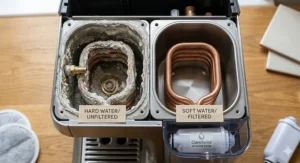
Limescale forms when water containing dissolved calcium and magnesium bicarbonates gets heated. In your coffee machine’s boiler, these minerals precipitate out as solid calcium carbonate – that familiar white, chalky deposit. Water with hardness above 100 ppm leads to rapid limescale formation, requiring more frequent descaling and potentially causing permanent component damage.
According to Barista Hustle, temporary hardness (also called carbonate hardness) is the villain here. It’s called “temporary” because boiling removes it – by turning it into limescale. Permanent hardness, conversely, stays dissolved even after heating.
Balancing Machine Protection and Flavour
Here’s the rub: completely demineralised water (0 ppm) prevents limescale but produces terrible coffee. Minerals, particularly magnesium, are crucial for extracting flavour compounds from ground coffee. Higher levels of magnesium increase acidic complexity and produce more balanced, sweeter coffee.
The ideal solution maintains 40-70 ppm alkalinity (which buffers acidity in your cup) whilst keeping total hardness between 50-175 ppm. Quality water filters achieve this balance by selectively removing scale-forming minerals whilst preserving extraction-enhancing ones.
How to Choose the Right Water Filter for Coffee Machine
Match Filter to Machine Brand
Most manufacturers design filters specifically for their machines’ internal architecture. DeLonghi DLSC002 filters fit DeLonghi’s ECAM and ESAM series perfectly, whilst Philips AquaClean works with Philips and Saeco models. Using brand-matched filters ensures optimal water flow, proper mineral reduction, and maintained warranty coverage.
Compatible third-party filters like Waterdrop or ICEPURE can offer excellent value, but verify your specific model number before purchasing.
Consider Your Local Water Hardness
Check your water company’s quality report online. If you’re in London, Essex, Kent, or other hard water regions (250+ ppm), prioritise filters with robust ion-exchange capabilities like the Philips AquaClean or DeLonghi DLSC002. Softer water areas like Scotland or Wales may manage with standard activated carbon filters.
The UK water quality database provides detailed regional information. Alternatively, purchase a simple TDS meter (£10-15 on Amazon.co.uk) for precise measurements.
Calculate Long-Term Value
Don’t just compare upfront costs. The Philips AquaClean costs more initially but lasts up to 5,000 cups – potentially 18 months for average users. Compare this to cheaper filters requiring replacement every 2 months, and the AquaClean often works out more economical.
Cost calculation example:
- Philips AquaClean: £24.50 for 5,000 cups = £0.005 per cup
- Basic filter: £7.79 for ~200 cups = £0.039 per cup
Assess Filtration Technology
Premium filters employ multiple technologies:
- Ion-exchange resins: Remove calcium and magnesium (scale prevention)
- Activated carbon: Eliminates chlorine, odours, organic compounds
- Micro-porous filters: Capture fine particles and microplastics
- Mineral balancing: Some filters add beneficial minerals back
The Brita INTENZA with its Aroma Ring lets you customise filtration intensity, whilst Philips AquaClean‘s micro-porous technology prevents clogging better than standard filters.
Installation and Maintenance Guide
Pre-Installation Preparation
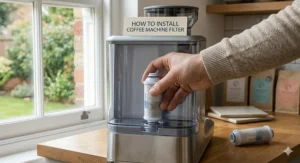
Before installing any water filter for coffee machine, soak it in clean water for 5-10 minutes. This crucial step removes air bubbles and rinses away loose activated carbon particles. Flip the filter several times during soaking to ensure complete saturation.
Most UK water filters include clear installation guides, but the general process involves:
- Soaking the filter (5-10 minutes)
- Rinsing under cold tap water
- Inserting into the machine’s filter housing
- Running a water cycle to prime the system
Setting Replacement Reminders
Modern machines like Philips and DeLonghi models include automatic filter counters, but for manual tracking:
- Hard water areas (London, Birmingham, Bristol): Replace every 2 months
- Medium hardness (Manchester, Sheffield): Every 2.5 months
- Soft water (Edinburgh, Glasgow): Every 3 months
Set calendar reminders on your phone, or mark your kitchen calendar. Some UK users report setting up Amazon Subscribe & Save for automatic filter deliveries.
Recognising Filter Exhaustion
Replace your filter immediately if you notice:
- Slower water flow through the machine
- Return of chlorine taste or smell
- Visible limescale in the water tank
- Machine requesting descaling more frequently
- Reduced coffee crema quality
Don’t wait for complete filter failure – exhausted filters can actually release trapped contaminants back into your coffee.
Benefits of Using Water Filter for Coffee Machine
Extended Machine Lifespan
Coffee machines aren’t cheap investments, and hard water can significantly shorten their lifespan through scale accumulation harming sensitive components. Quality filtration prevents costly repairs and premature replacement.
Consider that descaling a machine costs £5-10 in descaling solution plus your time. Premium espresso machines can require professional descaling (£80-150) if limescale causes blockages. A £25 filter preventing this damage pays for itself immediately.
Superior Coffee Flavour
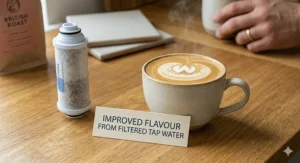
Water quality profoundly affects extraction. The Specialty Coffee Association recommends water with a TDS of 150-175 ppm because this mineral level helps extract the full flavour of coffee beans.
Filtered water removes chlorine (that “swimming pool” taste), reduces excessive minerals that cause bitterness, and balances alkalinity for proper acidity perception. UK coffee shops wouldn’t dream of using unfiltered tap water – why should you?
Reduced Descaling Frequency
Frequent descaling isn’t just inconvenient; it can damage machine components. Descale corrosion can damage chrome groups, strip internal chrome coatings, and harm temperature sensors in premium machines.
With proper filtration, most UK users report extending descaling intervals from monthly to quarterly or even bi-annually – saving time, money, and machine stress.
Environmental Benefits
Using filtered tap water instead of bottled water for coffee reduces plastic waste significantly. If you brew 3 cups daily using bottled water, that’s over 1,000 plastic bottles annually. A reusable filter eliminates this waste whilst costing far less.
Additionally, UK water companies treat tap water to drinking standards, making it perfectly safe once filtered for optimal coffee brewing.
Common Mistakes to Avoid
Using Completely Demineralised Water
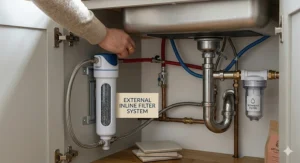
Some enthusiasts go too far, using reverse osmosis or distilled water without remineralisation. Completely demineralised water is highly corrosive to stainless steels when exposed to atmosphere, and it produces flat-tasting coffee due to lack of extraction-enhancing minerals.
If you use RO or distilled water, consider remineralisation packets like Third Wave Water (available on Amazon.co.uk, £15-20 for 12 packets).
Ignoring Pre-Soaking Requirements
Rushing installation without proper soaking leads to:
- Air bubbles affecting water flow
- Loose carbon particles in your first few cups
- Reduced initial filtration effectiveness
- Potential machine errors
Always follow the manufacturer’s soaking instructions – that 10-minute wait prevents hours of troubleshooting.
Mixing Filter Brands Incorrectly
Using incompatible filters can cause water leaks, poor filtration, or machine damage. Whilst many third-party filters work brilliantly, verify compatibility with your specific model number (usually found on the machine’s base or rating plate).
✨ Don’t Miss These Exclusive Deals!
🔍 Take your coffee brewing to the next level with these carefully selected products. Click on any highlighted item to check current pricing and availability on Amazon.co.uk. These filters will help you create authentic café-quality coffee your family will love!
Water Filter Comparison: Benefits vs Traditional Methods
| Method | Cost | Effectiveness | Convenience | Best For |
|---|---|---|---|---|
| Integrated machine filter | £7.79-£35.99 | Excellent | Very high | Daily coffee drinkers |
| Brita jug filtration | £15-30 initially | Good | Medium | Budget-conscious users |
| Bottled water | £0.50-2.00/bottle | Varies by brand | Low | Occasional use only |
| Reverse osmosis system | £150-400+ | Excellent (needs remineralisation) | High (after installation) | Coffee enthusiasts |
| No filtration | £0 | Poor (UK hard water) | Highest | Not recommended |
UK-Specific Water Considerations
Regional Water Hardness Variations
According to the Drinking Water Inspectorate, UK water hardness varies from 0 mg/l CaCO₃ in Scotland to 350+ mg/l in parts of London and the Southeast. This affects not just your coffee but your entire household.
Very Hard Water Areas (250+ mg/l): London, Essex, Kent, Sussex, Hertfordshire
- Requires robust ion-exchange filtration
- Filter replacement every 2 months
- Consider the Philips AquaClean or DeLonghi DLSC002
Hard Water Areas (150-250 mg/l): Birmingham, Bristol, Oxford, Cambridge
- Standard filtration adequate
- Replace filters every 2.5 months
- Brita INTENZA or Waterdrop work well
Soft Water Areas (<100 mg/l): Scotland, Wales, Cornwall, North West
- Lighter filtration needs
- Focus on chlorine removal
- Any quality filter suitable, 3-month replacement
UK Water Regulations and Standards
All UK tap water meets EU Drinking Water Directive standards (maintained post-Brexit), ensuring safety for consumption. However, “safe to drink” doesn’t equal “optimal for coffee.”
Water companies chlorinate supplies for safety, often at levels (0.5-1.0 mg/l) that noticeably affect coffee flavour. Quality filters remove this whilst maintaining beneficial mineral content.
FAQ
❓ How often should I replace my water filter for coffee machine in the UK?
❓ Can I use my coffee machine without a water filter?
❓ Are third-party water filters as good as branded ones?
❓ Will a water filter eliminate the need for descaling completely?
❓ Which water filter for coffee machine is best for Sage Barista Express in hard water areas?
Conclusion
Investing in a proper water filter for coffee machine ranks amongst the smartest decisions UK coffee lovers can make. Whether you’re protecting a £200 Sage Bambino or a £1,500 DeLonghi Magnifica, quality filtration pays dividends through extended lifespan, reduced maintenance, and significantly improved flavour.
The seven filters reviewed here cater to every budget and machine type. For DeLonghi owners, the DLSC002 (£7.79-£15.29) delivers unbeatable value. Philips and Saeco users should seriously consider the AquaClean (£24.50-£29.18) for its remarkable 5,000-cup lifespan. Sage machine owners are spoilt for choice with the premium Waterdrop 6-pack (£35.99), mid-range Filswa, or quality Mutital options.
Remember that water constitutes 98% of your coffee. Sourcing spectacular single-origin beans whilst ignoring water quality is like buying a Ferrari but filling it with contaminated fuel. Water makes up about 98% of a cup of coffee, so its quality has a significant impact on taste.
Check your local water hardness, choose an appropriate filter, install it properly with pre-soaking, and set replacement reminders. Your machine will last longer, your coffee will taste better, and you’ll save money on descaling solutions and potential repairs. That’s what I call a proper brew.
Recommended for You
- 7 Best Coffee Machine Cleaning Products UK 2026
- Best Descaler for Coffee Machine: 7 UK Picks 2026
- 7 Fellow Stagg Kettle UK Review Worth It UK 2026
Disclaimer: This article contains affiliate links. If you purchase products through these links, we may earn a small commission at no additional cost to you. Prices shown are approximate and may vary.
✨ Found this helpful? Share it with your mates! 💬🤗
