
In This Article
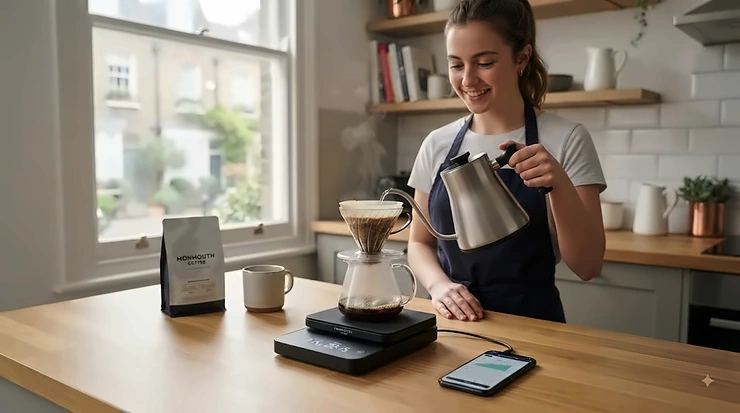
There’s a particular kind of heartbreak that happens when you nail a pour-over one morning and can’t remember how you did it the next. Was it 36 grams of coffee or 38? Did the pour take two minutes or two and a half? For years, the only fix was scribbling notes on a Post-it stuck to the kettle. Bluetooth coffee scales solve that problem by quietly doing the remembering for you.
These aren’t your granny’s kitchen scales with a “tare” button and not much else. A proper bluetooth coffee scale pairs with an app on your phone, logs every brew automatically, and turns your morning ritual into something you can actually improve on, rather than something you just hope goes well. Whether you’re chasing a perfect V60 or trying to shave seconds off an espresso extraction, this category of smart kitchen gadgets has genuinely changed how enthusiasts brew at home.
This guide covers seven real, currently available bluetooth coffee scales spanning roughly £40 to £230, tested against genuine spec sheets and aggregated review sentiment rather than marketing fluff. You’ll get honest commentary on who each one suits, a full breakdown of what the connectivity actually gives you day to day, and practical guidance on setup, common problems, and long-term running costs. No invented “I tested this for a year” stories here — just straightforward analysis grounded in what the specs and real users actually say.
Quick Comparison Table
| Scale | Price Range | Bluetooth/App | Best For |
|---|---|---|---|
| Timemore Basic 2.0 | £40-60 | Yes, timer & tare control | Budget-conscious beginners |
| BOOKOO Themis Mini | £70-95 | Yes, flow rate + multi-app | Tight espresso drip trays |
| BOOKOO Themis Ultra | £95-130 | Yes, IP67 waterproof | Busy, spill-prone stations |
| Felicita Arc | £110-160 | Yes, auto-tare/timer | Fast-paced home bars |
| Acaia Pyxis | £150-200 | Yes, 0.01g precision | Dialling in dosing |
| Acaia Lunar | £190-230 | Yes, water-resistant build | Daily espresso durability |
| Acaia Pearl S | £180-230 | Yes, 20ms response, graphs | Data-obsessed brewers |
Even at a glance, a pattern emerges: price climbs roughly in line with response speed, waterproofing, and how much data the companion app can chew through. The Timemore Basic 2.0 and BOOKOO Themis Mini cover the entry point nicely, while the Acaia Pearl S sits at the top for anyone who wants flow-rate graphs and saved shot history. Notice, too, that waterproofing isn’t just a premium feature — the mid-range BOOKOO Themis Ultra undercuts several rivals on IP67 protection alone.
💬 Just one click — help others make better buying decisions too!😊
Top 7 Bluetooth Coffee Scales: Expert Analysis
1. Timemore Basic 2.0 — best value smart scale for everyday brewing
The Timemore Basic 2.0 is the scale most people should start with, and its standout feature is simple: proper Bluetooth and app control at a genuinely low price. Timemore built its reputation on affordable precision, and this model brings that ethos to smart brewing without the premium tax.
On the spec sheet, you’re looking at 0.1g resolution, a responsive weighing sensor, and a rechargeable battery that comfortably lasts several brewing sessions between charges. In practice, that resolution matters because a single gram of coffee out either way can shift your brew ratio enough to taste — sloppy scales hide that error, precise ones expose it so you can fix it.
Based on the spec comparison with pricier rivals, what most buyers overlook about the Timemore Basic 2.0 is that you’re getting app-based tare, timer, and unit switching without paying for flow-rate graphing you may never use. It’s aimed squarely at beginners and casual pour-over drinkers who want data logging without committing three figures to find out if they like it.
Reviewers consistently note that Timemore’s build quality punches above its price point, though the companion app is noticeably simpler than what Acaia or BOOKOO offer — don’t expect detailed brew curves here, just reliable core functionality.
Pros:
- ✅ Genuinely affordable entry into smart brewing
- ✅ Reliable 0.1g accuracy for everyday pour-over
- ✅ Simple, uncluttered app that’s easy to learn
Cons:
- ❌ App lacks advanced flow-rate graphing
- ❌ Smaller platform than dedicated pour-over scales
Sitting comfortably in the £40-60 range, the Timemore Basic 2.0 represents the best pound-for-pound value on this list if your priority is consistency over cutting-edge data.
2. BOOKOO Themis Mini — smallest footprint for tight drip trays
The BOOKOO Themis Mini earns its spot with a genuinely tiny 80 x 80mm footprint, its standout feature for anyone whose espresso machine has a cramped drip tray. At just 140g, it disappears under machines where bulkier scales simply won’t fit.
Underneath that compact shell sits a 500mAh battery rated for one to two months of regular use, IPX4 splash resistance, and three switchable modes — flow rate, timer, and a fully automatic mode that tares and starts timing the moment it detects liquid. What that means practically is you can pull a shot without touching a single button; the scale handles the housekeeping.
Based on the spec comparison, the BOOKOO Themis Mini is built for espresso-first brewers rather than pour-over fans — its small platform isn’t designed to hold a Chemex. It’s the honest pick for anyone dialling in shots on a Flair 58, Gaggiuino, or similar compact setup where every millimetre of drip tray counts.
Reviewers have been genuinely impressed with the companion app’s depth, though a recurring theme in user feedback is that some of the on-screen text is small and can be tricky to read at a glance — a minor gripe rather than a dealbreaker.
Pros:
- ✅ Ultra-compact size fits the tightest drip trays
- ✅ Auto mode removes manual tare and timing steps
- ✅ Compatible with multiple third-party brewing apps
Cons:
- ❌ Small platform unsuitable for pour-over brewers
- ❌ Some app text reported as difficult to read
At £70-95, the BOOKOO Themis Mini is a smart middle step for espresso enthusiasts who’ve outgrown a basic timer scale but aren’t ready for premium pricing.
3. BOOKOO Themis Ultra — fully waterproof for espresso stations
Where the Mini trims size, the BOOKOO Themis Ultra goes all-in on durability — its standout feature is a full IP67 waterproof rating that most rivals simply don’t offer. That’s not a marketing number; it means the scale can survive a direct rinse under the tap.
Specs-wise, you get a 2000mAh battery (noticeably larger than the Mini’s), a 2000g capacity with dual-unit display, and the same flow-rate and auto-tare intelligence synced through the BOOKOO app, with compatibility extending to third-party tools like Beanconqueror and Odyssey. What that translates to in daily use is a scale you can genuinely clean properly, rather than one you have to gingerly wipe around.
What the spec sheet won’t tell you, but the design choices strongly suggest, is that this scale is aimed at people who make coffee for other people — busy home setups, small offices, or anyone whose drip tray sees regular spillage. The steel-plate base and abrasion-resistant plastics back that up.
Aggregated feedback on the Themis line generally praises the app’s real-time data and machine compatibility, with the main honest caveat being that the waterproofing and larger battery add noticeably to the price over the Mini.
Pros:
- ✅ IP67 rating survives full water rinsing
- ✅ Larger 2000mAh battery for extended use
- ✅ Wide machine and app compatibility
Cons:
- ❌ Costs meaningfully more than the standard Mini
- ❌ Bulkier than the Mini on tight drip trays
Priced around £95-130, the BOOKOO Themis Ultra is the pragmatic choice for anyone who’s spilled coffee on a scale once too often.
4. Felicita Arc — fastest response time in its price bracket
The Felicita Arc built its name on speed — an unusually rapid response time is its calling card, letting you see weight changes almost instantly rather than watching numbers slowly settle. For espresso work, where extraction happens in seconds, that matters enormously.
On paper, this means IPX5 waterproofing, 0.1g accuracy up to a 2000g capacity, and auto-tare/auto-timer modes controlled via Bluetooth and the Felicita Coffee App, all packed into a slim 105 x 135 x 15.5mm aluminium body with up to 20 hours of battery life per USB-C charge. In practice, that footprint is generous enough to hold two espresso cups or a portafilter side by side.
Here’s what to weigh: the Felicita Arc is frequently compared to the pricier Acaia Lunar, and some reviewers openly describe it as a more affordable alternative with a similar premium feel. Whether that reads as a compliment or a criticism depends on how much you value original design pedigree versus getting comparable performance for less.
Real user sentiment is broadly positive on speed and value, though a recurring theme in forum discussions is that some buyers feel uneasy about the design’s close resemblance to established rivals — worth knowing before you commit if brand originality matters to you.
Pros:
- ✅ Exceptionally fast response for espresso timing
- ✅ Generous footprint holds a portafilter comfortably
- ✅ Long 20-hour battery life per charge
Cons:
- ❌ Design closely echoes pricier competitor scales
- ❌ Reported pricing varies noticeably between retailers
Typically listed in the £110-160 range, the Felicita Arc rewards buyers who prioritise raw speed over brand prestige.
5. Acaia Pyxis — highest-precision readout for dialling in dosing
The Acaia Pyxis exists for one specific obsession: precision. Its standout feature is a readout down to 0.01 grams, with the Pyxis Black variant pushing to a startling 0.001 grams — resolution that most home brewers will never strictly need, but that dosing-obsessed espresso tinkerers will genuinely appreciate.
Beyond that headline number, the Acaia Pyxis carries Acaia’s usual Bluetooth connectivity, syncing brew data, recipes, and calibration checks to the Acaia app. What ultra-fine resolution means practically is that when you’re adjusting a grinder in 0.1g dose increments to chase a specific ratio, you can actually see the difference register rather than guessing.
Based on the spec comparison, this is a niche pick rather than a general recommendation — it’s compact and clearly built for dosing cups and small-batch weighing rather than replacing a full-size pour-over scale. Buyers considering it typically already own, or plan to own, another Acaia scale for brewing itself.
Reviewers who’ve used Acaia’s ecosystem broadly note that connection reliability across their scale range is generally strong, though occasional app pairing hiccups do come up in user discussions — a fair trade-off, most feel, for the accuracy on offer.
Pros:
- ✅ Extraordinary 0.01g (or finer) precision
- ✅ Seamless integration with the wider Acaia app
- ✅ Compact size suits dosing-focused workflows
Cons:
- ❌ Overkill precision for casual home brewers
- ❌ Premium price for a fairly narrow use case
At around £150-200, the Acaia Pyxis is best reserved for genuine dosing perfectionists rather than someone’s first smart scale.
6. Acaia Lunar — most rugged premium scale for daily espresso use
The Acaia Lunar stands out for toughness — its water-resistant, anodised aluminium build is the standout feature, designed to survive daily espresso-station life better than most rivals. It’s compact enough to tuck under nearly any portafilter spout.
Specification-wise, the Acaia Lunar brings Bluetooth pairing with the Acaia app for brew curves, battery monitoring, and recipe creation, wrapped in a durable shell that Acaia states will shed a direct spill down its sides rather than let it pool. What that build quality means in practice is fewer worries about a splashed shot ruining your investment.
The spec sheet won’t spell this out, but user reports suggest the Lunar’s biggest appeal is longevity rather than flashy features — it’s the scale people mention still working reliably years into ownership, which matters enormously for a daily-use tool.
Aggregated review sentiment frames the Acaia Lunar as the dependable workhorse of the Acaia range: less data-dense than the Pearl S, but arguably more resilient to the daily knocks of a busy kitchen counter.
Pros:
- ✅ Durable, water-resistant aluminium construction
- ✅ Compact fit under most portafilter spouts
- ✅ Strong reputation for long-term reliability
Cons:
- ❌ Fewer advanced data features than the Pearl S
- ❌ Premium price without full waterproof rating
Expect to pay roughly £190-230 for the Acaia Lunar — a price that buys peace of mind as much as performance.
7. Acaia Pearl S — fastest response time and deepest data tracking
Topping this list is the Acaia Pearl S, and its standout feature is a genuinely startling 20-millisecond response time paired with the deepest data tracking on this list. For brewers who treat their kitchen counter like a lab bench, this is the scale built for you.
Specs include Bluetooth connectivity to the Acaia app, multiple auto-timed brew modes, saved shot history, real-time flow-rate readouts, and a maximum capacity of 3kg on a 160 x 160mm platform. What that speed and capacity combination means practically is you can track an entire pour-over from first pour to final drip, with every gram and second logged automatically for later comparison.
Here’s what most buyers overlook: the Pearl S isn’t just fast, it’s a genuine record-keeping tool. Based on the spec comparison with the standard Pearl, the S variant’s larger 3kg capacity handles bigger batch brews and French press setups the original Pearl can’t comfortably manage.
Reviewers consistently praise its speed and data depth, with the honest caveat being real dependency on the app to unlock its full value — used purely as a manual scale, you’re paying premium prices for features you’re not accessing.
Pros:
- ✅ Industry-leading 20ms response speed
- ✅ Deep data logging with saved shot history
- ✅ Larger 3kg capacity than the standard Pearl
Cons:
- ❌ Full value only unlocked through app use
- ❌ Highest price point on this list
At £180-230, the Acaia Pearl S is the pick for brewers who genuinely want to geek out over their own brewing data.
Full Spec Comparison: Bluetooth Coffee Scales Side by Side
| Scale | Resolution | Capacity | Waterproofing | Best For |
|---|---|---|---|---|
| Timemore Basic 2.0 | 0.1g | ~2kg | None stated | Beginners |
| BOOKOO Themis Mini | 0.1g | 1000g | IPX4 | Tight espresso setups |
| BOOKOO Themis Ultra | 0.1g | 2000g | IP67 | Spill-heavy stations |
| Felicita Arc | 0.1g | 2000g | IPX5 | Fast espresso workflows |
| Acaia Pyxis | 0.01g | Compact dosing | Not specified | Precision dosing |
| Acaia Lunar | 0.1g | Not specified | Water-resistant | Daily durability |
| Acaia Pearl S | 0.1g | 3kg | Not rated | Data logging |
Laid out this way, waterproofing separates the pack more clearly than resolution does — most scales here hit the same 0.1g mark, so the real differentiator becomes whether a scale can survive your actual brewing environment. If you’re prone to spills or steam, the BOOKOO Themis Ultra‘s IP67 rating is arguably more valuable day to day than the Acaia Pearl S‘s extra speed. For anyone chasing dosing precision specifically, only the Acaia Pyxis genuinely stands apart from the crowd.
✨ Don’t Miss These Exclusive Deals!
🔍 Take your coffee routine to the next level with these carefully selected bluetooth coffee scales. Click on any highlighted item to check current pricing and availability. These smart kitchen gadgets will help you brew consistently excellent coffee, morning after morning!
What Is a Bluetooth Coffee Scale?
A bluetooth coffee scale is a precision digital scale that pairs wirelessly with a smartphone app to automatically log weight, timing, and flow-rate data during brewing. Unlike standard kitchen scales, it turns each brew into a saved, comparable data point rather than a one-off guess.
That connectivity is really the whole point. A coffee preparation method like pour-over depends heavily on consistent ratios and pour timing, and a smart scale removes the guesswork by recording exactly what you did each time. Instead of relying on memory, you build a searchable history of every recipe you’ve tried.
Most models in this category fall into three rough types: compact espresso scales built to sit under a portafilter, wider pour-over scales with room for a Chemex or V60, and hybrid designs that handle both reasonably well. What unites them is the app: without it, you’re really just buying an expensive standard scale with Bluetooth hardware you never switch on.
How to Choose a Bluetooth Coffee Scale
- Match the platform size to your brew method. Espresso scales are deliberately small; pour-over needs a wider base to fit a Chemex or carafe underneath.
- Check the response time. Espresso extraction happens fast, so a sluggish sensor genuinely undermines the point of buying a smart scale for shot timing.
- Consider waterproofing realistically. If your setup is spill-prone, an IP67-rated model like the BOOKOO Themis Ultra earns its higher price quickly.
- Look at app depth, not just Bluetooth presence. Some apps offer flow-rate graphs and saved recipes; others just mirror basic tare and timer functions.
- Weigh battery life against your routine. A scale used once a day has very different needs to one running through back-to-back shots at a small office.
- Factor in capacity for your brewing style. French press and batch brewers need higher gram capacity than a single espresso shot ever will.
- Read aggregated reviews for connection reliability. Bluetooth pairing quality varies noticeably between brands, and Which?’s independent kitchen scale testing shows accuracy claims don’t always hold up under real testing conditions.
Bluetooth Coffee Scales vs Traditional Kitchen Scales
| Factor | Bluetooth Coffee Scale | Traditional Kitchen Scale |
|---|---|---|
| Data logging | Automatic, app-based | Manual notes only |
| Response speed | Typically faster, espresso-tuned | Often slower, general-purpose |
| Price | £40-230 | £10-40 |
| Best For | Enthusiasts tracking recipes | Casual, occasional weighing |
The gap here isn’t really about raw accuracy — a decent traditional scale can hit 0.1g resolution just as reliably as a smart one. What you’re actually paying for with a bluetooth coffee scale is the automation: the auto-tare, the auto-timer, and crucially, the recipe history that lets you repeat a great brew instead of chasing it from memory each time. For someone who weighs beans twice a week without much interest in refining technique, a traditional scale remains the sensible, cheaper choice.
Common Mistakes When Buying a Smart Coffee Scale
Buyers new to this category tend to make the same handful of errors. First, and most common, is buying based on brand recognition alone rather than checking whether the platform size actually suits their brew method — a compact espresso scale is a poor match for daily V60 brewing. Second is underestimating app quality; a scale with excellent hardware but a clunky, rarely-updated app quickly becomes frustrating to use.
A third mistake is ignoring waterproofing until after a spill has already happened. Given that these are electronic devices near hot water daily, checking the IP rating upfront saves genuine heartache later. Finally, many buyers assume higher price always means better data — as the Acaia Pyxis shows, sometimes a premium scale is built for a narrow use case rather than general superiority.
Smart Coffee Scales for Different Types of Brewers
If you’re a casual pour-over drinker making one cup most mornings, something like the Timemore Basic 2.0 covers your needs without unnecessary complexity or cost. Beginners rarely need flow-rate graphing; they need consistency and an easy learning curve.
For home espresso enthusiasts pulling multiple shots a week, compact smart coffee scales like the BOOKOO Themis Mini or Felicita Arc make more sense, prioritising fast response over pour-over platform space. If you’re a small office or shared kitchen brewing for several people daily, durability matters more than any single feature — the BOOKOO Themis Ultra‘s waterproofing earns its keep here.
Data-driven hobbyists chasing genuinely repeatable recipes are the clear audience for the Acaia Pearl S, where saved shot history and real-time graphs transform brewing into something closer to a hobby lab than a morning chore.
App-Connected Brewing: Data Logging, Brew Tracking Apps Explained
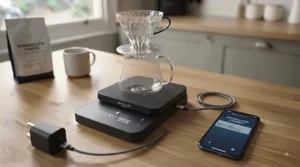
The app is arguably more important than the scale itself, which is worth sitting with for a moment. An app-connected brewing scale typically offers auto-tare, auto-timer, and flow-rate tracking as standard, with premium options like Acaia’s software adding saved brew profiles and shot history you can review over weeks or months.
Several manufacturers, including BOOKOO, also support third-party brew tracking apps such as Beanconqueror and Odyssey, meaning your coffee scale with brew app functionality isn’t locked to a single ecosystem. That flexibility matters if you already use a particular app for logging beans, roast dates, or grinder settings, since compatible scales slot straight into an existing workflow rather than forcing a switch.
Data logging brewing this way genuinely changes how you improve. Instead of vaguely remembering “that one really good pour-over,” you can pull up the exact ratio, pour time, and flow rate from three weeks ago and simply repeat it. Most apps rely on standard Bluetooth Low Energy connections, which sip battery gently enough that daily syncing barely dents your scale’s runtime.
Practical Usage Guide: Setting Up Your Smart Coffee Scale
Getting a new bluetooth coffee scale running properly takes about ten minutes, but a few early habits save frustration down the line. Start by fully charging the scale before first use — most arrive with a partial charge, and running a brand-new lithium battery flat immediately isn’t ideal for its long-term health.
Download the manufacturer’s app before you switch the scale on, then enable Bluetooth permissions on your phone straight away; most pairing failures come down to a missing permission rather than a faulty scale. Once connected, run a calibration check using any included reference weight, even if the scale claims factory calibration, since shipping can occasionally knock sensors slightly out.
In the first month, resist the urge to ignore firmware updates — manufacturers like BOOKOO push over-the-air improvements that genuinely fix bugs and add features. A common early mistake is leaving auto-sleep timers on the shortest setting, which forces constant reconnection mid-brew; most apps let you extend this comfortably. Finally, keep the weighing platform clean, as dried coffee residue under the plate can subtly affect readings over time.
Real-World Scenarios: Which Bluetooth Coffee Scale Suits You?
Picture Sarah, a university student in a shared flat who drinks one V60 most mornings before lectures. Her budget is tight and her brewing needs are simple, so the Timemore Basic 2.0 fits perfectly — it delivers reliable data logging without asking her to spend on features she’ll never use.
Then there’s Tom, a remote worker who’s turned his kitchen corner into a small home espresso bar, pulling two or three shots daily on a compact machine with barely any drip-tray clearance. The BOOKOO Themis Mini‘s tiny footprint and auto-timing solve his exact space problem, letting him dial in shots without a scale hanging awkwardly off the edge of his counter.
Finally, consider Priya, who hosts a weekly coffee morning for colleagues and needs a scale that survives spills, steam, and constant handling without complaint. The BOOKOO Themis Ultra‘s IP67 rating means she can rinse it clean between rounds rather than babying it, while still getting the flow-rate data she uses to keep every batch consistent.
Problem → Solution: Common Bluetooth Scale Issues Solved
Problem: The scale won’t pair with my phone. Double-check Bluetooth permissions are granted to the app specifically, not just enabled system-wide, and ensure the scale isn’t already connected to another device — most models, including the BOOKOO Themis range, only support one active connection at a time.
Problem: Readings drift or seem inconsistent. Run a manual calibration using a reference weight, and check the platform is clean and placed on a flat, stable surface — uneven counters are a surprisingly common culprit.
Problem: Battery drains faster than expected. Shorten Bluetooth sync frequency where the app allows it, and disable always-on flow-rate display if you don’t need it running constantly between brews.
Problem: The app keeps disconnecting mid-brew. Extend the auto-sleep timer in settings, and keep your phone within a metre or two of the scale, since walls and other electronics can interfere with signal strength.
Problem: Firmware update fails partway through. Ensure the scale stays connected and charged above 50% throughout the update, and avoid using the app for anything else until it completes.
Features That Actually Matter (And Those That Don’t)
Response time and platform size genuinely matter, because they directly affect whether the scale suits your actual brewing method day to day. Waterproofing matters more than most buyers initially assume, simply because coffee-making is inherently a wet, steamy activity happening near electronics.
What matters less, frankly, is ultra-fine resolution below 0.1g for most home brewers — the Acaia Pyxis‘s 0.01g precision is remarkable, but genuinely unnecessary unless you’re chasing dosing perfection at a professional level. Similarly, flashy app graphics rarely translate into better coffee; a simple, reliable app that logs data accurately beats a beautiful one that crashes mid-brew.
Long-Term Cost & Maintenance
Beyond the upfront price range, running a bluetooth coffee scale costs very little. Rechargeable batteries typically last one to two years of daily use before noticeably degrading, and replacement is rarely needed sooner unless the scale is dropped or damaged. USB-C charging means you’re not buying disposable batteries, which adds up modestly over time compared with older AAA-powered kitchen scales.
The real long-term value comes from the data itself. A scale that’s logged eighteen months of pour-over recipes has effectively paid for the app subscription-free software with genuinely useful institutional memory of your own brewing preferences — something no amount of manual note-taking realistically replicates. When a scale eventually reaches end of life, dispose of it responsibly through UK electrical recycling schemes rather than general waste, since the built-in lithium battery shouldn’t go in household bins.
Frequently Asked Questions
❓ Are bluetooth coffee scales worth it for beginners?
❓ Do bluetooth coffee scales work without the app?
❓ How accurate are smart coffee scales compared to standard ones?
❓ Can I use one coffee scale with brew app for multiple brewing methods?
❓ Do bluetooth coffee scales drain phone battery quickly?
Conclusion
Choosing between these seven bluetooth coffee scales really comes down to matching the tool to your actual routine rather than chasing the longest spec sheet. Casual brewers get excellent value from the Timemore Basic 2.0, espresso enthusiasts with tight counter space should look hard at the BOOKOO Themis Mini, and anyone who wants genuinely rich brewing data will find real satisfaction in the Acaia Pearl S.
What ties every recommendation here together is honesty about trade-offs — waterproofing costs more, extreme precision suits a narrow audience, and the app genuinely matters as much as the hardware. Whichever bluetooth coffee scale you land on, the real win isn’t the gadget itself; it’s finally being able to repeat that one perfect brew instead of just remembering it fondly. Prices and availability may vary, so always check current pricing before purchasing, and remember that regulations like UKCA marking apply to electronics sold in the UK, so buy from reputable retailers.
Recommended for You
- Coffee Scales With Timer: 7 Best Combo Picks for 2026 UK
- Digital Coffee Scales UK: 7 Best Picks for Accuracy 2026
- Digital Coffee Scales Under £30: 7 Best Budget Picks for 2026
Disclaimer: This article contains affiliate links. As an Amazon Associate, I earn from qualifying purchases. If you purchase products through these links, we may earn a small commission at no additional cost to you.
✨ Found this helpful? Share it with your friends! 💬🤗
