
In This Article
There’s a particular kind of heartbreak that only coffee people understand: you’ve dialled in the perfect ratio, the grinder’s singing, the kettle’s at temperature — and then your scale rounds 18.4 grams up to “18” like it’s doing you a favour. It isn’t. That missing 0.4 grams is the difference between a shot that sings and one that just sort of mumbles. This is exactly why precision coffee scales 0.1g have quietly become non-negotiable kit for anyone past the “just wing it” stage of brewing.
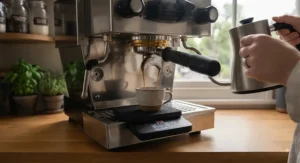
Here’s the short version: a scale that reads to 0.1g gives you ten times the resolution of the average kitchen scale, and it does it fast enough to keep up with a pour, not lag two seconds behind it. That gap between “reads to 1g” and “reads to 0.1g” sounds trivial until you’re pulling an 18g espresso dose and a single gram of error represents a 5.5% swing in your brew ratio — enough to nudge a balanced shot toward bitter or sour territory.
Below, I’ve pulled together seven genuinely available scales spanning budget pour-over basics to competition-grade Bluetooth kit, all built around 0.1g accuracy, so you can match the right tool to how you actually brew rather than how a marketing page says you should. Prices shift constantly on Amazon UK, so I’ll stick to ranges rather than exact figures — always check the current listing before you buy. As an Amazon Associate, this article may earn from qualifying purchases; more on that below.
Quick Comparison Table
| Scale | Precision | Best For | Price Range |
|---|---|---|---|
| Fellow Tally Pro | 0.1g | Pour-over brewers who want guided ratios | £150-£190 |
| Acaia Pearl S | 0.1g | Serious home brewers wanting app data | £180-£230 |
| Acaia Lunar | 0.1g | Dedicated espresso dosing | £150-£190 |
| Timemore Black Mirror Basic 2 | 0.1g | Best all-round value | £60-£90 |
| Hario V60 Drip Scale | 0.1g (2-200g range) | Budget pour-over classic | £35-£50 |
| MHW-3BOMBER Espresso Scale | 0.1g | Compact espresso drip trays | £30-£45 |
| Greater Goods Coffee Scale | 0.1g | Budget all-purpose brewing | £30-£45 |
Looking at the spread here, the gap between the Hario V60 Drip Scale and the Acaia Pearl S isn’t really about accuracy at all — both genuinely hit 0.1g. What separates them is response speed, app integration, and whether you need flow-rate data or you’re happy just watching the number climb. Budget-conscious brewers can stop at the Timemore Black Mirror Basic 2 and lose almost nothing measurable in the cup; the premium tier buys you workflow features, not extra grams of accuracy.
💬 Just one click — help others make better buying decisions too!😊
Top 7 Precision Coffee Scales: Expert Analysis
Coffee scales built for specialty brewing aren’t just repackaged kitchen scales with a fancier badge — the load cell, the sampling rate, and the software all get tuned specifically for the tiny, fast-changing weights involved in pulling a shot or pouring a V60. Here’s how seven genuinely available options stack up, drawn from real specs and aggregated review sentiment rather than marketing copy.
1. Fellow Tally Pro — guided brew-assist mode for ratio-perfect pours
The standout here is the brew assist mode, which walks you through pulsed pours in real time rather than just displaying a number and leaving you to do the maths. Specs-wise, you’re looking at 0.1g readability with matching repeatability, a 2,500g capacity, USB-C rechargeable battery, and an OLED display that’s genuinely legible in low kitchen light — a small thing that matters more than you’d think at 6am. Based on the spec comparison with rivals in this bracket, what stands out is the removable weigh pan and water-resistant build, which solves the “coffee grounds jammed under the platform” problem that plagues cheaper scales within months. This is the pick for pour-over drinkers who want a scale that actively teaches better technique rather than one that just measures it — beginners graduating from guesswork benefit most, while advanced brewers may find the guided mode more novelty than necessity once they’ve internalised their recipes. Reviewers consistently report that the mechanical dial and tactile buttons feel more durable than touch-sensitive competitors, with one recurring theme being that owners appreciate not having buttons fail the way they have on older scale designs; a smaller thread of feedback flags the price as steep for what is, underneath the software, still a scale.
Pros:
- ✅ Guided brew-assist mode simplifies ratio-perfect pour-overs
- ✅ OLED display stays readable in dim morning light
- ✅ Water-resistant build with an easy-clean removable pan
Cons:
- ❌ Premium price relative to non-app scales
- ❌ Brew-assist mode adds little once you know your recipes
At around £150-£190, the Fellow Tally Pro sits in premium territory, but for anyone who brews pour-over daily and values a guided workflow over raw spec-sheet numbers, the value case holds up.
2. Acaia Pearl S — the specialty-coffee benchmark with Bluetooth data logging
What most buyers overlook about the Acaia Pearl S is that its real advantage isn’t the 0.1g readout — plenty of scales hit that — it’s the 2-millisecond response time paired with Bluetooth logging that turns every brew into data you can actually review later. The spec sheet lists a 3,000g capacity, a real-time flow-rate display, and a companion app that stores step-by-step Brewguides, letting roasters or fellow enthusiasts share exact recipes that load straight onto the scale. Here’s what to weigh: this is built for people who treat brewing as something worth iterating on, not a one-and-done morning ritual — home baristas chasing repeatable results across different beans, and anyone curious enough to want a record of what worked last Tuesday. Aggregated review sentiment repeatedly praises the touch-sensitive controls and battery life stretching well beyond a working week between charges, though a consistent complaint is that the scale isn’t water-resistant, so a splash from an enthusiastic pour genuinely risks the electronics in a way that rivals with sealed platforms don’t.
Pros:
- ✅ Bluetooth app logging tracks and shares full brew recipes
- ✅ 2ms response time keeps pace with fast pulsed pours
- ✅ Long battery life between USB-C charges
Cons:
- ❌ Not water-resistant despite the premium price
- ❌ App dependency for full feature access
Expect to pay in the £180-£230 range for the Acaia Pearl S — it’s the priciest scale on this list, but among home brewers chasing specialty-coffee consistency, it’s also the one most frequently name-checked as the reference point everyone else gets compared against.
3. Acaia Lunar — purpose-built for espresso dosing and shot timing
The standout feature here is a 20-millisecond response time, which on paper sounds like a spec-sheet flex until you realise espresso shots run 25-35 seconds and every millisecond of lag is time your yield reading is lying to you. Key numbers: a 2kg capacity, a low-profile 105mm x 105mm footprint designed specifically to sit under a portafilter without overhanging a drip tray, and Bluetooth connectivity for shot-tracking through the Acaia app. Based on the spec comparison, this is the scale for anyone whose brewing is espresso-first rather than pour-over-first — home baristas dialling in dose-to-yield ratios, or small commercial setups needing a scale that fits the physical constraints of an espresso machine’s drip tray, which most pour-over scales simply don’t. What the spec sheet won’t tell you, but reviewers note, is that sensitivity to weight changes is high enough to register evaporation loss during longer pulls, a detail that borders on overkill for casual users but genuinely useful for anyone tracking yield precisely; the trade-off flagged most often is that its small platform makes it a poor fit for anything beyond espresso, so it’s a specialist tool rather than an all-rounder.
Pros:
- ✅ 20ms response time built for espresso’s short brew window
- ✅ Compact footprint fits under espresso drip trays
- ✅ Bluetooth app tracks dose-to-yield ratios over time
Cons:
- ❌ Small platform limits use for pour-over or batch brewing
- ❌ Premium pricing similar to the more versatile Pearl S
Pricing generally sits around £150-£190. If espresso is genuinely your main event, the Acaia Lunar‘s specialisation is a feature, not a limitation — but pour-over brewers should look elsewhere on this list.
4. Timemore Black Mirror Basic 2 — the value sweet spot with flow-rate readout
The Timemore’s standout is delivering flow-rate display and auto-timer functionality at roughly a third of the price of the Acaia and Fellow options above it. On paper this means a 2kg capacity, 0.1g precision, a rechargeable 1600mAh battery, and a mirrored glass surface that looks noticeably more premium than its price bracket suggests. Based on the spec comparison, what most buyers overlook is that this scale delivers essentially the same core accuracy as scales costing two to three times more — the missing pieces are app connectivity and ultra-low-latency response, not fundamental precision. That makes it the pick for brewers who want serious functionality without paying for features they won’t use daily: home baristas moving up from a basic kitchen scale, or anyone who wants one scale that handles both pour-over and light espresso duty competently. Reviewers consistently report that it hits the sweet spot of price, performance, and daily usefulness, with the flow-rate function singled out as surprisingly useful for spotting inconsistent pour technique; the main recurring gripe is that the glass surface shows fingerprints and water spots more readily than matte alternatives.
Pros:
- ✅ Flow-rate display at a fraction of premium-scale pricing
- ✅ Auto-timer and 2kg capacity cover most brew methods
- ✅ Rechargeable battery avoids constant AAA replacement
Cons:
- ❌ Glass surface shows smudges and water spots easily
- ❌ No Bluetooth or app-based recipe logging
At roughly £60-£90, the Timemore Black Mirror Basic 2 is consistently the scale recommended to brewers asking “what’s the minimum spend for a scale that won’t hold me back?” — and the value case here is genuinely hard to beat.
5. Hario V60 Drip Scale — the pour-over classic that started the trend
The standout is simplicity done properly: a dedicated drip timer running alongside the weight display, in a slim footprint engineered specifically to sit under a V60 dripper and server without wobbling. Specs show 0.1g accuracy across the 2-200g range that actually matters for a single-cup pour-over (accuracy steps down to 0.5g and then 1g at higher weights, which barely registers for typical brew sizes), a 2,000g maximum capacity, and simple AAA battery power rather than a rechargeable cell. Based on the spec comparison, what most buyers overlook is that the accuracy step-down above 200g is a total non-issue for the vast majority of pour-over recipes, since your coffee dose and most of your pour sit well inside the fully precise range. This is the pick for pour-over purists who want proven, no-fuss kit rather than software features — beginners building their first proper brew station, and anyone who’s read enough V60 guides to know the Hario name is basically shorthand for “does the job right.” Aggregated review sentiment is remarkably consistent: reviewers repeatedly praise the slim profile and low price relative to accuracy, with the most common complaint being that AAA batteries need swapping more often than owners of rechargeable rivals are used to, and that it lacks any smart features whatsoever.
Pros:
- ✅ Purpose-built slim profile fits under V60 and server
- ✅ Genuinely 0.1g accurate across the range that matters
- ✅ Low price for a proven, widely trusted design
Cons:
- ❌ Runs on AAA batteries rather than rechargeable
- ❌ No app, Bluetooth, or flow-rate features
Typically priced around £35-£50, the Hario V60 Drip Scale remains the go-to budget recommendation for anyone starting a pour-over habit, and its longevity in the market says something about how little it needs updating.
6. MHW-3BOMBER Espresso Scale — the compact specialist for tight drip trays
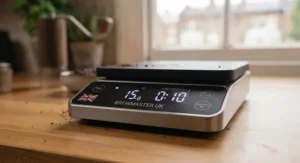
The standout feature is its footprint: small enough to sit flush on most home espresso machines’ drip trays, which the larger pour-over-style scales on this list simply can’t manage without overhang. Key specs include 0.1g accuracy across a 0.3g-2000g range, manual and automatic timing modes, solid-liquid detection that can distinguish espresso extraction from a plain weight change, auto-tare, and a rechargeable battery. Based on the spec comparison, what stands out here is the balance of pro-style workflow features — auto-tare and solid-liquid sensing are genuinely useful for espresso — packed into a scale that costs a fraction of the Acaia Lunar covering similar ground. This suits home baristas whose kitchen counter or machine drip tray genuinely can’t fit a bigger scale, and anyone prioritising espresso-specific features over pour-over versatility, while it’s a poor match for anyone who also wants to weigh a full Chemex batch. Reviewers consistently note that it feels more “pro” in daily use than its price suggests, citing the auto-tare and detection features as genuinely time-saving; a recurring criticism is that the small buttons can be fiddly to operate one-handed mid-pull.
Pros:
- ✅ Compact size fits tight espresso drip trays
- ✅ Auto-tare and solid-liquid detection speed up dosing
- ✅ Strong feature set relative to its price point
Cons:
- ❌ Small buttons are fiddly during a live pull
- ❌ Too small a platform for pour-over batches
Priced generally in the £30-£45 range, the MHW-3BOMBER Espresso Scale earns its spot as the espresso-specific budget pick, particularly for anyone whose current scale simply doesn’t physically fit their setup.
7. Greater Goods Coffee Scale — dependable all-purpose brewing at entry-level cost
The standout is straightforward reliability: a waterproof cover, a genuinely generous 3kg capacity, and a built-in timer, all without the interface quirks that plague some budget scales. Specs list 0.1g precision, the aforementioned 3kg capacity — enough for large French press or batch-brew jobs most competitors in this price bracket can’t handle — and a display large enough to read at a glance. Based on the spec comparison, what most buyers overlook is that budget scales often cut corners on display quality or button responsiveness to hit a lower price; this one doesn’t feel stripped down in the way cheaper alternatives sometimes do. It’s the pick for brewers who want one dependable scale for everything from a single V60 to a full batch brew for guests, and for anyone nervous about spilling water on their kit given the waterproof cover. Reviewers consistently flag the protective cover and sensible capacity as standout value at this price, with the main criticism being that the auto-off timing is shorter than some brewers would like, occasionally cutting out mid-session during a slow, contemplative pour.
Pros:
- ✅ Waterproof cover protects against pour-over splashes
- ✅ 3kg capacity handles batch brews, not just single cups
- ✅ Clear, easy-to-read display at a budget price
Cons:
- ❌ Auto-off timer can feel too aggressive
- ❌ No app or Bluetooth connectivity
At around £30-£45, the Greater Goods Coffee Scale is a genuinely solid all-purpose entry point, especially for households brewing a mix of single cups and larger batches.
Practical Usage Guide: Getting 0.1g Accuracy Every Time
Buying a scale that reads to 0.1g is only half the job — plenty of brewers own one and still get inconsistent results because the setup habits around it are sloppy. First thirty days matter: place your scale on a genuinely flat, stable surface, not a wobbly wooden board, since even a slight tilt introduces measurement drift that no amount of precision engineering fixes. Always tare with your actual brewing vessel on the scale, not an empty platform, and re-tare before every single dose rather than trusting yesterday’s zero point. A common early mistake is leaving a rechargeable scale like the Fellow Tally Pro or Acaia Pearl S plugged in constantly “just in case” — most lithium batteries actually last longer with regular full discharge-recharge cycles rather than being topped up obsessively.
Maintenance is minimal but not optional. Wipe the platform after every session, particularly on non-waterproof models like the Acaia Pearl S, where residual moisture near the load cell is the single most common cause of drift complaints in aggregated reviews. Recalibrate periodically using a set of certified reference weights if your scale supports it — most 0.1g scales, including the Timemore Black Mirror Basic 2 and Hario V60 Drip Scale, ship with a calibration mode buried in a button-hold sequence worth learning early rather than discovering during a frustrated troubleshooting session. One optimisation trick that rarely makes it into manuals: warm the scale to room temperature before use if it’s been stored somewhere cold, since load cells can read slightly inaccurately for the first minute or two after a temperature shift.
Real-World Scenarios: Which Scale Fits Your Coffee Life
Consider three genuinely different brewers. First, the office-desk pour-over drinker who brews one V60 most mornings before work, cares about consistency but not data-logging, and wants something that survives being shoved in a drawer — the Hario V60 Drip Scale or Greater Goods Coffee Scale cover this comfortably without overspending on features that will never get used. Second, the home barista running a domestic espresso machine daily, chasing repeatable 1:2 ratios and genuinely caring about shot timing down to the second — here the Acaia Lunar or MHW-3BOMBER Espresso Scale earn their keep specifically because of their compact, drip-tray-friendly footprints, something the larger pour-over scales simply can’t match. Third, the enthusiast who brews multiple methods across the week, wants to log and compare recipes over time, and treats their Sunday morning pour-over as a genuine hobby rather than a caffeine delivery mechanism — the Acaia Pearl S or Fellow Tally Pro justify their higher price through app connectivity and guided brewing features that reward that level of engagement.
Budget and frequency of use matter more than most buying guides admit. Someone brewing twice a week doesn’t need the same tool as someone brewing three times a day, and the Timemore Black Mirror Basic 2 exists precisely for the middle ground — frequent enough brewing to want flow-rate feedback, but not frequent or data-obsessed enough to justify Bluetooth logging.
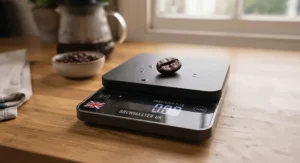
Problem → Solution: Common Dose Accuracy Issues
A handful of dose accuracy problems come up repeatedly across owner reviews, and most have straightforward fixes. Ghost readings that drift up or down with nothing on the platform usually trace back to temperature swings or a surface that isn’t level — reset on a stable, room-temperature surface and recalibrate. Slow response during a fast pulsed pour, most commonly reported with budget scales lacking a dedicated fast-sampling mode, is largely solved by upgrading to something like the Timemore Black Mirror Basic 2, whose sampling rate is noticeably quicker than entry-level alternatives. Inconsistent tare between brews, where the scale seems to “remember” a previous weight, is nearly always a case of not fully re-zeroing before adding coffee — get into the habit of tare, dose, tare, pour as a fixed sequence rather than trusting muscle memory. Battery scales like the Hario V60 Drip Scale occasionally show erratic low-battery behaviour before the low-battery warning triggers; keeping a spare set of AAAs nearby solves this permanently. Finally, water splashed onto non-sealed platforms — a known weak point on the Acaia Pearl S — can cause sticky buttons or false readings; a simple silicone splash guard, sold separately by several third-party accessory makers, resolves this cheaply.
How to Choose Precision Coffee Scales 0.1g
What is a precision coffee scale? A precision coffee scale is a digital scale purpose-built for brewing, typically reading to 0.1g increments with fast response times, letting you measure coffee dose and water pour accurately enough to replicate a recipe reliably, unlike standard 1g kitchen scales.
Choosing between models comes down to a handful of genuinely important criteria, in rough order of importance:
- Confirm true 0.1g accuracy across your actual dose range — some budget scales advertise 0.1g but only maintain it up to a certain weight, so check the fine print rather than the headline spec.
- Match response time to your brew method — espresso needs sub-50ms response; slower pour-over brewing tolerates more lag.
- Consider platform size and shape for your vessel — a Chemex needs more real estate than an espresso portafilter.
- Decide whether you need a built-in timer or prefer a separate one — combined units like the Hario V60 Drip Scale save counter space but complicate replacing a faulty timer independently.
- Weigh app connectivity against simplicity — Bluetooth logging on the Acaia Pearl S is genuinely useful for iterative brewers, overkill for casual ones.
- Check battery type and charging convenience — USB-C rechargeable scales like the Timemore Black Mirror Basic 2 suit daily use better than AAA-powered models for most people.
- Factor in water resistance if your brewing station is splash-prone — the Greater Goods Coffee Scale‘s waterproof cover matters more than it sounds on paper.
Precision Coffee Scales 0.1g vs Standard Kitchen Scales
| Factor | Precision Coffee Scale (0.1g) | Standard Kitchen Scale (1g) |
|---|---|---|
| Readability | 0.1g increments | 1g increments |
| Response speed | Typically 2ms-100ms | Often 1-3 seconds |
| Coffee ratio error at 18g dose | Under 0.6% | Up to 5.5% |
| Built for pouring | Yes, stable during liquid flow | Rarely designed for it |
| Typical UK price | £30-£230 depending on features | £10-£25 |
The gap here isn’t just cosmetic. According to the BBC Science Focus explainer on brewing science, using scales at all — regardless of resolution — is described as one of the single biggest upgrades a home brewer can make, and that’s before factoring in the tenfold resolution jump a dedicated 0.1g scale provides over the kitchen drawer alternative. A standard kitchen scale will get you in the right postcode; a coffee-specific 0.1g scale gets you to the right house.
✨ Ready to Stop Guessing Your Dose?
🔍 Grab one of the models above and see the difference 0.1g precision makes in your next brew. Click through to check current availability and pricing on Amazon UK before you put the kettle on.
Dose Accuracy: Why 0.1g Matters for Specialty Coffee
Dose accuracy is arguably the single most underrated variable in home brewing, and it’s worth explaining why the number itself matters rather than just asserting that it does. Coffee extraction is a chemical process where roughly 18-22% of the ground coffee’s mass dissolves into your cup under ideal conditions — a phenomenon rooted in how solubility and surface area interact, as Wikipedia’s overview of coffee preparation touches on when discussing brewing variables. Get the dose wrong by even a gram, and you shift the entire extraction percentage, pulling flavour compounds out of proportion to what the recipe intended. On an 18g espresso dose, a 1-gram error represents a 5.5% swing — more than enough to move a shot from balanced to noticeably bitter or sour, since over-extraction and under-extraction sit on opposite sides of a fairly narrow sweet spot.
This is precisely where 0.1g resolution earns its keep over standard 1g scales: it doesn’t just make the number look more impressive, it genuinely narrows your margin of error to roughly a tenth of what a kitchen scale allows. For pour-over brewing, where doses commonly run 15-30g against water totals in the hundreds of grams, dose accuracy compounds with pour accuracy — get both wrong simultaneously and you’re brewing a genuinely different recipe than the one you intended, without realising it.
Specialty Coffee Dosing Scales for Espresso vs Pour-Over
Dosing scales built for espresso and those built for pour-over solve genuinely different problems, even though both hit 0.1g precision. Espresso dosing, exemplified by the Acaia Lunar and MHW-3BOMBER Espresso Scale, prioritises speed and footprint: shots run 25-35 seconds, so response lag matters enormously, and the scale has to physically fit under a portafilter on a cramped drip tray. Pour-over dosing scales, like the Hario V60 Drip Scale and Fellow Tally Pro, prioritise platform size and timer integration instead, since a pour-over session runs two to four minutes and needs to comfortably hold a dripper, filter, and server without wobbling.
The practical upshot: buying an espresso-optimised scale for pour-over, or vice versa, technically “works” since both hit 0.1g, but you’ll fight the ergonomics constantly — a tiny espresso scale under a full Chemex setup is comically undersized, while a broad pour-over platform overhangs most espresso drip trays. If you brew both regularly, either budget for two specialised scales, or compromise with a mid-sized all-rounder like the Timemore Black Mirror Basic 2 or Greater Goods Coffee Scale, both of which handle either job adequately without excelling at either.
High Accuracy Brewing Scales: Features That Actually Matter (And Those That Don’t)
Marketing copy loves throwing every possible feature at a scale, but not all of them earn their keep. Features that actually matter: genuine sub-100ms response time (critical for espresso, nice-to-have for pour-over), a stable and level base that resists rocking, and accurate calibration retention over months of use. Features that sound impressive but rarely change outcomes: multiple unit conversions beyond grams and ounces (most specialty brewers never touch millilitres or pounds), elaborate colour displays with animations, and “smart” AI-driven brew suggestions that, in practice, just restate the SCA’s well-established ratio guidelines back at you.
Bluetooth connectivity sits in a genuinely useful-but-optional category — the Acaia Pearl S owners who actually log and review their brew data get real value from it, while plenty of buyers pay the premium and never open the app past week one. Flow-rate display, offered on the Timemore Black Mirror Basic 2 and premium Acaia models, is more broadly useful than Bluetooth for most brewers, since it visually flags inconsistent pour technique in real time without needing a phone in hand.
Coffee Competition Brewing: What World Barista Championship Baristas Use
Coffee competition brewing operates under formal rules and standardised equipment procedures, and scales sit at the centre of that precision. Competitive brewers at events sanctioned by the Specialty Coffee Association follow published World Coffee Championships rules and regulations, which govern everything from grinder models to service protocols across disciplines like the World Barista Championship and World Brewers Cup — and while personal scales aren’t always the standardised item on stage, the broader competition culture has done more than almost anything else to popularise 0.1g precision as the baseline expectation for serious brewing, rather than a luxury.
That competition influence trickles directly into home kit. Acaia scales in particular built their early reputation partly through visibility in competitive and training environments, which is a large part of why the Acaia Pearl S and Acaia Lunar carry the reputation they do among enthusiast brewers today — buying one doesn’t make you a competitor, but it does put comparable measurement precision on your own countertop.
Common Mistakes When Buying Precision Coffee Scales
The single most common mistake is buying based on the “0.1g” headline claim alone without checking the weight range that precision actually applies across — as the Hario V60 Drip Scale‘s stepped-down accuracy above 200g demonstrates, the fine print matters more than the badge. A close second is underestimating platform size requirements; buyers regularly purchase espresso-focused scales like the MHW-3BOMBER Espresso Scale and then discover their Chemex simply doesn’t fit. Overspending on Bluetooth connectivity nobody ends up using is another recurring theme in review sentiment — genuinely useful for iterative, data-driven brewers, genuinely wasted on someone who just wants consistent mornings. Buyers also frequently skip checking battery type until after purchase, only to discover AAA-powered models need more frequent attention than rechargeable rivals like the Timemore Black Mirror Basic 2. Finally, ignoring water resistance is a mistake that tends to surface expensively later — a splashed Acaia Pearl S with no protective cover is a costlier lesson than a spilled Greater Goods Coffee Scale, which was built to shrug it off.
Long-Term Cost & Maintenance
Total cost of ownership for a precision coffee scale extends well past the sticker price. Budget picks like the Hario V60 Drip Scale carry a genuine ongoing cost in AAA batteries — modest individually, but it adds up over years of daily brewing, and it’s worth weighing against the higher upfront cost of a rechargeable model like the Timemore Black Mirror Basic 2, which effectively pays that difference back in avoided battery purchases within a couple of years for daily brewers. Rechargeable lithium batteries in scales like the Acaia Pearl S and Fellow Tally Pro typically hold meaningful capacity for several years of regular charge cycles before performance noticeably degrades, at which point replacement usually means replacing the whole unit rather than just the cell, since most aren’t designed for battery swaps.
When a scale does eventually reach end of life, disposing of it responsibly matters — rechargeable electronics and batteries fall under the UK’s WEEE regulations, and the UK government’s guidance on electrical and electronic equipment makes clear that lithium-containing devices shouldn’t go in general household waste, both for environmental reasons and basic fire safety around damaged cells. Most UK retailers and local recycling points accept small electricals like coffee scales free of charge.
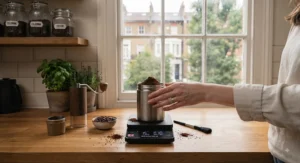
Frequently Asked Questions
❓ What does 0.1g precision actually mean for coffee?
❓ Is a 0.1g scale overkill for pour-over coffee?
❓ Do I need Bluetooth on my coffee scale?
❓ How long do rechargeable coffee scale batteries last?
❓ What's the difference between espresso and pour-over coffee scales?
Conclusion
If there’s one takeaway worth carrying to the checkout page, it’s this: 0.1g precision isn’t a luxury spec reserved for competition baristas — it’s the practical floor for anyone who wants their coffee to taste the same on Tuesday as it did on Sunday. Budget doesn’t have to mean compromise here, either; the Hario V60 Drip Scale and Greater Goods Coffee Scale deliver genuinely accurate readings for under £50, while the Timemore Black Mirror Basic 2 remains the standout middle-ground pick for anyone wanting flow-rate feedback without premium pricing. At the top end, the Acaia Pearl S, Acaia Lunar, and Fellow Tally Pro buy you workflow features and data logging rather than fundamentally better accuracy, which is worth knowing before you overspend chasing a number that budget scales already hit.
Whichever you land on, the habit matters more than the hardware: tare properly, dose consistently, and let the scale do the one job kitchen guesswork never could. Your next cup will taste like it.
✨ Don’t Miss These Exclusive Deals!
🔍 Take your brewing setup to the next level with one of the seven precision scales above. Click through to check current pricing and availability on Amazon UK, and start pulling shots and pour-overs you can actually repeat tomorrow.
Recommended for You
- Bluetooth Coffee Scales: 7 Best Smart Picks for 2026 UK
- Coffee Scales With Timer: 7 Best Combo Picks for 2026 UK
- Digital Coffee Scales UK: 7 Best Picks for Accuracy 2026
Disclaimer: This article contains affiliate links. As an Amazon Associate, I earn from qualifying purchases. If you purchase products through these links, we may earn a small commission at no additional cost to you.
✨ Found this helpful? Share it with your friends! 💬🤗
