
In This Article
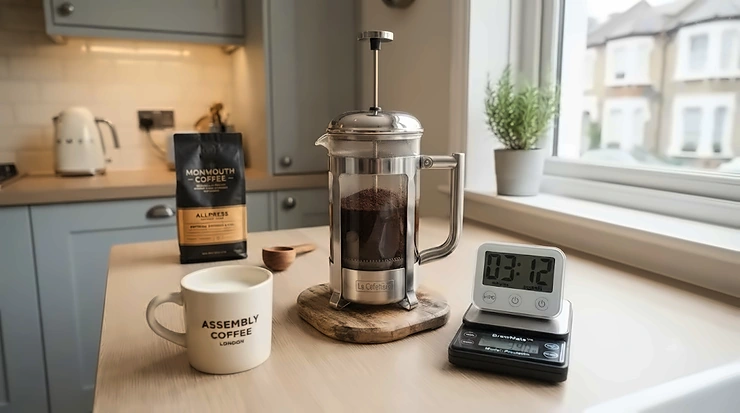
There’s a particular kind of heartbreak that only coffee people understand: you’ve bought good beans, ground them fresh, boiled the kettle just right — and the cup still tastes thin, sour, or weirdly bitter. Nine times out of ten, the culprit isn’t the coffee. It’s timing you never actually measured. A coffee brew timer takes the guesswork out of that window between “pour” and “perfect,” whether you’re chasing a silky V60 or a rich, syrupy French press.
This guide walks through seven genuinely good coffee brew timers on the market in 2026, from pocket-money digital clocks to app-connected smart scales that calculate your brew ratio for you. Along the way, we’ll unpack why a coffee brew timer earns its place next to your kettle, how extraction time actually shapes flavour, and which device suits your particular brewing habits — whether that’s a rushed Tuesday pour over or a slow Sunday French press.
Every product here is a real, currently available device, and every recommendation is grounded in published specifications and aggregated review sentiment rather than invented testimonials. We’ve deliberately avoided listing exact prices, since these shift constantly — instead you’ll see realistic price ranges and a nudge to check current availability before buying. What follows is one part buying guide, one part brewing-science primer, built specifically for UK readers using amazon.co.uk.
What Is a Coffee Brew Timer?
A coffee brew timer is a dedicated clock — often built into a digital scale — used to measure how long water is in contact with ground coffee during brewing. Extraction happens when hot water passes over the grounds, drawing out desirable compounds such as caffeine, carbohydrates, lipids and acids, and that process is highly time-sensitive, so precise timing genuinely changes how a cup tastes. You can read more about the mechanics of the process on Wikipedia’s coffee extraction entry.
Some brew timers are standalone digital clocks costing a few pounds; others are precision scales that track weight, time and pour rate simultaneously. What most buyers overlook is that the timer function and the scale function solve two separate problems — one controls when things happen, the other controls how much — and the best manual-brewing setups need both working together.
Quick Comparison Table
| Product | Type | Price Range | Best For |
|---|---|---|---|
| Timemore Black Mirror Basic 2 | Scale + timer | £35-£50 range | All-round pour over |
| Hario V60 Drip Scale | Scale + timer | £45-£65 range | Beginners wanting simplicity |
| MHW-3BOMBER Mini | Scale + timer | £25-£35 range | Portable / travel brewing |
| TempPro TM01 | Standalone timer | Under £15 | French press, no scale needed |
| Brewista Smart Scale II | Scale + timer | £70-£90 range | Multi-mode home bar |
| Acaia Pearl S | Smart scale + timer | £140-£170 range | App-connected precision |
| Fellow Tally Pro | Smart scale + timer | £150-£180 range | Ratio-calculating premium pick |
Looking at the spread above, there’s a clear budget tier under £50 built around simple scale-and-timer combos like the Timemore Black Mirror Basic 2 and Hario V60 Drip Scale, a genuinely cheap entry point in the TempPro TM01 for anyone who only needs a clock, and a premium tier where the Acaia Pearl S and Fellow Tally Pro add app connectivity or built-in maths. Notice that the jump in price from budget to premium doesn’t always buy more accuracy — most of these devices measure to 0.1g — it buys convenience, connectivity and extra brewing modes instead.
💬 Just one click — help others make better buying decisions too!😊
Top 7 Coffee Brew Timers: Expert Analysis
1. Timemore Black Mirror Basic 2 — best all-round pour-over timer and scale
The Basic 2 earns its “all-rounder” tag by nailing the fundamentals without overcomplicating them. Weighing accuracy runs to 0.1g up to a 2,000g capacity, and the built-in auto-timing mode starts measuring time automatically when you begin pouring and stops when you finish, so there’s nothing extra to remember mid-brew. The 1600mAh rechargeable battery charges via USB-C and comfortably outlasts a week of daily brewing, while the flow-rate display adds a layer most rivals in this price band skip entirely.
Based on the spec comparison, this is the scale to buy if you want near-premium functionality without paying premium money — the auto-timing and flow-rate tracking usually only show up on scales costing twice as much. It suits home brewers who’ve outgrown a basic kitchen timer but aren’t ready to commit to an app-connected system. Aggregated reviews across coffee retailers and forums consistently praise the responsive timer and the compact, waterproof design, with the recurring compliment being how “premium” it feels for the money; a smaller number of buyers mention the touch buttons occasionally misfiring when hands are wet.
Pros:
- ✅ 0.1g accuracy with auto-start, auto-stop timing
- ✅ Flow-rate display rare at this price point
- ✅ USB-C rechargeable battery lasts many brews
Cons:
- ❌ Touch buttons can misfire with wet fingers
- ❌ No app or Bluetooth connectivity
Typically found in the £35-£50 range, this is arguably the best value pick on this entire list — check current price before buying, as stock and promotions shift often.
2. Hario V60 Drip Scale — simplest classic combo for beginners
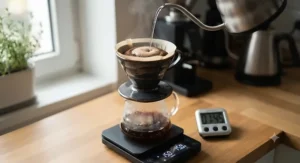
Hario more or less normalised the idea of a dedicated pour-over scale, and the V60 Drip Scale is still the reference point new brewers reach for first. It measures in 0.1g increments up to 2,000g, with the interval widening slightly to 0.5g and 1g at higher weights, and the timer button sits alongside a big enough weighing pad to hold large drippers, jugs or mugs.
What most buyers overlook is that this scale deliberately keeps things basic — there’s no auto-start, no backlight, no flow-rate readout — and that’s precisely the point for someone who just wants a reliable number on a screen without a learning curve. It’s the sensible pick for anyone brewing one method (typically V60 or Kalita) who doesn’t yet know if they’ll go deeper into the hobby. Reviewers on Tom’s Guide and other outlets note the display can lag slightly and the scale runs on AAA batteries rather than being rechargeable, but they consistently praise its accuracy and how easy it is to master in one sitting.
Pros:
- ✅ Large pad fits big drippers and carafes easily
- ✅ Dead simple two-button operation
- ✅ Trusted, well-established brand in specialty coffee
Cons:
- ❌ Runs on AAA batteries, not rechargeable
- ❌ No backlight or auto-timing feature
Expect to pay in the £45-£65 range, occasionally dipping lower during promotions — always check current price rather than relying on the RRP.
3. MHW-3BOMBER Mini — most portable budget pick
If your coffee habit travels with you — camping, hotel rooms, a desk at work — the MHW-3BOMBER Mini is built for exactly that. At roughly 104mm square and under 20mm thick, it’s genuinely pocketable, and the gravity-sensing wake function means it automatically turns on and tares when a coffee vessel over 100g is placed on it, cutting out a fiddly step.
The smart mode is the standout feature here: it detects the shift from solid coffee grounds to liquid water and starts timing automatically, then cycles through displaying time, liquid volume and the resulting brew ratio once you lift your cup. On paper, that’s a genuinely clever piece of engineering to find on a budget scale, and it’s a strong pick for anyone who wants auto-timing without paying Timemore or Acaia prices. Review sentiment on Amazon and specialty retailers is generally positive on portability and the auto-detection feature, with the main gripe being the smaller 700mAh battery needing more frequent top-ups than larger rivals.
Pros:
- ✅ Genuinely pocket-sized for travel brewing
- ✅ Auto-detects liquid to start timing
- ✅ 0.1g accuracy despite the low price
Cons:
- ❌ Smaller battery needs charging more often
- ❌ Tiny weighing platform limits larger vessels
You’ll typically find this in the £25-£35 range, making it one of the cheapest ways to get auto-timing on this list — check current price for the latest deals.
4. TempPro TM01 — cheapest standalone timer, ideal for French press
Not everyone needs a scale bolted to their timer, and the TempPro TM01 (previously sold as ThermoPro) is proof that a simple, honest kitchen timer still has a place on the coffee counter. It counts up or down to 99 hours 59 minutes 59 seconds, has four adjustable alarm volumes, and doubles as a 12/24-hour clock when it isn’t timing anything, with a magnetic back that sticks straight to a fridge or kettle stand.
Here’s what the spec sheet won’t tell you but makes sense in practice: French press brewing doesn’t require weighing water to 0.1g the way pour over does, because the grounds sit fully immersed regardless of pour technique — what actually matters is a consistent steep time. That makes a no-frills timer like this one arguably the smarter buy for French press drinkers than an expensive scale, since you’re not paying for precision you won’t use. Reviewers consistently note the loud, clear alarm and large display as the main draws, with occasional complaints about the plastic build feeling a little basic for the price.
Pros:
- ✅ Loud, adjustable alarm hard to miss
- ✅ Doubles as a clock between brews
- ✅ Magnetic back keeps it within reach
Cons:
- ❌ No weighing function at all
- ❌ Plastic housing feels basic
At under £15 in most listings, this is the cheapest genuinely useful option here — always check the current price and available colourways.
5. Brewista Smart Scale II — most versatile multi-mode home bar pick
The Brewista Smart Scale II is aimed squarely at people who brew more than one way — espresso one morning, pour over the next. It offers six distinct weighing and timing modes, from fully manual operation to fully automatic tare-and-timer combinations, plus a dedicated pour-over mode that starts the clock the moment water hits the grounds.
Based on the spec comparison, the real value here is flexibility rather than any single standout feature: the nano water-resistant coating means it survives life on an espresso drip tray, while the same device switches cleanly into pour-over mode for a V60 session later. That dual-purpose design makes it a strong shout for households with more than one brewing method in rotation, rather than pour-over purists who’ll rarely touch the espresso modes. The Coffee Folk and other reviewers rate its accuracy highly and call it a solid, if less flashy, alternative to Acaia’s range, though most note the response speed lags Acaia’s flagship scales by roughly a second — noticeable to serious baristas, invisible to everyone else.
Pros:
- ✅ Six modes cover espresso and pour over
- ✅ Water-resistant nano coating for daily use
- ✅ Two weighing platforms for different vessels
Cons:
- ❌ Slightly slower response than premium rivals
- ❌ Menu of modes takes a session to learn
Realistically priced in the £70-£90 range, it sits comfortably between the budget and premium tiers — check current price before ordering.
6. Acaia Pearl S — best app-connected smart scale
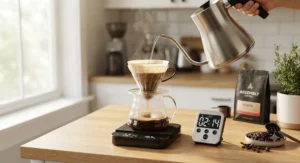
The Acaia Pearl S is the scale most likely to turn a curious pour-over hobbyist into a data-obsessed home barista. It tracks weight to 0.1g and liquid flow with genuine precision, and pairs with Acaia’s Brewguide app so that downloaded step-by-step brewing guides can display directly on the scale’s screen while you pour.
What the spec sheet doesn’t fully convey is how much the six brewing modes change day-to-day use: switching between auto-tare, auto-start and dedicated espresso or pour-over practice modes means the scale adapts to the task rather than forcing you to adapt to it. This is squarely a scale for brewers upgrading from something basic who want live flow-rate feedback and recipe logging, not for someone brewing their first V60. Reviewer sentiment is broadly glowing on build quality and the 30-40 hour battery life, though outlets including Gear Patrol have flagged a genuinely odd quirk: pausing the built-in timer resets it to zero unless you resume via the companion app rather than the scale itself.
Pros:
- ✅ Live flow-rate tracking plus app recipe logging
- ✅ Long 30-40 hour rechargeable battery life
- ✅ Six brewing modes for different methods
Cons:
- ❌ Pausing the on-scale timer resets it to zero
- ❌ Premium price for largely software-driven features
Expect a price in the £140-£170 range depending on retailer promotions — worth checking current price given how often this one appears in sales.
7. Fellow Tally Pro — best for ratio calculation with Brew Assist
The Fellow Tally Pro’s party trick is doing the maths so you don’t have to. Its Brew Assist mode lets you enter the weight of ground coffee you’re using, select a target brew ratio via the dial, and the scale calculates exactly how much water to pour — genuinely useful if ratio arithmetic has ever put you off experimenting with recipes.
Here’s what most buyers overlook: Brew Assist tells you how much water to add but deliberately doesn’t dictate when to pour it, because bloom times vary between coffees — so this is a scale for people who already understand pacing and just want the ratio maths automated. Reviewers including Gear Patrol and Tom’s Guide are unanimous that build quality and the OLED display are excellent, but equally unanimous that the price is steep for what amounts to a very well-designed timer and calculator without live flow-rate monitoring or a companion app, features rivals include for less.
Pros:
- ✅ Brew Assist calculates water weight for you
- ✅ Gorgeous, easy-to-read OLED display
- ✅ Doubles as a capable general kitchen scale
Cons:
- ❌ No flow-rate monitor despite the price
- ❌ No companion app unlike similarly priced rivals
Sitting in the £150-£180 range, this is the most expensive pick here — it’s a premium purchase best suited to committed pour-over enthusiasts, so check current price and consider whether Brew Assist alone justifies the jump over the Acaia Pearl S.
Practical Usage Guide: Setting Up and Getting the Most from Your Brew Timer
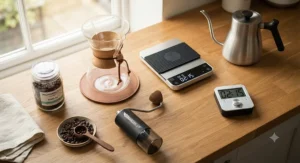
Getting a new coffee brew timer out of the box is the easy part; using it well is where the improvement in your cup actually happens. Start by placing your empty brewing vessel — dripper, French press, or espresso cup — on the scale first and taring to zero before adding any coffee. This sounds obvious, but it’s the single most common step beginners skip, and skipping it throws off every measurement that follows.
Next, tare again after adding your ground coffee, so the display reads zero right as you’re about to start pouring water. If your scale has an auto-timing mode, like the Timemore Black Mirror Basic 2 or MHW-3BOMBER Mini, test it a couple of times with plain water before your first real brew — auto-start sensitivity varies between units, and it’s worth knowing whether yours triggers instantly or with a slight lag.
For maintenance, wipe the weighing platform after every use rather than letting coffee residue build up, since dried coffee oils can interfere with touch-sensitive buttons on models like the Hario V60 Drip Scale. Rechargeable models should be topped up before the battery drops below 20%, not run flat, to preserve long-term battery health — a habit that matters more with smaller-capacity batteries like the one in the MHW-3BOMBER Mini. A common mistake in the first 30 days is over-relying on auto-timing features and never learning to time a brew manually; batteries die, sensors misfire, and knowing your recipe by feel is a useful backup skill.
Real-World Scenarios: Matching a Timer to How You Actually Brew
Picture a university student brewing a single V60 before an 8am lecture, coffee bag balanced precariously on a shared kitchen counter. Speed and simplicity matter more than data logging here — the Hario V60 Drip Scale or MHW-3BOMBER Mini fit that rushed, low-fuss routine without a learning curve eating into sleep.
Now picture a home barista running an espresso machine on weekday mornings and a pour-over setup at weekends, genuinely curious about how small ratio tweaks change flavour. That’s the Brewista Smart Scale II or Acaia Pearl S territory — someone who benefits from multiple brewing modes and is willing to spend a bit more time understanding a menu system in exchange for versatility.
Finally, picture someone who drinks French press exclusively, values ritual over data, and has no interest in weighing anything to a tenth of a gram. For that person, a scale is arguably wasted money — the TempPro TM01 standalone timer covers everything they actually need: a reliable four-minute steep, every time, for a fraction of the outlay a smart scale demands.
Problem → Solution: Fixing Common Brew-Timing Mistakes
Problem: Coffee tastes sour and thin. This usually points to under-extraction — either the water moved through the grounds too quickly, or your brew time was too short for the grind size. Solution: extend contact time slightly, or use a slightly finer grind, and track the change precisely using a scale timer like the Timemore Black Mirror Basic 2.
Problem: Coffee tastes bitter or harsh. This is the opposite issue — over-extraction, usually from too long a brew time or too fine a grind. Solution: shorten your extraction window by a fixed increment (start with 15-20 seconds) and hold everything else steady so you can isolate the effect of timing alone.
Problem: Inconsistent results between brews of the same coffee. Without a timer, “eyeballing” pour speed and bloom time introduces variables you can’t control. Solution: standardise every stage — bloom time, first pour, total brew time — using a scale that logs or displays elapsed time, so you’re only changing one variable at a time when experimenting.
Problem: French press coffee has gritty sediment. This is often a grind-size issue rather than a timing one, but rushing the plunge compounds it. Solution: use a coarser grind and don’t shorten the steep time to compensate for impatience — a standalone timer like the TempPro TM01 removes the temptation to guess.
Problem: Forgetting to start the timer altogether. Solution: auto-start scales like the Timemore Black Mirror Basic 2 or MHW-3BOMBER Mini solve this structurally by beginning timing the moment they detect poured water, removing human memory from the equation entirely.
How to Choose a Coffee Brew Timer
- Decide if you need a scale at all. If you brew French press or use pre-measured pods, a standalone timer such as the TempPro TM01 may be all you need — save the money a scale would cost.
- Check accuracy for your brewing method. Pour over and espresso genuinely benefit from 0.1g precision; French press tolerates looser measurement, since immersion brewing is less sensitive to pour technique.
- Consider auto-timing versus manual. Auto-start features on scales like the Timemore Black Mirror Basic 2 remove a step, but manual timing (as on the Hario V60 Drip Scale) is more predictable if you dislike sensor-triggered features.
- Think about battery type. Rechargeable USB-C batteries, found on most models here bar the Hario V60 Drip Scale and TempPro TM01, avoid the ongoing cost and waste of disposable batteries.
- Weigh up app connectivity. The Acaia Pearl S and its recipe-logging app suit data-driven brewers; if you’ll never open the app, that connectivity isn’t worth the premium.
- Match capacity to your vessel. Most scales here handle up to 2,000g, comfortably covering a Chemex batch brew, but check dimensions against your largest dripper or carafe.
- Set a realistic budget band. Genuinely useful auto-timing starts around £25-£35 with the MHW-3BOMBER Mini; app-connected features and ratio calculators push that towards £150-£180.
Pour Over Brew Timer: Dialling In Bloom and Pour Phases
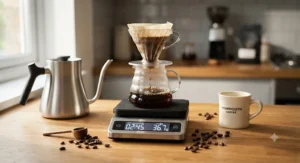
A pour over brew timer earns its keep in the details most other brewing methods don’t need to worry about. Pour over coffee is typically brewed in distinct phases — a short bloom pour to let trapped gas escape, followed by one or more main pours — and each phase has its own target window. Missing the bloom window by even 15 seconds can meaningfully change how evenly the rest of the water extracts the grounds.
This is exactly where auto-timing scales like the Timemore Black Mirror Basic 2 and Acaia Pearl S pull ahead of a basic kitchen clock: both can display elapsed time alongside weight, so you’re watching one screen instead of glancing between a scale and a separate timer mid-pour. Based on the spec comparison, the flow-rate display featured on the Timemore and the Acaia adds another layer of feedback — pouring too fast rushes extraction, pouring too slowly risks the water cooling before it’s finished its job. For anyone serious about pour over specifically, a dedicated pour over brew timer with flow-rate tracking is a genuinely worthwhile upgrade over a plain clock.
French Press Timer: Why Immersion Brewing Needs Its Own Rules
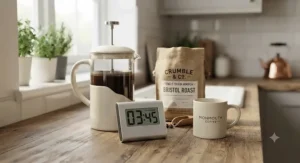
French press coffee works completely differently to pour over, and that changes what you actually need from a timer. Because the grounds sit fully immersed in water for the entire brew, pour technique barely matters — what matters is a single, consistent number: total steep time, typically around four minutes, as outlined in most brew guides for the French press method.
That’s precisely why a French press timer doesn’t need to be a scale at all. A simple countdown clock like the TempPro TM01 does the entire job: start it when water hits the grounds, plunge when it beeps. Reviewers consistently note that spending on a precision scale for French press brewing alone is money better spent elsewhere, since the method’s tolerance for small measurement variance is far higher than pour over’s. Where a scale does help French press drinkers is dosing the coffee itself accurately before brewing starts — but once water goes in, a loud, reliable countdown timer is doing the real work.
Extraction Timer Coffee: Understanding Extraction Time and Brew Ratio Timing
Extraction time and brew ratio timing are two sides of the same coin, and understanding both is what separates someone who owns a coffee brew timer from someone who actually uses it well. Extraction is shaped by water temperature, brewing time, grind fineness, and quantity of grounds, and a longer brewing time generally pulls a higher yield of soluble compounds from the coffee — up to a point, beyond which flavour turns harsh.
The Specialty Coffee Association’s widely referenced brewing standards frame this using a target coffee-to-water ratio alongside a recommended extraction window, details laid out in the SCA’s published coffee standards. Reviewers consistently note that once you’ve measured a brew’s ratio and total extraction time, tweaking just one variable at a time — say, shortening total time while keeping ratio fixed — is by far the fastest way to learn how your specific coffee responds. This is where an “extraction timer coffee” setup, meaning a scale that tracks both weight and elapsed time simultaneously, genuinely earns its keep: it turns trial-and-error into a repeatable experiment rather than a guessing game.
Manual Brewing Methods: Timer Needs Method by Method
Not every manual brewing method demands the same level of timing precision, and knowing the difference stops you overspending on features you won’t use.
Pour over (V60, Kalita, Chemex): Needs the tightest timing, ideally paired with weight tracking, because pour speed and phase timing both shape the cup. A scale-and-timer combo like the Timemore Black Mirror Basic 2 suits this method best.
French press: Needs loose, consistent steep-time tracking only. A standalone clock like the TempPro TM01 covers it comfortably.
Espresso: Needs fast, precise short-interval timing, typically 20-30 seconds, alongside weight — multi-mode scales like the Brewista Smart Scale II are built with this in mind.
AeroPress: Sits between pour over and French press in its timing sensitivity, generally benefiting from a simple auto-start scale without necessarily needing flow-rate tracking.
The takeaway across all manual brewing methods is straightforward: match the precision of your timer to how sensitive your method actually is to timing variance, rather than assuming every method needs the most advanced device on this list.
✨ Don’t Miss These Exclusive Deals!
🔍 Take your coffee brewing to the next level with these carefully selected timers and scales. Click on any highlighted product above to check current pricing and availability. These tools will help you brew consistently great coffee your household will actually look forward to.
Coffee Brew Timer vs Guessing by Eye: Why Precision Wins
| Factor | Brewing With a Timer | Brewing By Eye |
|---|---|---|
| Consistency between brews | High — repeatable numbers | Low — varies with mood, rush |
| Ability to diagnose bad cups | Easy — isolate one variable | Hard — too many unknowns |
| Learning curve | Short, especially with auto-timing | None, but plateaus quickly |
| Best For | Anyone wanting repeatable results | Casual, no-fuss brewers |
The comparison above makes the practical case plainly: brewing by eye isn’t wrong, it’s simply harder to improve on, because you can’t fix what you haven’t measured. A timer doesn’t make coffee taste better on its own — it makes inconsistency visible, which is the first step to fixing it. For anyone who’s ever made a great cup once and then failed to repeat it, that visibility alone tends to be worth more than any single feature on this list.
Common Mistakes When Buying a Coffee Brew Timer
The most common mistake is buying more scale than your brewing method needs — a French press drinker spending £150 on the Fellow Tally Pro‘s Brew Assist mode is paying for precision they’ll rarely use. The opposite mistake is just as common: pour-over brewers buying a basic timer with no weighing function and wondering why their results still aren’t consistent, when ratio control matters as much as timing.
Another frequent pitfall is ignoring battery type until it’s too late. Buyers who dislike routine maintenance often regret choosing a scale that runs on disposable AAA batteries, like the Hario V60 Drip Scale, over rechargeable USB-C alternatives. Finally, many buyers skip checking a scale’s physical footprint against their actual brewing kit — a wide Chemex or large French press carafe may simply not sit stably on a compact scale like the MHW-3BOMBER Mini, so it’s worth checking dimensions before adding to basket rather than after unboxing.
Long-Term Cost & Maintenance: Batteries, Charging and Care
The upfront price tag is only part of the total cost of owning a coffee brew timer. Battery-powered models like the Hario V60 Drip Scale need a steady supply of AAA batteries, which adds up modestly over a few years of daily use and generates ongoing waste. Rechargeable models, by contrast — including the Timemore Black Mirror Basic 2, Acaia Pearl S, and Fellow Tally Pro — trade that recurring cost for an occasional battery replacement further down the line, since lithium batteries degrade gradually with charge cycles.
Physical maintenance is minimal across the board: wiping the weighing surface after each brew and avoiding submerging any of these devices in water (even the “waterproof” ones are typically splash-resistant rather than fully submersible) will extend their working life considerably. Cheaper scales like the MHW-3BOMBER Mini are less expensive to replace outright if something fails, which is worth factoring in if you’re prone to knocking things off a crowded counter — the calculation shifts when you’ve spent £170 on an Acaia Pearl S versus £30 on a budget alternative.
Safety, Batteries & Disposal: What UK Buyers Should Know
Every device on this list contains either disposable or rechargeable batteries, which means none of them belong in a general household bin once they reach the end of their life. Under UK regulations, items with a plug, battery or charging cable fall under Waste Electrical and Electronic Equipment rules, and government guidance on WEEE regulations sets out how retailers and local councils are required to support proper recycling of exactly this kind of small electrical item.
In practice, that means a broken coffee scale should go to a household waste recycling centre, an in-store electrical take-back point, or a kerbside small-electricals collection where your council offers one — not the general recycling bin. For lithium battery-powered models specifically, avoid puncturing or exposing the internal battery to heat, and if a rechargeable scale swells, feels unusually warm during charging, or stops holding charge reliably, stop using it and dispose of it through a proper WEEE recycling route rather than continuing to charge it.
Frequently Asked Questions
❓ How accurate does a coffee brew timer need to be?
❓ Do I need a scale as well as a timer for pour over coffee?
❓ What's the ideal brew time for French press coffee?
❓ Can I use my phone as a coffee brew timer instead of buying one?
❓ Are expensive smart coffee scales worth it for casual home brewers?
Conclusion
A coffee brew timer isn’t a gimmick bolted onto your morning routine — it’s the missing piece that turns “sometimes great coffee” into “reliably great coffee.” Whether that means the auto-timing convenience of the Timemore Black Mirror Basic 2, the honest simplicity of the Hario V60 Drip Scale, or the no-frills reliability of a standalone clock like the TempPro TM01 for French press devotees, matching the device to how you actually brew matters more than chasing the most feature-packed option on the shelf.
For brewers wanting to go further, the Acaia Pearl S and Fellow Tally Pro offer genuinely useful data and automation, while the Brewista Smart Scale II splits the difference nicely for households juggling more than one brewing method. And for anyone brewing on a budget or on the move, the MHW-3BOMBER Mini proves that auto-timing precision doesn’t have to come with a premium price tag.
Whichever you choose, the underlying lesson holds: measure what you can, hold your variables steady, and let the timer do the remembering so your attention stays on the pour. That’s really all consistent coffee comes down to.
✨ Don’t Miss These Exclusive Deals!
🔍Take your morning brew to the next level with these carefully selected timers and scales. Click on any highlighted item above to check current pricing and availability today!
Recommended for You
- Digital Timer for Coffee Brewing Under £10: 7 Picks for 2026
- Precision Coffee Scales 0.1g: 7 Best Picks for 2026 (UK)
- Bluetooth Coffee Scales: 7 Best Smart Picks for 2026 UK
Disclaimer: This article contains affiliate links. As an Amazon Associate, I earn from qualifying purchases. If you purchase products through these links, we may earn a small commission at no additional cost to you.
✨ Found this helpful? Share it with your friends! 💬🤗
