
In This Article
Choosing between conical vs flat burr grinder options can feel overwhelming when you’re investing in your coffee setup. I’ve spent years testing both types, and here’s the truth: the burr shape dramatically affects your coffee’s flavour, consistency, and overall brewing experience.
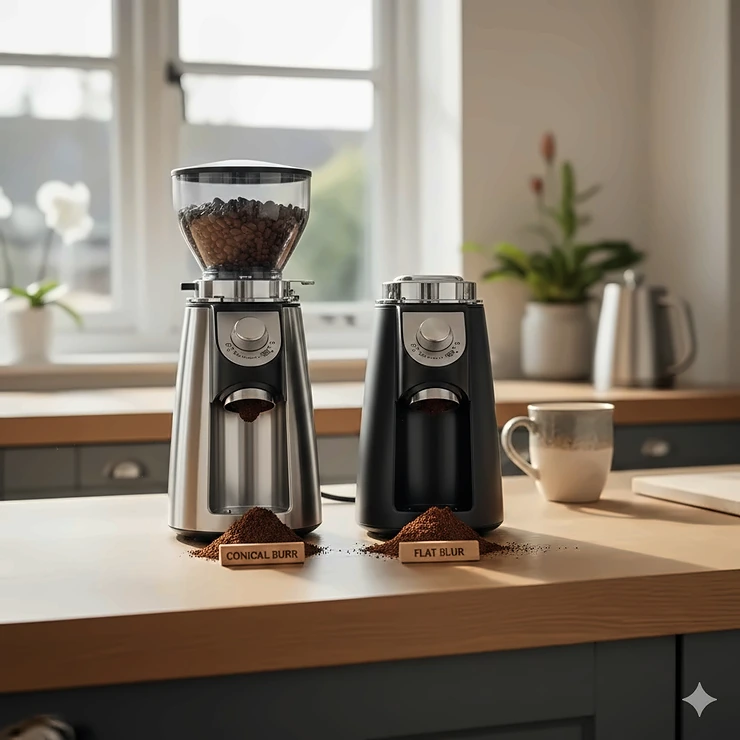
The fundamental difference lies in their geometry and grinding mechanics. Conical burrs feature a cone-shaped inner burr within a ring-shaped outer burr, whilst flat burrs utilise two parallel disc-shaped plates. This seemingly simple distinction creates cascading effects on grind consistency, heat generation, retention rates, and ultimately, what ends up in your cup.
According to research from the Specialty Coffee Association, 85% of competition-level home baristas prefer flat burr grinders for espresso, whilst conical burrs dominate the home market due to affordability and versatility. Both produce exceptional coffee when properly engineered—the “better” choice depends entirely on your brewing priorities, budget, and taste preferences.
Quick Comparison Table
| Feature | Conical Burr Grinder | Flat Burr Grinder |
|---|---|---|
| Grind Distribution | Bimodal (varied particle sizes) | Unimodal (uniform particles) |
| Heat Generation | Low (slower RPM) | Higher (needs faster rotation) |
| Retention Rate | Lower (gravity-assisted) | Higher (centrifugal force) |
| Noise Level | Quieter operation | Generally louder |
| Price Range | £40–£250 | £150–£600+ |
| Best For | Filter coffee, versatility | Espresso precision |
| Maintenance | Easier to clean | More involved |
| Flavour Profile | Sweeter, rounded | Clearer, brighter separation |
💬 Just one click – help others make better buying decisions too!😊
Top 7 Burr Grinders: Expert Analysis
1. Baratza Encore – The UK’s Favourite Conical All-Rounder
The Baratza Encore remains the gold standard for entry-level conical burr grinding, and for good reason. This workhorse grinder features European-manufactured 40mm hardened alloy steel burrs that deliver consistent results across 40 grind settings, from espresso-fine to French press coarse.
Key Specifications:
- 40mm conical steel burrs (Liechtenstein-made)
- 40 grind settings
- 300g bean hopper capacity
- 550 RPM motor speed
UK Price: £144.99–£189.95
UK buyers consistently praise its reliability and grind consistency. “Very happy with my conical burr grinder, it is quiet & quick to use and requires almost zero maintenance to clean,” notes one verified Amazon UK purchaser. The straightforward operation—twist the hopper to adjust, press the button to grind—makes it brilliantly approachable for beginners.
✅ Pros:
- Exceptional grind consistency for the price
- European-engineered burrs built to last 10+ years
- Widely available replacement parts in UK
❌ Cons:
- Finest setting not quite fine enough for high-end espresso machines
- Some grind retention (approximately 0.5–1g)
2. Sage Smart Grinder Pro – Premium Conical with 60 Settings
The Sage Smart Grinder Pro (branded as Breville elsewhere) represents the pinnacle of accessible conical burr grinding technology. Its stainless steel conical burrs rotate slower than flat burrs, reducing heat transfer whilst maximising particle surface area for balanced flavour extraction.
Key Specifications:
- Stainless steel conical burrs
- 60 precise grind settings
- 450g bean hopper
- LCD display with dosing IQ
UK Price: £188.95–£209.95
This programmable grinder excels at versatility. Choose between “cups” mode for filter coffee or “shots” mode for espresso, with precision digital time adjustment in 0.2-second increments. UK customers particularly appreciate its magnetic portafilter cradles (50–54mm and 58mm) and the airtight grounds container that keeps coffee fresher.
✅ Pros:
- Programmable dosing eliminates guesswork
- Grind directly into portafilter, filter basket, or container
- Excellent build quality with premium finish
❌ Cons:
- Higher price point than basic models
- Can struggle with ultra-light roasts on finest settings
3. SHARDOR Conical Burr Grinder – Budget Champion with 48 Settings
For UK coffee enthusiasts seeking professional-grade features without the premium price tag, the SHARDOR Conical Burr Grinder delivers remarkable value. Its low-speed conical burrs minimise heat buildup, preserving essential coffee oils that would otherwise be lost to oxidation.
Key Specifications:
- Low-speed conical burrs
- 48 adjustable grind settings
- 9.7 oz (275g) bean hopper
- Anti-static technology
UK Price: £79.99–£99.99
The upgraded anti-static technology is a game-changer at this price point, drastically reducing the messy static cling that plagues many entry-level grinders. The precision electronic timer (adjustable in 1-second increments up to 40 seconds) allows accurate dosing without constant monitoring.
✅ Pros:
- Impressive grind settings range for the price
- Anti-static design keeps workspace tidy
- Quiet operation suitable for early mornings
❌ Cons:
- Slight variance at finest espresso settings with oily beans
- Plastic components feel less premium
4. Fellow Opus Conical Burr Grinder – Modern Design Meets Performance
The Fellow Opus brings contemporary aesthetics and thoughtful engineering to conical burr grinding. Its 40mm stainless steel burrs deliver café-quality results across 41 stepped settings, making it brilliantly versatile for everything from AeroPress to cold brew.
Key Specifications:
- 40mm stainless steel conical burrs
- 41 grind settings
- 110g single-dose hopper
- Anti-static technology
UK Price: £169.00–£189.00
Fellow’s intuitive stepped adjustment system lets you easily repeat settings when switching between brewing methods or trying new beans. Whilst it won’t go fine enough for traditional espresso (by design), it absolutely nails everything from pour-over to French press with consistent, uniform grounds every time.
✅ Pros:
- Exceptional grind consistency for filter methods
- Beautiful matte finish fits modern kitchens
- Low retention design (under 0.2g)
❌ Cons:
- Not suitable for espresso
- Smaller hopper requires frequent refilling
5. Eureka Mignon Zero – Premium Flat Burr Precision
Now we enter flat burr territory. The Eureka Mignon Zero represents old-school Italian craftsmanship meeting smart design. Hand-built in Florence by artisans with over 100 years of experience, this grinder features chunky 55mm flat burrs made from hardened stainless steel.
Key Specifications:
- 55mm flat stainless steel burrs
- Stepless micrometric adjustment
- 320-watt motor (1650 RPM)
- Silent operation technology
UK Price: £449.00–£499.00
The stepless micrometric adjustment system provides exceptional control through a simple dial next to the hopper—perfect for dialling in finicky espresso shots that need tiny tweaks. Powered by a substantial motor, it cranks out consistent grounds whilst staying surprisingly quiet, a huge advantage for early morning brewing when everyone else is still sleeping.
✅ Pros:
- Professional-grade flat burr performance
- Remarkably quiet for flat burr design
- Built to last decades
❌ Cons:
- Premium pricing
- Designed specifically for espresso (not ideal for frequent method switching)
6. DF64 Gen 2 – Flat Burr Single-Dose Specialist
The DF64 Gen 2 (also sold as Turin DF64) is a 54mm flat burr single-dose grinder that’s taken the UK coffee community by storm. This zero-retention grinder features stainless steel flat burrs in a compact footprint that belies its serious performance credentials.
Key Specifications:
- 54mm stainless steel flat burrs
- Stepless adjustment
- Single-dose design (50g capacity)
- Anti-popcorning disc included
UK Price: £299.00–£349.00
What makes the DF64 remarkable is its single-dose workflow at an accessible price point. The anti-popcorning disc prevents beans from jumping out during grinding—a common issue with single-dosing. UK buyers appreciate that it’s a proper flat burr grinder for less than half the price of traditional options.
✅ Pros:
- Exceptional value for flat burr technology
- True zero-retention design
- Compact 11cm width fits smaller kitchens
❌ Cons:
- Burr alignment may need adjustment out of the box
- Less polished than premium brands
7. Niche Duo – Ultimate Flat Burr Flexibility
The Niche Duo represents the cutting edge of flat burr grinding technology. This innovative single-dose grinder uses two specialised 83mm flat burr sets—one optimised for espresso’s fine, consistent grinds, and another for flawless filter brews’ coarser, uniform particles.
Key Specifications:
- Dual 83mm flat burr sets
- Stepless adjustment dial
- Single-dose workflow
- UK-made quality (220–240V)
UK Price: £1,299.00–£1,399.00
The stepless adjustment dial provides precise control over your ground coffee, whilst the dual burr system means you’re never compromising on quality regardless of brewing method. It’s a significant investment, but one that delivers professional-grade results consistently.
✅ Pros:
- Two burr sets optimised for different brew methods
- British engineering and support
- Virtually zero retention
❌ Cons:
- Substantial investment required
- Burr sets sold separately (espresso set included)
✨ Don’t Miss These Exclusive Deals!
🔍 Take your coffee grinding to the next level with these carefully selected products. Click on any highlighted item to check current pricing and availability on Amazon.co.uk. These grinders will help you create authentic café-quality coffee your family will love!
What is a Burr Grinder and Why Does It Matter?
A burr grinder crushes coffee beans between two abrasive surfaces (burrs) rather than chopping them like blade grinders. This crushing action creates uniform particle sizes essential for proper extraction—when water passes through evenly-sized grounds, it extracts flavour compounds consistently, resulting in balanced, delicious coffee.
Research published by Perfect Daily Grind demonstrates that burr grinders produce significantly fewer “fines” (tiny dust-like particles) and “boulders” (oversized chunks) compared to blade grinders. This consistency directly translates to better-tasting coffee, whether you’re pulling espresso shots or brewing a French press.
The distance between burrs determines final grind size. Twist the adjustment mechanism, and the burrs move closer (finer grind) or farther apart (coarser grind). This precision control is impossible with blade grinders, which randomly pulverise beans into chaotic particle distributions.
Conical Burr Grinders: Deep Dive
How Conical Burrs Work
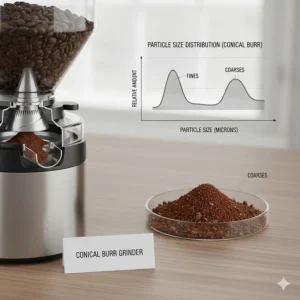
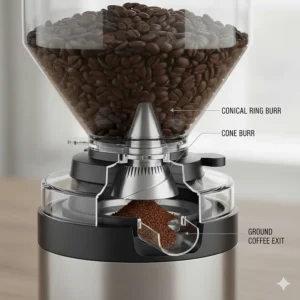
Conical burr grinders feature a cone-shaped inner burr rotating within a ring-shaped outer burr. Coffee beans enter from above, getting channelled downward between the burrs’ opposing angled edges. Gravity assists the grinding process, allowing grounds to fall naturally into the collection chamber below.
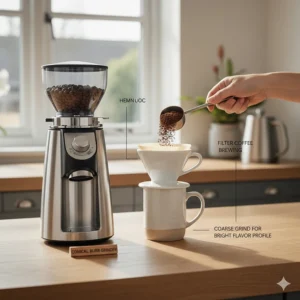
This vertical geometry means conical burrs typically operate at lower RPMs (rotations per minute) than flat burrs—often between 400–550 RPM. The slower rotation generates less heat, preserving delicate aromatic compounds and coffee oils that would otherwise degrade with excessive temperatures.
Advantages of Conical Burrs
Lower Heat Generation: Operating at slower speeds, conical burrs minimise heat transfer to coffee beans. This preservation of essential oils results in sweeter, more rounded flavour profiles—particularly noticeable with light to medium roasts where subtle notes would be lost to heat damage.
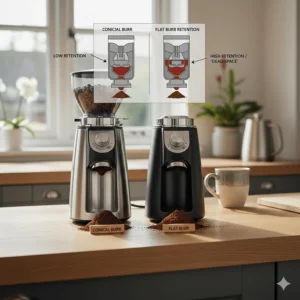
Superior Retention Characteristics: The vertical design and gravity-assisted flow mean conical burrs naturally retain fewer grounds. Expect retention rates of 0.5–1.5g in quality models, compared to 1.5–3g+ in flat burr equivalents. For single-dosing enthusiasts, this translates to more accurate recipes and less waste.
Quieter Operation: Lower RPMs produce less mechanical noise. If you’re grinding at 6am whilst family members sleep, conical burrs won’t wake the household. This seemingly small consideration becomes significant for daily use.
More Forgiving for Beginners: Baristas often note conical burrs are easier to dial in and require less frequent adjustment. The bimodal particle distribution (a mix of particle sizes) provides a buffer against minor dialling errors, making them brilliantly suited to home use.
Disadvantages of Conical Burrs
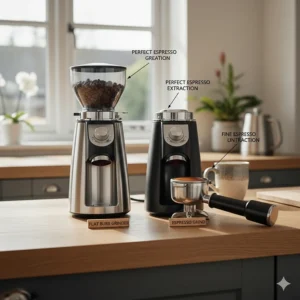
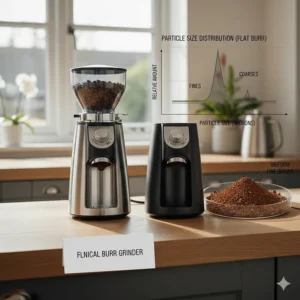
Less Uniform Particle Distribution: Conical burrs produce what’s called a bimodal distribution—grounds contain both smaller and larger particles alongside the target size. Whilst this can benefit espresso extraction by allowing water to flow through varying pathways, it may result in less clarity compared to flat burrs’ unimodal distribution.
Potential for Channelling: In espresso brewing, the varied particle sizes can create channels where water flows preferentially through areas of larger particles, resulting in uneven extraction. Proper puck preparation helps mitigate this, but flat burrs have an inherent advantage here.
Flat Burr Grinders: Deep Dive
How Flat Burrs Work
Flat burr grinders employ two disc-shaped burrs positioned parallel to one another, with serrated or toothed surfaces facing each other. Coffee beans enter through a hole in one burr, get crushed between the opposing teeth, then exit outward to the sides via centrifugal force.
This horizontal geometry necessitates higher RPMs—typically 700–1650 RPM—to generate sufficient centrifugal force for propelling grounds out of the burr chamber. The parallel alignment allows for exceptionally precise burr spacing, contributing to flat burrs’ renowned consistency.
Advantages of Flat Burrs
Exceptional Grind Uniformity: Flat burrs excel at producing unimodal particle distributions, with most grounds clustered tightly around the target size. This uniformity translates to even extraction rates and clean, balanced flavour profiles where individual bean characteristics shine through distinctly.
Superior Flavour Separation: The consistent particle size allows for remarkable flavour clarity. Tasting notes become more pronounced and layered—you’ll detect individual characteristics of the beans rather than a muddled blend. This makes flat burrs particularly brilliant for showcasing expensive single-origin coffees.
Ideal for Espresso Precision: When dialling in espresso, flat burrs’ uniformity means adjustments produce predictable, repeatable results. The reduced channelling risk (compared to conical burrs) yields more consistent shot times and extraction percentages.
Professional-Grade Results: There’s a reason commercial cafés predominantly use flat burr grinders for espresso. The precision and consistency they deliver at scale translates beautifully to home use when you want competition-level results.
Disadvantages of Flat Burrs
Higher Heat Generation: The increased RPM and mechanical friction create more heat. Whilst premium models incorporate cooling features and slower grinding speeds to mitigate this, cheaper flat burr grinders can heat up during extended use, potentially affecting grind consistency and coffee flavour.
Greater Retention Rates: Flat burrs’ horizontal orientation and centrifugal force-based ejection mean more grounds cling to burr chambers and chutes. Quality models employ clever engineering to minimise retention, but expect 1.5–3g+ retention in most designs—problematic for single-dosing workflows.
Noisier Operation: Higher RPMs generally translate to louder motors. If noise levels concern you, check manufacturer specifications—some premium flat burr grinders incorporate sound-dampening features, but most produce more mechanical noise than conical equivalents.
Higher Cost of Entry: Quality flat burr grinders typically start around £300–£450, with premium options reaching £1,000+. The precision engineering and larger burr sets required for flat burr performance command premium pricing.
Key Factors to Consider When Choosing
Burr Size and Material
Burr diameter significantly impacts grinding performance. Larger burrs provide greater cutting surface area, allowing them to grind more beans without generating excessive heat. For conical burrs, look for 40mm+ (home use) or 63mm+ (prosumer). For flat burrs, 54mm+ delivers excellent results, whilst 64mm+ enters professional territory.
Burr materials matter too. Stainless steel burrs offer durability and stay sharp for years (often 500kg+ of coffee before requiring replacement). Ceramic burrs resist heat better but can be more brittle—excellent for manual grinders where drop risk is minimal.
Grind Settings and Adjustability
For versatility across brew methods, seek grinders offering 30+ settings spanning espresso-fine to French press coarse. Stepped adjustment (click-stop settings) provides excellent repeatability—crucial for dialling in recipes. Stepless adjustment offers infinite control between extremes, brilliant for micro-adjustments during espresso dialling.
Motor Power and Speed
Conical burr grinders typically feature 100–300 watt motors spinning at 400–550 RPM. Flat burr grinders need more muscle—expect 300–500+ watts at 700–1650 RPM. Don’t assume higher wattage means better performance; efficient motor design and burr geometry matter more than raw power figures.
Retention and Single-Dose Performance
If you single-dose (weighing beans for each brew), retention becomes critical. Premium conical burrs achieve 0.2–1g retention, whilst flat burrs typically retain 1.5–3g+. Some grinders employ bellows or knockers to purge retained grounds—essential features for dosing accuracy.
Noise Levels
Grinding coffee generates noise—there’s no avoiding it entirely. Conical burrs’ lower RPMs produce 55–70 dB (roughly equivalent to normal conversation). Flat burrs reach 70–85 dB (similar to a vacuum cleaner). For early morning grinding, conical burrs win decisively.
Burr Grinder Types Comparison
| Aspect | Conical Burr | Flat Burr |
|---|---|---|
| Particle Distribution | Bimodal (varied) | Unimodal (uniform) |
| Typical RPM | 400–550 | 700–1650 |
| Heat Generation | Low | Moderate to high |
| Retention | 0.5–1.5g | 1.5–3g+ |
| Noise | 55–70 dB | 70–85 dB |
| Flavour Profile | Sweet, rounded | Bright, clear separation |
| Best Brewing Methods | Filter, French press, pour-over | Espresso, precise methods |
| Maintenance | Easy burr removal | More involved |
| Price Entry Point | £40–£80 | £150–£300 |
Coffee Grinder Burr Comparison by Price Range
Budget Tier (Under £100)
Conical Options Dominate: The budget category is overwhelmingly conical burr territory. Models like the SHARDOR (£79.99–£99.99) and basic manual grinders deliver decent results without breaking the bank. Expect plastic construction, basic adjustment mechanisms, and some retention issues.
What You Sacrifice: Budget grinders typically use smaller burrs (25–40mm), less precise adjustment mechanisms, and lower-quality motors. Grind consistency suffers compared to premium options, though results still vastly exceed blade grinders.
Best Uses: Filter coffee, French press, cold brew—methods forgiving of particle size variation.
Mid-Range (£100–£300)
Sweet Spot for Conical: This tier features exceptional conical burr grinders like the Baratza Encore (£144.99–£189.95) and Sage Smart Grinder Pro (£188.95–£209.95). Expect European-made burrs, metal construction, stepless or extensive stepped adjustment, and grind quality rivalling far more expensive models.
Entry-Level Flat Burrs Emerge: The DF64 Gen 2 (£299.00–£349.00) brings flat burr precision to this price point, though with trade-offs in build quality compared to premium options.
Best Uses: Versatile enough for all brewing methods, with sufficient precision for home espresso in traditional baskets.
Premium Tier (£300–£600)
Flat Burrs Shine: Models like the Eureka Mignon Zero (£449.00–£499.00) deliver professional-grade flat burr grinding with exceptional build quality, low retention, and quiet operation despite high RPMs.
Competition-Grade Conical: High-end conical options in this tier feature oversized burrs (63mm+), precision calibration, and build quality matching commercial grinders.
Best Uses: Serious home baristas seeking competition-level espresso or showcasing expensive single-origin beans.
Ultra-Premium (£600+)
Titan-Class Grinders: The Niche Duo (£1,299.00–£1,399.00) and similar models represent the pinnacle of home grinding technology. Expect massive flat burrs (75mm+), virtually zero retention, premium materials throughout, and performance matching café equipment.
Worth the Investment? For passionate enthusiasts extracting every nuance from specialty beans, yes. For casual coffee drinkers, the mid-range delivers 90% of the performance at fraction of the cost.
How to Choose Between Conical vs Flat Burr Grinder
Choose Conical Burr Grinders If You:
- Primarily brew filter coffee, pour-over, French press, or AeroPress
- Want quieter operation for early morning grinding
- Prefer sweeter, more rounded flavour profiles
- Single-dose and value low retention rates
- Seek excellent value in the £100–£200 range
- Brew multiple methods and need versatility
- Want easier cleaning and maintenance
- Appreciate forgiving dialling (less frequent adjustment)
Choose Flat Burr Grinders If You:
- Focus primarily on espresso brewing
- Desire maximum flavour clarity and separation
- Want the most uniform particle distribution possible
- Don’t mind higher price points for precision
- Can accommodate louder operation
- Appreciate bright, acidic coffee profiles
- Seek competition-level results at home
- Use a grinder with hopper (retention less critical)
The Hybrid Approach
Some enthusiasts maintain both grinder types—conical for filter methods, flat for espresso. Whilst this requires additional investment and counter space, it optimises each brewing method’s potential. Alternatively, dual-burr grinders like the Niche Duo offer both capabilities in one unit.
Ceramic vs Steel Burr Materials
Beyond burr shape, material choice influences performance:
Stainless Steel Burrs:
- Extremely durable (500kg+ coffee lifespan)
- Sharper cutting edges for cleaner grinds
- Slightly higher heat transfer than ceramic
- Standard in electric grinders
- Easier to sharpen/replace
- Better value long-term
Ceramic Burrs:
- Superior heat resistance
- Lighter weight (ideal for manual grinders)
- More brittle (can chip if dropped)
- Quieter operation
- Longer lifespan before dulling
- Higher upfront cost
- Common in premium manual grinders
For electric grinders, stainless steel burrs represent the best choice for most users. Ceramic makes more sense in manual grinders where heat generation is minimal and weight reduction matters.
Burr Grinding Technology Evolution
Modern burr grinders incorporate advanced features improving consistency and user experience:
Anti-Static Technology: Static electricity causes grounds to cling to grinder components and create mess. Advanced coatings and ionisers neutralise static, delivering fluffy, clump-free grounds.
Variable RPM Control: Premium grinders allow adjusting motor speed. Slower speeds reduce heat for delicate light roasts; faster speeds power through dense dark roasts efficiently.
Low-Retention Designs: Single-dose enthusiasts demand minimal retention. Manufacturers employ vertical burr orientations, knocker mechanisms, and polished chutes to achieve sub-0.5g retention.
Precision Calibration: High-end models ship with factory calibration ensuring burrs align perfectly parallel. Misaligned burrs produce inconsistent grinds regardless of burr quality.
Maintaining Your Burr Grinder
Proper maintenance extends grinder lifespan and preserves performance:
Weekly Cleaning:
- Remove hopper and burrs
- Brush away coffee residue from burrs and chamber
- Wipe hopper clean
- Reassemble carefully
Monthly Deep Clean:
- Vacuum out grinder internals
- Use grinder cleaning tablets (follow manufacturer instructions)
- Check burr sharpness and alignment
- Inspect for worn components
Burr Replacement: Steel burrs typically last 500–800kg of coffee (3–5 years for average home use). Signs requiring replacement include:
- Slower grinding despite normal motor function
- Increasing particle size inconsistency
- Unusual noises during operation
- Visible burr damage or dullness
Never wash burrs with water unless manufacturer specifically permits—moisture can cause rust and damage precision grinding surfaces.
Frequently Asked Questions
❓ What's the main difference between conical and flat burr grinders for espresso?
❓ Are flat burr grinders louder than conical burr grinders?
❓ How often should I replace burrs in my coffee grinder?
❓ Can I use the same grinder for both espresso and filter coffee?
❓ Why do flat burr grinders cost more than conical burr grinders?
Conclusion
The conical vs flat burr grinder debate ultimately reduces to your brewing priorities and budget. Conical burrs excel at versatility, offering quiet operation, low retention, and brilliant value across filter brewing methods. They’re forgiving for beginners and deliver sweet, rounded flavour profiles that make everyday coffee delightful.
Flat burrs represent the espresso enthusiast’s choice, providing unmatched particle uniformity and flavour clarity that showcases exceptional beans’ nuanced characteristics. They demand higher investment and generate more heat and noise, but reward dedicated users with competition-level results.
For most UK coffee drinkers, a quality conical burr grinder like the Baratza Encore or Sage Smart Grinder Pro delivers exceptional performance across all brewing methods without breaking the bank. Serious espresso enthusiasts should consider flat burr options like the Eureka Mignon Zero or DF64 Gen 2 for precision extraction.
Remember: the best burr grinder is the one you’ll use consistently. Whether you choose conical or flat burrs, investing in proper burr grinding technology transforms your coffee experience immeasurably compared to blade grinders or pre-ground coffee. Your morning cup deserves better—choose the burr type that matches your brewing style, and enjoy the journey to exceptional coffee.
Recommended for You
- 7 Best Burr Grinder Under £100 UK (2026 Expert Tested)
- Best Burr Coffee Grinder UK 2026: 7 Top-Rated Picks Tested
- 7 Best Cold Brew Coffee Makers UK 2026
Disclaimer: This article contains affiliate links. If you purchase products through these links, we may earn a small commission at no additional cost to you. Prices shown are approximate and may vary.
✨ Found this helpful? Share it with your mates! 💬🤗
