
In This Article
There’s a specific kind of frustration that comes from a bitter, thin cup of pour-over you were absolutely certain you’d nailed the recipe for. Nine times out of ten, the culprit isn’t your technique — it’s your scale. Digital coffee scales exist because eyeballing 18 grams of beans or “about 300ml” of water introduces exactly the kind of inconsistency that separates a great cup from a forgettable one. A proper coffee scale measures to 0.1g rather than the 1g increments most kitchen scales default to, and that tenfold jump in precision matters enormously when your entire recipe is built on ratios.
This guide compares seven real, currently available digital coffee scales sold in the UK, from budget general-purpose kitchen scales through to professional Bluetooth models used by baristas. We’ve researched actual specifications, aggregated genuine UK customer review sentiment, and leaned on independent testing bodies rather than marketing copy. According to Which?’s own testing of digital kitchen scales, accuracy tends to drop off at heavier weights even among well-reviewed models, which is exactly the kind of detail that matters when you’re weighing both a 15g dose and an 800g brew on the same device. Whether you’re chasing better pressure-consistent espresso, dialling in a V60, or just want kitchen scale calibration you can actually trust, there’s a genuinely suitable option below — priced honestly in ranges, never exact figures, since Amazon pricing shifts by the week.
Quick Comparison Table
| Product | Type | Accuracy | Best For | Price Range |
|---|---|---|---|---|
| Salter Digital Kitchen Scale | All-round kitchen scale | 1g | Budget all-round digital coffee scale | £10–£20 |
| BAGAIL Digital Coffee Scale with Timer | Dedicated coffee scale | 0.1g | Budget pour-over starter | £15–£25 |
| Hario V60 Drip Scale | Pour-over specific | 0.1g | Classic accurate kitchen scales for coffee | £30–£45 |
| TIMEMORE Black Mirror Basic 2 | Pour-over + flow rate | 0.1g | Serious pour-over brewing | £35–£55 |
| Heston Blumenthal Precision by Salter | Compact precision scale | 0.5g | Everyday coffee and baking crossover | £25–£40 |
| Fellow Tally Pro Precision Scale | Smart brewing scale | 0.1g | Guided pour-over recipes | £90–£120 |
| Acaia Pearl | Professional Bluetooth scale | 0.1g | Gram accuracy for serious home baristas | £160–£210 |
The spread here matters more than it might look: the Salter Digital Kitchen Scale is a genuine all-round digital coffee scale in the sense that it’ll also weigh your Sunday roast, while the Acaia Pearl is purpose-built for coffee alone and priced accordingly. Notice that gram accuracy and price don’t move in lockstep — both the BAGAIL Digital Coffee Scale with Timer and the far pricier Acaia Pearl claim 0.1g precision, so the premium buys you response speed, build quality, and app integration rather than raw accuracy alone.
💬 Just one click – help others make better buying decisions too!😊
Top 7 Digital Coffee Scales: Expert Analysis
We’ve deliberately spread this list across general-purpose kitchen scales that double up for coffee, dedicated pour-over scales, and professional smart scales, so you can see exactly what extra money actually buys.
1. Salter Digital Kitchen Scale — best budget all-round digital coffee scale
The Salter Digital Kitchen Scale isn’t marketed as a coffee scale at all, but its 3kg capacity, add-and-weigh function, and 15-year guarantee make it a sensible all-round digital coffee scale for anyone not yet ready to commit to a dedicated device.
Salter has been a UK weighing scale manufacturer since 1760, and this model reflects that heritage with a straightforward tare function, a slim stainless steel platform, and a clear LCD display. Based on the spec comparison with dedicated coffee scales, the obvious limitation is resolution — this scale measures in 1g increments, ten times coarser than a true coffee scale, which matters far more for a 15–18g espresso dose than it does for a 60g pour-over dose. What most buyers overlook is that 1g resolution is often perfectly workable for pour-over brewing precisely because the doses involved are larger, even if it falls short for espresso.
Aggregated review sentiment consistently praises the 15-year guarantee as a rare commitment in this price bracket, with the most common criticism being the coarser gram resolution compared with purpose-built coffee scales.
Pros:
- ✅ Doubles as a genuine everyday kitchen scale
- ✅ 15-year guarantee is unusually generous for the price
- ✅ Add-and-weigh tare function simplifies multi-ingredient recipes
Cons:
- ❌ 1g resolution is too coarse for precise espresso dosing
- ❌ No timer or flow-rate function for brew tracking
At £10–£20, the Salter Digital Kitchen Scale is the sensible starting point if you want one scale that does everything reasonably well.
2. BAGAIL Digital Coffee Scale with Timer — best budget dedicated coffee scale
Where the Salter is a generalist, the BAGAIL Digital Coffee Scale with Timer is a proper entry-level coffee scale, offering genuine 0.1g precision with a built-in auto-tare and touch-sensor timer for around the same price bracket as a mid-range kitchen scale.
Its 3kg maximum capacity comfortably covers both espresso dosing and full pour-over brews, and the rechargeable battery avoids the ongoing cost of coin cells that plagues cheaper models. Here’s what to weigh: touch-sensor buttons feel more premium than physical buttons at this price point, but reviewers consistently note they’re less reliable with wet fingers — a real consideration given coffee brewing inherently involves splashes and steam. On paper this means the BAGAIL punches above its price bracket on precision, even if the interface has a minor practical trade-off.
Reviewers frequently cite it as their first “real” coffee scale after outgrowing a standard kitchen scale, with the large display and rechargeable battery mentioned as standout practical touches.
Pros:
- ✅ True 0.1g precision at a genuinely budget price
- ✅ Rechargeable battery avoids ongoing coin-cell costs
- ✅ Large display is easy to read during a pour
Cons:
- ❌ Touch-sensor buttons can misfire with wet fingers
- ❌ Build quality feels noticeably less premium than mid-range rivals
Priced around £15–£25, the BAGAIL Digital Coffee Scale with Timer is the pick for anyone wanting their first genuinely precise coffee scale without a big spend.
3. Hario V60 Drip Scale — best classic pour-over specific scale
The Hario V60 Drip Scale is something of a benchmark in this category — a scale most other pour-over scales are informally measured against, thanks to its purpose-built design for exactly this brewing method.
Its compact platform is sized specifically to sit under a V60 dripper and server, with 0.1g precision across the 2–200g range that covers the vast majority of pour-over recipes, before stepping down to coarser 0.5g and 1g increments at higher weights where precision matters less. What most buyers overlook about touch-sensitive controls like Hario’s is that they trade a small amount of tactile responsiveness for a genuinely sleeker, easier-to-wipe-clean interface — a sensible trade for a device that regularly gets splashed with hot water. The built-in timer starts automatically with the first drip in some use cases, which is a small but genuinely useful design touch for tracking bloom time accurately.
Aggregated reviewer sentiment consistently flags a slight response lag compared with newer rechargeable rivals, though most agree it’s negligible for the slower, more deliberate pace of pour-over brewing specifically.
Pros:
- ✅ Purpose-built platform size for V60 and similar drippers
- ✅ Reliable 0.1g precision across the core brewing range
- ✅ Decades-long reputation as the pour-over benchmark scale
Cons:
- ❌ Runs on AAA batteries rather than being rechargeable
- ❌ Touch controls have a slight lag versus newer rivals
At roughly £30–£45, the Hario V60 Drip Scale remains a benchmark accurate kitchen scale for coffee, and a fair one at that.
4. TIMEMORE Black Mirror Basic 2 — best for serious pour-over brewing
The TIMEMORE Black Mirror Basic 2 adds a genuine flow-rate display to the standard timer-and-weight combination, showing grams-per-second in real time as you pour — a feature that turns a good scale into a training tool rather than just a measuring device.
Built with a rechargeable 1600mAh battery, a 2kg capacity, and 0.1g precision, it’s positioned squarely at pour-over enthusiasts wanting to refine their technique rather than just record a final weight. What the spec sheet won’t tell you, but reviewers note repeatedly, is how genuinely useful the flow-rate readout becomes after a few dozen pours — watching the grams-per-second number in real time builds the muscle memory to maintain a steady 4–6g/s pour without constantly checking the display, which is roughly the range associated with even extraction in V60 brewing. Drop below that and the coffee tends to taste flat; push above it and you risk washing fines to the filter edges.
Reviewers consistently rate response speed as the standout feature, frequently comparing it favourably against the Hario above on exactly this point, with most complaints centred on the touch buttons occasionally over-responding to a firm tap.
Pros:
- ✅ Real-time flow-rate display genuinely improves pour technique
- ✅ Fast, low-lag response compared with older rivals
- ✅ Rechargeable battery with splash-resistant surface
Cons:
- ❌ Touch buttons can be overly sensitive to firm taps
- ❌ Auto-off during timer mode can catch out longer brews
Priced around £35–£55, the TIMEMORE Black Mirror Basic 2 is the strongest all-round pick for anyone serious about improving pour-over technique specifically.
5. Heston Blumenthal Precision by Salter Digital Kitchen Scales — best compact crossover scale
Sitting between the general-purpose Salter above and the dedicated coffee scales elsewhere on this list, the Heston Blumenthal Precision by Salter Digital Kitchen Scales offers 0.5g increments in a genuinely compact, slim stainless steel design aimed at buyers who weigh coffee and food ingredients on the same device.
Based on the spec comparison with the standard Salter model, halving the resolution from 1g to 0.5g is a meaningful step up for coffee dosing without the cost of a fully dedicated 0.1g scale. This makes it a sensible middle-ground pick for households where coffee brewing is one use case among several, rather than the primary reason for buying a scale. The Heston Blumenthal branding here reflects a genuine collaboration around precision cooking rather than a simple relabel, and the slim design stores more easily than bulkier dedicated coffee scales.
Aggregated review sentiment highlights the slim profile and stainless steel finish as standout features, with occasional criticism that 0.5g still isn’t quite fine enough for very light espresso doses under 10g.
Pros:
- ✅ 0.5g precision beats standard kitchen scales without full coffee-scale cost
- ✅ Slim, stainless steel design stores easily
- ✅ Genuinely dual-purpose for cooking and coffee
Cons:
- ❌ Still not precise enough for very light espresso doses
- ❌ No timer or flow-rate function included
In the £25–£40 range, the Heston Blumenthal Precision by Salter Digital Kitchen Scales suits buyers who want a meaningful accuracy upgrade without going fully dedicated.
6. Fellow Tally Pro Precision Scale — best guided brewing experience
The Fellow Tally Pro Precision Scale distinguishes itself with a dedicated Brew Assist mode that actively guides pour-over, AeroPress, French press, and cold brew recipes by ratio, rather than simply displaying a static weight and timer.
Alongside standard weight and timer modes, the OLED display and rechargeable battery give it a genuinely premium feel, and the ability to switch between grams, millilitres, ounces, and pounds covers most brewing preferences without a separate calculator. What most buyers overlook about Brew Assist mode specifically is that it removes the mental arithmetic of ratio brewing entirely — instead of calculating bloom water at roughly double your coffee dose yourself, the scale prompts you through each stage, which genuinely helps less experienced brewers replicate a recipe consistently. That said, this is squarely a pour-over and manual brewing tool rather than an espresso scale, given its more moderate response speed.
Reviewers consistently single out Brew Assist mode as the standout differentiator versus rivals at a similar price, with best-in-class display quality mentioned repeatedly as a secondary strength.
Pros:
- ✅ Brew Assist mode actively guides ratio-based recipes
- ✅ Best-in-class OLED display and premium design
- ✅ Switches cleanly between multiple measurement units
Cons:
- ❌ Response speed isn’t quite fast enough for serious espresso work
- ❌ Premium price for what is fundamentally a pour-over tool
At around £90–£120, the Fellow Tally Pro Precision Scale earns its premium price for pour-over enthusiasts who want genuine guidance, not just numbers.
7. Acaia Pearl — best professional Bluetooth coffee scale
At the top of this list, the Acaia Pearl remains a fixture in specialty coffee shops for good reason: aluminium construction, Bluetooth app integration, and industry-leading response times under 50 milliseconds combine to make it the most capable scale here for both pour-over and espresso work.
Its rechargeable lithium battery, bright LED display, and 0.1g precision are matched by app connectivity that logs shot and pour data over time — genuinely useful for anyone treating home brewing as a hobby to refine methodically rather than a one-off purchase. Based on the spec comparison with every other product on this list, the Pearl’s defining advantage isn’t raw accuracy, since several cheaper scales also claim 0.1g precision, but response speed and consistency under repeated professional use, which is exactly what justifies the price gap to hobbyist buyers weighing up the investment. Reviewers and professional testers alike consistently describe the sensor as capable of registering something as small as a single stray coffee bean landing on the platform.
The clear trade-off is cost: this is roughly four to five times the price of the mid-range TIMEMORE above it on this list, and casual pour-over drinkers are unlikely to notice the difference in daily use.
Pros:
- ✅ Industry-leading response speed under 50 milliseconds
- ✅ Bluetooth app logs brew data for consistent recipe tracking
- ✅ Aluminium build quality suited to daily professional use
Cons:
- ❌ Significant price premium over near-identical 0.1g rivals
- ❌ App dependency adds complexity casual users don’t need
At roughly £160–£210, the Acaia Pearl is the premium pick for buyers who genuinely want gram accuracy backed by professional-grade consistency.
Accurate Kitchen Scales for Coffee: What Actually Matters
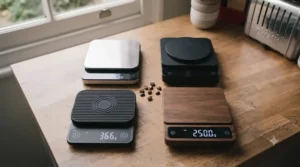
Buying accurate kitchen scales for coffee comes down to three factors that matter far more than brand reputation: resolution, response time, and repeatability. Resolution — the smallest increment the scale can display, typically 0.1g on dedicated coffee scales versus 1g on general kitchen scales — determines whether small dosing errors are even visible to you. Response time, how quickly the display settles on a stable reading, matters more for espresso than pour-over, since espresso doses are smaller and brew times shorter.
Repeatability is the factor Amazon listings almost never mention explicitly, yet it’s arguably the most important: a scale that reads 18.1g one moment and 18.3g the next for an identical weight is functionally less useful than one that consistently reads 18.2g every time, even if the second scale is technically less “accurate” against a lab reference. Which?’s testing methodology for kitchen scales specifically checks this by using calibration weights and repeating measurements multiple times — precisely the kind of consistency check that separates a genuinely reliable coffee scale from one that merely displays fine increments without backing them up.
How to Choose a Digital Coffee Scale
- Match resolution to your brewing method. Espresso doses under 20g genuinely need 0.1g precision; pour-over doses of 15–30g coffee can work reasonably well even at 0.5–1g resolution.
- Check the platform size against your brewer. A scale too small for your V60, Chemex, or portafilter defeats the purpose regardless of its precision rating.
- Decide whether you need a timer. Pour-over recipes built around bloom and total brew time benefit enormously from an integrated timer rather than juggling a phone.
- Consider flow-rate display if you’re refining technique. Real-time grams-per-second readouts, like the TIMEMORE’s, are genuinely useful for building consistent pouring habits.
- Weigh up rechargeable versus battery-powered. Rechargeable scales avoid ongoing coin-cell costs but need remembering to charge; battery models are more “grab and go” reliable.
- Check splash resistance. Coffee brewing inherently involves spills — a scale with genuine water resistance will simply last longer.
- Set a realistic budget band. Under £25 covers genuinely usable dedicated coffee scales; £35–£55 covers most serious pour-over needs; £90+ buys guided brewing or professional-grade consistency.
Common Mistakes When Buying a Digital Coffee Scale
The most frequent mistake is assuming any scale advertising “0.1g precision” performs identically — as the comparison above shows, the BAGAIL Digital Coffee Scale with Timer and the Acaia Pearl both claim 0.1g resolution, yet differ enormously in response speed, consistency, and build quality. A second common error is buying a scale sized for espresso when the primary use is pour-over, or vice versa; a small espresso-focused platform can struggle to fit a V60 and server safely, while an oversized flow-rate scale is overkill for someone dosing a single AeroPress shot occasionally.
Buyers also frequently overlook auto-off timing, which on several budget scales activates within two to three minutes — genuinely disruptive mid-pour if you’ve paused to grind more beans. Finally, many people buy a coffee scale expecting it to double flawlessly as a full kitchen scale, only to find the smaller platform and lower maximum capacity awkward for weighing a chicken or a bag of flour — the Salter Digital Kitchen Scale or Heston Blumenthal Precision by Salter genuinely suit that dual-purpose use far better than a dedicated coffee scale ever will.
Cooling and Splash Protection Compared: Digital Coffee Scale vs Standard Kitchen Scale
A standard kitchen scale, as reflected in the Salter Digital Kitchen Scale, is built primarily around convenience and general-purpose accuracy — a 1g resolution that suits baking and everyday cooking perfectly well, but leaves coffee dosing markedly less precise than dedicated alternatives. A digital coffee scale, by contrast, trades some of that general-purpose flexibility for brewing-specific features: finer resolution, integrated timers, splash-resistant surfaces, and platform sizes matched to brewing equipment rather than mixing bowls.
The table earlier in this guide makes the practical difference clear — moving from 1g to 0.1g resolution isn’t a marginal upgrade for espresso dosing, where a single gram of coffee can meaningfully shift extraction and taste. For pour-over specifically, the gap narrows because doses are larger, which is exactly why a well-specced general kitchen scale like the Salter remains a genuinely defensible choice for pour-over-only households on a tight budget, even if it would frustrate an espresso drinker.
Pour-Over Brewing: What to Expect from Each Scale
Pour-over brewing, sometimes called drip coffee when made manually rather than by machine, relies on pouring water over ground coffee in stages — typically a bloom phase followed by the main pour — with both the coffee dose and total water weight tracked precisely throughout. In real-world use, budget scales like the BAGAIL Digital Coffee Scale with Timer handle this adequately but can lag slightly when water is poured quickly, briefly displaying an unstable number before settling.
Mid-range and premium scales, particularly the TIMEMORE Black Mirror Basic 2 and Fellow Tally Pro Precision Scale, track a continuous pour far more smoothly, which matters most during the main pour phase when you’re actively adjusting your pace based on the number in front of you. The Acaia Pearl‘s sub-50-millisecond response time is arguably wasted on a slow, deliberate pour-over pour compared with fast-paced espresso extraction — a useful reminder that the “best” scale genuinely depends on which brewing method you do most often, not which scale has the most impressive spec sheet.
Kitchen Scale Calibration: Why It Matters
Every digital scale, regardless of price, can drift out of true accuracy over time — a process influenced by temperature changes, mechanical shock, and simple component ageing in the load cell that does the actual weighing. Kitchen scale calibration is the process of checking a scale’s readings against a known, certified weight and adjusting or verifying accordingly, and it’s a far more established science than most coffee drinkers realise. In the UK, the National Physical Laboratory provides UKAS-accredited calibration services that trace measurement standards all the way back to the UK’s national mass reference — the same underlying principle, just at industrial scale, behind checking your own coffee scale with a set of calibration weights at home.
For home use, most digital coffee scales include a basic self-calibration function, usually triggered by placing a specified reference weight (often 100g or 200g) on the platform and following an on-screen or button-based prompt. Reviewers of the Hario V60 Drip Scale and TIMEMORE Black Mirror Basic 2 both mention this process as reasonably straightforward, though neither ships with an actual calibration weight included — a small set of certified calibration weights, sold separately for under £10, is a worthwhile companion purchase for anyone serious about long-term gram accuracy.
Gram Accuracy for Espresso vs Pour-Over
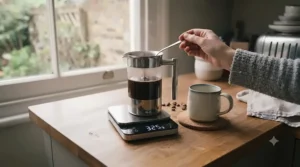
Gram accuracy needs differ meaningfully between brewing methods, and treating them identically is a common source of buyer disappointment. Espresso doses typically sit between 14g and 20g, meaning a 0.5g error represents a 2.5–3.5% deviation from the recipe — enough to noticeably shift extraction and taste, which is exactly why espresso-focused buyers should prioritise the fastest, most precise scales like the Acaia Pearl or TIMEMORE Black Mirror Basic 2.
Pour-over doses, by contrast, typically range from 15g to 30g of coffee against 250–500g of water, meaning the same 0.5g error represents a much smaller proportional deviation — which is precisely why a compact, well-specced scale like the Hario V60 Drip Scale remains entirely fit for purpose despite lacking the ultra-fast response times of pricier rivals. Reviewers consistently confirm this pattern: complaints about insufficient accuracy cluster around espresso use cases far more than pour-over ones, even when reviewing the exact same scale model.
✨ Don’t Miss These Exclusive Deals!
🔍 Take your coffee routine to the next level with these carefully selected scales. Click on any highlighted item to check current pricing and availability. These picks will help you brew genuinely consistent, café-quality coffee your household will actually taste the difference in!
Long-Term Cost and Maintenance
Cost per use tells a more honest story than upfront price alone. A £15 dedicated coffee scale used daily for two years works out to roughly 2 pence per day, while the £180 Acaia Pearl used equally often over five years — a realistic lifespan given its build quality — works out to around 10 pence per day. Neither figure is dramatic on its own, but the comparison matters when deciding whether premium response speed and app integration justify the gap for your actual brewing frequency.
Maintenance is straightforward across the board: wipe platforms clean after each use to prevent coffee residue affecting the load cell over time, avoid submerging any scale even if marketed as splash-resistant, and recalibrate periodically using a certified reference weight, particularly after any knock or drop. Rechargeable models like the TIMEMORE Black Mirror Basic 2 and Fellow Tally Pro Precision Scale also benefit from an occasional full discharge-recharge cycle, which reviewers note helps maintain battery accuracy in the on-screen charge indicator over time.
Practical Usage Guide: Setup, First Brews and Common Mistakes
Unbox your scale and let any rechargeable model charge fully before first use — most manufacturers recommend this even if the scale arrives with partial charge already. Place the scale on a genuinely flat, stable surface, since even a slight tilt can introduce measurable error on sensitive load cells; a kitchen worktop with a visible lean is a more common culprit than buyers expect.
For your first few brews, resist the temptation to immediately trust the flow-rate or Brew Assist features fully — spend the first week simply weighing dose and total water accurately to build a baseline before layering on more advanced features. In the first 30 days, the most common mistake reviewers report is forgetting to zero (tare) the scale between adding the brewer, the filter, and the coffee itself, which throws off the entire ratio; get into the habit of tare-ing after each addition rather than trying to calculate the difference mentally. Clean the platform weekly with a barely damp cloth, never fully wet, and store the scale away from direct heat sources like a hob or kettle, since sustained heat exposure can affect load cell accuracy over months of use.
Real-World Scenarios: Which Scale Fits Your Brewing Habits
If you’re a student making the occasional AeroPress in a shared kitchen, the Salter Digital Kitchen Scale or BAGAIL Digital Coffee Scale with Timer covers the basics without a significant outlay, and either genuinely doubles as a general kitchen scale for the rest of your cooking. If you’re a committed home barista brewing V60 daily and actively trying to improve your pouring technique, the TIMEMORE Black Mirror Basic 2‘s flow-rate display offers training-tool value that a simpler scale simply can’t match.
For someone splitting time between espresso and pour-over equally, prioritising fast, consistent response over specialised pour-over features, the Acaia Pearl is worth the investment precisely because its response speed benefits both methods rather than just one. And if you’re newer to manual brewing and want the scale itself to teach you proper ratios rather than researching them separately, the Fellow Tally Pro Precision Scale‘s Brew Assist mode is built exactly for that learning curve.
Buyer’s Decision Framework
If your budget is under £25 and you brew mostly pour-over with occasional AeroPress use, choose the BAGAIL Digital Coffee Scale with Timer, because genuine 0.1g precision at this price outweighs the lack of extra features. If your budget is £25–£55 and you want either dual kitchen use or serious pour-over refinement, choose the Heston Blumenthal Precision by Salter for the former or the TIMEMORE Black Mirror Basic 2 for the latter, since your primary use case should decide between them.
If your budget is £90+ and you want the scale to actively teach and guide your brewing, choose the Fellow Tally Pro Precision Scale. And if budget genuinely isn’t the deciding factor and you brew both espresso and pour-over regularly enough that response speed and consistency compound daily, choose the Acaia Pearl — it’s the only scale here built to professional-use standards from the ground up.
Frequently Asked Questions
❓ Do I really need a dedicated coffee scale?
❓ What accuracy do I need for pour-over coffee?
❓ How do I calibrate a digital coffee scale at home?
❓ Why does my coffee scale show different numbers for the same weight?
❓ Is a Bluetooth coffee scale worth the extra cost?
Conclusion
Choosing between digital coffee scales ultimately comes down to matching resolution and features to how you actually brew, not chasing the most impressive spec sheet available. For pour-over specifically, the Hario V60 Drip Scale remains a genuinely fair benchmark, while the TIMEMORE Black Mirror Basic 2 earns its slightly higher price through a flow-rate display that measurably improves technique over time. Budget buyers shouldn’t feel short-changed either — the BAGAIL Digital Coffee Scale with Timer delivers real 0.1g precision at a fraction of premium pricing, and the Salter Digital Kitchen Scale remains a defensible all-round choice for anyone whose coffee habit doesn’t yet justify a dedicated purchase.
At the premium end, the Fellow Tally Pro Precision Scale and Acaia Pearl both justify their cost differently — one through guided brewing intelligence, the other through professional-grade consistency and response speed. Whichever you choose, remember that gram accuracy is only useful if the scale is genuinely calibrated and stable; a £200 scale on an uneven worktop will underperform a £15 scale on solid ground every single time.
Recommended for You
- Digital Coffee Scales Under £30: 7 Best Budget Picks for 2026
- 7 Best Milk Pitcher Thermometer Strips for Espresso in 2026
- Milk Thermometer for Espresso: 7 Brilliant Picks (2026)
Disclaimer: This article contains affiliate links. As an Amazon Associate, I earn from qualifying purchases. If you purchase products through these links, we may earn a small commission at no additional cost to you.
✨ Found this helpful? Share it with your friends! 💬🤗
