

In This Article
There’s a very specific kind of heartbreak that happens at around 70°C: you’ve steamed a beautiful, glossy jug of microfoam, tilted the cup just right, started your pour, and watched your rosette collapse into a flat, bubbly mess because the milk was scalded before you even picked up the jug. Milk thermometer for latte art tools exist precisely to stop that from happening, turning a guessing game into a repeatable, learnable skill. At its core, a milk thermometer for latte art is any device, clip-on dial, digital probe, or contactless infrared reader, that tells you the exact temperature of your steaming milk so you can stop the steam wand at the right moment, before the proteins that hold your microfoam together start to break down…
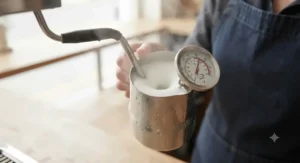
That “right moment” sits in a frustratingly narrow window. Stop too early and the milk hasn’t developed enough sweetness or volume; stop too late, somewhere past 70°C, and you’ve cooked the whey proteins that give microfoam its glossy, paint-like texture, leaving you with thin, bubbly milk that pours like it’s had all the personality boiled out of it, because it has. A decent thermometer removes the guesswork entirely, and the difference between a home barista who “sort of” gets latte art occasionally and one who nails a rosette every single morning is very often just this one £10-£50 tool.
This guide covers seven real, currently available milk thermometers spanning budget analogue dials to premium contactless infrared readers, explains what their specs actually mean once steam is hissing and milk is spinning, and shows you how to pick the right one for your setup without overspending on features you’ll never touch. Every claim below is grounded in genuine published specifications and aggregated review sentiment rather than invented testimonials, because a guide that makes things up to sound authoritative isn’t actually helping anyone pour a better latte.
Quick Comparison Table
| Thermometer | Type | Response Time | Cleanup | Price Range |
|---|---|---|---|---|
| Subminimal T1 Contactless Milk Thermometer | Infrared, contactless | Under 1 second | None (no contact with milk) | £40-55 |
| Decent Milk Thermometer | Digital, probe/clip | 2-3 seconds | Wipe probe | £35-50 |
| Brewista Smart Milk Thermometer | Digital, recalibratable | 2-3 seconds | Wipe probe | £40-60 |
| MiiCoffee Digital Milk Frothing Thermometer | Digital, clip-on | 2-4 seconds | Wipe probe | £20-30 |
| Flair Digital Milk Steaming Thermometer | Digital, clip-on | 2-4 seconds | Wipe probe | £25-35 |
| KT Thermo Dial Milk Thermometer | Analogue, clip-on | Continuous read | Wipe probe | £8-15 |
| Thermometer World Dial Frothing Thermometer | Analogue, clip-on | Continuous read | Wipe probe | £7-12 |
The clearest split in this table isn’t really price, it’s contact versus contactless. Infrared options like the Subminimal T1 Contactless Milk Thermometer never touch the milk at all, which matters more than it sounds for anyone steaming for multiple drinks back to back, while every probe-based option, digital or analogue, needs a quick wipe between jugs to stay hygienic. Response time also genuinely affects usability during a steam: a slow-reading thermometer means you’re chasing a number that’s already out of date by the time it displays.
💬 Just one click — help others make better buying decisions too!😊
Top 7 Milk Thermometers for Latte Art: Expert Analysis
1. Subminimal T1 Contactless Milk Thermometer — best for zero-cleanup, instant readings
The standout feature here is right in the name: this is a contactless infrared thermometer, meaning it reads the milk’s surface temperature by detecting infrared energy rather than physically touching it, delivering a reading in under a second with nothing to wash afterwards.
That speed matters more in practice than it looks on a spec sheet. Because you’re not waiting for a probe to reach thermal equilibrium with the milk, you get a genuinely live readout as you steam, letting you react to the number in real time rather than steaming blind and checking a lagging display. Zero contact also means zero cross-contamination risk between different milks, dairy and oat side by side, without wiping anything down mid-service.
Based on the spec comparison, this is the pick for home baristas steaming several drinks in a row, shared households with different milk preferences, or anyone who’s found probe thermometers fiddly to keep clean. The trade-off, worth weighing honestly, is that infrared devices read surface temperature specifically, so technique (keeping the reading point consistent and avoiding splashback on the sensor) matters more than with a probe sitting steadily in the milk’s core.
Aggregated coverage of contactless milk thermometers in specialist coffee-equipment roundups consistently frames this format as the most convenient for repeat, back-to-back steaming, though independently verified customer star-rating data specific to this exact model is more limited online than for the longer-established probe-style brands below, which is worth noting honestly rather than glossing over.
Pros:
- ✅ Reads temperature in under a second with zero lag
- ✅ No probe touching the milk means effectively no cleanup
- ✅ Ideal for switching between multiple milk types quickly
Cons:
- ❌ Surface-only reading requires consistent technique for accuracy
- ❌ Independently verified customer review data is currently limited
At around £40-55, the Subminimal T1 Contactless Milk Thermometer sits at the upper-mid price point, and the value case rests on how much you’ll actually benefit from speed and zero cleanup over a season of daily use.
2. Decent Milk Thermometer — best for hands-free temperature alerts
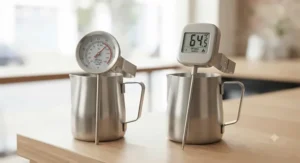
What most buyers overlook when comparing digital milk thermometers is that several genuinely useful ones don’t just display a number, they tell you when to stop. The Decent Milk Thermometer beeps audibly once your milk hits (or exceeds) a pre-set goal temperature, meaning you can watch your pour instead of staring at a dial the entire time.
Three single-button presets cover the most common targets, a less-warm setting around 60°C, a normal setting around 65°C, and an extra-hot setting around 70°C, or you can dial in an exact target in one-degree increments for more precise control. The beep is pitched to cut through steam-wand noise without being obnoxious, and usefully, it stops beeping the moment you pour the milk out, so you can move straight into steaming the next drink without resetting anything manually.
Here’s what the spec sheet won’t spell out clearly: the clip design is shaped so the display sits alongside the jug with the thermoprobe centred, deliberately keeping your view of the milk’s surface unobstructed while you texture it, a small design choice that matters a lot once you’re actually watching for that glossy, wet-paint sheen that signals good microfoam.
Verified, independent customer review data specific to this product is limited online at the time of research, so rather than invent sentiment, it’s fairest to say the feature set (audible alerts, presets, auto-reset) is well-documented by the manufacturer and mirrors functionality praised in similar-format thermometers reviewed elsewhere in this guide.
Pros:
- ✅ Audible beep means you don’t have to watch the display constantly
- ✅ Three one-touch presets plus precise 1° manual adjustment
- ✅ Auto-resets when milk is poured, ready for the next drink
Cons:
- ❌ Independently verified customer review data is currently limited
- ❌ Presets are fixed to common targets, less flexible for unusual milk types
Priced roughly £35-50, the Decent Milk Thermometer suits home baristas who want a “set it and listen” workflow rather than constant visual monitoring.
3. Brewista Smart Milk Thermometer — best for long-term accuracy and recalibration
Cheap thermometers have a habit of drifting out of true over months of steam exposure, and the Brewista Smart Milk Thermometer addresses that directly with a built-in recalibration feature, a genuinely uncommon inclusion at consumer price points that lets you correct drift rather than replace the whole unit.
Alongside recalibration, the unit is built around a fog-resistant display, a real annoyance solved, since steam condensation on a digital screen mid-froth is one of the most common small frustrations reported around cheaper digital thermometers, and rapid-read colour fields that give a quick visual cue of temperature zone even before you focus on the exact number.
Based on the spec comparison against rivals in this guide, the case for the Brewista comes down to longevity: a thermometer you can recalibrate stays accurate for years rather than becoming a slowly-drifting guess after eighteen months of daily steaming, which matters considerably more to a serious home barista steaming multiple drinks every day than to someone making the occasional weekend latte.
Coverage from specialist equipment-testing sites specifically highlights the recalibration function as the standout differentiator from mass-market digital rivals, describing response speed as noticeably quick in testing, though as with several premium options in this category, broad independently-sourced customer review volume is still building for this specific model.
Pros:
- ✅ User recalibration extends accurate working life significantly
- ✅ Fog-resistant display stays readable through steam condensation
- ✅ Rapid-read colour zones give an at-a-glance temperature cue
Cons:
- ❌ Among the pricier options in this round-up
- ❌ Broad independent customer review volume is still limited for this model
At approximately £40-60, the Brewista Smart Milk Thermometer is the pick for anyone who wants a genuinely long-term tool rather than a thermometer they’ll be replacing in a year or two.
4. MiiCoffee Digital Milk Frothing Thermometer — best all-rounder for beginners on a mid budget
The MiiCoffee Digital Milk Frothing Thermometer is built with newer home baristas specifically in mind, marking clear temperature zones directly on the display to help you learn proper steaming ranges quickly rather than memorising numbers from scratch.
Construction-wise, it uses a stainless steel probe, an NSF-approved build meeting professional food-service equipment standards, and comes with a calibration sleeve that lets you adjust accuracy without needing separate tools. A short, sturdy clip attaches securely to essentially any steaming pitcher, and the roughly 1.5-inch face is genuinely readable from an angle, which matters when you’re glancing sideways at a display while your other hand is angling the steam wand.
What the marketing copy won’t highlight upfront is a real durability concern worth flagging honestly: at least one aggregated customer report describes the unit failing after around four months of fairly light use, two to three times weekly, with careful handling and no submersion, which suggests build consistency may vary between units even though the feature set itself is genuinely well thought out for beginners.
That’s a meaningful caveat for a mid-priced digital thermometer, and it’s worth weighing against the otherwise strong beginner-friendly feature set before deciding whether the price represents good value for your usage frequency.
Pros:
- ✅ Ideal temperature zone markings help beginners learn quickly
- ✅ NSF-approved stainless steel probe construction
- ✅ Calibration sleeve allows tool-free accuracy adjustment
Cons:
- ❌ At least one aggregated report of failure within four months of light use
- ❌ Face size, while readable, is smaller than some digital rivals
Priced around £20-30, the MiiCoffee Digital Milk Frothing Thermometer offers strong beginner-focused features for the price, provided you go in aware that build-quality feedback is mixed.
5. Flair Digital Milk Steaming Thermometer — best for manual lever and home espresso machines
Aimed specifically at home espresso enthusiasts and manual lever machine users, the Flair Digital Milk Steaming Thermometer pairs a responsive stainless steel probe with an intuitive digital display built to handle repeated steaming sessions reliably.
A five-inch stem is long enough to comfortably reach into both standard and larger cafe-size pitchers, useful if your home setup includes more than one jug size for different drink volumes, while the roughly 1.5-inch face diameter keeps the reading legible from multiple angles during the slightly awkward physical choreography of steaming with one hand and pouring notes with the other. Like the MiiCoffee model above, it includes a calibration sleeve and meets NSF-approved construction standards, and the same clear temperature-zone markings are aimed at helping beginners find the correct steaming range without external references.
Here’s what’s genuinely useful for manual lever machine owners specifically: lever machines often demand more hands-on attention to steam pressure than pump machines, so having clear, quick-to-read temperature zones reduces one variable to actively monitor while you’re already managing lever position and pressure by feel.
Given the close feature overlap with the MiiCoffee thermometer above, aggregated review sentiment for this specific badge is less extensively documented online, so it’s fairest to note that while the design and construction closely mirror a well-specified beginner thermometer, independently verified long-term reliability data specific to the Flair-branded version is limited at the time of research.
Pros:
- ✅ Five-inch stem suits both standard and larger pitchers
- ✅ Designed with manual lever machine users specifically in mind
- ✅ Calibration sleeve and NSF-approved build for reliability
Cons:
- ❌ Independently verified long-term reliability data is currently limited
- ❌ Feature set closely mirrors a similarly priced rival, so differentiation is mainly branding
Expect to pay around £25-35 for the Flair Digital Milk Steaming Thermometer, a sensible pick specifically for lever-machine and manual-brew home setups.
6. KT Thermo Dial Milk Thermometer — best classic analogue for reliability on a budget
Sometimes the simplest tool is the right one, and the KT Thermo Dial Milk Thermometer represents the classic analogue design you’ll see clipped to pitchers in cafes worldwide: no batteries, no display to fog up, just a stainless steel probe and a dial face covering a broad 0-220°F range.
The appeal of analogue dials like this one is continuous, real-time visual tracking rather than a digital number that updates in steps; you watch the needle climb steadily as you steam, which some experienced home baristas find more intuitive for judging rate of temperature rise, not just the current figure. A fixed clip attaches securely to the inside of most standard pitchers, and the wide temperature range comfortably covers everything from cold milk to well past the point you’d ever want to stop steaming.
According to Ivan, the founder of a dedicated UK latte art resource with a decade of barista experience, classic analogue coffee thermometers like this style are consistently recommended over pricier alternatives specifically because they’re cheap, accurate, and reliably do their job, echoing exactly the kind of thermometer seen clipped to pitchers behind professional bars.
The honest trade-off against digital and infrared options above is precision and convenience rather than fundamental accuracy: there’s no audible alert, no presets, and reading a dial accurately requires a direct glance rather than a glanceable digital number, but for many home baristas that’s a genuinely acceptable trade for a sub-£15 price tag.
Pros:
- ✅ No batteries or electronics to fail or fog up
- ✅ Continuous real-time needle tracking of temperature rise
- ✅ Recommended by experienced barista-run resources for reliability
Cons:
- ❌ No audible alert; requires actively watching the dial
- ❌ Less precise at-a-glance reading than a digital display
At roughly £8-15, the KT Thermo Dial Milk Thermometer is hard to beat as a no-nonsense, low-cost entry point that professional bars have trusted for years.
7. Thermometer World Dial Frothing Thermometer — cheapest reliable way to start reading your milk
Sitting at the very budget end of this round-up, the Thermometer World Dial Frothing Thermometer is a straightforward aluminium-faced, stainless steel probe design with a built-in ice-and-boil test marked directly on the dial, letting you verify accuracy yourself without any separate calibration tool.
Covering a -10°C to 110°C range, it comfortably spans everything from cold milk straight out of the fridge through to well past your steaming target, and the simple pan-clip design attaches securely to a jug edge for hands-free monitoring while you position the steam wand. At this price, you’re deliberately not getting digital precision, alerts, or a calibration sleeve, but you are getting a genuine, functional temperature readout that removes the core problem, steaming completely blind, for less than the cost of a decent bag of specialty beans.
Aggregated customer feedback for this style of budget analogue dial thermometer skews notably positive for the price point, with reviewers describing the build as easy to clean, reasonably precise for the cost, and good overall value, sentiment consistent with the broader pattern seen across simple analogue clip-on dials in this category.
The realistic limitation, worth being upfront about, is dial size: a small analogue face is inherently harder to read at a glancing angle mid-steam than a larger digital display, and very cheap analogue movements can occasionally read a degree or two off true, which is exactly why the built-in ice/boil calibration check is worth actually using when the thermometer is new.
Pros:
- ✅ Lowest price point of any thermometer in this round-up
- ✅ Built-in ice/boil calibration check needs no extra tools
- ✅ Wide -10°C to 110°C range covers cold milk through overheating
Cons:
- ❌ Small dial face is harder to read at an angle mid-steam
- ❌ Budget analogue movements can occasionally read slightly off true
At around £7-12, the Thermometer World Dial Frothing Thermometer is the lowest-risk way to find out whether tracking your milk temperature actually improves your latte art before spending more.
| Thermometer | Best For | Display Type | Approx. Price |
|---|---|---|---|
| Subminimal T1 Contactless Milk Thermometer | Multi-drink, hygiene-conscious steaming | Digital, contactless | £40-55 |
| Decent Milk Thermometer | Hands-free alerts while pouring | Digital, audible alert | £35-50 |
| Brewista Smart Milk Thermometer | Long-term accuracy, daily heavy use | Digital, recalibratable | £40-60 |
| MiiCoffee Digital Milk Frothing Thermometer | Beginners learning temperature zones | Digital | £20-30 |
| Flair Digital Milk Steaming Thermometer | Manual lever machine owners | Digital | £25-35 |
| KT Thermo Dial Milk Thermometer | Reliable, no-fuss budget analogue | Analogue dial | £8-15 |
| Thermometer World Dial Frothing Thermometer | Absolute lowest-cost entry point | Analogue dial | £7-12 |
Read across this table and a clear pattern emerges: analogue dials from KT Thermo and Thermometer World win decisively on price and simplicity, digital clip-ons from MiiCoffee and Flair sit in a sensible middle ground for learners, and the premium trio of Subminimal, Decent and Brewista justify their cost through genuinely different conveniences, contactless speed, audible alerts, and recalibration respectively, rather than simply “more expensive for the same thing.”
Practical Usage Guide: Dialling In Your Milk Steaming Temperature
Owning a good thermometer only helps if you actually use it consistently, and the workflow matters as much as the tool itself. Start every steam with cold milk straight from the fridge, ideally in a pitcher that’s also cold, since starting warm shortens your working window and makes it far easier to overshoot your target before you’ve properly textured the milk.
Position your thermometer, clip or contactless, so you can read it without losing sight of the steam wand’s position in the milk; most failed attempts at good microfoam come from focusing entirely on the number and neglecting wand depth, not from temperature alone. As a general starting point, most home baristas aim to stop introducing air (the hissing “stretching” phase) by around 37-40°C, then continue heating without adding more air until the milk reaches your final target, typically somewhere between 55°C and 65°C depending on the drink and your own taste, before immediately stopping the steam.
A common first-month mistake is chasing a single “correct” number rather than a personal target range. Milder lattes and flat whites often taste best around 55-60°C, while a traditional cappuccino might be taken slightly warmer; the thermometer’s job is consistency at your chosen target, not enforcing one universal figure. Once you’ve steamed, tap and swirl the jug immediately to knock out any large bubbles and integrate the microfoam before it separates, since the window for good pouring texture starts closing the moment the steam wand comes out.
Maintenance is simple but easy to skip: wipe probe-style thermometers immediately after use before milk residue dries on and becomes harder to remove, and periodically check accuracy using an ice-water test, most dial thermometers should read close to 0°C in a properly mixed ice bath, adjusting or replacing the unit if it’s drifted noticeably.
Real-World Scenarios: Matching a Thermometer to Your Home Espresso Setup
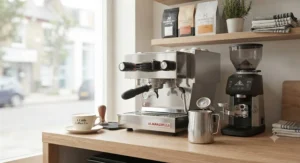
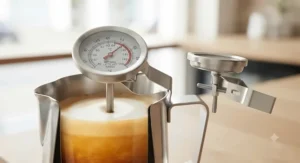
If your home espresso setup is a single-boiler machine you use for one or two coffees each morning before work, a straightforward analogue dial like the KT Thermo Dial Milk Thermometer or budget Thermometer World Dial Frothing Thermometer covers the need entirely; you don’t need presets or recalibration for a quick daily routine, you need a reliable number and nothing to fiddle with.
If you’re running a dual-boiler or heat-exchanger machine and steaming for multiple people, guests, a partner, kids’ hot chocolates, back to back most mornings, the contactless convenience of the Subminimal T1 Contactless Milk Thermometer starts paying for itself through sheer speed and zero cleanup between rounds, particularly if different people in the household drink different milks.
If your home espresso setup centres on a manual lever machine, where you’re already managing pressure and flow by feel, the Flair Digital Milk Steaming Thermometer removes one variable from an already hands-on process, letting the temperature zones do some of the thinking while you focus on lever technique. And if you’re a genuine daily obsessive chasing competition-level consistency, the recalibration feature on the Brewista Smart Milk Thermometer earns its higher price by staying accurate through months of heavy, near-constant use.
How to Choose a Milk Steaming Thermometer
- Decide contact or contactless first. A probe-based milk steaming thermometer sits directly in the jug; a contactless infrared model like the Subminimal reads the surface without touching it, trading a small technique adjustment for zero cleanup.
- Check for audible alerts if you multitask. If you’re often pouring a shot or grinding while steaming, a thermometer that beeps at your target temperature, like the Decent, removes the need to watch constantly.
- Match precision to how seriously you’ll use it. Digital 1° increments matter for competition-level consistency; a dial thermometer’s continuous read is genuinely fine for a daily home routine.
- Consider calibration and long-term accuracy. Recalibratable units like the Brewista or those with a built-in ice/boil check, like the Thermometer World dial, stay accurate for years rather than slowly drifting.
- Check probe or stem length against your pitcher. A short probe in a tall, large-capacity jug won’t reach deep enough milk to give an accurate core reading.
- Think about hygiene if multiple people or milk types are involved. Contactless designs avoid any cross-contamination risk between dairy and plant-based milks entirely.
- Set a realistic budget based on frequency of use. A £10 analogue dial genuinely suffices for occasional weekend lattes; a daily multi-drink routine justifies stepping up to a £40-plus digital or contactless option.
Common Mistakes When Buying a Thermometer for Frothing Milk
The most common mistake is buying the cheapest available analogue dial without checking its temperature range, only to discover it doesn’t cover the low end needed for accurately reading cold milk at the start of a steam, undermining the entire point of tracking the process from the beginning.
A close second is assuming every digital thermometer for frothing milk includes audible alerts or presets; several budget digital models, much like their analogue counterparts, simply display a number and require the same active visual monitoring as a dial, so it’s worth checking the specific feature list rather than assuming “digital” automatically means “smarter.”
Buyers also frequently overlook probe or stem length relative to their actual pitcher size, ending up with a thermometer that reads shallow milk near the surface rather than the genuinely representative core temperature, particularly in larger 600ml-plus jugs. Finally, many first-time buyers skip checking whether a thermometer is genuinely food-safe and NSF-rated or similar, versus a generic craft or candy thermometer repurposed for coffee, a distinction that matters for both hygiene and, often, probe responsiveness in thin layers of milk.
Contact vs Contactless: Latte Art Temperature Tools Compared
Contact thermometers, whether analogue dials or digital probes, physically sit in the milk throughout steaming, giving a continuous, real-time reading from the milk’s actual core temperature rather than just its surface. Contactless infrared latte art temperature tools instead measure surface temperature from a short distance, trading a small technique adjustment (keeping the reading angle and distance consistent) for genuinely zero cleanup and near-instant readings.
| Factor | Contact (Probe/Dial) | Contactless (Infrared) |
|---|---|---|
| Reading location | Core milk temperature | Surface temperature |
| Cleanup required | Wipe probe after each use | None, no contact made |
| Response speed | 2-4 seconds (digital) or continuous (dial) | Under 1 second |
| Multi-milk hygiene | Requires wiping between milks | No cross-contamination risk |
| Best For | Budget-conscious, single-milk households | Multi-drink, multi-milk, hygiene-focused setups |
The practical upshot is that neither format is objectively better, they solve slightly different problems. A contact probe like the KT Thermo Dial Milk Thermometer gives you a genuinely representative core-temperature reading for a fraction of the price, while a contactless option like the Subminimal T1 Contactless Milk Thermometer wins decisively on speed and hygiene for anyone steaming multiple drinks or milk types in quick succession. For a deeper dive into how baristas actually developed and refined the pouring techniques these tools support, the background on how latte art itself developed is well documented on Wikipedia.
What to Expect: Real-World Performance
Specs rarely translate directly to the lived experience of steaming milk with one hand while adjusting a portafilter with the other, so here’s what these numbers generally mean once steam is actually hissing. A contactless thermometer claiming sub-one-second response genuinely does feel closer to a live video feed of temperature than a lagging number, letting you react to rate of change rather than a stale reading, provided you keep the sensor angled consistently at the milk’s surface throughout.
Digital probe thermometers with a 2-4 second response feel slightly behind real time during the fastest part of a steam, when temperature climbs quickly, so experienced users tend to anticipate slightly and stop a touch before their exact target reading appears, compensating for that small lag. Analogue dials, despite having no digital lag in the same sense, respond to the physical heating of the probe’s internal mechanism, so very cheap dials can occasionally feel a beat slower to visibly move than a genuinely well-made one, which is where the honest quality variance between a £7 and a £15 analogue thermometer tends to show up.
Across all formats, technique still matters enormously: even the most precise thermometer available won’t fix milk that’s been over-aerated or under-textured, it simply tells you accurately when to stop a process you still need to execute well.
Understanding Microfoam Texture and Why Temperature Matters
Microfoam, the glossy, paint-like texture that makes latte art possible, is essentially thousands of tiny, evenly distributed air bubbles suspended in milk whose proteins have been gently unfolded by heat and agitation, thick enough to hold a pattern but fluid enough to pour smoothly. Getting that texture right depends on stopping at the right temperature, not just any temperature, because milk’s proteins behave very differently across the steaming range.
Whey proteins in milk begin denaturing, unfolding from their natural structure, at around 65°C, and published food-science research on heat-treated milk proteins confirms that this denaturation accelerates sharply as temperatures climb further, altering both texture and, eventually, flavour. Stop your steam comfortably below that threshold and you preserve the glossy, elastic microfoam structure baristas want; push past it and the proteins begin to break down in ways that show up as thin, bubbly, “cooked-tasting” milk rather than silky microfoam, which is exactly why a reliable thermometer for frothing milk matters more than it might first appear.
What most home baristas overlook is that this isn’t just a taste preference, it’s genuine, measurable food chemistry: the detailed effect of heat treatment on milk protein structure has been studied and published in food science literature, and the practical takeaway for latte art specifically is straightforward, stopping consistently in the 55-65°C range gives your microfoam its best chance at holding a clean pattern.
Features That Actually Matter (And Those That Don’t)
Response speed and probe or stem length genuinely matter, a slow or short-stemmed thermometer either lags behind reality or reads the wrong part of the milk, undermining the entire purpose of owning one. Audible alerts matter significantly if you’re multitasking during steaming, but matter far less if you’re someone who watches the jug closely anyway out of habit.
Calibration and recalibration features matter more than most buyers initially assume, since even a small, consistent offset compounds into genuinely wrong stopping points over months of use, particularly on cheaper analogue dials. Contactless technology matters most specifically for hygiene and multi-drink speed, and matters considerably less if you’re steaming for yourself alone once a day.
What tends not to matter as much as marketing suggests: extremely wide temperature ranges far beyond anything milk steaming actually needs, since you’re only ever really monitoring roughly 0-70°C in practice, and elaborate app connectivity or Bluetooth syncing, features occasionally bolted onto premium kitchen thermometers generally, add cost without meaningfully improving a process that’s fundamentally about watching one number climb steadily and stopping at the right moment.
Long-Term Cost & Maintenance
The upfront price of a milk thermometer is only part of its real cost over time, and it’s worth thinking through before choosing purely on the lowest sticker price. Analogue dials have essentially no batteries to replace but can drift slowly out of calibration over years of steam exposure, while digital models depend on button-cell batteries that need occasional replacement and, in cheaper units, potential display or probe failure over time.
| Price Tier | Example Product | Typical Working Life | Ongoing Cost Consideration |
|---|---|---|---|
| Budget (under £15) | Thermometer World Dial Frothing Thermometer | 2-4 years | Occasional recalibration via ice/boil check |
| Mid-range (£20-40) | MiiCoffee Digital Milk Frothing Thermometer | 1-3 years | Battery replacement; variable build consistency |
| Premium (£40+) | Brewista Smart Milk Thermometer | 3+ years | User recalibration extends working life significantly |
Reading across the aggregated feedback gathered for this guide, a clear pattern holds: genuinely low-cost analogue dials tend to offer surprisingly good longevity relative to price simply because there’s less to fail electronically, while mid-priced digital units show the widest variance in reported build consistency. Premium options that specifically build in recalibration, like the Brewista, tend to justify their higher upfront cost through meaningfully longer accurate service life for anyone steaming daily, whereas an occasional weekend user may never need a thermometer to outlast a much cheaper option’s low purchase price in the first place.
Thermometer Hygiene, Calibration & Food Safety
Keeping a milk thermometer genuinely hygienic matters beyond just rinsing it under a tap, particularly if it’s shared across multiple milk types or used by more than one person in a household. Probe-style thermometers should be wiped clean immediately after each use, before residue dries and becomes harder to fully remove, and periodically sanitised rather than just rinsed, especially if switching between dairy and plant-based milks where allergen cross-contact is a genuine consideration for some households.
Checking accuracy regularly is straightforward and doesn’t require special equipment: an ice-water bath should read close to 0°C on a correctly calibrated thermometer, a simple verification method that mirrors official UK food-safety guidance on checking probe thermometer accuracy, which recommends this kind of routine check to make sure temperature readings can genuinely be trusted before relying on them.
For anyone managing a shared kitchen or occasionally hosting guests with dietary needs, a contactless thermometer sidesteps most hygiene concerns entirely by never touching the milk in the first place, which is worth weighing as a genuine practical benefit alongside its speed, not just a nice-to-have convenience feature.
Frequently Asked Questions
❓ What temperature should milk be steamed to for latte art?
❓ Are contactless milk thermometers accurate enough for latte art?
❓ Do I need a digital thermometer, or is analogue good enough?
❓ How often should I calibrate my milk thermometer?
❓ Can I use a regular kitchen thermometer instead of one made for coffee?
Conclusion
Good latte art isn’t really about talent, it’s about consistency, and consistency starts with knowing exactly what temperature your milk is at before you pour. The seven thermometers covered here span the full range honestly, from the budget-friendly, genuinely reliable Thermometer World Dial Frothing Thermometer through to the premium, near-instant Subminimal T1 Contactless Milk Thermometer, and every option in between solves the same fundamental problem in a slightly different way.
What actually separates a good purchase from a disappointing one isn’t brand prestige, it’s whether the thermometer’s format, response speed, and features line up with how often and how seriously you steam milk at home. Work through the “How to Choose” criteria against your own routine before buying, and remember that even the best thermometer only tells you when to stop, the swirling, tapping and pouring technique afterwards is still very much on you.
Silky, glossy microfoam and confident latte art patterns are entirely achievable at home, and a properly chosen thermometer removes the single biggest variable standing in the way.
✨ Don’t Miss These Exclusive Deals!
🔍 Take your home espresso setup to the next level with the milk thermometers covered above. Click through on any highlighted pick to check current pricing and availability, and start pouring consistent, glossy microfoam on every drink!
Recommended for You
- Best Coffee Brew Timer 2026: 7 Picks for Perfect Extraction
- Digital Timer for Coffee Brewing Under £10: 7 Picks for 2026
- Precision Coffee Scales 0.1g: 7 Best Picks for 2026 (UK)
Disclaimer: This article contains affiliate links. As an Amazon Associate, I earn from qualifying purchases. If you purchase products through these links, we may earn a small commission at no additional cost to you.
✨ Found this helpful? Share it with your friends! 💬🤗
