
In This Article
Here’s an uncomfortable truth about your morning routine: the difference between a coffee that tastes flat and one that tastes genuinely brilliant often comes down to a number most people never check. Water temperature. Pour too hot and you scorch the grounds into bitterness. Pour too cool and you’re left with something sour and underwhelming, no matter how good the beans were. A digital coffee thermometer solves this in seconds, taking the guesswork — and the “just wait a bit after it boils” folklore — out of the equation entirely.
This matters more in 2026 than it used to. UK specialty roasters have pushed lighter roasts into the mainstream, and lighter roasts are far less forgiving of sloppy temperature control than the darker, more robust blends that dominated supermarket shelves a decade ago. Get the water even five degrees off and a delicate Ethiopian single-origin can swing from floral and bright to flat and papery.
We’ve spent time digging through real specifications, verified customer feedback, and the technical differences between thermocouple, thermistor and infrared sensors to work out which digital coffee thermometer genuinely earns a place on your kitchen counter. Whether you’re chasing the perfect pour-over water temp, steaming milk for a flat white, or just tired of guessing, this guide covers seven real, currently available options — from £10 budget picks to precision instruments serious home baristas swear by — alongside the comparison analysis, buying framework and troubleshooting advice that Amazon product listings simply don’t provide.
Quick Comparison Table
Before the deep dive, here’s the shape of the market at a glance. Response time and accuracy vary more than you’d expect between models that look almost identical in a product photo.
| Thermometer | Type | Response Time | Accuracy | Price Range | Best For |
|---|---|---|---|---|---|
| ThermoPro TP03 | Probe (digital) | 4-6 seconds | ±0.5°C | Under £15 | Absolute beginners |
| ThermoPro TP19H | Probe (digital) | 3-4 seconds | ±0.5°C | £15-£20 range | Budget all-rounder |
| OXO Good Grips Chef’s Precision | Probe (digital) | 3-4 seconds | ±0.5°C | £20-£25 range | Everyday ergonomics |
| CDN ProAccurate IRT220-F | Clip-on probe | 4-5 seconds | ±1°C | £25-£35 range | Milk frothing & pour-over |
| ThermoWorks ThermoPop 2 | Probe (digital) | 3-4 seconds | ±0.5°C | £30-£40 range | Serious hobbyists |
| Subminimal Contactless | Infrared, no-touch | Under 1 second | ±1°C | £40-£50 range | Speed and hygiene |
| ThermoWorks Thermapen ONE | Probe (digital) | 1 second | ±0.3°C | Around £90-£100 | Precision perfectionists |
Looking at the spread here, there’s a clean line between “good enough” and “genuinely fast.” Anything under £20 will get you within half a degree eventually, but you’re waiting several seconds with a probe hovering over hot water, which matters more than it sounds like when you’re timing a pour-over bloom. The jump to sub-second response time — as seen on the ThermoWorks Thermapen ONE and, via infrared, the Subminimal Contactless — is where price climbs fastest, because that speed comes from more expensive thermocouple hardware and tighter factory calibration.
💬 Just one click — help others make better buying decisions too!😊
Top 7 Digital Coffee Thermometers: Expert Analysis
We’ve grouped these from budget to premium so you can land on the tier that matches your brewing habits, whether that’s an occasional cafetière or a daily pour-over ritual involving a gooseneck kettle and a set of scales.
1. ThermoPro TP03 — best budget pick for occasional brewers
The standout here is simplicity: this is a no-frills probe thermometer that does one job and does it reliably. Its foldable stainless steel probe extends to roughly 4 inches and the whole unit lives comfortably in a kitchen drawer between uses.
Specs-wise, it reads across a wide range (from around -50°C to 300°C), lands within ±0.5°C once settled, and takes 4-6 seconds to stabilise — noticeably slower than the pricier probes on this list, but perfectly workable if you’re not timing a precise pour. The backlit LCD switches between Celsius and Fahrenheit, which is handy given most UK coffee guides quote Celsius while some imported brewing charts still use Fahrenheit.
Based on the spec comparison, this is squarely a starter thermometer: buyers who make one or two cups a day and just want to stop guessing when their kettle water has cooled enough for pour-over will get everything they need from it, without paying for speed they won’t notice. Reviewers consistently report that the clip and probe design works well for checking milk temperature too, though the plastic body feels noticeably lighter-duty than the metal-bodied options further down this list.
Pros:
- ✅ Genuinely low entry price for a digital probe
- ✅ Wide temperature range covers coffee, milk and baking
- ✅ Simple, foldable design stores in a drawer easily
Cons:
- ❌ Slower 4-6 second response versus premium probes
- ❌ Plastic housing feels less durable long-term
At under £15, the ThermoPro TP03 is easy to justify even as a “just in case I need it” purchase — the value proposition rests on cost, not speed.
2. ThermoPro TP19H — best waterproof all-rounder on a budget
What immediately stands out about this model is the auto-rotating backlit display, which flips 180 degrees so left- and right-handed users both get a screen that reads the right way up. Small detail, genuinely useful at 6am.
The 4.3-inch stainless probe reaches a reading in 3-4 seconds with ±0.5°C accuracy, and the whole unit carries an IP65 waterproof rating, meaning you can rinse the probe under the tap rather than wiping it gingerly with a cloth. Motion-sensing sleep/wake extends battery life dramatically — Amazon’s own listing cites battery life measured in thousands of hours of use rather than months.
What most buyers overlook about this tier of thermometer is that the magnetic back genuinely changes how often you use it. Stick it to the side of your kettle or hob extractor and it’s there every morning rather than buried in a drawer, which — in practice — means people actually check their water temperature instead of eyeballing steam and hoping. Aggregated review sentiment across major retailers is strongly positive on reliability and speed for the price, with the most common complaint being that the calibration function is a little fiddly to find in the manual the first time.
Pros:
- ✅ Reversible backlit display reads at any angle
- ✅ IP65 waterproof rating survives a rinse under the tap
- ✅ Magnetic back keeps it within reach every morning
Cons:
- ❌ Calibration steps aren’t intuitive without checking the manual
- ❌ Bulkier profile than slimline dial-style thermometers
Sitting in the £15-£20 range, the ThermoPro TP19H is arguably the sweet spot for anyone who wants speed and durability without stepping into premium pricing.
3. OXO Good Grips Chef’s Precision Digital Instant Read Thermometer — best ergonomics for daily use
The pivoting head is the party trick here — it rotates so the display always faces you regardless of the angle you’re holding the probe at, which sounds minor until you’ve fumbled a thermometer over a steaming mug at speed.
OXO’s version reads in around 3-4 seconds to within roughly ±0.5°C, backed by an auto-on/auto-off backlit screen and a soft-grip handle that’s genuinely comfortable to hold one-handed while you’re also managing a kettle and a dripper with the other. The stainless probe folds flush into the body for storage, so there’s no sharp point rattling around a drawer.
Here’s what the spec sheet won’t tell you, but aggregated user feedback consistently notes: the pivoting head mechanism, while clever, is also the first thing to loosen with heavy daily use over a year or more — a trade-off for the ergonomic win. For anyone brewing multiple cups a day, or double-jobbing the thermometer for cooking as well as coffee, that comfort factor tends to outweigh the minor mechanical wear reported by long-term owners.
Pros:
- ✅ Pivoting head keeps the display readable at any angle
- ✅ Comfortable soft-grip handle for one-handed use
- ✅ Folding probe design protects the tip in storage
Cons:
- ❌ Pivot mechanism can loosen with years of heavy use
- ❌ Roughly £5-£10 pricier than similarly fast budget probes
In the £20-£25 range, the OXO Good Grips Chef’s Precision Digital Instant Read Thermometer earns its keep through comfort rather than raw speed — a genuinely underrated factor for anyone using it daily.
4. CDN ProAccurate Beverage & Frothing Thermometer (IRT220-F) — best clip-on design built for coffee
This one is purpose-built rather than repurposed from meat-cooking gear, and it shows: the spring clip is specifically shaped to grip the rim of a milk jug, pour-over kettle, or French press, holding the probe at a fixed depth so you’re not guessing how far in it needs to sit.
The 5-inch stainless stem and instant-read digital sensor land within around ±1°C, slightly less tight than the thermocouple-based options on this list, but more than accurate enough for brewing and milk steaming, where a degree either way rarely changes the outcome noticeably. The large, backlit display is genuinely easy to read from an angle while you’re pouring, which matters more here than on general-purpose meat thermometers designed to be glanced at from above.
Based on the spec comparison, what sets this apart from the general-purpose probes above is the clip itself — reviewers who steam milk regularly for lattes note it stays gripped through vigorous frothing in a way generic clip attachments don’t. On paper this means less time holding a thermometer in one hand while frothing with the other, which is a meaningful quality-of-life improvement for anyone making espresso drinks at home rather than filter coffee.
Pros:
- ✅ Purpose-built clip grips jugs and kettles securely
- ✅ Large backlit display readable mid-pour
- ✅ Genuinely useful for milk steaming, not just brewing
Cons:
- ❌ ±1°C accuracy is looser than thermocouple rivals
- ❌ Clip won’t fit every dripper or narrow-necked vessel
At £25-£35, the CDN ProAccurate Beverage & Frothing Thermometer (IRT220-F) is the pick for anyone whose coffee routine involves a milk jug as often as a kettle.
5. ThermoWorks ThermoPop 2 — best all-round upgrade for serious hobbyists
The rotating, auto-backlit display is the headline feature, flipping automatically depending on which way you’re holding the unit — a small refinement over the manual-rotate designs on cheaper models, but one that adds up over hundreds of morning brews.
Response time sits around 3-4 seconds with ±0.5°C accuracy across most of its usable range, and the probe folds away for storage with a magnetic back for kettle-side mounting. ThermoWorks builds its reputation on food-safety and hospitality-grade instruments rather than budget kitchen gadgets, and the ThermoPop 2 carries that DNA down into a genuinely affordable consumer product.
What most buyers overlook about stepping up to this tier is water resistance combined with drop resistance — this isn’t a thermometer you need to baby. Reviewers consistently note the splash-proof housing survives being knocked into the sink mid-clean, which is exactly the kind of everyday abuse a kitchen tool actually experiences. For pour-over enthusiasts weighing beans on a gram scale and timing their bloom with a stopwatch, this level of build quality matches the seriousness of the rest of the setup.
Pros:
- ✅ Auto-rotating display works from any grip angle
- ✅ Splash and drop-resistant housing for daily abuse
- ✅ Backed by ThermoWorks’ hospitality-grade reputation
Cons:
- ❌ Costs roughly double the budget probes on this list
- ❌ Slightly larger footprint than pocket-style dial thermometers
Priced in the £30-£40 range, the ThermoWorks ThermoPop 2 is where “good enough” starts becoming “genuinely enjoyable to use.”
6. Subminimal Contactless Thermometer — best for speed and zero cross-contamination
Here’s the standout: this is an infrared thermometer, not a probe, so it never touches the coffee or milk at all. Point it, read it, done — no rinsing a probe between uses, no risk of a metal stem clanking against a glass server.
Readings register in under a second thanks to the infrared sensor, though accuracy sits around ±1°C rather than the tighter tolerances of contact thermocouples, since infrared measurement reads surface temperature rather than a fully immersed core reading. It’s designed specifically around coffee and milk workflows — Subminimal builds barista-focused gear rather than general kitchen tools, and the sizing and beam angle reflect that specialism.
Based on the spec comparison, the trade-off here is precision for speed and hygiene: a contact probe reading the centre of a liquid will generally out-accuracy an infrared surface reading, but for the practical purpose of checking whether milk is nearing scalding point or water has cooled into pour-over range, the sub-second, no-touch readout is arguably more useful day-to-day than the extra tenths of a degree you’d get from immersing a probe. Reviewers who steam milk multiple times a day particularly value never having to wash a probe between drinks.
Pros:
- ✅ Sub-second infrared reading, no probe contact needed
- ✅ Zero cross-contamination between drinks
- ✅ Purpose-designed for coffee and milk workflows
Cons:
- ❌ ±1°C accuracy trails top thermocouple probes
- ❌ Surface reading can be thrown off by steam or foam
At £40-£50, the Subminimal Contactless Thermometer suits anyone prioritising speed and cleanliness over laboratory-grade precision.
7. ThermoWorks Thermapen ONE — best precision instrument for perfectionists
The number that matters here is one second — that’s how long it takes this thermometer to settle on a reading, roughly four times faster than most of the probes above it on this list, and it’s the reason professional kitchens reach for the Thermapen family over cheaper alternatives.
Accuracy is rated at ±0.3°C across the range most relevant to brewing, a meaningfully tighter tolerance than the ±0.5°C typical of budget and mid-range probes. The rotating, auto-dimming backlit display, IP67 water resistance, and a five-year warranty round out a spec sheet built for people who use a thermometer daily rather than occasionally. The 4.3-inch folding probe uses a high-performance thermocouple sensor rather than the thermistor sensors found in cheaper models, which is the underlying reason for both the speed and the accuracy gap.
What the spec sheet won’t tell you, but user reports across retailers consistently suggest, is that the one-second read time changes brewing behaviour rather than just measuring it faster — you check the water temperature mid-pour without breaking rhythm, rather than pausing your kettle to wait out a five-second countdown. For anyone dialling in a specific pour-over recipe, chasing repeatable results cup after cup, that responsiveness is arguably the actual product, not just a nice-to-have spec.
Pros:
- ✅ Class-leading one-second response time
- ✅ Tight ±0.3°C accuracy for genuine precision brewing
- ✅ Five-year warranty reflects serious build confidence
Cons:
- ❌ Premium price, several times the cost of budget probes
- ❌ Arguably more precision than casual brewers need
At around £90-£100, the ThermoWorks Thermapen ONE is the thermometer to buy once you already know exactly why you want it — overkill for a casual cafetière drinker, essential for a pour-over obsessive.
What Is a Digital Coffee Thermometer?
A digital coffee thermometer is a handheld electronic device — typically using a metal probe or infrared sensor — that measures water or milk temperature within seconds, displaying the result on an LCD screen so brewers can hit the specific temperature range a given coffee style requires, rather than guessing based on how long the kettle has been off the boil.
Unlike a built-in kettle gauge, a dedicated thermometer measures the actual liquid you’re pouring, not an average taken somewhere inside the kettle body — a distinction that matters more than most buyers expect, as covered further down. The category splits broadly into probe-style thermometers, which need brief contact with the liquid, and infrared models like the Subminimal Contactless, which read from a short distance without touching anything at all. Both approaches trace back to the same underlying coffee preparation science that has shaped brewing methods for well over a century, but digital sensors only made split-second, precise readings genuinely accessible to home brewers in the last couple of decades.
What Is the Optimal Brewing Temperature for Coffee?
Most specialty coffee guidance places optimal brewing temperature between roughly 90°C and 96°C, with 92-94°C treated as the practical sweet spot for filter and pour-over methods. Espresso runs slightly cooler at the point of extraction, typically 88-94°C depending on the machine and roast.
Straight off the boil, water sits around 100°C — too hot for most filter methods, since it accelerates extraction and pulls out bitter compounds faster than the pleasant acids and sugars. Left to sit for roughly 30-45 seconds off the boil in a typical kettle, water tends to drop into that 92-96°C window, though ambient kitchen temperature, kettle material, and pour volume all shift that timing meaningfully — which is precisely why a thermometer beats a stopwatch-and-guesswork approach.
Darker roasts generally tolerate slightly cooler water, in the 88-92°C range, because the roasting process has already broken down more of the bean’s structure, making over-extraction and bitterness a bigger risk at full boiling temperatures. Lighter, more delicate roasts often benefit from sitting closer to 94-96°C, since their density needs a touch more heat energy to extract fully within a normal brew time. A digital coffee thermometer removes the ambiguity from all of this, letting you match water temperature to the specific roast in front of you rather than applying one rule to every bag of beans.
How to Choose a Digital Coffee Thermometer
Working through the market, seven criteria separate a genuinely useful thermometer from one that ends up forgotten in a drawer:
- Response time — anything over 5 seconds starts to feel genuinely annoying during a timed pour-over; aim for 4 seconds or faster if you brew daily.
- Accuracy rating — ±0.5°C is a sensible minimum for coffee; ±1°C is still workable but leaves more room for a slightly off-tasting cup.
- Probe or infrared — probes give a true liquid-core reading; infrared is faster and more hygienic but reads surface temperature only.
- Display readability — backlit, auto-rotating screens matter more than they sound like they would at 6am with tired eyes.
- Water resistance — an IPX5 rating or higher means you can rinse it under the tap without babying it.
- Attachment method — a clip designed for jugs and kettles (like the CDN ProAccurate IRT220-F) saves you holding it by hand through an entire pour.
- Calibration function — a thermometer that drifts out of accuracy over time and can’t be recalibrated becomes a liability, not a tool.
Prioritise response time and accuracy first if you’re a daily pour-over brewer chasing repeatable results; prioritise water resistance and price if you’re an occasional user who just wants to stop guessing.
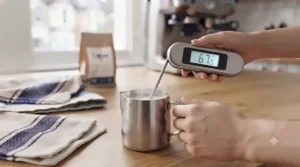
Water Temperature Thermometer for Coffee: Pour-Over vs French Press vs Espresso
Not every brewing method wants the same water temperature thermometer reading, and this is where a lot of buyers get caught out treating “coffee temperature” as a single fixed number.
Pour-over and drip methods sit at the top of the range, typically 92-96°C, because the water only contacts the grounds briefly as it passes through, so slightly hotter water compensates for that shorter contact time. French press, by contrast, holds water against grounds for several minutes during a full immersion steep, which means slightly cooler water — often 90-93°C — avoids over-extracting bitter compounds during that longer soak. Espresso sits in its own category entirely: water is forced through densely packed, finely ground coffee under pressure in around 25-30 seconds, so machines typically target 88-94°C depending on the specific bean and shot recipe being pulled.
| Method | Ideal Water Temp | Contact Time | Best Thermometer Type |
|---|---|---|---|
| Pour-over / drip | 92-96°C | 2-4 minutes | Fast probe, e.g. ThermoWorks Thermapen ONE |
| French press | 90-93°C | 4-5 minutes | Any probe, e.g. ThermoPro TP03 |
| Espresso (manual dial-in) | 88-94°C | 25-30 seconds | Fast probe or infrared, e.g. Subminimal Contactless |
| Milk steaming (lattes) | 55-65°C | Ongoing during frothing | Clip-on probe, e.g. CDN ProAccurate IRT220-F |
The table makes the practical point clearer than a paragraph of prose alone: the shorter the contact time, the more a fast-reading thermometer earns its keep, because you’re taking a live reading rather than a one-off check before you start. Milk steaming is the outlier worth flagging separately — 55-65°C is dramatically cooler than any coffee-brewing range, and pushing past roughly 70°C starts to scald milk proteins, flattening the sweetness that makes a good flat white work.
Pour-Over Water Temp: Getting It Right Every Pour
Getting a consistent pour-over water temp isn’t about hitting one magic number once — it’s about building a habit around checking it every single time, because kettle behaviour genuinely does vary batch to batch depending on how much water you’ve boiled and how long it’s been standing.
Start by boiling a full kettle rather than a partial one; a fuller kettle retains heat more predictably as it cools, giving you a more consistent temperature curve to work from each morning. Once it clicks off the boil, don’t reach straight for the dripper — most electric kettles will read a genuine 100°C at the point of switch-off, still too hot for filter coffee. Instead, pour a small amount into your server or mug first, which both warms the vessel (stopping it from robbing heat from your actual brew) and buys roughly 10-15 seconds of cooling time.
Check the water with your thermometer at that point rather than guessing by eye; steam alone is a poor indicator, since water can still be releasing visible steam anywhere from 80°C upward. If it’s reading above your target range, give it another 20-30 seconds and check again rather than pouring immediately — patience here is the actual skill, not the thermometer itself. A common first-30-days mistake is checking temperature once at the start of a brewing session and assuming it holds steady through a second or third cup; it doesn’t, since the kettle continues cooling between pours, so recheck between each one if you’re serving multiple cups.
Thermometer Accuracy: Why ±0.5°C Actually Matters
On paper, the gap between a ±0.5°C thermometer and a ±1°C model looks trivial — half a degree, who cares? In practice, accuracy tolerances compound with the other variables already at play in a brew, and that’s where the difference becomes noticeable in the cup rather than just on a spec sheet.
Consider that your kettle’s own thermostat typically has a tolerance of its own, your ambient room temperature shifts water cooling speed, and your pour technique introduces further variation in how long water actually contacts the grounds. Stack a ±1°C thermometer reading on top of those existing variables and you can genuinely be brewing anywhere across a 2-3°C window while believing you’ve hit your target precisely — enough to shift a light roast from bright and floral to noticeably flat. This is the underlying engineering reason instruments like the ThermoWorks Thermapen ONE use a thermocouple sensor rather than the cheaper thermistor sensors common in budget probes — thermocouples respond faster and hold tighter tolerances across a wider temperature range, which is exactly what daily precision brewing rewards.
Here’s what the spec sheet won’t tell you, but is worth knowing before you buy: accuracy also drifts with age and use on any digital thermometer, regardless of price tier, which is precisely why a working calibration function (usually via an ice-water bath test at 0°C) matters as much as the factory-stated tolerance. A £15 thermometer that’s been recalibrated recently can genuinely out-perform a neglected £90 one that’s drifted a degree over two years of daily use.
Digital Brew Thermometer vs Traditional Kettle Gauges
Plenty of gooseneck kettles marketed at home baristas now ship with a built-in temperature gauge — either a simple dial on the lid or, on premium electric models, a digital display on the base. It’s worth being honest about where these genuinely compete with a standalone digital brew thermometer, and where they fall short.
| Factor | Built-In Kettle Gauge | Standalone Digital Thermometer |
|---|---|---|
| Measurement point | Reads near the spout or base sensor | Reads the actual liquid you’re pouring |
| Typical accuracy | ±2-3°C on budget kettles | ±0.3-1°C depending on model |
| Versatility | Locked to one kettle | Works across kettles, jugs, servers |
| Upfront cost | Bundled into kettle price | £10-£100 as a separate purchase |
| Response to pour changes | Fixed reading, doesn’t adjust mid-pour | Live reading, checkable at any point |
The analysis here isn’t that built-in gauges are useless — a decent electric gooseneck kettle with a digital temperature-hold function is a genuinely convenient upgrade over a basic kettle. The gap is precision and flexibility: a fixed sensor built into the kettle base is measuring water near the heating element, not necessarily the water arriving in your dripper several seconds later, and it can’t travel with you to check milk temperature or a French press separately. A standalone thermometer like the ThermoPro TP19H costs a fraction of a premium gooseneck kettle and works across your entire kitchen, not just one vessel — for most buyers, owning both a decent kettle and a separate probe beats relying on a built-in gauge alone.
Real-World Scenarios: Which Thermometer Fits Your Coffee Routine
The weekday commuter. Up at 6:15am, one cafetière of coffee before the school run or commute, budget firmly capped. The ThermoPro TP03 covers this completely — a quick dip to confirm the water’s cooled enough, into a drawer, done. Spending more here buys speed this routine doesn’t need.
The weekend pour-over enthusiast. Grinds beans fresh on Saturday and Sunday mornings, owns a gooseneck kettle and digital scales already, cares about repeating a good result rather than a lucky one. This is exactly the buyer the ThermoWorks ThermoPop 2 or, budget allowing, the Thermapen ONE is built for — the sub-4-second response time matches the deliberate pace of a proper pour-over ritual, and the tighter accuracy actually shows up in the cup given the rest of their setup is already dialled in.
The home latte maker. Makes espresso-based drinks daily via a home machine, steams milk by hand, values speed and cleanliness over lab-grade precision. The CDN ProAccurate IRT220-F or Subminimal Contactless both suit this profile well — the clip-on CDN model for anyone who wants a physical grip on the jug rim, the infrared Subminimal for anyone who’d rather never touch a probe to milk at all between drinks.
Common Mistakes When Buying a Digital Coffee Thermometer
The most frequent misstep is buying purely on price without checking response time — a thermometer that takes 8-10 seconds to settle effectively forces you to hold a hot probe in liquid for that entire window, which is annoying enough that people simply stop using it after a few weeks.
A second common mistake is assuming all “instant read” branding means genuinely fast; the term is used loosely across the market, and a thermometer marketed as instant-read can still take 5-6 seconds in practice, so checking the actual stated response time in seconds — not just the marketing label — avoids disappointment. A third mistake is overlooking water resistance entirely; a thermometer that can’t be rinsed under a tap becomes a genuine hassle to keep hygienic if you’re using it across both coffee and raw meat in the same kitchen. Finally, buyers regularly skip checking whether a model has a functioning calibration process, which matters far more over an 18-month ownership period than it seems to on day one, since even quality sensors drift slightly with age and repeated temperature swings.
Long-Term Cost & Maintenance
A digital coffee thermometer is a low-maintenance tool by kitchen-gadget standards, but total cost of ownership isn’t purely the sticker price — battery replacement, probe wear and eventual sensor drift all factor in over a few years of daily use.
| Consideration | Budget Tier (£10-£20) | Premium Tier (£40-£100) |
|---|---|---|
| Typical battery life | 1,500-3,000+ hours with motion sensors | 2,000+ hours, often replaceable AAA cells |
| Probe durability | Plastic housing, moderate wear over 2-3 years | Reinforced housing rated for years of daily use |
| Calibration accuracy over time | Can drift faster without regular checks | Tighter factory tolerance, slower drift |
| Typical lifespan | 2-4 years with daily use | 5+ years, often backed by multi-year warranty |
Interpreting that table, the cost-per-use maths actually favours premium instruments for daily users: a £15 thermometer replaced every three years works out to roughly £5 a year, while a £90 Thermapen-tier device backed by a five-year warranty and built for heavier daily use can land in a similar annual cost bracket, while delivering meaningfully better speed and accuracy throughout its life. For occasional brewers, though, that maths flips — a budget thermometer used a handful of times a week may simply never wear out fast enough to justify the premium spend. Maintenance itself is minimal across the board: wipe the probe after each use, avoid submerging the electronics housing even on waterproof-rated models, and run an ice-bath calibration check every few months if your model supports it.
Problem → Solution: Fixing Common Coffee Temperature Issues
Problem: Coffee tastes bitter and harsh every time. This is the classic signature of over-extraction from water that’s too hot. Check your kettle water with a thermometer like the ThermoPro TP19H immediately after it clicks off the boil — if it’s reading a genuine 100°C, let it rest 20-30 seconds before pouring rather than going in straight away.
Problem: Coffee tastes sour or weak despite using good beans. Usually the opposite issue — under-extraction from water that’s cooled too far, often because the kettle sat too long before pouring. A quick check with any of the thermometers above before you pour catches this instantly rather than leaving you guessing after the fact.
Problem: Milk tastes scorched or has a burnt smell after steaming. Milk proteins begin breaking down noticeably above roughly 70°C, well below coffee brewing temperatures. A clip-on thermometer like the CDN ProAccurate IRT220-F, held in the jug throughout steaming, lets you pull the steam wand the moment you hit your target rather than relying on the sound or feel of the jug.
Problem: Inconsistent results from one brew to the next despite following the same recipe. Nine times out of ten this traces back to inconsistent water temperature rather than inconsistent technique — a kettle that’s stood for two minutes cools noticeably compared to one checked immediately. Rechecking temperature at the moment of pouring, every time, rather than trusting a remembered countdown, closes this gap.
Problem: Thermometer readings seem to drift or feel unreliable over time. Run a calibration check by submerging the probe in an ice-water bath, which should read as close to 0°C as your model’s accuracy rating allows; if it’s consistently off by more than that tolerance, recalibrate if the model supports it, or consider replacing it if calibration isn’t user-adjustable.
Safety, Regulations & Compliance Guide
Food-contact kitchen thermometers sold in the UK fall under general product safety and food-contact material regulations rather than a dedicated “coffee thermometer” standard, which means the practical safety checks are the same ones that apply to any food thermometer. Probes and housings that touch food or drink should be made from food-grade materials — genuine stainless steel rather than unspecified “metal alloy,” and BPA-free plastics on the housing — details that reputable brands list clearly on their packaging and product pages.
Buyers importing thermometers from outside the UK, or buying from third-party marketplace sellers rather than the manufacturer directly, should specifically check for UKCA or CE marking, which indicates the product has been assessed against relevant UK or EU safety standards. The Office for Product Safety and Standards is the UK body responsible for enforcing product safety rules, including electrical and food-contact goods, and its guidance is worth a glance if you’re ever unsure whether a listing looks legitimate.
Beyond formal compliance, a couple of practical safety habits matter day to day: never fully submerge a digital thermometer’s electronics housing even on IP65-rated models, since that rating typically covers splashing and rinsing rather than full immersion, and replace batteries promptly when a low-battery indicator appears, since a dying display can start showing inaccurate readings before it fails outright — a genuinely easy way to end up with a misleadingly “safe” reading on scalding-hot milk.
Frequently Asked Questions
❓ What is the best digital coffee thermometer for beginners?
❓ How accurate does a coffee thermometer need to be?
❓ Can I use a meat thermometer for coffee?
❓ How long should I wait after boiling before pouring over coffee?
❓ Do digital thermometers work for milk frothing as well as brewing?
Conclusion
If there’s one takeaway from all of this, it’s that water temperature isn’t a minor detail of coffee brewing — it’s one of the two or three variables that actually determines whether a good bag of beans turns into a genuinely great cup or a merely adequate one. A digital coffee thermometer turns that variable from a guess into a number you can see, check, and repeat.
For most people reading this, the decision comes down to how often you brew and how far you’ve already gone down the specialty coffee rabbit hole. Occasional drinkers get real value from a budget probe like the ThermoPro TP03 or ThermoPro TP19H — cheap enough to buy without deliberation, accurate enough to fix the “why does my coffee taste off today” problem entirely. Daily pour-over brewers chasing consistency will feel the difference a faster, tighter-tolerance instrument like the ThermoWorks ThermoPop 2 or Thermapen ONE makes, not because the number on the screen is dramatically different, but because checking it becomes effortless enough that you actually do it every single time. And anyone steaming milk regularly should weight the CDN ProAccurate IRT220-F or Subminimal Contactless more heavily than the others, since they’re solving a slightly different problem than pure water temperature.
Whichever tier you land on, the underlying habit matters more than the specific model: check before you pour, recheck between cups, and let a real number replace the guesswork that’s probably been shaping your coffee — for better or worse — all along.
✨ Don’t Miss These Exclusive Deals!
🔍 Take your coffee routine to the next level with these carefully selected thermometers. Click on any highlighted product to check current pricing and availability on Amazon. A few pounds spent here genuinely pays off in every single cup you brew afterwards!
Recommended for You
- 7 Best Milk Thermometer for Latte Art UK 2026: Perfect Pours
- Best Coffee Brew Timer 2026: 7 Picks for Perfect Extraction
- Digital Timer for Coffee Brewing Under £10: 7 Picks for 2026
Disclaimer: This article contains affiliate links. As an Amazon Associate, I earn from qualifying purchases. If you purchase products through these links, we may earn a small commission at no additional cost to you.
✨ Found this helpful? Share it with your friends! 💬🤗
