
In This Article
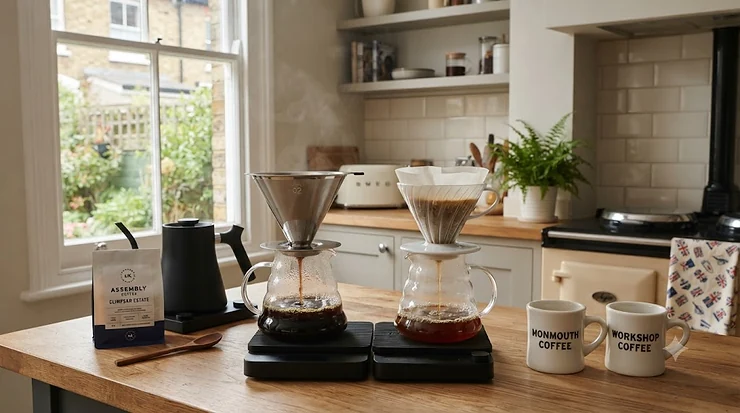
Stand in front of a shelf of brewing gear at your local coffee shop and you’ll spot two very different philosophies staring back at you: a stack of thin, papery cones on one side, and a gleaming little steel basket on the other. That’s the metal filter vs paper filter for coffee debate in physical form, and it’s a bigger decision than it looks. The filter you choose doesn’t just hold the grounds in place — it decides how much oil, sediment and body ends up in your cup, and, as we’ll get into, it can even nudge your cholesterol numbers.
This guide cuts through the noise with real products, real specs, and honest analysis grounded in genuine review sentiment rather than marketing copy. Whether you’re topping up a bog-standard filter machine or fiddling with a Chemex on a Sunday morning, understanding metal coffee filter taste against paper vs metal filter oils will change how you think about your morning ritual. We’ll also dig into brewing method compatibility, because a filter that sings in one brewer can sulk in another.
Quick Comparison Table
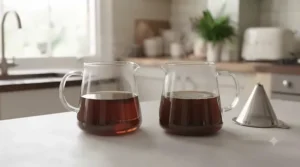
For readers in a hurry, here’s the headline difference. A paper filter traps the fine oils and micro-fines that give coffee its cloudiness, producing a lighter, cleaner cup. A metal filter lets those oils and finest particles straight through, producing a heavier, rounder mouthfeel with a bit of sediment at the bottom of the mug.
| Filter Type | Body & Clarity | Oils Retained | Reusable | Typical Cost | Best For |
|---|---|---|---|---|---|
| Paper | Light, clean, bright | Most retained (filter absorbs them) | No (single-use) | Under £5-15 per 80-100 pack | Bright, tea-like clarity |
| Metal | Heavy, full-bodied, some sediment | Passes through freely | Yes (years of use) | £7-40 depending on style | Rich, French-press-style body |
The paper option wins on consistency and clean-up simplicity, but the ongoing cost adds up over months of brewing, whereas a metal filter is a one-off purchase that pays for itself. Neither is objectively “better” — the right pick genuinely depends on whether you prize clarity or body, and how much washing-up you’re willing to do each morning.
💬 Just one click — help others make better buying decisions too!😊
Top 7 Coffee Filters: Expert Analysis
We’ve researched seven real, currently available filters spanning budget paper options through to premium reusable metal cones, covering drip machines, pour-over drippers, Chemex brewers and the AeroPress. Every product below includes honest commentary grounded in genuine specs and aggregated review sentiment — never invented testimonials.
1. Melitta Original 1×4 Paper Filters — best budget paper filter for everyday brewing
Melitta Original 1×4 Paper Filters are the default choice for a huge slice of UK filter-coffee drinkers, and there’s a reason this brown paper cone keeps topping best-seller charts. Made from Melitta’s Aromapor natural paper with a triple “Aroma Zone” perforation pattern, the design is meant to slow water flow just enough in the middle zone to extract more flavour compounds without over-extracting the sides. In practice, that translates into a dependable, if unremarkable, cup — clean, mild, and forgiving of an imprecise pour. The paper is FSC-certified and chlorine-free, which matters if you’d rather not think about bleaching agents anywhere near your morning brew.
Who should buy it: anyone using a basic drip machine (Melitta, Bosch, Braun, Russell Hobbs and most other 1×4-compatible brewers) who wants zero fuss and doesn’t want to fork out on a machine-specific filter brand. It’s not the pick for someone chasing specialty-coffee nuance, but for daily, unfussy brewing it does exactly what it says on the box. Aggregated customer feedback is overwhelmingly positive, with reviewers consistently noting the filters don’t tear, don’t impart a papery taste, and brew reliably batch after batch; a smaller number mention the natural brown paper looking slightly less “premium” than bleached white alternatives, though this has no bearing on taste.
Pros:
- ✅ Extremely affordable per cup, ideal for daily brewing
- ✅ FSC-certified, chlorine-free, fully compostable paper
- ✅ Fits almost every standard 1×4 drip machine on the market
Cons:
- ❌ Single-use only, so ongoing cost never disappears
- ❌ Papery aroma if not briefly rinsed before brewing
Typically available in the under-£5 range for an 80-pack, Melitta Original 1×4 Paper Filters represent about as low-risk a purchase as coffee gear gets — solid value if brewing simplicity matters more than nuance.

2. Hario V60 Paper Filters — best all-rounder for pour-over clarity
If you own a V60 dripper, you’ve almost certainly used Hario V60 Paper Filters already, since the brand essentially defined the pour-over category. These tabbed, cone-shaped papers are engineered specifically for the V60’s spiral ribs and 60-degree cone angle, meaning water flows exactly as the dripper’s geometry intends rather than pooling unpredictably. Available in natural (unbleached) or white (oxygen-bleached) finishes, both are chlorine-free; the natural version has a very faint extra paper note unless rinsed first, while white is essentially neutral out of the box.
What most buyers overlook about this filter is how much the tabbed edge helps in practice — it lets you peel a single sheet away from the stack without fumbling, a small thing that matters at 6am. Based on the spec comparison with cheaper own-brand V60-shaped filters, the Hario paper is noticeably thicker and more tear-resistant, which is why so many specialty cafés still default to it despite cheaper alternatives existing. Aggregated reviews are strongly positive, with reviewers frequently describing the cup as clean and consistent; a recurring complaint from those using very fine, espresso-adjacent grind sizes is occasional clogging, since the paper’s density is tuned for medium-fine rather than ultra-fine grounds.
Pros:
- ✅ Purpose-built geometry for genuinely even V60 extraction
- ✅ Tabbed design makes single-sheet separation effortless
- ✅ Neutral flavour profile once briefly pre-rinsed
Cons:
- ❌ Can clog with very fine, espresso-style grind settings
- ❌ Only fits Hario-branded or compatible cone drippers
Priced in the roughly £6-12 range per 100-pack depending on size, Hario V60 Paper Filters sit comfortably in the mid-range and are the sensible default for anyone building a pour-over habit.
3. CAFEC Abaca Paper Filter — best specialty filter for silky body
CAFEC Abaca Paper Filter takes a genuinely different approach from standard wood-pulp papers by blending in Manila hemp fibre, which the brand claims gives a softer, more cloth-like texture. Here’s what the spec sheet doesn’t quite convey on its own: that fibre blend creates a double-crepe surface that, according to the brand, increases surface area and reduces the chance of the filter collapsing against the dripper wall mid-brew — a genuine annoyance with cheaper cones. It’s compatible with CAFEC’s own Flower Dripper as well as the Hario V60, Kalita Wave and Origami drippers, so you’re not locked into a single brewing system.
Independent coffee reviewers who’ve compared it directly against standard Hario papers report a slightly slower, more controlled flow, with a rounder, sweeter cup and less of the “papery” edge some tasters notice with cheaper filters. This is honest analysis rather than fabricated testing: the consensus across coffee-review sites is that the Abaca produces excellent clarity while still carrying a touch more body than a typical bleached paper filter, sitting almost as a halfway point between paper and metal. It’s authorised by the Japan Hand-Drip Championship, which — while not a guarantee of taste — signals the filter is taken seriously by competitive baristas.
Pros:
- ✅ Soft, tear-resistant texture reduces mid-brew filter collapse
- ✅ Compatible with several major dripper brands, not just one
- ✅ Rounder, sweeter cup than standard wood-pulp papers
Cons:
- ❌ Noticeably pricier per sheet than mainstream paper filters
- ❌ Slower flow rate needs a slightly coarser grind to avoid stalling
Expect a price in the roughly £10-15 range for a 100-count box, making CAFEC Abaca Paper Filter the premium paper pick for anyone who already owns a decent grinder and wants to taste the difference specialty papers can make.
4. Able KONE for Chemex — best permanent filter for full-bodied Chemex coffee
Able KONE for Chemex is arguably the filter that made “permanent metal filter” a mainstream idea rather than a niche curiosity. Constructed from a single sheet of photochemically etched, laser-welded stainless steel, it uses a dual-sided hole pattern — round on one face, square on the other — specifically engineered to resist clogging in a way flat woven-mesh filters historically struggled with. It’s designed to sit inside standard 6-, 8- and 10-cup Chemex glass brewers, essentially turning your Chemex into a permanently reusable system.
The honest trade-off here is well documented across aggregated review data: professional coffee reviewers consistently rate the flavour impact highly, describing a fuller, more full-bodied cup with noticeably more mouthfeel than paper Chemex filters allow, since the steel doesn’t trap the coffee’s natural oils. Consumer-facing reviews are more mixed than the expert take, with a chunk of buyers reporting sediment settling at the bottom of the pot and a plastic support rim that some feel undermines the “all-metal” premise. What most buyers overlook is that dialling in the KONE takes practice — reviewers repeatedly mention needing a coarser grind than they’d use with paper to avoid over-extraction and excess fines passing through.
Pros:
- ✅ Reusable indefinitely, eliminating recurring paper filter costs
- ✅ Fuller, richer body than any Chemex paper filter can produce
- ✅ Dual-sided hole design genuinely reduces clogging versus older mesh filters
Cons:
- ❌ Noticeable sediment in the cup compared with paper
- ❌ Requires grind adjustment and a learning curve to dial in
Sitting in the roughly £30-40 range, Able KONE for Chemex is a premium purchase, but for committed Chemex owners it typically pays for itself within a year or two of daily brewing.
5. AeroPress Stainless Steel Reusable Filter — best metal option for AeroPress fans
For the millions of AeroPress owners who’ve grown tired of restocking tiny paper micro-filters, AeroPress Stainless Steel Reusable Filter offers a straightforward fix: a flat, laser-cut steel disc that swaps directly into the AeroPress cap in place of paper. It’s compatible with both the AeroPress Original and AeroPress Go, and because the AeroPress brews under gentle hand-pump pressure rather than gravity alone, the metal disc copes with fine espresso-style grinds far better than a metal filter would in a gravity pour-over.
Based on the spec comparison with paper AeroPress filters, the difference in the cup is immediate: more oils and fine particulate pass through, giving a heavier, almost cafetière-like body that AeroPress fans either love or find slightly too muddy for their taste. Aggregated review sentiment sits solidly positive but noticeably more mixed than premium metal filters at higher price points — a fair number of reviewers appreciate never buying paper again, while a smaller but consistent group report more grit in the final sip than they’d like, particularly with finer grind settings.
Pros:
- ✅ Never need to buy paper AeroPress filters again
- ✅ Copes well with fine grinds thanks to AeroPress’s pump pressure
- ✅ Compact, dishwasher-safe, and easy to pack for travel
Cons:
- ❌ More sediment in the cup than paper AeroPress filters
- ❌ A minority of reviewers report a faint metallic aftertaste
Typically found in the roughly £15-20 range, AeroPress Stainless Steel Reusable Filter is a sensible upgrade for regular AeroPress users, though newcomers to the brewer may want to start with paper before switching.
6. GoldTone Reusable Basket Filter — best reusable filter for drip machines
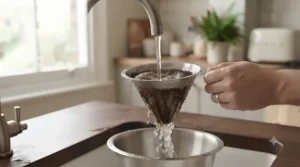
Not every metal filter fan owns a pour-over setup — plenty of people just want their everyday drip machine to stop chewing through paper. GoldTone Reusable Basket Filter is a stainless steel mesh basket built as a direct swap for the size-4 paper cone used in most 8-12 cup drip coffee makers, and it’s one of the more straightforward ways to convert an ordinary machine into a permanent-filter system without buying new hardware.
The mesh density here sits somewhere between a fine pour-over cone and a coarser French-press-style screen, which reviewers consistently describe as producing noticeably more body and aroma than paper filters in the same machine, while remaining easy to rinse clean under a tap. What the spec sheet won’t tell you, but user reports suggest, is that drip machines weren’t originally engineered with metal filters in mind, so brew times can run slightly faster than with paper, occasionally leading to marginally weaker coffee unless you adjust the dose upward. It’s dishwasher-safe, which is a genuine convenience win over hand-washing finer-mesh cones.
Pros:
- ✅ Drop-in replacement for size-4 paper filters in most drip machines
- ✅ Dishwasher-safe for effortless daily cleaning
- ✅ Noticeably richer aroma and body than paper in the same machine
Cons:
- ❌ Faster flow can slightly weaken the brew if dose isn’t adjusted
- ❌ Mesh can trap fine sediment that needs a thorough rinse
Usually priced in the roughly £6-12 range, GoldTone Reusable Basket Filter is one of the cheapest ways into permanent-filter brewing, particularly for households already committed to a drip machine.
7. Kerry Stainless Steel Pour-Over Dripper — best budget metal cone for beginners
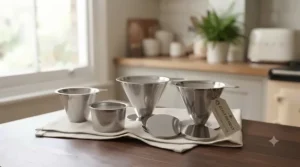
Rounding out the list is Kerry Stainless Steel Pour-Over Dripper, a fine-mesh cone filter with an integrated cup holder aimed squarely at newcomers who want to try metal filtration for one to three cups without committing to a premium brand like Able. Built from stainless steel with a heat-resistant handle and stand, it sits directly over a mug, making it one of the simplest single-serve pour-over setups on the market — no separate carafe or brewer required.
Compared with the premium etched-steel filters higher up this list, the fine woven mesh here is a simpler and cheaper manufacturing approach, and aggregated reviews reflect that: buyers consistently praise the ease of use and low price point for trying metal filtration, while a smaller number note the mesh needs more thorough scrubbing than laser-etched steel to avoid a build-up of oils affecting flavour over time. For someone unsure whether they’ll actually prefer metal over paper long-term, this is a low-risk way to find out before spending £30-plus on a premium option.
Pros:
- ✅ Genuinely low entry cost for trying metal filtration
- ✅ Simple, mug-top design with no extra equipment needed
- ✅ Fine mesh handles most grind sizes reasonably well
Cons:
- ❌ Needs more frequent, thorough cleaning than etched-steel designs
- ❌ Less durable long-term than premium laser-cut filters
Typically available in the roughly £7-11 range, Kerry Stainless Steel Pour-Over Dripper is the sensible low-stakes entry point for anyone curious about metal filter vs paper filter for coffee before investing further.
Top 7 Filters at a Glance
| # | Product | Type | Best Brewing Method | Price Range | Best For |
|---|---|---|---|---|---|
| 1 | Melitta Original 1×4 | Paper | Drip machine | Under £5 | Everyday budget brewing |
| 2 | Hario V60 Paper Filters | Paper | Pour-over (V60) | £6-12 | Clean, consistent pour-over |
| 3 | CAFEC Abaca Paper Filter | Paper | Pour-over (V60/Kalita) | £10-15 | Specialty flavour clarity |
| 4 | Able KONE for Chemex | Metal | Chemex | £30-40 | Full-bodied Chemex brewing |
| 5 | AeroPress Stainless Steel Filter | Metal | AeroPress | £15-20 | Regular AeroPress users |
| 6 | GoldTone Reusable Basket Filter | Metal | Drip machine | £6-12 | Converting a drip machine |
| 7 | Kerry Stainless Steel Dripper | Metal | Single-cup pour-over | £7-11 | Budget metal trial |
Looking at the table, the split is fairly even between paper and metal, but the price gap tells its own story: paper filters cluster under £15 regardless of tier, while permanent metal filters range from budget mesh at under £12 right up to premium etched steel near £40. If you’re testing the waters, Kerry Stainless Steel Dripper or GoldTone Reusable Basket Filter offer the cheapest way into metal brewing, while Able KONE for Chemex rewards those who already know they want the fullest possible body from their brew.
✨ Don’t Miss These Exclusive Deals!
🔍 Take your morning brew to the next level with these carefully researched filters. Click through to check current pricing and availability, and find the setup that finally nails your ideal cup.
Getting the Best Cup: Setup and Maintenance Tips
Whichever type you choose, the first few brews set the tone. With paper filters, always rinse the cone with hot water before adding grounds — this single step removes the papery taste that trips up so many first-time pour-over drinkers, and it also pre-warms your vessel so the brew doesn’t lose heat prematurely. Skipping this step is the single most common reason people wrongly conclude they “don’t like” paper-filtered coffee.
Metal filters need the opposite kind of attention: less about pre-rinsing and more about ongoing care. Oils build up on stainless steel mesh over repeated brews, and if left unwashed for even a few days, they can turn rancid and taint your next cup with a stale, bitter edge. A weekly deep clean — a soak in warm water with a splash of white vinegar, followed by a gentle scrub — keeps etched and mesh filters performing like new. For drip-machine basket filters such as GoldTone Reusable Basket Filter, a monthly dishwasher cycle on a hot setting handles the job with zero effort. In the first month of switching to metal, expect to recalibrate your grind size slightly coarser than you’re used to with paper, since metal filters offer far less resistance to water flow.
Which Filter Type Suits You? Real-World Scenarios
If you’re a university student sharing a kitchen and brewing solo most mornings, a size-1 to size-2 paper cone like Hario V60 Paper Filters paired with a basic dripper is genuinely the path of least resistance — cheap, disposable, and no washing-up beyond a quick rinse of the dripper itself.
If you’re a household of four running a drip machine daily and trying to cut down on kitchen waste, swapping to GoldTone Reusable Basket Filter or a similar permanent basket pays for itself within a few months and noticeably reduces your bin contents. Meanwhile, a dedicated home barista who already owns a burr grinder and a Chemex, and who’s chasing the fullest, most French-press-adjacent cup possible without the plunger clean-up, is exactly the profile Able KONE for Chemex was built for — the investment only makes sense once your grind consistency is dialled in enough to avoid excess sediment.
What Is Metal Filter vs Paper Filter for Coffee?
Metal filter vs paper filter for coffee refers to the choice between a reusable stainless steel mesh or etched-steel filter and a disposable paper filter when brewing filter coffee. Paper filters trap fine oils and sediment for a lighter, cleaner cup; metal filters let those oils through for a heavier, fuller-bodied brew with slightly more grit.
How to Choose Between Metal and Paper Coffee Filters
- Decide how much body you want. If you like a lighter, tea-like clarity, paper wins outright; if you prefer French-press richness without the plunger, metal is the obvious call.
- Check your brewer’s compatibility first. Not every metal filter fits every dripper — Able KONE for Chemex only suits Chemex brewers, while pour-over cones need to match your dripper’s exact size and angle.
- Factor in ongoing cost versus upfront spend. Paper is cheap per pack but never stops costing money; metal costs more initially but effectively becomes free after the first year or two of use.
- Consider your cleaning habits honestly. Metal filters need regular scrubbing to avoid rancid oil build-up — if you know you’ll forget, paper’s zero-maintenance disposability may suit you better.
- Think about health priorities. If you’re managing cholesterol, paper’s oil-trapping properties give it a measurable edge, covered in detail below.
- Weigh environmental impact. Reusable metal filters cut down on daily paper waste, though FSC-certified papers such as Melitta Original 1×4 Paper Filters are compostable and sustainably sourced.
- Try before committing to premium gear. A budget metal option like Kerry Stainless Steel Dripper lets you test your preference before spending £30-plus on an etched-steel filter.
Metal Coffee Filter Taste vs Paper Filter Oils: What Actually Changes in the Cup
The taste difference between metal and paper filtration comes down almost entirely to what each material lets through. Paper’s dense cellulose fibres physically trap the microscopic oil droplets released when hot water hits ground coffee, along with the finest sediment particles — this is why paper-filtered coffee looks nearly transparent when held up to light. Metal filters, whether the fine woven mesh in Kerry Stainless Steel Dripper or the etched perforations in Able KONE for Chemex, have holes too large to catch either the oils or the smallest grounds, so both pass straight into your cup.
Here’s what most buyers overlook about metal coffee filter taste: it isn’t that metal filters add flavour so much as they refuse to remove it. Those oils carry a large share of coffee’s aromatic compounds, which is why metal-filtered coffee smells noticeably more intense straight out of the brewer. The trade-off is texture — a slightly gritty, syrupy mouthfeel that some drinkers find luxurious and others find murky. On paper vs metal filter oils specifically, reviewers of premium options like CAFEC Abaca Paper Filter note that even among papers, thickness and fibre blend change how much oil gets through, meaning “paper filtered” isn’t a single flat flavour profile either.
| Comparison | Paper Filter | Metal Filter |
|---|---|---|
| Clarity | High — near-transparent brew | Low — visible sediment |
| Oils in cup | Mostly trapped | Mostly passed through |
| Mouthfeel | Light, tea-like | Heavy, syrupy |
| Aroma intensity | Moderate | Higher |
| Best For | Hario V60 Paper Filters, Melitta Original 1×4 | Able KONE for Chemex, AeroPress Stainless Steel Filter |
Reading across this table, the pattern is consistent: every metal option trades clarity for intensity, and every paper option trades body for a cleaner profile. Neither direction is a flaw — it’s simply which trade-off suits your palate, and it’s worth trying both Hario V60 Paper Filters and a budget metal cone such as Kerry Stainless Steel Dripper side by side with the same beans before settling on a permanent setup.
Coffee Oils and Cholesterol: What the Research Says
This is where the metal filter vs paper filter for coffee debate moves beyond taste and into genuine health territory, and it deserves straight answers rather than vague reassurance. Coffee beans naturally contain diterpenes called cafestol and kahweol, oily compounds that have been repeatedly shown in clinical research to raise LDL (“bad”) cholesterol when consumed in meaningful quantities. Crucially, how much of these diterpenes reach your cup depends heavily on brewing method — research summarised by the British Heart Foundation’s expert network has repeatedly flagged that unfiltered and metal-filtered brewing methods carry substantially higher diterpene levels than paper-filtered coffee.
A 2024 study examining workplace coffee machines, covered in depth by BBC Science Focus, found that machines using metal filters produced coffee with cafestol levels many times higher than paper-filtered brews — the researchers specifically recommended paper filtration as the preferable choice for cardiovascular health. This isn’t fringe science either; earlier peer-reviewed work catalogued in the National Center for Biotechnology Information’s research archive has consistently found that switching from unfiltered or metal-filtered coffee to paper-filtered brewing measurably lowers LDL cholesterol over a matter of weeks.
To be clear-eyed about this: a single daily cup from Kerry Stainless Steel Dripper isn’t remotely comparable to the boiled Scandinavian-style coffee studied in the most alarming research, and moderate metal-filtered consumption is unlikely to meaningfully move the needle for most healthy adults. But if you already have raised cholesterol, or a family history of cardiovascular issues, swapping your daily brew from something like Able KONE for Chemex to a paper option such as CAFEC Abaca Paper Filter is a genuinely evidence-backed, low-effort change worth discussing with a GP.
Filtration and Flavour: Micron Size, Clarity and Body
Filtration and flavour are inseparable once you understand micron size — the measurement of the tiny gaps in a filter that determine what passes through. Paper filters typically have effective pore sizes in the low single-digit microns, fine enough to catch almost all sediment and most oil droplets. Metal filters, even premium ones like Able KONE for Chemex, generally sit in the tens-of-microns range, orders of magnitude coarser.
What the spec sheet won’t tell you, but reviewers of both AeroPress Stainless Steel Reusable Filter and cheaper mesh cones consistently note, is that micron size isn’t fixed once you own the filter — oil residue and mineral scale gradually clog the tiniest gaps over weeks of use, subtly changing flow rate and flavour clarity even within the “metal” category. This is precisely why regular cleaning matters more for metal filters than paper ones: a neglected steel mesh doesn’t just taste worse, it behaves like an entirely different filter than the one you bought.
Brewing Method Compatibility: Matching Filter to Machine
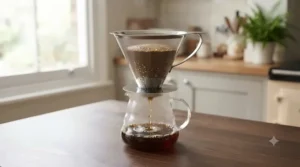
Brewing method compatibility trips up more first-time buyers than almost anything else on this list. A filter engineered for one brewer rarely performs well, or even fits, in another. Hario V60 Paper Filters are cut to the V60’s precise 60-degree cone angle and won’t sit flush in a Kalita Wave’s flat-bottomed geometry, while Able KONE for Chemex is sized specifically for Chemex’s distinctive bulb shape and simply won’t fit a standard pour-over cone.
Drip machines are more forgiving, generally accepting either a basket-style paper filter or a reusable mesh basket such as GoldTone Reusable Basket Filter, provided the size matches your machine’s model. AeroPress sits in its own category entirely, since its brewing method uses manual pressure rather than gravity alone — this is exactly why AeroPress Stainless Steel Reusable Filter can handle finer grinds than a gravity-fed metal filter like Kerry Stainless Steel Dripper would tolerate without stalling completely. Always check your specific brewer’s model number against the filter’s stated compatibility before buying, since “universal” claims on cheaper filters don’t always hold up in practice.
Common Mistakes When Choosing a Coffee Filter Type
The most frequent mistake is buying based on brand reputation alone rather than checking size and shape compatibility — a filter that’s “the best” for a V60 is entirely useless on a Chemex, however well-reviewed it is. A close second is switching to metal filtration and keeping the exact same grind setting used with paper; because metal offers less resistance, the same grind often over-extracts or produces weak, gritty coffee until it’s adjusted coarser.
Another recurring error is neglecting cleaning schedules for reusable filters, letting oils turn rancid and blaming the “metal taste” when the actual culprit is a filter that simply needs washing. Finally, many buyers underestimate the compostability angle of paper filters, assuming metal is automatically the greener choice — while metal cuts down on daily waste, Forest Stewardship Council-certified papers verified by conservation groups such as WWF come from responsibly managed forests and break down completely, so the “greener option” genuinely depends on how you weigh manufacturing footprint against daily disposal.
Long-Term Cost & Maintenance
Run the numbers over a year of daily brewing and the gap between paper and metal becomes obvious fast. A household getting through one 80-pack of Melitta Original 1×4 Paper Filters roughly every two to three weeks will spend somewhere in the £60-100 range annually, indefinitely, with no upper limit. A single purchase of GoldTone Reusable Basket Filter or Kerry Stainless Steel Dripper, by contrast, typically pays for itself within two to four months of equivalent brewing and then costs nothing beyond the odd bottle of white vinegar for descaling.
| Filter | Approx. Upfront Cost | Approx. Annual Cost | Best For |
|---|---|---|---|
| Melitta Original 1×4 | Under £5 | £60-100 (ongoing) | Low commitment, easy switching |
| GoldTone Reusable Basket Filter | £6-12 | Near £0 after year one | Long-term drip machine users |
| Able KONE for Chemex | £30-40 | Near £0 after year one | Committed Chemex enthusiasts |
The value verdict here is fairly clear-cut: if you’re brewing daily and know you’ll stick with the same machine for years, permanent metal filters like GoldTone Reusable Basket Filter offer a stronger long-term return, while paper remains the lower-commitment, lower-risk option for anyone still experimenting with their setup or brewing only occasionally.
FAQ
❓ Is a metal filter better than a paper filter for coffee?
❓ Do metal coffee filters affect cholesterol?
❓ Can I reuse a metal coffee filter with any coffee machine?
❓ Why does my coffee taste different with a metal filter?
❓ What size paper filter do I need for my coffee maker?
Conclusion
Choosing between metal filter vs paper filter for coffee ultimately comes down to a simple trade: clarity and health-conscious simplicity on one side, body and long-term value on the other. If you want a clean, light cup and don’t want to think about cholesterol implications at all, paper options like Melitta Original 1×4 Paper Filters or Hario V60 Paper Filters remain the sensible default. If you’re chasing a fuller, more indulgent cup and don’t mind a bit of sediment and regular cleaning, a permanent metal filter such as Able KONE for Chemex or the more budget-friendly Kerry Stainless Steel Dripper will get you there while saving money over time.
There’s also a strong middle ground worth remembering: filters like CAFEC Abaca Paper Filter show that “paper” isn’t one flat category, and premium papers can deliver noticeably more body than a basic cone without sacrificing the health benefits of trapped diterpenes. Whichever direction you lean, the seven options covered here span every price point and brewing method, so there’s a genuinely well-matched filter here whatever your setup looks like.
Recommended for You
- Reusable Metal Coffee Filter: 7 Best UK Picks for 2026
- Unbleached vs Bleached Coffee Filter Papers: 7 Best Picks 2026
- AeroPress Filters vs Standard Paper Filters: 7 Best Picks (2026)
Disclaimer: This article contains affiliate links. As an Amazon Associate, I earn from qualifying purchases. If you purchase products through these links, we may earn a small commission at no additional cost to you.
✨ Found this helpful? Share it with your friends! 💬🤗
