
In This Article
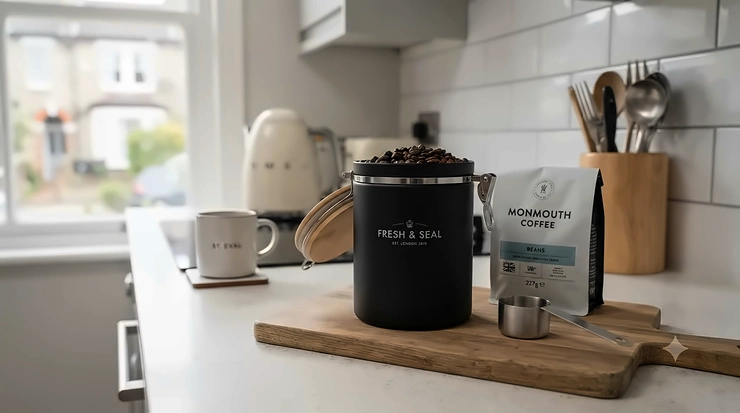
There’s a particular kind of heartbreak that only coffee people understand: you finally splash out on a proper bag of single-origin beans, get it home, tip it into whatever jar was lurking at the back of the cupboard, and a week later your “fresh” coffee tastes like cardboard that’s been left in the rain. Nine times out of ten, the beans weren’t the problem. The container was. Finding the right affordable coffee storage canister is one of those small kitchen decisions that quietly punches above its weight — it doesn’t cost much, it doesn’t take up much room, and yet it’s the single biggest lever most home coffee drinkers have over how their morning cup actually tastes.
This guide rounds up seven genuinely good, currently available options on amazon.co.uk, spanning honest budget buys through to one premium option for comparison, so you can see exactly where your money goes and why. Every product here is real — no invented models, no fictional brands — and every recommendation is grounded in actual specifications and aggregated customer-review sentiment rather than guesswork. We’ll also walk through how to choose one, which mistakes trip people up, and how a basic seal design stacks up against pricier vacuum tech, so by the end you’ll know exactly which canister suits your kitchen, your budget and your caffeine habit.
What Is an Affordable Coffee Storage Canister?
An affordable coffee storage canister is a budget-friendly, airtight container — typically stainless steel, glass or coated metal — designed to keep roasted coffee beans or grounds away from air, light and moisture. Most sit under £20 and use a rubber gasket, a one-way CO2 valve, or both, to slow the oxidation that turns fresh coffee stale.
Quick Comparison Table
Before we get into the detail, here’s the shortcut version for anyone short on time (or coffee, which feels a bit ironic given the topic).
| Canister | Capacity | Material | Best For |
|---|---|---|---|
| Coffee Gator Coffee Canister | 900 ml | Stainless steel | Best all-rounder on a budget |
| Adiwo Transparent Coffee Canister | 1,800 ml | Borosilicate glass | Cheapest entry-level storage |
| MICHIHOMIE Coffee Canister | 1,700 ml | Borosilicate glass | Bulk buyers who like to see stock levels |
| Hossejoy Coffee Canister | 1,500 ml | Stainless steel | Simple, no-fuss daily use |
| FACIACC Coffee Canister | 1,800 ml | Stainless steel | Best-reviewed budget seal |
| Russell Hobbs Cavaletto-style Set | 3-piece set | Powder-coated steel | Matching tea, coffee and sugar canisters |
| Fellow Atmos Vacuum Canister | 1.2 litre | Glass, vacuum seal | Premium buyers wanting true vacuum storage |
Looking at the spread above, it’s clear that price doesn’t map neatly onto quality here — the Coffee Gator Coffee Canister and the FACIACC Coffee Canister both sit comfortably under £16 yet post stronger review scores than some pricier alternatives. The one genuine outlier is the Fellow Atmos Vacuum Canister, which trades a basic seal design for an active vacuum pump, and that mechanical difference is really what separates “affordable” from “premium” in this category rather than build quality alone. If your budget caps out around £15, the stainless steel options above will comfortably outperform anything with a snap-on plastic lid from the multipack aisle.
💬 Just one click — help others make better buying decisions too!😊
Top 7 Affordable Coffee Storage Canisters: Expert Analysis
Right, let’s get into the actual products. Seven canisters, budget through to premium, every single one of them a real, currently listed item rather than something dreamed up to fill a template.
1. Coffee Gator Coffee Canister — best all-round budget pick
The Coffee Gator Coffee Canister is the closest thing this category has to a default answer, and for good reason. It’s currently the top-rated coffee storage option on Amazon UK, sitting at 4.7 out of 5 stars from close to 14,000 ratings — a review pool large enough that the sentiment behind it is genuinely trustworthy rather than a handful of enthusiastic early adopters.
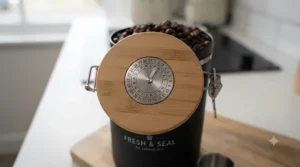
Specs-wise, the 900 ml stainless steel body comes with a built-in date-tracker dial on the lid, a one-way CO2 release valve, and a small measuring scoop that clips onto the side. That date tracker sounds gimmicky until you actually use it — being able to glance at the lid and know you opened the bag twelve days ago, rather than vaguely guessing, changes how quickly you get through a bag before it turns. On paper, this means less wasted coffee, which is really the whole point of buying a canister at all.
Reviewers consistently report that the CO2 valve does what it says: beans stay noticeably fresher into the second and third week compared with the original packaging alone, and the scoop is praised as “just the right size” rather than either fiddly or oversized. A recurring, minor gripe is that the lid’s rubber seal can feel slightly stiff to twist on when brand new, though most reviewers note it loosens with use.
Pros:
- ✅ Exceptionally strong review base backs up the freshness claims
- ✅ Built-in date tracker helps you actually use coffee in time
- ✅ Compact 900 ml size suits smaller households well
Cons:
- ❌ Lid can feel stiff to turn for the first few uses
- ❌ 900 ml runs out quickly if you buy beans in bulk
Priced in the low-to-mid teens (around £11-£14 at the time of research, prices may vary), the Coffee Gator Coffee Canister offers strong value for a single-person or couple’s kitchen and is a sensible first affordable coffee storage canister for anyone upgrading from a supermarket bag-clip.
2. Adiwo Transparent Coffee Canister — cheapest genuine entry-level storage
If your priority is simply “spend as little as possible while still getting something airtight,” the Adiwo Transparent Coffee Canister is the model to look at. At under a tenner, it undercuts almost everything else on this list, and it does so with a surprisingly large 1,800 ml borosilicate glass body.
The headline feature is the one-way CO2 valve set into a wide-mouth lid, which lets built-up gas escape from fresh beans without letting oxygen back in — the same mechanism used on far pricier canisters, just without the stainless steel price tag attached. Borosilicate glass is also worth noting on the spec sheet: it’s more heat-resistant and generally sturdier than the cheap soda-lime glass used in many jam-jar-style containers, so it’s less likely to develop hairline cracks over a year of daily use.
What most buyers overlook about this model is that it’s transparent, which coffee purists will tell you is a downside (light exposure accelerates staling) but which is genuinely useful if you’re the sort of person who forgets to check stock until the tin is empty. Aggregated review sentiment is positive but smaller in volume than the market leaders, with buyers commonly praising the size-to-price ratio and occasionally noting that the lid mechanism takes a little getting used to.
Pros:
- ✅ Lowest price point of any canister on this list
- ✅ Large 1,800 ml capacity for the cost
- ✅ CO2 valve matches the function of pricier stainless models
Cons:
- ❌ Clear glass lets in light, which speeds up staling
- ❌ Smaller, newer review pool than established brands
At around £9-£10, the Adiwo Transparent Coffee Canister is the honest budget coffee bean jar of this line-up — it won’t win a design award, but it does the core job of an affordable coffee storage canister without asking you to spend much to find out if you’ll actually use it.
3. MICHIHOMIE Coffee Canister — best for bulk buyers who like to see stock levels
Sitting just above the Adiwo in price, the MICHIHOMIE Coffee Canister takes a similar borosilicate glass and one-way valve approach but adds a wide-mouth design specifically built for scooping rather than pouring, plus its own built-in date tracker on the lid.
The 1,700 ml capacity comfortably swallows a full 1 kg bag of beans with room to spare, which matters more than it sounds — canisters that are slightly undersized for a standard bag force you to either cram beans in (bad for the seal) or store the overflow elsewhere (defeats the point). Reviewers holding a 4.6-star average note that the wide mouth makes it noticeably easier to get a scoop right to the bottom without beans skittering across the counter, a small thing that becomes a daily annoyance if it’s missing.
Based on the spec comparison with the Adiwo, the extra couple of pounds buys you the date tracker and a wider opening, both genuinely useful upgrades rather than cosmetic ones. A common theme in review sentiment is that buyers appreciate being able to see roughly how much coffee is left without opening the lid and letting air in, which slightly undercuts the “always use opaque storage” advice but is a fair trade-off for households that go through coffee quickly enough that oxidation isn’t the biggest risk factor.
Pros:
- ✅ Wide mouth makes scooping from a full bag genuinely easier
- ✅ Date tracker built into the lid, no extra gadget needed
- ✅ 1,700 ml comfortably fits a standard 1 kg bean bag
Cons:
- ❌ Glass body still lets light reach the beans
- ❌ Slightly pricier than the most basic glass options
At roughly £13-£16, the MICHIHOMIE Coffee Canister is a solid step up in day-to-day usability, and it remains firmly in affordable coffee storage canister territory rather than tipping into premium pricing.
4. Hossejoy Coffee Canister — best for simple, no-fuss daily use
The Hossejoy Coffee Canister doesn’t try to be clever. It’s a 1.5 litre stainless steel container with a measuring scoop and a straightforward airtight lid, and that simplicity is precisely what its 4.6-star rating from 200-plus reviewers seems to reward.
There’s no date tracker dial here, no transparent window, just a solid seal and a decent-sized body. What most buyers overlook about a stripped-back model like this is that fewer moving parts generally means fewer failure points — no plastic dial to snap off, no window seal to eventually perish. The spec sheet won’t tell you this, but user reports suggest the lid gasket on stainless models like this tends to hold its shape for longer than the softer silicone rings found on some glass competitors, because it isn’t stretched around a wider glass rim.
Aggregated sentiment describes the build as “sturdier than expected for the price,” with a handful of reviewers mentioning they bought a second one after the first performed well. The honest downside is that, without a window or tracker, you’re relying on memory and habit to know how fresh your beans are — fine for most people, less ideal if you’re the type who genuinely forgets what’s in the cupboard.
Pros:
- ✅ Genuinely sturdy stainless steel build for the price
- ✅ Simple seal design with fewer parts to wear out
- ✅ 1.5 litre size suits most single-bag households
Cons:
- ❌ No date tracker or viewing window included
- ❌ Basic looks compared with branded alternatives
Priced around £13-£15, the Hossejoy Coffee Canister is a dependable choice for anyone who’d rather spend their attention on the coffee than the container.
5. FACIACC Coffee Canister — best-reviewed budget seal
With a 4.8-star average, the FACIACC Coffee Canister currently posts one of the strongest review scores in the entire budget category, despite a smaller overall review count than the market leader. That combination — high score, moderate volume — is usually a decent signal that the product is quietly good rather than heavily marketed.
It shares a similar profile to the Coffee Gator model: 1,800 ml stainless steel body, date tracker, measuring scoop, all for a price that undercuts most name-brand alternatives. Reviewers consistently note that the seal feels notably tight straight out of the box, with several specifically mentioning an audible “suction” sound when the lid is pressed down — a small but reassuring sign that the basic seal design is doing its job rather than just looking airtight.
Here’s what to weigh with a less established brand name: you get comparable functionality to bigger names at a lower price, but the smaller review pool means slightly less long-term data on how the gasket holds up after a year or two of daily opening and closing. Early sentiment is strongly positive, though, and the 1,800 ml capacity is generous enough to store a full bag of beans plus a bit of backup stock.
Pros:
- ✅ Highest star rating of any canister in the budget tier
- ✅ Noticeably tight seal noted by multiple reviewers
- ✅ Generous 1,800 ml capacity for the price point
Cons:
- ❌ Smaller review history than more established brands
- ❌ Long-term gasket durability is less proven
Around £14-£17, the FACIACC Coffee Canister is arguably the best-value affordable coffee storage canister on this list for anyone happy to bet on a strong early track record over decade-old brand recognition.
6. Russell Hobbs Cavaletto-style 3-Piece Canister Set — best for matching kitchen sets
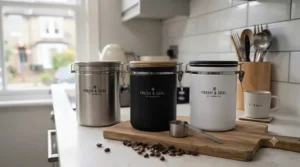
Sometimes the brief isn’t just “keep my coffee fresh,” it’s “make my worktop look like it belongs on a homeware catalogue page.” That’s where the Russell Hobbs Cavaletto-style 3-Piece Canister Set earns its place — a set of three matching powder-coated steel canisters for tea, coffee and sugar, from a brand most UK households already trust for kettles and toasters.
The coffee canister within the set uses a simple pull-top lid rather than a valve or dial system, which is a genuinely basic seal design compared with the CO2-valve models earlier on this list. What that means in practice: it’s fine for coffee you’ll get through within a few weeks, but reviewers and coffee experts alike agree it won’t outperform a valve-equipped canister for beans you’re storing for longer stretches, a point echoed by UK roasters who stress that oxygen exposure is the main driver of stale coffee, as Urban Baristas explain in their bean storage guide.
The honest analytical take here is that you’re paying partly for brand trust and matching aesthetics rather than best-in-class sealing technology, and that’s a completely reasonable trade-off if your kitchen already runs on Russell Hobbs kit and you want visual consistency across your worktop canisters.
Pros:
- ✅ Recognisable, trusted UK kitchen brand
- ✅ Matching tea and sugar canisters included in the set
- ✅ Ribbed powder-coated steel design suits most kitchen styles
Cons:
- ❌ Pull-top lid is a more basic seal than CO2-valve models
- ❌ Less effective for very long-term bean storage
At around £19-£23 for the full three-piece set, this works out cheaper per canister than buying three separate specialist containers, even though the coffee-specific sealing performance sits a notch below the dedicated options above it on this list.
7. Fellow Atmos Vacuum Canister — best premium pick for comparison
Every honest buying guide needs at least one product that shows you what extra money actually buys, and the Fellow Atmos Vacuum Canister is that product here. At roughly £38-£42, it costs two to three times more than most entries on this list — and unlike the others, it isn’t relying on a gasket or a passive valve at all.
Instead, twisting the glass lid physically pulls a vacuum inside the 1.2 litre chamber, evacuating air rather than merely blocking it. On paper this means a meaningfully lower oxygen level around the beans than any passive seal can achieve, which is precisely why specialty coffee shops and serious home enthusiasts tend to gravitate towards it. With over 5,800 reviews and a 4.0-star average, sentiment is generally strong on performance but more mixed on value, with a recurring theme being that buyers feel the freshness improvement is real but modest compared with a good £15 canister — noticeable if you’re chasing the last 10% of flavour, less so if you’re simply trying to avoid stale coffee altogether.
Reviewers consistently note the tactile satisfaction of the mechanism (the twist-and-vacuum action gets described almost universally as “oddly satisfying”) but several also flag that the glass body, while attractive, is heavier and more breakable than the stainless steel budget options above.
Pros:
- ✅ True active vacuum seal, not just a passive gasket
- ✅ Strong long-term review volume backs up durability
- ✅ Genuinely satisfying, well-engineered mechanism
Cons:
- ❌ Costs roughly three times the average budget canister
- ❌ Glass body is heavier and more fragile than steel
If budget genuinely isn’t a constraint, the Fellow Atmos Vacuum Canister is the ceiling of what this category currently offers — but for most readers comparing prices on an affordable coffee storage canister, it’s more useful as a benchmark than a default purchase.
Top 7 Canisters at a Glance: Specs and Value
| Canister | Price Range | Seal Type | Rating |
|---|---|---|---|
| Coffee Gator Coffee Canister | Under £15 | CO2 valve + gasket | 4.7★ |
| Adiwo Transparent Coffee Canister | Under £10 | CO2 valve | Newer, positive |
| MICHIHOMIE Coffee Canister | £13-£16 range | CO2 valve | 4.6★ |
| Hossejoy Coffee Canister | £13-£15 range | Gasket seal | 4.6★ |
| FACIACC Coffee Canister | £14-£17 range | Gasket seal | 4.8★ |
| Russell Hobbs Cavaletto-style Set | £19-£23 range | Pull-top lid | Brand-trusted |
| Fellow Atmos Vacuum Canister | £38-£42 range | Active vacuum | 4.0★ |
Read across this table and a pattern emerges: the jump from “no seal” to “basic seal design” (a gasket or a valve) is where the real freshness improvement happens, while the jump from a good gasket to an active vacuum system is a smaller, more marginal gain that costs disproportionately more. For most kitchens, one of the five sub-£17 options above will comfortably outperform leaving beans in their original bag, and that’s really the comparison that matters most.
How to Choose an Affordable Coffee Storage Canister
Picking between near-identical stainless steel tubs can feel harder than it should, so here’s the shortlist of things actually worth checking before you buy.
- Seal type first, material second. A CO2 valve or a tight rubber gasket does more for freshness than whether the body is steel or glass — check this before you check the colour.
- Match capacity to your bag size. Most UK roasters sell in 250g or 1kg bags; buying a canister too small means overflow, too large means excess air sitting on top of your beans.
- Opaque beats transparent for long-term storage. If you buy in bulk and don’t get through it quickly, a solid steel body genuinely outperforms glass here.
- Check the scoop and lid mechanism separately. A great seal paired with a fiddly, two-handed lid gets skipped in a rushed morning routine, which defeats the purpose.
- Read the review volume, not just the star rating. A 4.8-star rating from 30 reviews tells you less than a 4.6-star rating from 2,000.
- Decide whether you need a date tracker. Genuinely useful for households that buy coffee infrequently, less critical if you’re going through a bag every week or two.
- Set a realistic budget band. As the comparison table shows, anything from roughly £10 to £17 covers the genuine sweet spot for an affordable coffee storage canister — beyond that, you’re paying for diminishing marginal freshness gains.
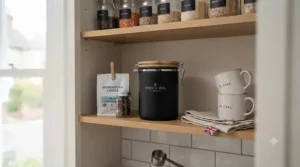
Basic Seal Design: What Actually Matters (And What’s Just Marketing)
Coffee storage packaging loves a bit of jargon, and “airtight” gets stamped on everything from a £6 plastic tub to a £75 electric vacuum canister. So what does a basic seal design actually need to do its job?
At its simplest, there are two mechanisms doing the real work across this list. The first is a compressed rubber or silicone gasket, usually built into the underside of the lid, that physically blocks air from passing between the lid and the container rim when it’s twisted or clamped shut. The second is a one-way CO2 valve, a small membrane that lets gas escape outward (useful because freshly roasted beans continue releasing carbon dioxide for days after roasting) while stopping oxygen getting back in.
Neither of these needs to be complicated or expensive to work well — the FACIACC Coffee Canister and Coffee Gator Coffee Canister both demonstrate that a well-made gasket or valve on a sub-£15 product performs close to as well as the mechanism does on far pricier containers. What most buyers overlook is that a basic seal design fails not because the underlying mechanism is weak, but because of wear: a gasket that’s been stretched around a slightly warped lid, or a valve membrane that’s been pierced or clogged with coffee dust, will let air through no matter how good the original engineering was. Checking the seal periodically, and giving it an occasional wipe-down, matters more for long-term freshness than the initial price tag.
Where genuine complexity earns its keep is active vacuum systems like the one on the Fellow Atmos Vacuum Canister, which physically remove air rather than merely block it. That’s a different category of engineering, and it’s reflected in the price — but for the vast majority of home coffee drinkers, a well-executed basic seal design is doing 80-90% of the work for a fraction of the cost.
Entry-Level Storage vs Premium Vacuum Canisters
It’s worth being blunt about this comparison, because affiliate content often dodges it: does entry-level storage actually cost you noticeable flavour compared with a premium vacuum system?
| Factor | Entry-Level Storage (£10-£17) | Premium Vacuum (£38+) |
|---|---|---|
| Mechanism | Gasket or CO2 valve | Active air removal |
| Typical freshness window | 2-4 weeks | 3-6 weeks |
| Best For | Everyday household coffee drinkers | Enthusiasts chasing peak flavour |
| Material | Mostly stainless steel or glass | Usually glass, heavier |
The analysis here isn’t close to a landslide in either direction. Entry-level storage genuinely holds up well for the two-to-four-week window most people actually take to get through a bag of coffee, and the freshness gap versus a premium vacuum canister only really starts to show up in weeks five and six — by which point, frankly, most coffee has already been drunk. Where the premium option earns its keep is for households that buy in bulk, perhaps a 2kg bag every couple of months, and need beans to stay genuinely fresh for longer between top-ups. For everyone else, spending three times the price for a handful of extra “good” days is a fairly marginal return.
Homes & Gardens’ guide to coffee storage makes a similar point: the packaging matters less than people assume once beans are transferred into any genuinely airtight container within the first day or two of opening the bag, which is reassuring news for anyone working with a tighter budget.
Common Mistakes When Buying a Budget Coffee Bean Jar
Even a good budget coffee bean jar can underperform if it’s chosen or used badly. Here’s where people usually go wrong.
Buying based on looks alone is the biggest one — a beautiful matte-black canister with no valve and a loose-fitting lid will lose to an ugly stainless tub with a proper gasket every single time, flavour-wise. A close second is buying a canister sized for looks rather than for your actual coffee habit; a huge 2.8 litre tub holding a 250g bag of beans means a lot of trapped air sitting on top of your coffee, which somewhat undermines the whole exercise.
Another common misstep is ignoring the scoop. It sounds trivial, but a canister that’s genuinely airtight yet fiddly to open one-handed while you’re half-asleep tends to get left open “just for a minute,” which adds up over a week of mornings. Buyers also frequently skip checking whether the seal needs occasional maintenance — a CO2 valve can clog with fine coffee dust over months of use, quietly reducing performance while looking fine from the outside.
Finally, there’s a mistake that cuts the other way: assuming you need to spend big to get good storage. As the comparison above shows, a decent budget coffee bean jar in the £10-£17 range does the vast majority of the job that a £40 vacuum canister does, and for most households that’s genuinely the smarter spend.
Long-Term Cost & Maintenance
Buying an affordable coffee storage canister once and using it well beats replacing a cheap one every year, so it’s worth thinking about total cost of ownership rather than just the sticker price.
| Ownership Factor | Budget Canister (£10-£17) | Premium Vacuum (£38+) |
|---|---|---|
| Upfront cost | Low | High |
| Expected lifespan | 2-4 years with basic care | 3-5+ years, precision-built |
| Maintenance needed | Occasional gasket/valve wipe-down | Occasional seal check, gentler handling |
| Cost-per-year (rough) | £3-£6 | £8-£13 |
Looking at cost-per-year rather than upfront price changes the picture slightly less than you’d expect: because premium options tend to be built to higher tolerances, they often last proportionally longer, which narrows the annual cost gap. That said, the budget tier still comes out ahead for most households, and the maintenance burden is genuinely light either way — a quick rinse and dry every few weeks, checking the gasket hasn’t perished, and keeping the valve free of coffee dust is about as far as it needs to go. None of the seven products above demand anything beyond that.
Practical Usage Guide: Setting Up Your New Canister
Getting a new affordable coffee storage canister into a good routine takes about five minutes and pays off for months.
Start by washing and thoroughly drying the canister before first use — any residual moisture, even a trace, can encourage mould in a sealed environment, which rather defeats the object. Once it’s bone dry, transfer beans straight from the delivery bag rather than decanting via an intermediate container, since every extra step is another chance for air exposure. If your canister has a CO2 valve, don’t worry about the beans “hissing” slightly for the first day or two; that’s simply freshly roasted coffee still releasing gas, and it’s a good sign rather than a fault.
For the first thirty days, a few habits make a real difference: keep the canister away from anywhere near the hob or a sunny windowsill (heat and light are both enemies of freshness), resist the temptation to top up an old canister with a fresh bag on top of old beans, and use the scoop rather than pouring, since pouring tends to let more air rush in as beans tumble out. If your model includes a date-tracker dial, set it the moment you open a new bag — it takes two seconds and is genuinely one of the most useful small habits in this whole guide.
Longer term, a wipe-down of the gasket or valve every month or so, plus a full wash every time you switch bean varieties, keeps flavour carryover and staling to a minimum.
Real-World Scenarios: Which Canister Fits Your Kitchen?
Picture three different households, because “best” genuinely depends on who’s asking.
There’s the solo flat-dweller who buys one 250g bag every couple of weeks from a local roaster, brews a single cafetière most mornings, and doesn’t want clutter on a small worktop. For them, the Adiwo Transparent Coffee Canister or the Coffee Gator Coffee Canister makes the most sense — compact, cheap, and sized to match a modest coffee habit without a huge tub sitting mostly empty.
Then there’s the family kitchen, two or three coffee drinkers going through a 1kg bag every couple of weeks, wanting something that looks tidy alongside matching tea and sugar storage. That’s squarely where the Russell Hobbs Cavaletto-style 3-Piece Canister Set earns its keep — the aesthetic consistency across three canisters solves a real visual-clutter problem that a single mismatched jar doesn’t.
Finally, there’s the enthusiast who roasts-to-order from a specialty subscription, cares about extraction consistency, and genuinely notices the difference between week-two and week-four coffee. That’s the buyer for whom the extra spend on the Fellow Atmos Vacuum Canister is worth it — not because the cheaper options are bad, but because their palate is tuned to a level of difference most of us simply won’t register.
Buyer’s Decision Framework
If you’d rather skip straight to a decision, use this simple framework.
If you drink coffee occasionally and want to spend as little as possible, choose the Adiwo Transparent Coffee Canister because it’s the lowest-cost entry point that still includes a genuine CO2 valve. If you want the single best-reviewed all-rounder and don’t mind a mid-size canister, choose the Coffee Gator Coffee Canister because its review volume and score combination is currently unmatched in this price bracket. If matching kitchen aesthetics matters as much as function, choose the Russell Hobbs Cavaletto-style 3-Piece Canister Set because it solves storage for tea and sugar at the same time. If you buy beans in bulk and want maximum freedom from oxidation over five-plus weeks, choose the Fellow Atmos Vacuum Canister and accept the higher upfront cost as the price of that extra margin.
For UK buyers weighing food-safe material choices generally, it’s also worth remembering that food storage advice from local authorities consistently recommends transferring opened dry goods into a sealed container rather than leaving them in torn or resealed packaging, a point covered in Wrexham Council’s guidance on storing dry food safely, which applies just as much to coffee as it does to rice or pasta.
Frequently Asked Questions
❓Do cheap coffee canisters actually keep coffee fresh?
❓ What size coffee canister should I buy?
❓ Is glass or stainless steel better for coffee storage?
❓ How often should I clean a coffee storage canister?
❓ Do I need a vacuum canister or is a basic seal enough?
Conclusion
None of the seven options above requires a big leap of faith or a big spend. The honest takeaway from all this comparison is that an affordable coffee storage canister genuinely does the job for the vast majority of coffee drinkers — the jump from “no proper container” to “any of the sub-£17 options here” is where almost all the real-world freshness improvement happens. Beyond that point, you’re mostly paying for smaller, more marginal gains, plus whatever aesthetic or brand value matters to you personally.
If you want the safest, most reviewed pick, the Coffee Gator Coffee Canister is hard to argue with. If pure budget is the priority, the Adiwo Transparent Coffee Canister gets the fundamentals right for under a tenner. And if you’ve read this whole guide and decided you genuinely are the kind of coffee drinker who’ll notice the difference, the Fellow Atmos Vacuum Canister is there waiting, vacuum pump and all. As the science of oxidation makes clear — and as Redber Coffee’s breakdown of oxygen, light and temperature sets out in more depth — the enemy was never really the coffee. It was always the air getting to it.
Recommended for You
- Glass Coffee Jar vs Stainless Steel Canister: 7 Best UK Picks (2026)
- Stainless Steel Coffee Canister: 7 Best UK Picks (2026)
- Vacuum Sealed Coffee Container: 7 Best Picks Tested (2026)
Disclaimer: This article contains affiliate links. As an Amazon Associate, I earn from qualifying purchases. If you purchase products through these links, we may earn a small commission at no additional cost to you.
✨ Found this helpful? Share it with your friends! 💬🤗
