
In This Article
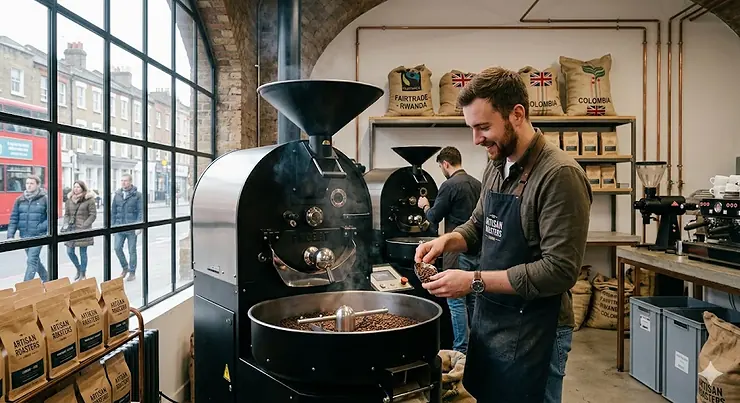
There’s a particular kind of smugness that comes with roasting your own coffee. Not the insufferable sort — just the quiet, private satisfaction of standing in your kitchen at 7am, listening to the first crack of green beans, knowing the cup in your hand will be fresher than anything in any café on your high street. The best coffee roasters make that possible for a lot less faff than you might expect.
Home roasting has gone from a niche hobby confined to obsessives with shed workshops to something genuinely approachable for the average British coffee drinker. The machines have got smarter, smaller, and considerably less smoky. The green bean supply chain has matured — you can now source single-origin Ethiopian Yirgacheffe or Colombian La Rosa with a few clicks, have it at your door in days, and roast it to precisely the profile you want. No guesswork. No stale supermarket bags. Just coffee the way it was actually meant to taste.
So what are the best coffee roasters available in the UK right now? That’s exactly what this guide answers. Whether you’re a total newcomer looking for a forgiving first machine, a weekend enthusiast ready to step up, or a serious home barista chasing repeatability and precision, there’s something on this list for you — all verified available to UK buyers, all 230V compatible, and all worth your hard-earned pounds. Let’s get into it.
Quick Comparison Table: Best Coffee Roasters UK 2026
| Product | Type | Capacity | Approx. Price | Best For | UK Voltage |
|---|---|---|---|---|---|
| NIASIA 500g Automatic Roaster | Air/Drum Hybrid | 500g | £150–£200 | Best all-rounder | 230V ✅ |
| Fresh Roast SR800 | Air | 226g | £120–£160 | Beginners | 230V ✅ |
| MAGO MAGA Smart Roaster | Air | 300g | £200–£280 | Tech-savvy roasters | 230V ✅ |
| PEIXEN Professional Electric Roaster | Air | 250g | £80–£130 | Budget buyers | 230V ✅ |
| Electric Roaster with 3 Baking Curves | Drum | 300g | £100–£160 | Flavour experimenters | 230V ✅ |
| Gene Cafe CBR-101 | Off-Axis Drum | 250g | £450–£550 | Intermediate–advanced | 230V ✅ |
| Stainless Steel Manual Drum Roaster | Manual Drum | 500g | £50–£80 | Hands-on hobbyists | Gas/Stovetop |
What this table tells you, beyond the obvious: the price gap between budget and intermediate options is real but the jump in roast quality and control is even more significant. The NIASIA sits in a sweet spot that neither embarrasses beginners nor bores those with a bit of experience. If you’re on a tight budget, the PEIXEN is genuinely capable — but you’ll outgrow it. And if you’re even slightly considering the Gene Cafe, budget the full £500-range and don’t look back.
💬 Just one click — help others make better buying decisions too! 😊
✨ Don’t Miss These Exclusive Deals!
🔍 Take your home coffee roasting to the next level with these carefully selected machines. Click any highlighted product to check current pricing and availability on Amazon.co.uk — and get the freshest cup you’ve ever brewed.
Top 7 Best Coffee Roasters UK 2026: Expert Analysis
1. NIASIA 500g Automatic Coffee Roaster Machine — Best Overall
The NIASIA is that rare thing: a machine that manages to be genuinely beginner-friendly without feeling like a toy. At its heart is a 500g capacity roasting chamber that uses a combination of infrared halogen heating and forced-air convection — a hybrid approach that delivers even heat distribution across the bean mass, which is the difference between a beautifully developed medium roast and a batch with pale centres and scorched tips.
The 500g capacity is meaningfully practical for British households. That’s enough for roughly 400g of roasted coffee, or about two weeks’ worth of morning brews for two people. You’re not fussing about with 100g micro-batches. The separate “Cool” mode with its dedicated fan drawer brings roasted beans down to room temperature quickly — crucial for flavour development, since beans that stay hot continue to cook even after leaving the roaster. The smoke filter and chaff collector are a particularly thoughtful inclusion; British kitchens tend to be on the compact side, and the last thing you want is chaff decorating the extractor hood above your hob.
One experienced UK buyer noted on Amazon that the bean temperature probe reads approximately 15°C low on smaller batches — worth knowing if you like to log your roast profiles with any precision. Compensate by targeting slightly higher temperature settings than a profile guide might suggest.
✅ 500g capacity — enough for a fortnight’s coffee in one session
✅ Smoke filter + chaff collector keep your kitchen clean
✅ 230V compatible — no adaptor drama
❌ Temperature sensor can read low on batches under 200g
❌ Limited manual control compared to premium machines
Priced in the £150–£200 range, the NIASIA offers the best balance of capacity, usability, and features for most UK home roasters. A very solid choice for anyone who wants to stop buying pre-roasted bags without committing to a semester’s worth of learning curve.
2. Fresh Roast SR800 — Best for Beginners
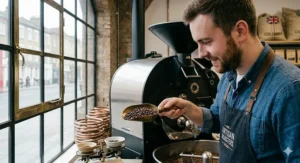
Fresh Roast have been making air roasters long enough to have earned genuine credibility, and the SR800 is their strongest consumer offering yet. It’s a hot-air roaster — think of it as a very precise, very purposeful version of a popcorn maker — and that simplicity is precisely why it’s the best coffee roaster for beginners. Hot air both heats the beans and keeps them in constant motion, which means even roasting without any mechanical drum to fuss over or maintain.
The SR800 roasts up to 226g per batch — roughly 180g of roasted coffee — and does it quickly, typically in 8–15 minutes depending on your target roast level. Nine heat levels, variable fan speed, and a real-time temperature display give you just enough control to develop your palate and technique without drowning you in variables. The roasting chamber is noticeably larger than the older SR540, which means better airflow and more consistent results across the batch.
Available on Amazon.co.uk with Prime delivery, this is frequently the machine recommended by UK coffee communities for anyone starting out. It handles washed Ethiopian and Kenyan origins particularly beautifully — the clean, fruit-forward profiles that lighter roasts reward.
✅ Fast and easy — roasting in under 15 minutes
✅ Great for light-to-medium roasts on single origins
✅ Strong online community for UK beginners
❌ 226g capacity limits batch size — fine for one person, modest for two
❌ Can be audibly loud during the cooling cycle
At £120–£160 on Amazon.co.uk, the SR800 is the easiest entry point into serious home roasting. Prime eligible — expect it at your door next day.
3. MAGO MAGA Smart Home Coffee Bean Roaster (230V) — Best Smart Roaster
MAGO MAGA burst onto the home roasting scene via a remarkably successful crowdfunding campaign and quickly gathered a following among roasters who want the precision of professional kit without the industrial footprint. The 230V version is UK compatible straight out of the box — no voltage converter needed, which might sound obvious but genuinely isn’t with all the budget machines floating around on Amazon’s marketplace.
The 300g capacity sits sensibly between the SR800’s modest batches and the NIASIA’s larger loads. What distinguishes the MAGO MAGA is its transparent roasting chamber, which lets you watch the beans’ colour development in real time — a surprisingly useful feature that develops your eye faster than any roasting guide. The digital display shows elapsed time and temperature simultaneously; the auto-cooling function kicks in precisely at the end of the roast cycle, rather than relying on you to remember to switch modes. Ultra-low smoke output and an integrated chaff collection system make it particularly well suited to British terraced houses and flats where kitchen ventilation is, shall we say, more of an aspiration than a reality.
The dual Auto and Manual modes are genuinely well thought-out. Auto mode runs a preprogrammed profile for hands-off roasting; Manual lets you intervene at any point. Most buyers start in Auto and gradually migrate to Manual as their confidence grows — a sensible learning curve.
✅ 230V compatible — UK-ready
✅ Transparent chamber for visual monitoring of roast development
✅ Auto + Manual modes suit both beginners and developing roasters
❌ 300g capacity means multiple batches for larger households
❌ At the higher end of the mid-range budget
Available on Amazon.co.uk in the £200–£280 range.
4. PEIXEN Professional Electric Coffee Bean Roaster — Best Budget Option
“Professional” is doing some heavy lifting in that product name, but don’t let the marketing bravado put you off. The PEIXEN is a capable, well-specified air roaster that punches above its price point in the sub-£130 category. Adjustable wind speed, hot/cold air switching, a built-in timer, and a design that keeps chaff relatively contained make it a genuinely respectable first roaster for buyers who aren’t yet ready to spend two hundred quid on what might turn out to be a hobby they abandon after three batches.
The practical interpretation of “adjustable wind speed” is important here: more airflow means faster, lighter roasts with brighter, more acidic cup profiles. Less airflow slows the roast, extends the Maillard reaction window, and builds more body and sweetness. That’s a meaningful degree of flavour control for a machine at this price. At 230V, it works without issue on the UK mains — though as with any lower-cost appliance, do check for UKCA or CE marking on the unit before use.
UK buyers on Amazon report consistent results for light-to-medium roasts, though darker roasting profiles produce more smoke than the unit’s modest ventilation can fully manage. In a British kitchen, that means opening a window — not exactly a hardship in June, slightly more character-building in January.
✅ Excellent value for money
✅ Adjustable airflow for genuine flavour control
✅ 230V compatible
❌ Struggles with darker roast profiles (more smoke)
❌ Lacks the precision of mid-range options
Available on Amazon.co.uk in the £80–£130 range, often eligible for free delivery over £25.
5. Electric Coffee Bean Roaster with 3 Baking Curves and Smoke Filter — Best for Flavour Experimentation
This machine’s defining feature is its three pre-set baking curves — essentially programmable roast profiles that follow different time/temperature trajectories, each producing a meaningfully different cup. Profile one is calibrated for a brighter, lighter roast that suits single-origin washed coffees; profile two delivers a classic medium with balanced sweetness; profile three pushes into darker territory for espresso-style body and lower acidity. It’s a level of programmability you don’t usually find at this price point, and it makes a real difference to the quality and repeatability of your results.
The integrated smoke filter is a genuine convenience for UK buyers living in smaller homes. One of the most common complaints about home roasting — especially in Britain, where opening all the windows in February is a particular form of suffering — is smoke. This filter won’t eliminate it entirely on darker roasts, but it reduces it sufficiently that you won’t be evacuating the kitchen on every session.
Drum-style roasting (as opposed to pure air roasting) produces a heavier body and more complex Maillard-derived flavours — the caramel, chocolate, and nutty notes that characterise the style of coffee most British drinkers are instinctively drawn to. This machine leans into that.
✅ Three programmable baking curves for repeatability
✅ Smoke filter — important for small UK kitchens
✅ Drum roasting for richer, fuller-bodied cups
❌ Less intuitive than pure air roasters for total beginners
❌ Drum cleaning requires more effort than air-roaster maintenance
Available on Amazon.co.uk in the £100–£160 range.
6. Gene Cafe CBR-101 — Best Mid-to-Advanced Roaster
Ask a hundred experienced home roasters in the UK what machine they use, and somewhere between 70 and 85 of them will say “Gene Cafe.” That’s not an exaggeration — it’s a figure borne out by informal polling across UK home-roasting communities, and it speaks to something real. The CBR-101 is not the flashiest roaster on this list. It doesn’t have a digital display with real-time graphing, it won’t talk to your phone, and it costs considerably more than the other options here. What it does is roast coffee exceptionally well, consistently, batch after batch, for years.
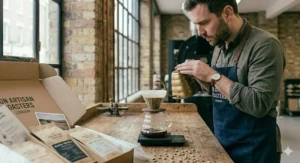
The off-axis rotating drum design — where the chamber spins on a tilted axis rather than horizontally — is the engineering trick that makes it special. Beans tumble constantly in a way that produces an unusually even roast across the entire batch, without hot spots or stalled development. The 250g capacity (dry bean weight) is a practical single-session amount for a household of two. Manual time and temperature controls give you full autonomy over your profiles, and the substantial online community means every problem you encounter has already been solved and documented by someone else.
For British buyers, the Gene Cafe is available from UK specialist retailers as well as Amazon.co.uk marketplace listings. Expect to spend in the £450–£550 range. Worth every penny if roasting is genuinely going to be part of your life rather than a passing experiment.
✅ Off-axis rotation for exceptionally even roast development
✅ Hugely popular in UK community — abundant advice online
✅ Built to last for years of regular use
❌ Premium price point — not a casual purchase
❌ No digital connectivity or profile logging software
7. Stainless Steel Manual Drum Roaster (Stovetop/Gas) — Best Hands-On Budget Option
Not everything needs a plug. The manual drum roaster — a cylindrical stainless-steel cage on a rotating handle, designed to sit over a gas hob or camping burner — is the oldest form of home roasting and, in its own way, the most instructive. You control absolutely everything: the heat level of the flame, the speed of your hand rotation, the moment you decide the roast is done. There are no programmes to save you, no timers to compensate for your inattention. It is, frankly, the best teacher available.
The 500g capacity is generous for the price — around £50–£80 on Amazon.co.uk — and it works over any gas hob, which most British kitchens still have. The learning curve is steep. Your first few batches will be uneven. That’s fine. By batch six, you’ll have developed a feel for the sound, smell, and colour changes of roasting that no digital display will ever replicate. What most buyers overlook about manual roasters is that they’re also excellent for roasting nuts, spices, and seeds — a versatility that justifies the purchase price several times over if you cook regularly.
Smoke is an honest reality with this approach — roast near an open window or under the extractor fan. In a British garden on a dry summer evening, it’s actually rather pleasant.
✅ Lowest cost entry into home roasting
✅ Excellent teaching tool — develops intuition quickly
✅ Works over any gas hob, no electricity required
❌ Steep learning curve — inconsistent results early on
❌ Produces more smoke than electric alternatives
Available on Amazon.co.uk in the £50–£80 range.
How to Set Up and Use Your New Coffee Roaster: A UK Practical Guide
First Roast Checklist
Getting your first roast right is less about technique and more about preparation. Before you heat anything up, there are a few things worth sorting.
Sourcing green coffee beans is your first task. Green (unroasted) coffee keeps for one to two years in sealed storage — a dramatic contrast to roasted coffee, which starts declining meaningfully within two weeks of roasting. UK suppliers including Has Bean Coffee, Square Mile, and The Green Coffee Collective (greencoffeecollective.com) offer excellent single-origin green beans, many available via Amazon.co.uk or direct delivery. Ethiopian naturals and Colombian washed varieties are ideal for first roasts because they’re forgiving and taste dramatically different from anything you’ll find in a supermarket.
Ventilation comes first. Always roast near an open window or directly under an extractor fan. Even the best smoke-filtered machines produce some chaff and steam. In a compact British kitchen — the kind with approximately 40cm between the worktop and the upper cupboards — this matters more than any spec sheet will tell you.
Expect the unexpected on batch one. Every roaster has its quirks. The NIASIA reads temperature slightly low; the Gene Cafe runs hot in the final two minutes; the SR800’s cooling cycle is louder than you’d expect. Give yourself three or four batches before judging the machine.
The Roasting Process, Demystified
Coffee roasting progresses through distinct stages you can track by ear and eye: the drying phase (beans turn from green to yellow, grassy smell), the Maillard stage (beans deepen to tan/light brown, bread-like aroma), first crack (an audible popping, like Rice Krispies — this is where light roasts live), development phase (where you make your key flavour decisions), and optionally second crack (a quieter crackling — medium-dark territory). Stop the roast by cooling quickly; beans continue cooking from residual heat if you don’t.
Rest your roasted coffee for 12–24 hours before brewing. Fresh-roasted beans release CO₂ aggressively, which disrupts extraction. The wait is agonising but genuinely worth it.
Real-World Roasting Scenarios: Which Machine Suits Your Life?
The London Flat Dweller — living in a one-bed in Hackney with a galley kitchen, no garden, and a smoke alarm within three metres of the hob. This buyer needs compact footprint, serious smoke management, and a machine that doesn’t require special ventilation. The MAGO MAGA 230V or the NIASIA 500g are the right calls here. Both have integrated smoke filters, both are 230V compatible with UK plug, and both sit comfortably on a worktop without occupying the entire surface area.
The Suburban Enthusiast — semi-detached in South Manchester, proper extractor fan, garage for storage, drinks two cups a day and wants to start buying green beans in bulk. This is Gene Cafe territory. The superior build quality, even roasting, and abundant community support justify spending £450–£550. The slightly larger kitchen and better ventilation mean the Gene Cafe’s lack of aggressive smoke filtering isn’t a problem.
The Curious Beginner — lives in a terraced house in Bristol, not yet certain if home roasting will stick, wants to spend under £150 to find out. The Fresh Roast SR800 is the honest answer. Quick, simple, produces genuinely excellent light roasts, and if the hobby doesn’t take, it hasn’t cost the earth.
The Budget-Conscious Hobbyist — student in Edinburgh, has access to a gas hob, enjoys hands-on processes. The manual stainless drum roaster at £50–£80 is a brilliant starting point. The learning curve teaches more about coffee roasting than any tutorial, and green beans from Edinburgh’s specialist coffee scene (Machina Coffee Roasters, for example) are excellent quality.
How to Choose the Best Coffee Roasters in the UK: 5 Key Criteria
Choosing a home roaster isn’t complicated, but the wrong decision costs money and enthusiasm. Here’s a straightforward framework.
1. Batch size relative to your consumption. Roast only what you’ll use within two weeks. A solo drinker consuming 15g of coffee per day needs about 200g per week — the SR800’s 226g capacity is perfect. A household of three doing espresso and filter needs 300–500g weekly; the NIASIA or MAGO MAGA makes more sense.
2. Smoke management. British kitchens are not designed with smoke extraction in mind. Unless you have a powerful overhead extractor or plan to roast outdoors, prioritise machines with smoke filters. The NIASIA, MAGO MAGA, and the Baking Curves model all include them. The Gene Cafe produces meaningful smoke and really needs a proper extractor or open-air roasting environment.
3. Voltage compatibility. This sounds trivial but trips up buyers regularly. Confirm the machine is 230V before purchasing — not 110V (US specification). Every product on this list is confirmed 230V compatible, but always verify if purchasing from third-party sellers on Amazon’s marketplace.
4. Manual vs automated control. Beginners benefit enormously from automated machines that remove variables. Intermediate roasters typically want the ability to intervene and adjust. Advanced roasters want full manual control, often with software logging. Match the machine’s control philosophy to where you actually are, not where you’d like to be.
5. Total cost of ownership. The roaster purchase is just the beginning. Budget for green coffee beans (around £10–£20 per kg from UK suppliers), a decent kitchen scale accurate to 1g, and — if you’re getting serious — a notebook or roasting app for profile logging. According to the Specialty Coffee Association, freshness is the single biggest driver of cup quality; the investment in home roasting pays back in that dimension immediately.
Common Mistakes When Buying a Home Coffee Roaster in the UK
Buying a 110V machine. It happens constantly. A product listed on Amazon.co.uk can still be a US-specification unit sold by a third-party seller. Check the product description for “230V” and, if uncertain, contact the seller before purchasing. A 110V machine run on a UK mains socket via an adaptor is a fire risk.
Ignoring chaff. Chaff is the papery skin that detaches from green beans during roasting. It’s flammable, gets everywhere, and in machines without chaff collectors, it burns on the heating element — producing off-flavours and shortening component life. This is why the NIASIA and MAGO MAGA’s chaff collection systems deserve more attention than they typically get in product descriptions.
Roasting in a poorly ventilated space. Coffee smoke contains acrolein and other compounds that, in a sealed room, will set off smoke alarms and potentially irritate lungs. The NHS guidance on indoor air quality consistently recommends ventilating cooking spaces — roasting coffee is no different. Open a window, use the extractor fan, or roast outdoors when the British weather cooperates (so, around three weekends per year).
Rushing the rest period. Roasted coffee degasses rapidly in the first 24 hours. Brewing it immediately produces flat, oddly carbonic espresso shots and muddy filter coffee. Rest the beans in an open container for 12–24 hours, then store in an airtight tin. Resist. It’s worth it.
Buying the cheapest possible green beans. Roasting transforms what’s already there — it can’t rescue poor-quality green coffee. Budget an extra £2–£3 per 100g for properly sourced, traceable green beans from a reputable UK supplier. The flavour difference is not subtle.
The Long-Term Value of Home Roasting: What the Numbers Say
Home roasting is not primarily an economy play — though it does save money over time. It’s a quality play. Let’s look at the numbers honestly.
Good quality pre-roasted specialty coffee from the best British artisan roasters — Kiss the Hippo, Assembly, Rave Coffee, Climpson & Sons — costs roughly £12–£18 per 250g bag. Equivalent green beans from the same origins cost £6–£12 per 500g. That’s a roast-weight-adjusted saving of roughly 50–60% per cup once you account for the approximately 15–20% weight loss during roasting.
On a typical UK household consumption of 500g roasted coffee per month, you’ll save £60–£100 per year — enough to recoup the cost of the NIASIA in 18–24 months, or the SR800 in about a year. After that, every bag is paying you back. Beyond the economics, there’s the Food Standards Agency‘s consistent finding that freshness is the primary determinant of flavour quality in prepared food and drink — and you simply cannot buy fresher coffee than coffee you roasted yourself this morning.
| Scenario | Monthly Cost (Pre-Roasted) | Monthly Cost (Home Roasted) | Annual Saving |
|---|---|---|---|
| Solo drinker (200g/month) | £12–£15 | £5–£7 | £60–£96 |
| Couple (400g/month) | £24–£30 | £10–£14 | £120–£192 |
| Family (600g/month) | £35–£45 | £15–£20 | £180–£300 |
The analysis here is clear: the longer you home roast and the more coffee you consume, the faster the machine pays for itself. Budget buyers with the PEIXEN or SR800 break even within 12 months. Gene Cafe buyers typically see payback around the 3–4 year mark — though most would tell you the quality improvement alone justified it long before then.
UK Regulations, Safety Standards & What to Check Before You Buy
Home coffee roasters sold in the UK should carry either UKCA marking (the post-Brexit British conformity mark that replaced CE for products placed on the UK market after 1 January 2023) or CE marking for products placed on the Northern Ireland market and sold across the UK. In practice, many products on Amazon.co.uk marketplace — particularly those sold by third-party sellers shipping from the EU or Asia — carry CE marking, which remains broadly acceptable under current UK transitional arrangements, but this is worth being aware of.
All electrical appliances sold in the UK must comply with the Electrical Equipment (Safety) Regulations 2016 and the Electromagnetic Compatibility Regulations 2016. Products sold by Amazon itself (as opposed to third-party marketplace sellers) are subject to Amazon’s own product compliance checks, which provide an additional layer of assurance.
Under the Consumer Rights Act 2015, UK buyers have strong protections: products must be of satisfactory quality, fit for purpose, and as described. If your roaster arrives faulty or develops a fault within 30 days, you’re entitled to a full refund. Between 30 days and six months, you’re entitled to repair or replacement as a first step. And don’t forget: all online purchases benefit from the 14-day cooling-off period under the Consumer Contracts Regulations — you can return a machine you simply change your mind about, within 14 days of delivery, for a full refund.
For any safety concerns with electrical appliances, the Office for Product Safety and Standards (OPSS) — part of the Department for Business and Trade — maintains a product recall database and advice for UK consumers.
Frequently Asked Questions: Best Coffee Roasters UK
❓ What is the best coffee roaster for home use in the UK?
❓ Are home coffee roasters safe to use in a UK kitchen?
❓ How long does it take to roast coffee at home?
❓ Where can I buy green coffee beans in the UK for home roasting?
❓ Does home roasting produce a lot of smoke?
Conclusion: Fresh Coffee, Every Morning
The barrier to home roasting has never been lower. For around £120, you can have a capable air roaster on your kitchen worktop by tomorrow morning (thank you, Amazon Prime), and be drinking genuinely extraordinary coffee — fresher than anything you’ve ever bought — within the week.
The best coffee roasters aren’t just appliances. They’re a direct connection to the origins of your cup: the Ethiopian highland farm, the Colombian micro-lot, the Guatemalan cooperative. Roasting at home doesn’t just improve the coffee. It changes your relationship with it. Suddenly you’re not just a consumer — you’re a participant in one of the world’s oldest, most complex agricultural processes, playing out in your kitchen between the toaster and the kettle.
Start with the Fresh Roast SR800 if you’re new and cautious. Step up to the NIASIA or MAGO MAGA when your confidence grows. And if the hobby takes hold properly — if you find yourself reading SCA roasting guides at 11pm and planning green bean orders from three continents — the Gene Cafe will be waiting, ready to grow with you.
✨ Don’t Miss These Exclusive Deals!
🔍 Check current pricing and availability for all seven roasters reviewed above on Amazon.co.uk. These picks represent the best of what’s available to UK buyers right now — fresh, honest, and ready to transform your morning.
Recommended for You
- Best 7 Seasonal Flavoured Coffee UK 2026
- Best Chocolate Flavoured Coffee Beans UK 2026: 7 Irresistible Picks
- Best Caramel Flavoured Coffee Beans UK 2026: 7 Sweet Picks
Disclaimer: This article contains affiliate links. As an Amazon Associate, I earn from qualifying purchases. If you purchase products through these links, we may earn a small commission at no additional cost to you.
✨ Found this helpful? Share it with your mates! 💬🤗
