
In This Article
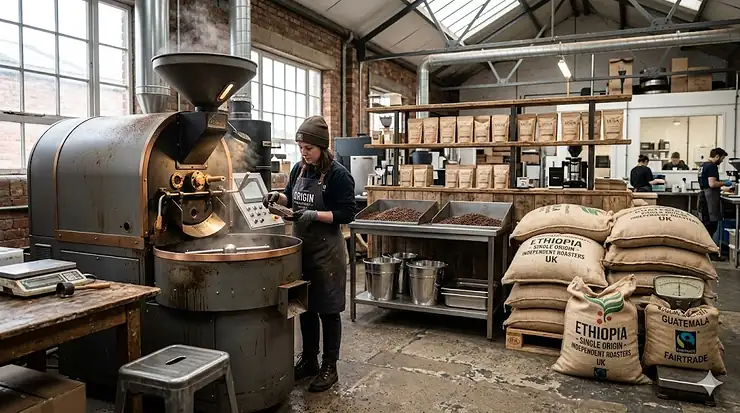
There’s a particular kind of smugness that comes from pulling a shot of coffee you roasted yourself. Not the insufferable kind — the quiet, deeply satisfied kind, when you inhale the first bloom of a freshly ground Ethiopian Yirgacheffe you took from green bean to dark magic in your own kitchen. That’s the feeling that’s driven a revolution on British high streets and in home kitchens alike. Independent coffee roasters — those small-batch, craft-obsessed artisans who reject the supermarket’s watery compromise — have transformed the UK’s coffee culture beyond recognition.
According to the British Coffee Association, approximately 98 million cups of coffee are consumed in the UK every single day. Eighty million of those deserve better than they’re getting. The specialty coffee market is surging — analysts project it will nearly double in value between now and 2030 — and at the beating heart of that growth are independent coffee roasters: small operations with enormous standards, sourcing single-origin beans from Ethiopia, Colombia, and Guatemala, then roasting them in micro-batches to coax out flavours that a mass-market brand simply isn’t designed to chase.
But here’s the thing. You don’t need a warehouse in East London and a Probat drum roaster the size of a small car to be part of this movement. A new generation of compact, home-friendly roasting machines — many available right now on Amazon.co.uk — puts genuine small-batch craft roasting within reach of anyone with a passion for a proper cup and roughly the counter space of a large kettle.
This guide covers the 7 best home coffee roasters for UK buyers in 2026: what they actually do in practice, who they’re best suited for, and why the spec sheet alone won’t tell you the half of it.
Quick Comparison: Top 7 Home Coffee Roasters at a Glance
| Machine | Capacity | Voltage | Price Range (GBP) | Best For |
|---|---|---|---|---|
| MAGO MAGA Smart Roaster (Roma Pro) | 300g | 230V ✅ | £350–£450 | Tech-savvy beginners |
| Behmor 2020SR Plus | 100–454g | 220V ✅ | £300–£400 | Indoor flat roasting |
| Fresh Roast SR800 | ~226g | 110V ⚠️ | £200–£280 | Air-roasting enthusiasts |
| PEIXEN Electric Air Roaster | 200–500g | 230V ✅ | £150–£250 | Budget-first buyers |
| Vogvigo Drum Roaster | 600g | 220V ✅ | £100–£180 | Drum-feel on a budget |
| 3-Baking-Curve Commercial Roaster | 500g | 230V ✅ | £200–£300 | Profile experimenters |
| Manual Stovetop Roasting Cage | 200–400g | N/A ✅ | £25–£60 | Total beginners/minimal spend |
From the table above, the choice splits fairly neatly by ambition and budget. If you’re roasting your first ever batch, the stovetop cage costs very little and teaches you more about how heat affects a bean than any app-controlled machine will. If you want genuine profile control — the ability to repeat a roast you loved and refine one you didn’t — the MAGO MAGA or Behmor are in a different league entirely. The Vogvigo sits in an interesting middle ground: drum-roaster character at fluid-bed prices, which is worth understanding before you dismiss it.
💬 Just one click — help others make better buying decisions too! 😊
✨ Don’t Miss These Exclusive Deals!
🔍 Take your home coffee roasting to the next level with these carefully selected machines. Click any highlighted product to check current pricing and availability on Amazon.co.uk — and find the roaster that suits your kitchen, your budget, and your palate.
Top 7 Home Coffee Roasters for Independent Coffee Enthusiasts: Expert Analysis
1. MAGO MAGA Smart Home Coffee Bean Roaster (Roma Pro, 230V)
This is the roaster that turned heads at the 2025 Specialty Coffee Association awards, winning Best New Product — and once you’ve used it, the accolade makes perfect sense. The Roma Pro operates on 230V (specifically designed for UK and European markets), which means no voltage adapters, no fire hazards, no unpleasant surprises. It roasts up to 300g of green beans per batch using hot-air fluid-bed technology, with five smart preset profiles that take you from light roast to dark without lifting a finger beyond pressing a button.
The digital display is clear and responsive; the auto-cooling function kicks in automatically post-roast so you’re not standing over the machine waiting to dump beans into a colander. In manual mode, experienced roasters can adjust temperature and airflow in real time. The transparent viewing window — a detail that sounds trivial until you’re watching your first second crack and realise you’ve no idea when to stop — is genuinely excellent.
What most UK buyers won’t find in the listing: the chaff collection is meaningfully better than anything in this price bracket from two years ago. Chaff (the papery skin that sheds during roasting) is a nuisance in small British kitchens, especially flats with limited ventilation. The Roma Pro’s internal collector catches the bulk of it, making post-roast cleanup far less theatrical. Some early reviewers noted the eject mechanism felt a touch fragile; the version 1.5 upgrade has addressed this, though still worth handling with care.
✅ Five smart preset profiles for consistent results
✅ 230V UK-compatible; no adapter required
✅ Transparent viewing window for real-time roast monitoring
❌ 300g capacity limits batch size for avid drinkers
❌ International brand — UK after-sales support can be slower
In the £350–£450 range; check current price on Amazon.co.uk. Prime-eligible; typically arrives within 1–2 days for Prime members.
2. Behmor 2020SR Plus (220V, Indoor Roaster)
If the Roma Pro is the stylish newcomer, the Behmor 2020SR Plus is the seasoned professional who’s been quietly producing exceptional results while everyone else was distracted by apps and algorithms. Available on Amazon.co.uk at the 220V spec compatible with UK mains supply (230V at 50Hz — well within tolerance), the Behmor remains one of the few home roasters in the world with genuine, patent-pending smoke suppression technology built in.
That matters enormously for the vast majority of British homes. You live in a terrace in Sheffield or a flat in Bristol — roasting coffee is a smoky business, and your smoke alarm doesn’t care that you’re developing a really interesting Honduras Marcala. The Behmor’s drum-within-a-drum system with a catalytic converter reduces visible smoke significantly, making it genuinely usable in a kitchen with windows shut. Not entirely smoke-free — be realistic — but dramatically better than the competition.
The capacity range of 100g to 454g is the widest of any machine at this price point. The five pre-programmed roast profiles cover the most common scenarios, and the manual mode lets you override power, drum speed, and timing independently. One important note for UK users: the built-in safety cutoff requires you to actively press a button to continue roasting past the 75% mark. Slightly counterintuitive at first, but sensible — and rather more thoughtful than most.
UK reviewers consistently highlight the drum motor speed control as a differentiator: it ensures beans move evenly through the heat without cold spots, which matters when you’re targeting a specific roast profile.
✅ Genuine smoke suppression — proper indoor-roasting solution for UK flats
✅ Widest capacity range in its class (100g–454g)
✅ Five roast programmes plus full manual override
❌ Not fully smoke-free — ventilation still advisable
❌ Learning curve steeper than purely automatic machines
In the £300–£400 range; check current price on Amazon.co.uk.
3. Fresh Roast SR800 Automatic Coffee Bean Roaster
The Fresh Roast SR800 has a devoted following among the home-roasting community — and forums like HomeRoasters.org will tell you that people who own one tend to keep it for years. It’s a fluid-bed air roaster: hot air lifts and spins the beans while roasting them, which produces notably even results with clean, bright flavour profiles. If you favour light to medium roasts — the kind of precise, origin-focused cup that independent coffee roasters like Square Mile and Assembly have made famous — air roasting suits that style beautifully.
The SR800’s nine heat levels and variable fan speed give you genuine control without being overwhelming. The digital display shows real-time temperature. The glass roasting chamber means you can see exactly what’s happening, which is both useful and strangely hypnotic.
The critical caveat for UK buyers: the SR800 is primarily engineered for the US market at 110V. It does appear on Amazon.co.uk, but always confirm the voltage specification before purchasing — operating a 110V appliance on UK 230V mains without a step-down transformer will destroy the machine instantly. Some UK sellers list a compatible version or include an adapter; verify this unambiguously with the seller before checkout. Where the correct version is available, this is a superb air roaster with a well-earned reputation.
✅ Exceptional even roast from fluid-bed air technology
✅ Nine heat settings and variable fan — genuine profile control
✅ Transparent glass chamber for real-time monitoring
❌ Voltage compatibility must be verified carefully for UK use
❌ 226g capacity is on the smaller side
In the £200–£280 range; check current voltage specification and price on Amazon.co.uk.
4. PEIXEN Professional Electric Coffee Bean Roaster (230V)
The PEIXEN sits in a rewarding middle ground: it’s the roaster that asks little of you but repays patience generously. Running at 230V on UK mains, it handles batches of 200g to 500g, with adjustable wind speed, hot/cold air switching, and a built-in timer that takes some of the stress out of your first dozen or so roasts. The LCD display is clear; the build quality is honest rather than luxurious.
What the PEIXEN does especially well for budget-conscious UK buyers is flexibility. You’re not locked into preset profiles, which means you’ll learn faster — but you’ll also make more mistakes early on, which is precisely how you develop an intuition for how a bean sounds and smells when it’s ready. Independent coffee roasters will tell you the first crack (a popcorn-like pop at around 196–205°C) and second crack (sharper, more rapid cracking at ~225°C) are your key navigational markers. The PEIXEN gives you enough control to find and respond to both without breaking the bank.
For a UK flat or a compact kitchen, the footprint is sensible. One genuine limitation: the smoke management is minimal, so you’ll want to roast near an open window or under an extractor hood. British drizzle permitting.
✅ 230V UK-compatible straight out of the box
✅ Adjustable wind speed and temperature — good control for the price
✅ Wider 500g maximum capacity for more productive sessions
❌ Smoke management is basic — open-window roasting advised
❌ Finish and build feel entry-level; not built for daily high-volume use
In the £150–£250 range; check current price on Amazon.co.uk.
5. Vogvigo Home Coffee Beans Roasting Machine (1200W, Drum Type, 220V)
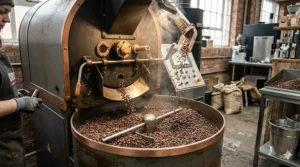
The Vogvigo occupies an interesting niche: drum-roaster mechanics at fluid-bed prices. Where hot-air machines circulate heat via a fan, the Vogvigo’s rotating drum tumbles beans through a heated chamber — the same principle used by commercial roasters like the Probat and Loring that you’d find in the back rooms of Britain’s best independent coffee roasters. The result is a slightly heavier body in the cup, with more developed sweetness and less of the brightness that air roasters typically produce.
At 1200W on 220V, it runs well within UK electrical tolerance. The 600g capacity is generous for a home machine and genuinely useful if you want to roast enough for a full week’s supply in one session. The stainless steel build is solid; the rotating mechanism is visible and satisfying. A few UK buyers have noted that seasoning the drum properly before your first real roast makes a meaningful difference to early results — worth factoring into your expectations.
The Vogvigo will produce more smoke than machines with active suppression systems, so ventilation is non-negotiable. In a well-ventilated kitchen, or propped near an open back door, it’s perfectly manageable on a British autumn afternoon.
✅ Drum-roaster character at a budget price — richer body in the cup
✅ 600g capacity for larger batches
✅ 220V compatible; stainless steel build
❌ Notable smoke production — ventilation essential
❌ Less precision control than dedicated home-roasting machines
In the £100–£180 range; check current price on Amazon.co.uk.
6. Electric Coffee Bean Roaster with 3 Baking Curves + Smoke Filter
This machine is the choice for anyone who finds themselves genuinely interested in roast profiling — the practice, beloved among serious home roasters and independent coffee roasters alike, of plotting heat-over-time curves to craft repeatable, optimised results. The three built-in baking curves give you distinct roast pathways to explore: broadly analogous to light, medium, and dark profiles, though the specifics depend on your green bean and batch size.
The included smoke filter is modest but meaningful: it’s not comparable to the Behmor’s active suppression system, but it does take the edge off smoke output in a typical UK kitchen. The bundled 48mm manual burr grinder is a useful addition for beginners who don’t yet own a grinder, though serious coffee fans will quickly graduate to a dedicated electric burr grinder.
Operating at 230V, this machine is UK-compatible and available on Amazon.co.uk. The combination of the three-profile system and smoke filter makes it a coherent package — not the most refined option available, but more purposeful than a basic single-setting roaster.
✅ Three roast curve profiles — genuine experimentation potential
✅ 230V UK-compatible with smoke filter included
✅ Bundled burr grinder adds value for beginners
❌ Smoke filter is basic — not a substitute for ventilation
❌ Less polished build quality than premium machines
In the £200–£300 range; check current price on Amazon.co.uk.
7. Manual Stovetop Coffee Roasting Cage
Don’t underestimate this. Before every electric roaster on this list existed, independent coffee roasters started somewhere. And many of them started with exactly this: a hand-cranked or rotatable wire cage that sits over a gas burner or electric hob, a bag of green beans from an online importer, and the patience to stand and watch for fifteen minutes while something genuinely extraordinary happens.
The manual stovetop roasting cage has no voltage to worry about, no firmware to update, and no proprietary app that might begin charging a subscription. It is 100% reliant on your attention, your timing, and your nose — which means you learn faster and understand the process more deeply than any automated machine will teach you.
It’s smoky, it requires constant stirring, and it won’t give you the even roast consistency of a drum or fluid-bed machine. But at under £60, it’s the single best way to discover whether home roasting is genuinely your thing before spending several hundred pounds on hardware. UK buyers who start here and fall in love typically upgrade within six months. Those who don’t bother have saved themselves a tidy sum.
✅ Under £60 — by far the lowest-cost entry point
✅ No electrical compatibility concerns; works on any hob
✅ Best learning tool for understanding the roasting process intuitively
❌ High smoke output — outdoor or very well-ventilated use strongly advised
❌ No consistency or repeatability — every roast differs
In the £25–£60 range; check current price on Amazon.co.uk.
What Makes Independent Coffee Roasters Different — And How to Replicate Their Results at Home
Walk into a speciality café in Manchester’s Northern Quarter, Edinburgh’s Leith Walk, or any of Bristol’s independently-minded side streets, and you’ll notice something the chain café two doors down will never offer: a roast date on the bag. Not a best-before. A roast date.
According to the Specialty Coffee Association, coffee is at its flavour peak within two to four weeks of roasting, then degrades progressively as CO₂ — the gas that carries most of coffee’s aromatic compounds — escapes the bean. The supermarket bag you bought last Tuesday was probably roasted somewhere between eight and fourteen months ago. Independent coffee roasters are obsessive about freshness because freshness is the product.
Replicating that at home requires three things: green beans (widely available from UK importers; look for Ethiopian, Guatemalan, or Colombian single-origins as starting points), a roasting machine that gives you temperature control, and enough practice to develop the instincts the professionals take for granted. The Maillard reaction — the chemical process that transforms green, grassy beans into the complex, roasted flavour profile we actually want — happens most expressively when you understand what you’re looking for, not just when you press “Auto.”
The first crack is your starting line: a series of audible pops indicating the bean has released steam and begun caramelising. Light-roast profiles stop shortly after this. Medium roasts push through into the pause between first and second crack. Dark roasts push to and sometimes beyond second crack. Master those three landmarks and you understand what every serious independent coffee roaster knows.
Buyer’s Decision Framework: Which Roaster Is Right for You?
Choosing a home coffee roaster isn’t really about which machine has the most features. It’s about honest self-assessment.
If you drink one or two cups a day and live in a flat or a smaller British semi-detached, the capacity question matters more than you think. A 300g roast of green beans yields roughly 250g of roasted coffee — about 12–15 espresso doses or 8–10 filter cups. Match your batch size to your consumption, or you’ll be over-roasting and under-using. The MAGO MAGA and Behmor are ideal here: manageable capacity, genuine indoor-friendly operation.
If you’re primarily after flavour exploration — single origins, light roasts, origin-specific profiles — an air roaster like the Fresh Roast SR800 (with confirmed UK-compatible voltage) will serve your palate better. Air roasting preserves brightness and delicacy; drum roasting develops body and sweetness. Neither is superior; they’re different tools for different tastes.
If you’re on a tighter budget and want to see whether home roasting actually interests you before committing significant money, the manual stovetop cage is the most sensible first step. If you find yourself roasting every few days and wanting more control, then invest in a machine. Upgrade regret is real; so is new-machine-gathering-dust regret.
If you genuinely want to develop roast profiles — keeping logs, refining curves, working toward consistency — the Behmor 2020SR Plus or the three-baking-curve commercial roaster give you the control architecture to do that meaningfully.
For rural buyers in areas like the Cotswolds, Scottish Highlands, or Pembrokeshire: ventilation options are typically better than in urban environments, which loosens the smoke-suppression constraint. You can prioritise raw roasting quality over indoor-friendliness, opening up options like the Vogvigo that might frustrate a flat-dweller in Zone 2.
Practical Roasting Tips: What Amazon Listings Won’t Tell You
Setting up your first home roasting session involves a few considerations that no product page covers — and getting them right makes a significant difference to your early results.
Green bean sourcing: This is arguably more important than your machine choice. UK importers like Hasbean, The Green Bean Company, and Raw Material Coffee supply excellent single-origin greens, often with detailed tasting notes and suggested roast profiles. Budget roughly £8–£15 per kilogram for entry-level greens, up to £25+ for microlots and rare origins.
Ventilation in British homes: UK kitchens are often compact and poorly ventilated by the standards of dedicated roasting spaces. Open windows are the baseline minimum. An extractor fan above the hob, if you’re using a stovetop method, helps enormously. For machine roasters, placing the unit near an open window and angling the chaff outlet toward it will make your post-roast cleanup — and your smoke alarm relationship — considerably more peaceful.
The resting period: Freshly roasted coffee needs 12–24 hours (for espresso, 3–5 days) to degas before it brews well. This surprises most new home roasters; the temptation to grind immediately after cooling is almost irresistible. Resist it. Store in a paper bag or purpose-made coffee bag with a one-way valve for the first few days, then transfer to an airtight container.
Damp conditions and bean storage: Britain’s wet climate is not your green beans’ friend. Keep green beans in a cool, dry area — not the kitchen cupboard next to the hob. A sealed container in a utility room, basement, or cool pantry keeps greens usable for up to twelve months without significant flavour degradation.
Starting roast weight vs. finished weight: Green beans lose roughly 12–18% of their weight during roasting (moisture evaporation and chaff loss). If your machine advertises a 300g capacity, expect around 250–260g of finished roasted coffee. Build that calculation into your batch planning.
Common Mistakes When Buying a Home Coffee Roaster in the UK
The home-roasting market in Britain has some specific pitfalls that catch even well-researched buyers out. Avoid these.
Buying a 110V machine without checking. This is the most expensive mistake a UK buyer can make. Several popular home roasters — particularly US-designed models — are engineered for the American 110–120V grid. Running them on UK 230V mains without a step-down transformer will destroy the machine on first use. Always confirm voltage in the product listing, and where ambiguous, contact the seller directly before purchasing.
Prioritising capacity over indoor suitability. Bigger batch sizes produce more smoke. A 500g roast in a small UK kitchen without active smoke suppression will test your relationships with both your smoke alarm and your neighbours. For most British home environments, the sweet spot is 200–300g with some form of smoke management. Scale up only when you’ve sorted the ventilation.
Ignoring the resting and grinding chain. A roaster without a decent grinder is like buying a top-spec guitar without learning any chords. If you’re investing in a serious home roasting setup, budget for a quality burr grinder alongside the roasting machine. The flavour benefits of fresh roasting will be substantially compromised by a mediocre grinder.
Underestimating the learning curve. Independent coffee roasters spend months or years developing their intuition. Your first three or four home roasts will probably be underwhelming. This is not a reflection of your machine — it’s the nature of learning a genuinely skilled process. Stick with it; the improvement curve is steep and the rewards are real.
Post-Brexit warranty and returns caution: Products shipped from EU sellers may carry CE rather than UKCA marking. Under UK consumer law (Consumer Rights Act 2015), you still have full statutory protection for purchases from any UK seller — including Amazon.co.uk marketplace sellers — but be aware that returning a large appliance to an EU-based seller may involve more friction than returning to a UK-stocked seller.
Independent Coffee Roasters UK: Real-World Performance in British Conditions
The UK’s climate deserves its own section in any honest gear guide. Not because it’s extreme — it isn’t — but because its mild, wet, low-sunlight character affects roasting in ways that surprise newcomers.
Humidity and green bean performance: During autumn and winter, higher ambient humidity means green beans contain slightly more moisture than they would in summer. This affects roast time and flavour development; the same profile may produce slightly different results in January versus July. If you’re keeping roast logs (which you absolutely should be), note the ambient conditions alongside your profiles.
Kitchen temperature: British kitchens in winter can be significantly cooler than in summer, and machine performance can vary by a few degrees accordingly. Some machines have longer warm-up times in cold ambient conditions; factor this in when you’re waiting impatiently for your morning roast.
Smoke and fog outside the window: Opening the kitchen window mid-roast on a grey November morning means exchanging smoke for cold damp air. This is fine for the roasting process, but it does mean keeping the session shorter in winter unless you’re committed to wearing a jumper throughout. Machines with active smoke suppression — particularly the Behmor — earn their keep disproportionately in the British winter months.
Independent coffee roasters like Kiss the Hippo and Union Hand-Roasted have made a point of their precision and consistency across seasonal variation. At home, you’ll develop similar instincts over time — the ability to read and adjust for conditions rather than just following a fixed programme.
Long-Term Value: What Home Roasting Actually Costs in the UK
The economics of home roasting are better than most people assume — provided you drink enough coffee to justify the setup cost.
Green beans typically cost £8–£15/kg for quality single-origins from UK importers. Specialty roasted bags from independent coffee roasters retail at £12–£20 per 250g (£48–£80 per kg). Even accounting for machine amortisation, home roasting comfortably delivers specialty-quality coffee at 20–40% of the retail price once you’ve found your feet.
Machine lifespan: The Behmor 2020SR line has been in production for over a decade and machines regularly last 5–10 years with proper maintenance. The MAGO MAGA Roma Pro is newer to market but has a one-year manufacturer’s warranty with optional 15-month VIP extension. Budget machines like the Vogvigo carry more replacement risk, but at their price point, the break-even calculation is still favourable.
Running costs: A typical 30-minute roast session on a 1200W machine costs approximately 8–10p at current UK electricity rates — negligible against the cost savings on beans.
Green bean sourcing in the UK: Several excellent green bean importers operate in Britain, shipping nationwide with next-day options. The Specialty Coffee Association’s UK directory is a useful starting point for finding verified-quality importers. Buying in 1–5kg quantities generally offers the best value without risking staleness.
FAQ: Home Coffee Roasting in the UK
❓ What is an independent coffee roaster, and how do they differ from commercial brands?
❓ Are home coffee roasters safe to use in a UK flat?
❓ Are products bought on Amazon.co.uk covered by UK consumer law?
❓ What voltage do I need for a UK coffee roaster?
❓ How long does freshly roasted coffee last before going stale?
Conclusion: Why Home Roasting Is Worth the Learning Curve
Independent coffee roasters didn’t create the UK’s specialty coffee revolution by accident. They created it through obsessiveness — about sourcing, timing, temperature, and above all freshness. The good news is that the same principles are available to you in your kitchen, with a machine that fits on your worktop and green beans that arrive through your letterbox.
The seven machines in this guide represent the best of what’s genuinely available to UK buyers on Amazon.co.uk right now. The MAGO MAGA Roma Pro and Behmor 2020SR Plus are the standout all-rounders for most British home roasters. The Fresh Roast SR800 excels for light-roast enthusiasts who confirm their voltage first. And the stovetop cage remains the most honest starting point for anyone who wants to learn before they invest.
Buy green beans. Find your first crack. Drink something better.
✨ Start Your Home Roasting Journey Today!
🔍 Click any of the highlighted products above to check current pricing and availability on Amazon.co.uk. These machines ship quickly — many with Amazon Prime next-day delivery — so you could be roasting your first batch by the weekend.
Recommended for You
- Best Coffee Roasters UK 2026: 7 Top Picks Tested & Ranked
- Best 7 Seasonal Flavoured Coffee UK 2026
- Best Chocolate Flavoured Coffee Beans UK 2026: 7 Irresistible Picks
Disclaimer: This article contains affiliate links. As an Amazon Associate, I earn from qualifying purchases. If you purchase products through these links, we may earn a small commission at no additional cost to you.
✨ Found this helpful? Share it with your mates! 💬🤗
