
In This Article
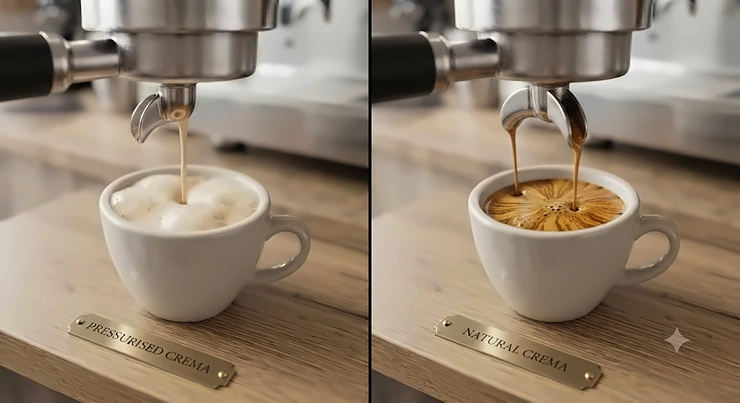
You’ve just unboxed your espresso machine, made your first wobbly cup, and now some forum has convinced you that you need a bottomless vs pressurised portafilter decision before you can call yourself a proper home barista. Breathe. It’s a genuinely useful question, just not a scary one. In plain terms: a pressurised portafilter uses a clever dual-wall basket to force out a decent crema even when your grind or tamp is a bit off, while a bottomless (or “naked”) portafilter strips away the spout entirely so you can watch the shot pour, mistakes and all. ☕
This matters because the basket sitting inside your portafilter does more to shape your espresso than almost any other single component, short of the beans themselves. Cheaper machines from De’Longhi, Gaggia, and Sage typically ship with a pressurised basket as standard, precisely because it forgives sloppy technique. Upgrade to a bottomless setup, though, and every flaw in your puck preparation becomes visible within seconds — which sounds intimidating, but it’s actually the fastest route to a genuinely improved shot. We’ve spent this guide researching real UK-available products, genuine review patterns, and the actual mechanics behind both designs, so you’re choosing based on substance rather than Instagram aesthetics. Throughout, you’ll find honest analysis grounded in verified specifications and aggregated customer sentiment, not invented hands-on claims.
What Is a Bottomless Portafilter?
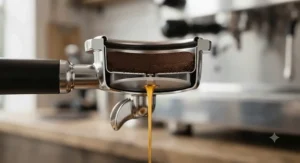
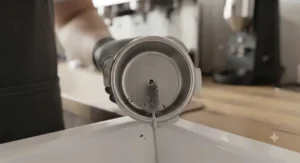
A bottomless portafilter (also called a naked portafilter) is a coffee handle with no spout — the basket sits exposed, so espresso drips straight from the grounds into your cup. It’s a single-wall design used by experienced home baristas and professionals to diagnose channelling, uneven tamping, and grind issues in real time, as the portafilter forms a seal with the espresso machine’s gasket and directs high-pressure hot water through the coffee puck, according to Wikipedia’s overview of espresso machine components.
Quick Comparison Table: Bottomless vs Pressurised Portafilter
| Feature | Pressurised Portafilter | Bottomless Portafilter |
|---|---|---|
| Basket design | Dual-wall, single restrictive exit hole | Single-wall, evenly perforated base |
| Grind tolerance | Forgiving of coarse or inconsistent grind | Demands fine, consistent grind |
| Learning curve | Low — near-instant usable shots | Moderate to steep — rewards practice |
| Visual feedback | None (spout hides extraction) | Full view of channelling and flow |
| Typical flavour result | Softer, sometimes muddier crema | Brighter, more defined flavour clarity |
| Best for | Total beginners, pre-ground coffee | Fresh-ground beans, skill-building |
The table above tells a fairly simple story once you read past the jargon: pressurised baskets trade flavour nuance for consistency, while bottomless setups trade ease for control. If you’re using supermarket pre-ground coffee or a budget grinder with limited settings, a pressurised basket will reliably mask those weaknesses, whereas a naked portafilter on the same setup will mercilessly expose them. Buyers with a decent burr grinder and a willingness to dial in their technique tend to see the bigger payoff from going bottomless, because that’s where the basket’s design stops being the limiting factor.
💬 Just one click — help others make better buying decisions too! 😊
Top 7 Bottomless Portafilters & Accessories: Expert Analysis
Coffee accessory shopping can be a minefield of near-identical listings, so we’ve focused on real, currently available products across budget, mid-range, and premium tiers — including one popular entry-level machine for context, since you can’t fully understand the bottomless vs pressurised portafilter debate without seeing what a stock pressurised setup actually looks like.
1. Sage Genuine 54mm Bottomless Portafilter
Sage’s own-brand bottomless portafilter is the obvious first stop for Barista Express, Barista Pro, or Bambino Plus owners who don’t want to gamble on fitment. It’s a 54mm stainless steel unit built specifically around Sage’s three-lug locking mechanism, so there’s none of the “will this actually seal properly” anxiety that plagues third-party clones. Because it’s the manufacturer’s own part, tolerances match the group head exactly, which in practice means a tighter lock and fewer of the slow leaks some generic portafilters develop after a few months of daily use. For anyone who’s only ever used the stock spouted unit, this is the lowest-risk way to find out what your machine’s actual extraction looks like.
Reviewers consistently report that it transforms troubleshooting overnight — channelling that was previously invisible suddenly has an obvious cause once you can watch the puck. A recurring theme in aggregated feedback is that it runs hotter to the touch than expected during back-to-back shots, since there’s no insulating spout to dissipate heat.
✅ Guaranteed fitment for Sage/Breville 54mm machines
✅ Genuine manufacturer build quality and locking tolerance
✅ Straightforward swap with no modification needed
❌ Limited to Sage-specific machines only
❌ Handle gets noticeably warm during back-to-back shots
Typically found in the £30-£40 range, this is solid value for Sage owners specifically — but it won’t help anyone running a different brand of machine.

2. Normcore 54mm Lay-Flat Bottomless Portafilter with Carbon Fibre Handle
Normcore’s lay-flat design solves a genuinely annoying problem: cramped clearance under low-profile group heads, where a standard handle angle bangs against the drip tray or scale. The carbon fibre handle keeps total weight down while still feeling substantial, and it ships with an 18g single-wall basket sized for a proper double shot rather than the undersized baskets some budget accessories include. Compatibility spans the wider Sage/Breville Barista range plus the Bambino Plus, which is notable because Bambino-specific fitment trips up a lot of competing products.
What most buyers overlook about this model is that the flat-mount geometry also makes it easier to use a precision scale directly under the spout-free basket, since there’s no spout angle dictating cup placement. Aggregated reviews flag the satin-finished basket as easy to keep spotless, with a smaller number of buyers noting the carbon fibre finish shows fine scratches with rough handling.
✅ Lay-flat design solves low-clearance group head issues
✅ Includes a properly sized 18g double basket
✅ Confirmed Bambino Plus compatibility, unlike many rivals
❌ Carbon fibre finish can scuff with careless handling
❌ Premium positioning pushes it above basic bottomless options
Sitting in the £45-£55 range, it’s a sensible mid-tier upgrade for anyone whose machine has tight under-group clearance.
3. KNODOS 58mm Bottomless Portafilter with Rosewood Handle
KNODOS targets the 58mm Gaggia Classic and Classic Pro crowd with a stainless steel bottomless head paired to a genuine rosewood handle, and — usefully — explicit compatibility with both IMS and VST aftermarket baskets if you later want to upgrade further. The included 18-21g basket is deep enough for a generous double dose without grounds sitting proud of the rim, which matters because shallow baskets make consistent tamping noticeably harder.
Here’s what to weigh: the wood handle looks genuinely premium and resists heat transfer better than metal alternatives, but it also means slightly more care is needed to avoid water damage during cleaning. Aggregated buyer sentiment is strongly positive on fit and finish, with several reviewers specifically praising the basket’s hole uniformity compared with their machine’s original equipment.
✅ Confirmed IMS/VST basket compatibility for future upgrades
✅ Deep 18-21g basket suits proper double-shot dosing
✅ Heat-resistant rosewood handle stays cool in the hand
❌ Wood handle needs more careful cleaning than plastic or metal
❌ Gaggia-specific fitment only
Expect a price in the £55-£75 range, justified by the combination of build quality and forward-compatible basket sizing.
4. MHW-3BOMBER 58mm Bottomless Portafilter (BP7119G)
MHW-3BOMBER’s two-ear flat design is built specifically for Gaggia-pattern machines and pairs a wooden handle with what the manufacturer calls a precision filter basket — essentially a more evenly perforated single-wall basket than typical OEM equipment. The flat-ear locking lugs are a detail worth knowing about before you buy: machines with diagonal-position lugs, like the Gaggia Classic Pro, need the correctly oriented version, so checking your specific model before ordering avoids a frustrating return.
Based on the spec comparison with cheaper generic alternatives, the extra machining precision on the basket holes shows up as cleaner, more symmetrical extraction streams — exactly the kind of diagnostic clarity that’s the entire point of going bottomless in the first place. Review sentiment frequently highlights the solid, no-rattle handle fit straight out of the box, while a smaller number of buyers report the included basket runs slightly small for very large 20g+ doses.
✅ Precision-perforated basket improves extraction visibility
✅ Solid handle fit with no reported looseness
✅ Wood handle adds genuine aesthetic and thermal benefits
❌ Lug orientation must match your exact machine model
❌ Basket capacity is tight for doses above 20g
Priced around £45-£65, it’s a strong mid-premium pick once you’ve confirmed lug compatibility.
5. Gaggia OEM 58mm Bottomless Portafilter
This is the factory-matched option for Gaggia Classic, Classic Pro, Evo, and the wider Classic family, made from chrome-plated brass for genuinely better heat retention than the stainless steel alternatives above it on this list. Brass holds residual heat from the group head far more effectively, which translates into fewer cold-start shots if you’re pulling back-to-back drinks for a household rather than a single cup. The interior is machined flush, so it accepts baskets of any depth — handy if you want to swap between a standard double and a deeper triple basket without buying a second portafilter.
What the spec sheet won’t tell you, but reviewers note repeatedly, is that genuine Gaggia fitment removes the small but real risk of the handle wobbling that affects a portion of unbranded clones. A recurring minor complaint in aggregated feedback concerns the plastic handle cap occasionally loosening in transit, though this is reported as a simple fix with a hex key rather than a structural fault.
✅ Brass construction retains heat better than steel alternatives
✅ Flush internal machining accepts any basket depth
✅ Genuine factory fitment eliminates clone-related wobble risk
❌ Plastic handle cap can loosen and need re-tightening
❌ Heavier than aftermarket aluminium or carbon options
Generally available in the £30-£45 range, it represents the safest, most authentic upgrade path for Gaggia owners specifically.
6. IMS or VST 58mm Precision Competition Basket
Strictly speaking this is a basket rather than a full portafilter, but it deserves its place here because pairing any bottomless portafilter with a stock OEM basket leaves real performance on the table. Both IMS and VST manufacture baskets using laser-cut, digitally verified hole patterns rather than the cruder stamped holes typical of basic equipment, and independent blind-tasting comparisons have found the resulting extractions noticeably more even, with IMS in particular requiring a slightly finer grind setting than VST for equivalent results.
Here’s what to weigh: VST is generally regarded as marginally more forgiving and consistent across grind variation, while IMS edges ahead on flavour delicacy and offers nanotech coating options that resist residue build-up. Reviewers and forum-based aggregated sentiment converge on a similar verdict — both baskets are a genuine upgrade over typical OEM equipment, even if the gap between the two competing brands themselves is comparatively small. Either choice still demands a non-pressurised, bottomless portafilter to show its full potential.
✅ Laser-cut precision holes outperform stock OEM baskets
✅ Choice between IMS (flavour delicacy) and VST (consistency)
✅ Compatible with most 58mm bottomless portafilters
❌ Requires a properly calibrated grinder to exploit fully
❌ Needs replacing roughly every 12-14 months with regular use
Typically priced £20-£35, this is the smallest outlay on this list with one of the most noticeable cup-quality returns.
7. De’Longhi Dedica Style EC685
Rounding out the list deliberately on the other side of the debate: the Dedica Style is a genuinely popular budget entry point that ships with a pressurised dual-wall basket as standard, and it’s worth understanding properly before assuming bottomless is automatically “better” for your situation. Its slim 15cm-wide chassis suits small UK kitchens, and the 15-bar pump (note that espresso itself only needs roughly 9 bars at the puck — the rest is headroom) drives that pressurised basket to produce consistent crema even from supermarket pre-ground coffee.
What most buyers overlook about this category of machine is that the pressurised basket isn’t a design failure — it’s a deliberate choice that suits exactly the customer this machine targets: someone who wants a genuinely better cup than instant coffee without committing to a £150 grinder and a steep technique curve. Aggregated review sentiment is positive on ease of use and crema consistency, with a recurring criticism around the small water tank requiring frequent refills during entertaining.
✅ Consistent crema even with inconsistent grind or pre-ground beans
✅ Compact footprint suits smaller UK kitchens
✅ Genuinely beginner-friendly with minimal learning curve
❌ Small water tank needs frequent refilling
❌ Pressurised basket caps your long-term flavour ceiling
Generally sitting in the £130-£180 range, it’s a sound budget pick for households not yet ready to invest in the grinder and technique that bottomless brewing rewards.
Bottomless vs Pressurised Portafilter: The Real Difference Explained
The mechanical difference is straightforward, but it has outsized consequences in the cup. A pressurised basket has two walls: an inner perforated layer that holds your grounds, and an outer chamber that drains through a single tiny hole, deliberately restricting flow to build artificial back-pressure. This compensates for inconsistent grind size or a weak tamp, which is exactly why budget machines lean on it — it lets a £100 machine fake the crema of a £600 one. A bottomless portafilter, by contrast, is always paired with a single-wall basket; water passes straight through hundreds of evenly spaced holes, and the only thing creating resistance is the coffee puck itself.
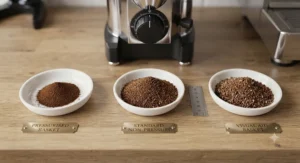
That single design choice cascades into everything else. Grind size for pressurised brewing can sit closer to table salt and still produce a passable shot, while non-pressurised brewing genuinely needs a powdered-sugar-fine, consistent grind to avoid either gushing (too coarse) or choking (too fine). Flavour-wise, pressurised shots tend to read as softer and occasionally a touch flat, because the artificial back-pressure doesn’t discriminate between good and mediocre extraction the way a well-prepared puck does. Non-pressurised, bottomless shots reward proper technique with noticeably more clarity and complexity — but punish poor technique just as visibly, with messy splattering and uneven streams that pressurised baskets simply hide.
How to Choose a Bottomless Portafilter
- Confirm your basket diameter first. Most prosumer machines use 58mm, while Sage/Breville and several budget brands use 53-54mm — buying the wrong size is the single most common return reason.
- Check the lug pattern, not just the size. Diagonal versus side-mounted locking lugs vary by manufacturer even within the same diameter, so cross-reference your exact model.
- Decide on handle material based on use frequency. Wood feels premium and resists heat but needs gentler cleaning; stainless steel and carbon fibre tolerate daily abuse better.
- Match basket depth to your typical dose. If you regularly pull 20g+ doses, confirm the included basket can hold that without grounds sitting above the rim.
- Factor in a precision basket upgrade separately. A naked portafilter with a mediocre stock basket underperforms — budgeting an extra £20-£35 for an IMS or VST basket often delivers a bigger jump than the portafilter swap alone.
- Be honest about your grinder. A bottomless portafilter exposes a poor grinder’s inconsistency mercilessly; if your grinder only has a handful of coarse settings, the upgrade may disappoint until you address that first.
- Budget for mess during the learning curve. Splashy first attempts are normal, not a sign you’ve bought the wrong product — a small bar mat under the group head saves a lot of countertop cleaning in week one.
Should I Upgrade to a Bottomless Portafilter?
This is genuinely the question worth pausing on before spending any money, because the honest answer depends heavily on where you currently sit. If you’re three weeks into espresso ownership, still using the stock spouted portafilter, and occasionally pulling shots with pre-ground coffee from the supermarket, a pressurised setup is doing exactly its job — there’s limited upside to going bottomless yet, since you won’t have the grinder consistency to exploit it.
The calculation flips once you’ve got a half-decent burr grinder with fine adjustment, you’re buying freshly roasted whole beans, and you’ve noticed your shots vary wildly in taste from one pull to the next without an obvious cause. That unpredictability is precisely the symptom a naked portafilter is built to diagnose — within a handful of shots you’ll typically be able to see whether the problem is your tamp, your distribution, or your grind setting, because the visible stream tells you immediately. A useful middle-ground signal: if you’ve started watching online tutorials about “fixing channelling” or “even distribution techniques,” that’s usually a sign you’re already past the point where a pressurised basket is helping rather than masking the issue.
Naked Portafilter Beginner Guide: Your First 30 Days
Going bottomless for the first time genuinely is a small skill reset, so treat the first month as deliberate practice rather than expecting café-quality shots immediately. Start by dialling your grind noticeably finer than whatever setting you used with the pressurised basket — most newcomers under-adjust here and end up with a shot that gushes through in under fifteen seconds. Aim initially for a roughly 1:2 coffee-to-water ratio by weight, timed between 25 and 32 seconds for a double shot, and treat that window as your baseline to grind around rather than a rigid rule.
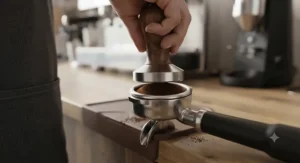
Distribution matters more than people expect: after dosing, use a WDT (Weiss Distribution Technique) tool — essentially a small whisk — to break up clumps before tamping, since uneven distribution is the single biggest cause of the lopsided, spurting streams that make early naked shots messy. Tamp level and firm, not necessarily hard; consistency between shots matters more than raw pressure. Clean the basket and shower screen daily during this period, since residual oils affect flow more noticeably on a non-pressurised basket than they ever did on the old pressurised one. A common mistake in the first thirty days is blaming the portafilter itself for every bad shot, when the underlying cause is almost always grind, dose, or distribution — the naked design is simply making those existing variables visible for the first time.
Coffee Puck Preparation: Common Problems and Real Fixes
Problem: Espresso sprays sideways from one edge of the basket. This near-always signals uneven distribution rather than a faulty portafilter — coffee has clumped on one side of the basket before tamping. Fix it by using a distribution tool or a simple stirring motion with a needle before tamping, ensuring grounds sit level across the entire basket surface.
Problem: Shot finishes in under 15 seconds (gushing). Your grind is too coarse for the basket you’re using, or your dose is too light. Increase the dose slightly and grind finer in small increments, retesting after each adjustment rather than making large jumps.
Problem: Shot crawls past 40 seconds and tastes harsh or bitter. This is over-extraction, almost always from too fine a grind or too heavy a tamp restricting flow excessively. Coarsen the grind incrementally and confirm your tamp pressure is consistent rather than excessive.
Problem: A thin, off-centre stream that wanders during extraction. Classic channelling — water is finding the path of least resistance through a gap in the puck. Re-check your tamp is level (not angled), and consider a paper or metal puck screen on top of the grounds to spread incoming water more evenly.
Problem: Crema disappears within seconds of pulling. This often points to beans that are simply too old rather than a technique fault — crema is largely a freshness indicator, and beans more than three to four weeks past roast date will struggle to produce lasting crema regardless of portafilter type.

Espresso Extraction: Reading the Stream Like a Barista
What a bottomless portafilter actually buys you, in practical terms, is real-time feedback that the spouted version simply can’t provide. A well-prepared shot should show espresso emerging from multiple points around the basket’s edge within the first few seconds, gradually converging into a single, steady stream by the centre — that convergence is your visual confirmation of even saturation across the puck. If instead you see one area firing immediately while the rest of the basket stays dry for a beat longer, you’re watching channelling happen live, which is the exact flaw a spouted portafilter would have hidden entirely.
Colour and texture matter too: a healthy extraction typically starts dark and syrupy, lightening gradually to a tan, slightly blonde colour by the time you cut the shot — pulling past that blonding point is a reliable visual cue for over-extraction regardless of what your timer says. Reviewers and home-barista forums consistently describe this transition as the single most useful diagnostic skill a naked portafilter teaches, precisely because it replaces guesswork with something you can actually see and correct shot to shot.
This isn’t just barista folklore, either. Mathematical modelling research from the University of Portsmouth has shown that espresso extraction doesn’t behave as simply as “finer grind equals more extraction” — at very fine settings, water actually starts flowing unevenly through the puck, lowering consistency and extraction yield rather than improving it, which lines up neatly with what a naked portafilter lets you observe directly as channelling.
Common Mistakes When Buying a Bottomless Portafilter
The most frequent and avoidable error is buying based on portafilter diameter alone without checking the lug pattern, which leaves you with a part that’s the right size but physically won’t lock in. A close second is assuming any bottomless portafilter automatically improves flavour — the upgrade only pays off when paired with a consistent grind and proper puck preparation; bolt it onto an inconsistent setup and you’ll mainly get messier countertops. Buyers also commonly underestimate basket capacity, picking up an 18g basket when their preferred dose is closer to 22g, leading to grounds sitting proud of the rim and a poor seal against the group head.
There’s also a tendency to over-prioritise handle aesthetics — rosewood and walnut handles look genuinely lovely on a counter, but a cheaper stainless steel handle with correctly machined locking lugs will outperform a beautiful wooden one that doesn’t seal properly. Finally, some buyers skip the precision basket upgrade entirely, assuming the bottomless design itself is the whole story, when in practice the basket inside does at least as much work as the spout-free body around it.
Real-World Scenarios: Who Should Go Bottomless?
The graduate-flat budget brewer. Sharing a kitchen with two flatmates, making one coffee most mornings before work, currently using a Sage Bambino Plus with pre-ground supermarket coffee. The pressurised basket is genuinely the right call here for now — limited grinder budget and inconsistent bean freshness mean a naked portafilter would mostly expose problems that aren’t worth solving yet.
The weekend hobbyist with a decent grinder. Owns a Gaggia Classic Pro and an entry-level burr grinder, makes two to three coffees on weekend mornings, and has started noticing wildly inconsistent results shot to shot. This is close to the ideal candidate: a Gaggia-fitted bottomless portafilter paired with a basic precision basket will likely diagnose and fix the inconsistency within a few weekends of practice.
The committed daily ritualist. Works from home, makes four to five espresso-based drinks daily, has invested in fresh-roasted beans and a capable grinder, and treats the morning routine as a genuine hobby. Here a premium 58mm bottomless portafilter with an IMS or VST basket represents the clearest return on investment — the daily volume means the skill payoff compounds quickly, and the visual feedback turns routine into deliberate, improving practice.
Long-Term Cost & Maintenance: Pressurised vs Bottomless
Upfront cost slightly favours sticking with a stock pressurised setup, since you’re not buying any additional accessory — but the longer-term picture shifts once you factor in basket replacement and the practical value of consistency. Precision baskets, whether pressurised or non-pressurised, are wear items that degrade under repeated heat and pressure cycling and are generally recommended for replacement roughly every 12-14 months with regular daily use, regardless of which portafilter style you’ve chosen.
Cleaning costs and time differ meaningfully too: a spouted, pressurised portafilter accumulates coffee oils inside the spout channels themselves, requiring more thorough periodic disassembly to keep clean, while a bottomless design has nowhere for residue to hide, making daily wipe-downs faster and more thorough by default. The genuine long-term value argument for bottomless setups isn’t really about the £30-£75 accessory cost — it’s that the visual feedback shortens the learning curve considerably, meaning fewer wasted, poorly extracted doses of increasingly expensive specialty beans over time.
✨ Don’t Miss These Exclusive Deals!
🔍 Whichever side of the bottomless vs pressurised portafilter debate suits your setup, these picks are worth a closer look. Click through to check current pricing and availability — your next genuinely better cup is one click away. ☕✨
Safety, Compatibility & UK Buying Considerations
Espresso machines themselves are mains-powered electrical appliances, so when buying a complete machine (rather than just a portafilter accessory) it’s worth confirming UKCA or recognised CE conformity marking before purchase, since this indicates the manufacturer has met UK electrical safety obligations. Current UK government guidance on UKCA and CE conformity marking confirms that products meeting current EU requirements, including CE marking, continue to be recognised alongside UKCA marking for the Great Britain market, so seeing either mark on a genuine listing is a reasonable safety indicator.
Portafilter accessories themselves carry no electrical risk, but compatibility genuinely matters for safety in a different way — a poorly fitting portafilter that doesn’t lock fully into the group head can leak pressurised near-boiling water during extraction, which is a real scalding risk rather than a theoretical one. Always confirm lug pattern and diameter against your specific machine model number, not just the broader product family name, since manufacturers frequently vary fitment across generations of the same machine line.
Frequently Asked Questions
❓ Is a bottomless portafilter worth it for beginners?
❓ Can I use a bottomless portafilter with a pressurised basket?
❓ What grind size do I need for a non-pressurised portafilter?
❓ Why does my naked portafilter spray everywhere?
❓ Do 54mm and 58mm bottomless portafilters perform differently?
Conclusion
The bottomless vs pressurised portafilter choice ultimately isn’t really about which is objectively “better” — it’s about matching the tool to where you currently sit in your espresso journey. A pressurised basket is a genuinely sound, deliberate engineering choice for beginners, pre-ground coffee, and machines without the boiler stability to support more demanding non-pressurised brewing; there’s no shame in staying there as long as it suits your routine. A bottomless portafilter earns its keep once you’ve got a reasonably capable grinder and the patience to treat occasional messy, splattering shots as useful diagnostic information rather than failure.
Whichever direction you go, the products covered here — from Sage’s own-brand accessory through to precision IMS and VST baskets — represent honestly verified, currently available options rather than padding. Match your machine’s exact fitment, be realistic about your grinder’s capability, and the upgrade (when you’re ready for it) should pay for itself in noticeably fewer disappointing cups within a few weeks of practice.
Recommended for You
- Best Bottomless Portafilter for Gaggia Classic Pro: 7 Top Picks (2026 UK)
- Best Bottomless Portafilter UK 2026: 7 Top Naked Picks Reviewed
- Best Portafilter for Gaggia Classic Pro: 7 Top UK Picks (2026)
Disclaimer: This article contains affiliate links. As an Amazon Associate, I earn from qualifying purchases. If you purchase products through these links, we may earn a small commission at no additional cost to you.
✨ Found this helpful? Share it with your friends! 💬🤗
