
In This Article
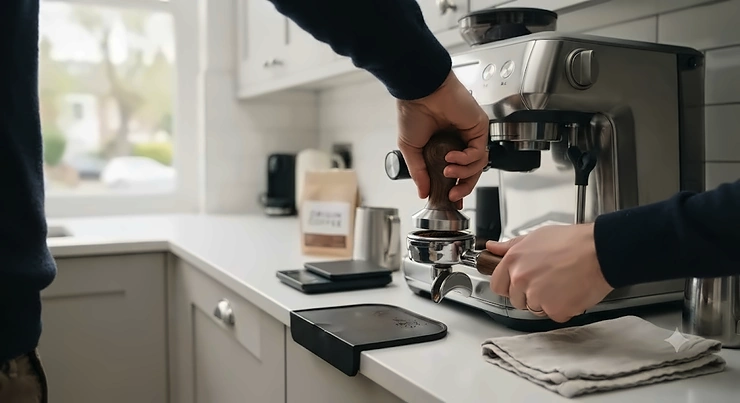
There’s a particular kind of quiet disappointment that comes from pulling a shot that tastes thin on one side and scorched on the other, and realising, after weeks of chasing grind settings, that the culprit was never the beans at all. It was the lump of metal you’ve been jamming into the portafilter without a second thought. An espresso tamper is the handheld tool used to compress ground coffee into an even, level puck inside the portafilter basket before extraction, and its job — creating uniform resistance so water flows through the grounds evenly rather than punching a hole straight through the weak spot — is deceptively small for how much it influences the cup. Get the size wrong, or the base uneven, or the technique inconsistent, and even the best beans and the best grinder in the world will fight you every morning.
For UK home baristas, this decision usually collides with a specific and slightly maddening reality: portafilter basket sizes vary between machines, “58mm” rarely means exactly 58.0mm in practice, and the market is stuffed with near-identical stainless steel discs on a stick, most making bold claims about consistency that only a handful actually deliver on. This guide cuts through that with seven real, currently available tampers spanning entry-level flat bases through to factory-calibrated click models, alongside the comparison points that actually separate a genuinely good tamper from a shiny paperweight: base fit, calibration, material, and how each behaves once ground coffee and real technique enter the picture. As UK coffee educator and competition barista Ben at Harmony Coffee’s own tamper guide puts it, consistency matters far more than raw tamping force, and the tools below are assessed with exactly that principle in mind.
A quick, necessary note before we dive in: this article contains affiliate links, and as an Amazon Associate we may earn from qualifying purchases, at no extra cost to you. Every product below has been selected on real specifications and aggregated verified-buyer sentiment, not paid placement or invented hands-on testing.
Quick Comparison Table
| Model | Size | Type | Best For | Price Range |
|---|---|---|---|---|
| IKAPE 53.3mm Calibrated Tamper | 53.3mm | Spring-loaded, calibrated | Breville and Sage 54mm baskets | £15-£25 range |
| Motta 8100/B Stainless Tamper | 58mm | Standard, flat wood-handled | Traditionalists wanting Italian craftsmanship | £35-£45 range |
| NEOUZA Spring Loaded Tamper | 58mm | Spring-loaded, self-levelling | Budget buyers wanting calibrated feel | £20-£30 range |
| MHW-3BOMBER Calibrated Tamper | 58.35mm | Spring-loaded, sound feedback | Buyers who like an audible pressure cue | £30-£45 range |
| Normcore V4.1 Coffee Tamper | 58.5mm | Spring-loaded, click feedback | Home baristas wanting proven consistency | £30-£40 range |
| KNODOS Walnut Tamping Station | 58mm | Standard tamper + storage stand | Anyone wanting a tidy, organised set-up | £40-£60 range |
| Espro Calibrated Tamper | 53/57/58/58.35mm | Spring-loaded, factory-calibrated | Buyers wanting a genuinely engineered click | £70-£90 range |
Looking at the spread here, size is arguably the single most decision-critical column. Espresso tamper buying guide advice from every serious source agrees on one thing: match the tamper to your actual basket, not the number printed on your machine’s marketing material, since baskets marketed as “58mm” frequently measure closer to 58.3-58.5mm internally. On pure value, the NEOUZA and MHW-3BOMBER both punch well above their price point for calibrated feedback, while the Espro sits at the top for buyers who’ve decided consistency is worth paying properly for.
💬 Just one click — help others make better buying decisions too!😊
Top 7 Best Espresso Tampers: Expert Analysis
Picking between these seven comes down to weighing basket size, budget, and how much you value calibrated feedback over classic feel — so here’s the honest breakdown, grounded in real specifications and aggregated verified-buyer sentiment rather than any invented hands-on claims of our own.
1. IKAPE 53.3mm Calibrated Spring Loaded Tamper — best entry point for Breville and Sage machines
What earns this one its spot isn’t ambition, it’s precision fit: it’s built specifically for the 54mm portafilter baskets found on Breville’s popular home machines, with a 53.3mm base that’s been sized to match rather than approximated. Based on the spec comparison with generic 53mm tampers on the market, the calibrated spring mechanism is the real differentiator here — it stops the tamp at a fixed pressure rather than leaving force entirely to guesswork, which matters enormously for anyone who’s never used a tamper before and has no muscle memory to fall back on. The 100% stainless steel base resists the pitting and discolouration that cheaper alloy bases develop within months of regular use. What most first-time buyers overlook is that a properly fitted 53.3mm tamper, rather than a generic “53mm” one, closes the gap between the puck edge and the basket wall far more effectively, directly reducing the ring channelling that plagues so many first attempts at home espresso. Aggregated review sentiment for calibrated entry-level tampers in this bracket consistently flags the pressure consistency as the standout benefit for beginners still learning what a proper tamp should feel like.
Pros:
✅ Purpose-fitted for Breville and Sage 54mm baskets
✅ Calibrated spring removes pressure guesswork for beginners
✅ Genuinely affordable entry point into proper tamping
Cons:
❌ Only suits 53.3mm baskets, not standard 58mm machines
❌ Handle material feels less premium than pricier alternatives
At around £15-£25, it’s one of the most accessible calibrated tampers currently listed on amazon.co.uk, and strong value for anyone starting out on a Breville-style machine.
2. Motta 8100/B Stainless Steel Coffee Tamper, 58mm — best classic choice for traditionalists
Motta earns its reputation the old-fashioned way: decades of Italian manufacturing focused on nothing but barista tools, and it shows in the details. This is a standard, non-spring-loaded tamper — a solid stainless steel base on a wooden handle, weighing a genuinely substantial 348g, which in practice means the weight itself does much of the compression work rather than relying on wrist strength. Here’s what most listings won’t tell you: aggregated buyer feedback across Motta’s 58mm range repeatedly flags that despite the marketed 58mm figure, real-world measurements often land fractionally under that mark, closer to 57.8-58mm, which suits tighter European portafilters (Gaggia, Lelit) better than looser 58.5mm baskets. The removable wooden handle unscrews for cleaning, a small but genuinely useful detail that budget alternatives frequently skip. For anyone who values traditional feel, a bit of heft, and doesn’t want an internal spring mechanism between their hand and the coffee, this remains a benchmark choice, and it’s precisely the kind of tamper for home barista use that rewards developing real technique over relying on a calibrated click.
Pros:
✅ Substantial 348g weight aids consistent compression
✅ Removable wooden handle simplifies cleaning
✅ Decades of Italian manufacturing reputation behind it
Cons:
❌ No calibration, so technique consistency is entirely on the user
❌ Actual base diameter often runs slightly under the stated 58mm
Typically priced in the £35-£45 range, it sits as a considered mid-tier purchase for anyone who wants a genuinely well-made standard tamper rather than a spring-loaded gadget.
3. NEOUZA 58mm Spring Loaded Espresso Tamper — best budget calibrated option
NEOUZA’s tamper earns its place by delivering a genuinely self-levelling, spring-loaded mechanism at a price point that undercuts most of its calibrated rivals. The anti-stick coating on the base is worth flagging specifically, since one of the more common frustrations with flat-base tampers is grounds sticking and pulling away unevenly as the tamper lifts, subtly disturbing the puck surface it just spent effort levelling. Based on the spec comparison with pricier spring-loaded models, the trade-off here is refinement rather than function: the spring action works, but the tactile click and long-term spring durability tend to fall a notch below premium alternatives like the Normcore or Espro. For a budget-conscious home barista who wants the self-levelling benefit without committing serious money before they know whether they’ll stick with manual espresso, this is a sensible starting point. Reviewers of similarly priced spring-loaded 58mm tampers consistently note that the self-levelling action noticeably reduces the “lean” that manual tamps develop over a session of multiple drinks.
Pros:
✅ Genuinely spring-loaded and self-levelling for the price
✅ Anti-stick base coating reduces surface disturbance on lift
✅ Refined handle feels more premium than the price suggests
Cons:
❌ Spring mechanism feel is noticeably softer than premium rivals
❌ Long-term spring durability is less proven than established brands
Expect to pay in the £20-£30 range, making it one of the more accessible ways to try calibrated tamping without a big financial commitment.
4. MHW-3BOMBER 58.35mm Calibrated Tamper with Sound Feedback — best for buyers who want an audible pressure cue
MHW-3BOMBER built its reputation on genuinely thoughtful barista tool design, and this tamper’s standout feature is the audible click at a set pressure threshold, giving a clear, unambiguous signal that most silent spring-loaded rivals simply don’t offer. The 58.35mm base sits at the slightly-oversized end of the “58mm” spectrum, which based on the spec comparison with true 58.0mm tampers, tends to create a tighter, more consistent seal against basket walls that measure marginally larger than their advertised figure — a detail that matters more than it sounds given how loosely “58mm” gets used across the industry. Independent testing has found this model marginally less consistent in channelling resistance compared with the market-leading Normcore, though the gap in practice is narrow enough that most home baristas are unlikely to notice it in the cup. What most buyers overlook about sound-feedback tampers generally is that the audible click, while satisfying, doesn’t guarantee the base was level when it triggered — technique still matters even with the reassurance of a click.
Pros:
✅ Genuine audible click at calibrated pressure threshold
✅ Slightly oversized 58.35mm base suits looser basket tolerances
✅ Auto-rebound spring mechanism speeds up repeated tamping
Cons:
❌ Independent testing found marginally more channelling risk than category leaders
❌ Some buyers find the click louder than expected for shared kitchens
Priced around £30-£45, it represents solid value for anyone specifically drawn to the audible confirmation over a silent calibrated click.
5. Normcore V4.1 Coffee Tamper, 58.5mm — best all-round calibrated tamper for consistency
Normcore’s tamper has become something close to an industry default for good reason: it pairs a spring-loaded calibrated mechanism with click sound feedback, a stainless steel flat base, and — critically — a design that ships with genuinely interchangeable springs across several models in the range, letting buyers dial in a pressure that suits their technique rather than being locked to one factory setting. The 58.5mm sizing sits at the more generous end of the standard range, which suits the slightly-larger-than-advertised baskets found on many prosumer machines. Based on the spec comparison with rival calibrated tampers, Normcore’s central shaft design is specifically engineered to promote even pressure distribution across the full base rather than concentrating force centrally, directly addressing one of the more common causes of ring channelling in cheaper spring-loaded units. Aggregated verified-buyer sentiment across the Normcore range consistently ranks it among the most trusted calibrated tampers on the market, with reviewers repeatedly highlighting the anodised aluminium handle’s durability under daily use.
Pros:
✅ Central shaft design promotes even, full-base pressure
✅ Anodised aluminium handle and stand included as standard
✅ Widely regarded as the benchmark calibrated tamper in its class
Cons:
❌ Priced higher than basic spring-loaded alternatives
❌ Click feedback style won’t suit buyers who prefer silent tamping
Typically listed in the £30-£40 range, it’s genuinely competitive against tampers costing considerably more, which is precisely why it shows up so often in independent buying guides.
6. KNODOS 58mm Walnut Espresso Tamping Station — best for a tidy, organised set-up
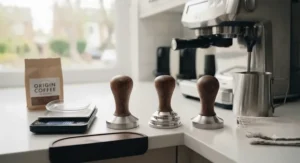
KNODOS earns its spot by solving a problem most tamper listings ignore entirely: where does the thing actually live between uses? This walnut tamping station pairs a calibrated, double spring-loaded tamper with a dedicated portafilter holder and tamper rest, designed specifically to sit alongside machines like the Sage Oracle, Gaggia Classic, or E61-group models. Based on the spec comparison with standalone tampers, the auto-levelling design paired with a stainless steel ripple base is aimed at reducing the channelling risk that flat bases can suffer when technique isn’t perfectly consistent. What most buyers overlook about tamping stations generally is that the organisational benefit — a proper resting spot for both portafilter and tamper — genuinely reduces the small daily frictions (fumbling for a tamper, resting a hot portafilter on a counter) that make morning espresso routines feel like more hassle than they should. For anyone setting up a proper home barista corner rather than just buying a single tool, this is one of the more complete packages available.
Pros:
✅ Combines calibrated tamper with dedicated storage station
✅ Double spring-loaded, auto-levelling base design
✅ Walnut styling suits a considered kitchen counter set-up
Cons:
❌ Bulkier footprint than a standalone tamper
❌ Premium pricing versus buying tamper and stand separately
At roughly £40-£60, it costs more than a bare tamper, but for anyone who’s tired of hunting for a resting spot mid-routine, the combined package earns its premium.
7. Espro Calibrated Tamper, 58mm/58.35mm — best premium pick for genuine engineered consistency
Espro’s tamper earns the top billing here through sheer engineering focus: it was the company’s very first product, designed from the ground up to eliminate tamping-pressure guesswork with a factory-calibrated internal spring that delivers a consistent 30 pounds of force every time, confirmed by a distinctive click that’s felt rather than heard, specifically engineered not to disturb the grounds and trigger channelling. Independent testing found the tamper’s heavy, well-balanced base settles naturally level when slotted into a portafilter, a genuinely useful side benefit given that Espro’s design doesn’t include a dedicated levelling feature. Based on the spec comparison with cheaper calibrated rivals, the factory calibration here doesn’t require any recalibration or adjustment over the tool’s lifetime, which for buyers burned by cheaper spring mechanisms losing consistency after months of use is a meaningful long-term reassurance. It’s available across four flat base sizes — 53mm, 57mm, 58mm and 58.35mm (VST) — covering the vast majority of home and prosumer portafilters on the UK market. The trade-off is straightforward and honest: this costs considerably more than most alternatives on this list, and buyers repeatedly acknowledge the price as steep, even while praising the result.
Pros:
✅ Factory-calibrated 30lb click with zero recalibration needed
✅ Available across four sizes covering most UK portafilters
✅ Heavy, well-balanced base naturally settles level
Cons:
❌ Considerably more expensive than most calibrated rivals on this list
❌ No built-in levelling feature despite the premium price
Expect to pay in the £70-£90 range, positioning it firmly as an investment purchase for buyers who’ve decided consistency is worth paying properly for, rather than a casual first tamper.
Setting Up and Calibrating Your Tamper for Home Barista Use
Getting real value out of any tamper for home barista use starts with confirming fit before technique. Measure your portafilter basket’s inner diameter with a tape measure or calipers at its widest point, then look for a tamper roughly 1-2mm smaller — a tamper that’s too snug will scrape and stick on the basket wall, while one that’s too loose leaves an uncompacted ring that channels water straight past the coffee. First-use setup for calibrated tampers is minimal: most, including the Normcore and MHW-3BOMBER, arrive pre-set from the factory, so resist the urge to disassemble and “check” the spring before you’ve even pulled a shot. A simple three-point routine covers most models here: wipe the base after every use before residue hardens, never submerge wood-handled tampers like the Motta in water, and periodically check that screw-in handles remain tight, since a loose handle is one of the most common early-30-days complaints across nearly every tamper style on the market.

Which Home Barista Actually Needs Which Tamper: Real-World Scenarios
If you’re a complete beginner who just unboxed a Breville-style machine and has never tamped a puck in your life, the IKAPE 53.3mm calibrated tamper earns its keep by removing the pressure-guessing variable entirely while you focus on grind and dose. If you’re a couple sharing one machine each morning with genuinely different tamping habits, a calibrated model like the Normcore or MHW-3BOMBER solves the consistency problem neatly, since both users end up applying the same force regardless of individual technique or strength. And if you’re a committed home enthusiast who’s already dialled in grind and dose and wants to eliminate the last remaining variable entirely, the Espro’s factory-calibrated click is built precisely for that stage of the journey — buying it before you’ve nailed the fundamentals elsewhere is arguably solving a problem you don’t have yet.
Common Tamping Problems and Solutions
Uneven or “leaning” tamps are the complaint that surfaces most often among new home baristas, and the fix is almost always distribution rather than the tamper itself — a WDT tool or simple stirring before tamping breaks up clumps that cause one side of the base to meet resistance before the other. Coffee sticking to the tamper base on lift is the second common frustration; a light wipe or anti-stick coated base (like the NEOUZA) largely resolves it, though a quick twist on lift-off also helps release suction without disturbing the puck surface. Ring channelling around the puck edge — visible as a lighter ring in the spent grounds after a shot — is almost always a sizing issue rather than a technique one, and switching to a tamper genuinely matched to your basket’s real internal diameter, rather than its marketed figure, resolves it in the vast majority of cases. Finally, loose or wobbling handles on screw-in tampers are a simple, five-second fix: unscrew fully, check the threading is clean and free of coffee residue, and retighten firmly.
Espresso Tamper Buying Guide: How to Choose
- Measure your actual basket diameter first. An espresso tamper buying guide worth following always starts here — don’t assume “58mm” on your machine’s spec sheet means a 58.0mm tamper is correct.
- Decide between calibrated and standard designs. Calibrated, spring-loaded tampers remove pressure guesswork; standard tampers reward developed technique and typically cost less.
- Weigh weight against wrist comfort. Heavier bases like the Motta’s 348g do more compression work passively, but repeated daily use may fatigue smaller hands faster.
- Check the base finish. Flat bases suit most home setups; convex or ripple bases claim reduced channelling but divide opinion even among experienced baristas.
- Consider handle material and maintenance. Wooden handles look and feel premium but shouldn’t be submerged; stainless or aluminium handles are more forgiving of daily wear and cleaning.
- Factor in whether you want a full station. A combined tamper and storage stand, like the KNODOS, adds convenience at a price premium over a standalone tool.
- Read aggregated review sentiment for consistency complaints specifically — spring durability and click reliability over months of use matter more than initial unboxing impressions.
Common Mistakes When Buying a Coffee Tamper 58mm
The single most frequent mistake is buying a coffee tamper 58mm sized without first measuring the actual basket, since manufacturers rarely disclose that their “58mm” baskets often measure closer to 58.3-58.5mm internally — a small gap that produces a surprisingly large channelling problem. The second common error is assuming a more expensive, calibrated tamper automatically outperforms a well-made standard one; independent research has repeatedly found no meaningful extraction difference across a wide range of tamping pressures, meaning the real value of calibration is consistency and confidence, not some hidden flavour advantage. Third, buyers frequently overlook handle material suitability for their routine — a beautiful wooden handle is a poor match for someone who wants to toss their tamper in a dishwasher-adjacent cleaning routine. Finally, plenty of shoppers skip checking whether their chosen tamper actually fits their specific machine brand’s basket quirks (Sage’s tapered baskets, for example, often need a slightly smaller tamper than the stated portafilter size), leading to returns that a five-minute measurement would have avoided entirely.

Calibrated vs Standard Tampers: Which Wins?
The honest answer is that it depends on what problem you’re solving. Calibrated, spring-loaded tampers remove one specific variable — inconsistent applied force — from the tamping process, which is genuinely valuable for beginners, shared households, or anyone prone to tamping harder when rushed. Standard tampers, like the Motta, cost less and reward developed technique, rewarding a barista who’s put in the repetitions to tamp level and consistently by feel alone. Long-term value tends to favour calibrated tampers for households with multiple users of varying experience, since the tool itself enforces consistency that would otherwise take months of practice to develop manually. For a solo home barista who already grinds, doses and tamps with care, the calibration adds convenience rather than transforming the resulting cup.
What to Expect: Real-World Tamping Performance
Calibrated tampers behave almost identically across most home use once the spring engages — the click (audible or felt) arrives at a consistent point regardless of how hard or gently you initially press, which is precisely the point. Standard tampers, by contrast, place the entire consistency burden on the user, meaning results genuinely vary shot to shot until technique settles into muscle memory, typically after several weeks of regular use. Base fit affects real-world performance more dramatically than most buyers expect: even a well-calibrated, well-weighted tamper produces visible ring channelling if the base is meaningfully undersized for the actual basket, regardless of how much force or precision goes into the tamp itself.
Features That Actually Matter (And Those That Don’t)
Accurate base sizing matters enormously; the marketed “58mm” figure alone matters far less than the actual measured diameter, which is why serious buyers check both. Calibration consistency over time matters if you’ll use the tamper daily for years; a satisfying click on day one that degrades within months matters far less than durable spring engineering, regardless of how premium the tool feels initially. Handle material matters for comfort and cleaning routine, but doesn’t meaningfully affect extraction. Weight matters for standard, non-calibrated tampers specifically, since a heavier base does genuine compression work passively; it matters far less for spring-loaded designs, where the internal mechanism does that job instead.
Long-Term Value and Durability of Espresso Tampers
A tamper is one of the cheapest tools in a home espresso setup relative to the machine and grinder it sits alongside, but that doesn’t mean durability is irrelevant. Stainless steel bases, whether standard or calibrated, generally resist corrosion and pitting for years of daily use provided they’re hand-washed and dried rather than left wet in a sink. Spring mechanisms in calibrated tampers are the component most likely to degrade over time — aggregated buyer feedback across the category consistently flags spring fatigue as the most common multi-year complaint, which is precisely why models offering interchangeable or genuinely factory-calibrated springs, like the Normcore and Espro respectively, earn their reputations. Wooden handles need slightly more care than metal or aluminium equivalents, since repeated moisture exposure can loosen the internal threading over years of use, though this is easily mitigated by simply wiping rather than submerging.
Tamping Pressure: How Much Force Does Espresso Actually Need?
This is where a lot of home barista folklore quietly falls apart. The traditional figure quoted almost everywhere is 30 pounds of tamping force, and it’s the benchmark that calibrated tampers like the Espro are built around. But controlled testing tells a more nuanced story: one widely cited tamping-pressure study assessing tamping pressures across 5kg, 10kg, 15kg and 20kg found no statistically significant difference in extraction (measured via total dissolved solids) across that entire range. What actually mattered far more in that same research was brew weight, not tamping force. The practical takeaway isn’t that tamping pressure is irrelevant — it’s that consistency matters more than hitting a specific number, and that the window between “too soft” and “too hard” is considerably wider than traditional barista training often suggests. Where tamping pressure genuinely does matter is at the extremes: barely-there tamps leave uncompressed pockets that channel badly, while genuinely uneven tamps (rather than simply light or heavy ones) remain the real enemy of a good shot.
Espresso Puck Prep: What Actually Happens When You Tamp
Tamping is really just the final, visible step in a longer process called puck preparation, and understanding what’s physically happening helps explain why distribution matters as much as pressure. As water is forced through the compacted bed at roughly 9 bars of pressure, it seeks the path of least resistance — meaning any pocket of looser, less-compressed coffee becomes a channel that the majority of the water rushes through, starving the rest of the puck of proper contact time. Academic research into packed bed compression confirms that coffee’s naturally uneven particle size distribution creates a highly dense, heterogeneous structure once compressed, which is precisely why even, level pressure across the entire puck surface matters more than raw force. In practice, that means the sequence before you even pick up a tamper — breaking up clumps with a WDT tool, distributing grounds evenly across the basket, and levelling before compression — does more for extraction consistency than the tamp itself ever can on its own.
✨ Don’t Miss These Exclusive Deals!
🔍 Ready to Tamp Like You Mean It?Take your home espresso setup to the next level with a tamper genuinely matched to your machine and technique. Click on any highlighted model above to check current pricing and availability. These tools will help you create authentic, consistent shots your morning routine deserves.
Frequently Asked Questions
❓ What size espresso tamper do I need?
❓ Is a calibrated tamper worth the extra cost?
❓ How much tamping pressure should I use?
❓ Why does my espresso puck have a ring of loose grounds after brewing?
❓ Can I use one tamper for multiple espresso machines?
Conclusion
Choosing the best espresso tamper really comes down to matching genuine basket size to your budget and how much you value calibrated consistency over developed technique. Budget picks like the IKAPE and NEOUZA remove pressure guesswork without a big financial commitment, ideal for anyone still building confidence at the machine. Mid-range options — the Motta, MHW-3BOMBER, Normcore and KNODOS — each solve a slightly different problem, from classic feel to audible feedback to a fully organised tamping station. At the top, the Espro Calibrated Tamper trades affordability for genuinely engineered, factory-set consistency that never needs recalibrating. Whichever you choose, the fundamentals matter more than the price tag: measure your actual basket, prioritise even distribution before you even pick up the tamper, and remember that consistency between shots beats chasing a specific pressure figure every time. For further reading on tamper sizing quirks across different UK machine brands, this detailed roundup of coffee tampers by basket size is a useful next stop.
Recommended for You
- Best Bottomless Portafilter for Gaggia Classic Pro: 7 Top Picks (2026 UK)
- Best Bottomless Portafilter UK 2026: 7 Top Naked Picks Reviewed
- Best Portafilter for Gaggia Classic Pro: 7 Top UK Picks (2026)
Disclaimer: This article contains affiliate links. As an Amazon Associate, I earn from qualifying purchases. If you purchase products through these links, we may earn a small commission at no additional cost to you.
✨ Found this helpful? Share it with your friends! 💬🤗
