
In This Article
Every home barista has a moment of reckoning. You’ve bought the machine, dialled in the grinder, weighed your dose to the tenth of a gram — and then you tamp by feel, like you’re pressing down a plug socket cover, and wonder why Tuesday’s shot tastes nothing like Monday’s. A best calibrated tamper exists precisely to end that guessing game. In short: it’s a tamper with a built-in mechanism — usually a spring or a click-feedback system — that applies the same, pre-set pressure every single time, removing your hand strength as a variable entirely.

We’ve dug through the real products sold on amazon.co.uk, weighed genuine aggregated review sentiment against manufacturer claims, and even chased down the actual physics research on whether tamping pressure matters as much as the marketing suggests (spoiler: it’s more nuanced than “harder is better”). According to Harmony Coffee’s UK tamper guide, a proper spring-calibrated tamper is one of the cheapest upgrades that meaningfully improves shot-to-shot consistency, and that’s the thread running through everything below.
Whether you’re a newly converted home barista tired of inconsistent shots, or a small café owner who wants every staff member pulling identical pucks, there’s a tamper here that fits. We’ll dig into self-levelling mechanisms, spring-loaded designs, exactly what 30lb pressure actually means, and why “consistent” matters more than “hard.”
Quick Comparison Table
| Product | Mechanism | Pressure | Price Range | Best For |
|---|---|---|---|---|
| Normcore Spring Loaded Tamper V4 | Spring, self-levelling | 15/25/30lb interchangeable | £35-£50 | Best overall spring loaded tamper espresso |
| Espro Calibrated Tamper | Click, factory-set | Fixed 30lb | £70-£90 | Best click-feedback calibrated pick |
| IKAPE V3 Calibrated Tamper | Spring, self-levelling | Fixed 30lb | £20-£30 | Best budget self levelling tamper |
| Normcore V5 Spring Loaded Tamper | Tri-spring, dial-adjustable | 10.5-15.5kg, 6 gears | £75-£100 | Best premium adjustable tamper |
| MHW-3BOMBER 3-Spring Tamper | Spring, sound feedback | 15/30lb interchangeable | £20-£35 | Best budget alternative pick |
| Barista Hustle Tamper | Manual, precision-machined | User-applied | £40-£55 | Best for advanced manual technique |
| The Force Tamper | Automatic punch, auto-level | Adjustable constant | £150-£180 | Best for ultimate espresso repeatability |
The spread here tells its own story: spring-loaded tampers dominate the mid-range because the mechanism itself is genuinely simple and cheap to manufacture well, while the premium end splits between refinement (Normcore V5’s adjustable dial) and outright automation (The Force Tamper’s punch mechanism). None of these prices are fixed — Amazon listings shift constantly, so always check the current price before buying.
💬 Just one click — help others make better buying decisions too!😊
Top 7 Best Calibrated Tampers: Expert Analysis
1. Normcore Spring Loaded Tamper V4 — best overall spring loaded tamper espresso
The Normcore V4 is the tamper most home baristas mean when they say “get yourself a calibrated one.” The standout feature is its central-shaft spring design, refined enough that the pressure genuinely feels consistent stroke after stroke, not just on paper.
It ships with three interchangeable springs — 15lb, 25lb and 30lb — with the 25lb installed as standard, letting you tune the tamp to your basket depth and bean density rather than being locked into one setting forever. The self-levelling plate rests directly on the portafilter basket rim as you press, which genuinely does eliminate the skewed, lopsided tamps that plague anyone learning by feel. Reviewers consistently praise how it removes an entire variable from their morning routine, several noting they stopped second-guessing whether “today’s shot” would taste different purely because of how hard they pressed.
This is the tamper for anyone serious about repeatable espresso at home without spending café-equipment money. What most buyers overlook is that swapping springs takes seconds once you’ve done it once, so don’t be put off by the idea of “fiddly disassembly” — it’s genuinely a thirty-second job. The most repeated criticism in aggregated feedback is that the mechanism shouldn’t be washed under running water or soaked, since moisture can affect the internal spring over time.
Pros:
- ✅ Genuinely consistent, self-levelling tamp every time
- ✅ Three interchangeable springs for flexibility
- ✅ Comes with a stand for tidy storage
Cons:
- ❌ Cannot be soaked or dishwasher-washed
- ❌ Slightly heavier than a basic manual tamper
At around £35-£50 depending on base finish and size, this remains the benchmark value pick in the category.
2. Espro Calibrated Tamper — best click-feedback factory-calibrated pick
Espro built its entire company around one product, and the Calibrated Tamper is still the reason people bring it up unprompted in barista forums nearly two decades later. The standout feature is the click mechanism itself — a subtle, tactile pulse you feel rather than hear, confirming you’ve hit exactly 30lb without disturbing the grounds or causing channelling.
Unlike spring designs with swappable tension, the Espro is factory-calibrated to a single fixed pressure and genuinely doesn’t need recalibrating — the internal mechanism is sealed and built to hold its setting for years rather than months. Long-term owners, including some reporting over a decade of daily use, consistently praise its durability, which says something meaningful about build quality in a category where cheaper imports sometimes fail within months.
This is the tamper for anyone who wants “set and forget” simplicity rather than the flexibility of adjustable springs — you’re trading customisation for absolute reliability. Aggregated review sentiment is overwhelmingly positive on the click feel itself, with the most common criticism being the price relative to spring-loaded alternatives offering broadly similar consistency for less outlay.
Pros:
- ✅ Reliable, tactile click confirms exact pressure
- ✅ No recalibration needed, ever
- ✅ Genuinely proven long-term durability
Cons:
- ❌ Fixed pressure, no adjustment for preference
- ❌ Priced noticeably higher than spring alternatives
Expect to pay around £70-£90 — a premium price, but one that reflects a genuinely mature, well-tested design.
3. IKAPE V3 Calibrated Tamper — best budget self levelling tamper
IKAPE’s calibrated tamper proves you don’t need to spend big to get the fundamentals right. The standout feature is unashamedly the transparent acrylic handle on some finishes, which sounds like a gimmick until you actually watch the spring compress mid-tamp — genuinely satisfying in a way that’s completely unnecessary but oddly hard to stop noticing.
Beneath the novelty, this is a proper 30lb calibrated tamper with a spring-loaded levelling ring, meaning you get both consistent pressure and a level tamp without any technique to master. Based on the spec comparison against pricier rivals, IKAPE sacrifices remarkably little in core function — the underlying mechanism achieves the same job as tampers costing two or three times as much, since the physics of a calibrated spring don’t fundamentally change with price.
This suits beginners testing whether a calibrated tamper is worth the hype, or anyone upgrading from the flimsy plastic tamper that ships free with most entry-level machines. Reviewers consistently flag it as excellent value, with the mildest recurring gripe being a slight squeak from the mechanism during use, which a drop of food-safe lubricant generally resolves.
Pros:
- ✅ Genuine 30lb calibrated pressure at a budget price
- ✅ Self-levelling ring included as standard
- ✅ Available across a wide range of basket sizes
Cons:
- ❌ Some units develop a minor squeak over time
- ❌ Rippled base variant traps a little coffee in grooves
At around £20-£30, this is the easiest entry point into calibrated tamping available right now.
4. Normcore V5 Spring Loaded Tamper — best premium adjustable tamper
The V5 is Normcore looking at its own bestselling V4 and asking “what if we made this properly adjustable, on the fly, with no tools?” The standout feature is the patented tri-spring system paired with a six-gear dial, letting you rotate between six preset pressures from 10.5kg to 15.5kg without ever swapping a physical spring.
That dial-based approach means adapting to a dense, freshly roasted single origin or a lighter, aged batch takes a twist of the wrist rather than a disassembly session — genuinely useful if you’re someone who rotates through several bags of beans in a given week. The titanium PVD coating on the base isn’t just cosmetic either; it adds a layer of wear resistance that matters if this tamper is getting knocked around a busy kitchen counter daily.
This is the tamper for enthusiasts who’ve already owned a V4, understand exactly why they want more control, and are willing to pay for it. What the spec sheet doesn’t emphasise enough is that the non-disassemblable body, while great for structural integrity, means you’re relying entirely on the dial mechanism rather than being able to service springs individually if something eventually wears.
Pros:
- ✅ Six adjustable pressure settings via dial, no tools needed
- ✅ Durable titanium-coated base
- ✅ Doubled durability claimed versus single-spring designs
Cons:
- ❌ Non-disassemblable body limits DIY servicing
- ❌ Premium price for what’s ultimately incremental refinement
Priced around £75-£100, it’s a genuine luxury upgrade rather than a necessity for most home setups.
5. MHW-3BOMBER 3-Spring Loaded Tamper — best budget alternative pick
MHW-3BOMBER has built a loyal following among home baristas who want Normcore-adjacent functionality without paying Normcore-adjacent prices, and this tamper is exactly that proposition delivered honestly. The standout feature is the audible sound feedback on activation, giving you both tactile and auditory confirmation that you’ve hit your target pressure — a small touch that genuinely helps beginners build confidence faster.
Like its more expensive rivals, it ships with interchangeable 15lb and 30lb springs, covering the practical range most home users actually need without the third mid-point spring some competitors include. The compatibility with ROK Espresso Makers and smaller basket sizes also makes it a sensible pick for lever-machine owners who are sometimes overlooked by tampers designed primarily around Breville-sized baskets.
This is the pick for anyone comparing spec sheets against the Normcore V4 and wondering whether the brand premium is truly justified — for many casual home users, honestly, it isn’t. Aggregated feedback is broadly positive on value for money, with occasional notes that the handle material feels slightly less refined than Normcore’s anodised aluminium.
Pros:
- ✅ Genuine spring-calibrated pressure at a low price
- ✅ Audible feedback aids confidence for beginners
- ✅ Good size range including smaller lever-machine baskets
Cons:
- ❌ Handle feels less premium than pricier rivals
- ❌ Only two spring options versus three on some competitors
At roughly £20-£35, this is a genuinely smart budget alternative rather than a compromise pick.
6. Barista Hustle Tamper — best for advanced manual technique
Not every serious barista wants a spring doing the thinking for them, and the Barista Hustle Tamper exists for exactly that crowd. The standout feature is its double-flange design, engineered specifically to eliminate the irritating vacuum-suction effect that makes some flat tampers stick to the puck on the way back out — a small annoyance that becomes genuinely tedious over dozens of daily tamps.
Precision-machined from military-spec hard-anodised aluminium with a replaceable 304 stainless steel base, this is a tool built for people who’ve already developed consistent technique and want a tamper that gets out of the way rather than one that imposes calibration on them. It’s worth being upfront here: this is not a spring-loaded or click-calibrated tamper, so it relies entirely on your own consistency rather than a mechanism enforcing it — a deliberate trade-off competition baristas often prefer once their technique is dialled in.
This suits experienced home baristas and café professionals who’ve moved past needing training wheels and want a tool that rewards good habits rather than compensating for inconsistent ones. Reviewers consistently praise the corner-radius design for maximising usable tamping surface, with the main criticism being that beginners genuinely won’t see the consistency benefits a calibrated tamper offers.
Pros:
- ✅ Double flange eliminates annoying vacuum suction
- ✅ Replaceable base extends genuine long-term lifespan
- ✅ Precision fit for modern VST-style baskets
Cons:
- ❌ No calibration — consistency depends entirely on your technique
- ❌ Not the right choice for beginners still building consistency
At around £40-£55, it’s a considered purchase for someone who already knows exactly why they want it.
7. The Force Tamper — best for ultimate espresso repeatability
If the other six tampers on this list are about assisting consistency, The Force Tamper is about removing the human element almost entirely. The standout feature is its automatic punch mechanism combined with auto-levelling — you position it, and it delivers a calibrated, dead-level tamp with genuinely minimal manual input required.
This is a serious piece of engineering rather than a novelty gadget: the adjustable constant-pressure system lets you dial in your preferred force and then trust it to repeat that exact figure, tamp after tamp, hour after hour, in a way that’s genuinely difficult for even a skilled human hand to match across an entire service shift. For anyone chasing genuine espresso repeatability — cafés training new staff, or serious home enthusiasts running side-by-side extraction tests — that mechanical consistency removes the single biggest remaining variable in puck preparation.
This is squarely aimed at small commercial setups and dedicated enthusiasts rather than casual home users, given both the price and the fact that it’s solving a problem most people simply don’t have at low shot volumes. What most buyers overlook is that a tool this precise only pays for itself if your grind and dose are already dialled in — no tamper, however automated, fixes an inconsistent grinder upstream of it.
Pros:
- ✅ Genuinely automated, dead-level tamp every time
- ✅ Adjustable constant pressure suits varied beans
- ✅ Removes technique variance almost entirely
Cons:
- ❌ Significant price premium over manual and spring options
- ❌ Overkill for casual, low-volume home use
At around £150-£180, this is squarely a professional or serious-enthusiast investment rather than an everyday upgrade.
Calibrated Tampers vs Manual Tamping
| Approach | Pressure Consistency | Learning Curve | Price Range | Best For |
|---|---|---|---|---|
| Manual tamper | Depends entirely on user | Steep, requires practice | £10-£55 | Experienced baristas with dialled-in technique |
| Spring-calibrated tamper | High, mechanically enforced | Minimal | £20-£100 | Most home baristas and small cafés |
| Automatic punch tamper | Very high, near-identical every time | None | £150+ | Commercial use, serious repeatability testing |
The honest takeaway from this comparison is that consistency scales with mechanism, not price alone — a £25 IKAPE calibrated tamper genuinely delivers more repeatable pressure than a £50 manual tamper in untrained hands, purely because the spring does the enforcing rather than muscle memory. Where the extra money at the top of the table goes is refinement, durability and, in The Force Tamper’s case, near-total automation, rather than some hidden leap in the underlying physics of tamping itself.
Getting the Most From Your Calibrated Tamper
The most common first-month mistake is treating a calibrated tamper like a manual one — pressing down harder than necessary “just to be sure,” which achieves nothing beyond fighting the spring and potentially straining your wrist. Trust the mechanism: press until it bottoms out, clicks, or stops compressing, and stop there, since additional force beyond that point does nothing to improve the tamp.
For spring-loaded models, a light wipe with a dry or barely damp cloth after each session keeps grounds from building up around the shaft, while a full disassembly and clean roughly once a month prevents coffee oils from gumming up the internal mechanism over time. Avoid soaking any calibrated tamper in water, and never run one through a dishwasher — the internal spring or click mechanism is precisely the part that moisture damages first.
A quick optimisation trick worth adopting: tamp with a slight clockwise twist as you press down on self-levelling models, which helps polish the puck surface and reduces the chance of the tamper catching on the basket rim as you withdraw it.
Which Calibrated Tamper Suits You?
The everyday home barista: Someone pulling two or three shots a day, still refining their grind and dose, benefits most from a straightforward spring-loaded tamper like the Normcore V4 or IKAPE V3 — enough consistency to remove guesswork, without unnecessary complexity.
The enthusiast running side-by-side tests: If you genuinely enjoy comparing extraction variables — different roasts, grind settings, dose weights — the adjustable Normcore V5 lets you isolate tamping pressure as a controlled variable rather than a fixed unknown.
The small café or training environment: Where multiple staff members need to produce identical pucks regardless of hand strength or experience, The Force Tamper’s automation removes the single biggest source of inter-barista variation entirely.
Common Calibrated Tamper Problems, Solved
Problem: the spring feels stiff or sticky after a few weeks. This is usually dried coffee residue inside the mechanism — solution: disassemble according to the manufacturer’s instructions and clean the internal shaft with a dry brush, never water.
Problem: the tamp comes out slightly uneven despite a self-levelling design. This typically means the basket itself is sitting at an angle in the portafilter, not a tamper fault — solution: check your portafilter and basket seating before assuming the tamper is defective.
Problem: you can’t tell if you’ve reached full pressure. Spring and click mechanisms should give a clear physical stop or click — solution: practice a few dry tamps without coffee to learn exactly what “fully compressed” feels like before relying on it during real extractions.
Problem: springs feel different in cold weather. Metal springs can stiffen marginally in a cold kitchen — solution: this is a minor, temporary effect and generally not worth worrying about unless your kitchen is genuinely close to freezing.
How to Choose the Best Calibrated Tamper
- Match the base size to your portafilter basket exactly. A tamper even half a millimetre too small or large compromises the seal against the basket wall, undermining everything else about calibration.
- Decide between fixed and adjustable pressure. A fixed-pressure tamper like the Espro suits people who won’t fuss over settings; an adjustable spring or dial suits those who like to experiment.
- Consider flat versus rippled or convex bases. Flat bases are the safer default for modern precision baskets; convex and rippled designs suit specific older or lever-machine setups.
- Weigh manual versus mechanically calibrated. If your technique is already excellent, a manual precision tamper may suit you; if you’re still building consistency, a calibrated mechanism does the heavy lifting.
- Check genuine review themes around long-term durability. Aggregated feedback about mechanisms failing after months, not years, is a bigger red flag than a slightly lower star rating.
- Factor in your actual usage volume. Automated options like The Force Tamper only make sense once daily shot volume justifies the price.
- Read the care instructions before buying, not after. Some calibrated mechanisms genuinely cannot be washed the way you’d wash a simple manual tamper, which matters for your cleaning routine. UK specialist retailers like Coffee Omega’s tamper range list manufacturer care notes alongside each product, which is worth a quick read even if you end up buying elsewhere.
Self Levelling Tamper: Why It Matters
A self levelling tamper solves a problem most beginners don’t even realise they have until someone points it out: tamping at even a slight angle compresses one side of the puck more than the other, creating an easy path for water to punch straight through during extraction — what baristas call channelling. The levelling mechanism, typically a plate or ring that rests flush against the basket rim as you press, physically prevents that tilt from happening in the first place.
What most buyers overlook about self-levelling designs is that they don’t just improve consistency between shots — they meaningfully shorten the learning curve for anyone brand new to espresso, since level tamping is genuinely one of the harder manual skills to develop by feel alone. On paper, a self-levelling tamper essentially trades a skill you’d otherwise need months to build for a mechanism that gets it right from day one.
Spring Loaded Tamper Espresso: How the Mechanism Works
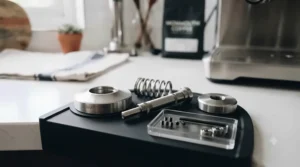
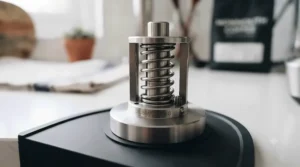
A spring loaded tamper espresso setup works on a genuinely simple principle: a calibrated spring inside the tamper body compresses as you press down, and once it reaches its pre-set limit, further pressure from your hand no longer transfers to the coffee — the spring absorbs it instead. That’s the entire trick, and it’s precisely why pressing harder than necessary achieves nothing beyond wasted effort.
This mechanical approach also has a genuine, if under-discussed, wellbeing benefit. Repetitive pressing motions performed with excessive or inconsistent force are exactly the kind of task the Health and Safety Executive flags as a risk factor for upper limb disorders in occupational settings, and while home tamping volumes are nowhere near industrial repetition, café baristas tamping hundreds of times per shift genuinely do benefit from a mechanism that caps the force required rather than relying on ever-increasing hand strength through a long day.
Normcore Tamper Review: V4 vs V5 Compared
Since Normcore dominates this category so thoroughly, a direct Normcore tamper review comparison between its two current flagship models is worth spelling out plainly. The V4 remains the smarter buy for the vast majority of home baristas: three interchangeable springs cover a genuinely wide preference range, the self-levelling plate works exactly as advertised, and the price sits comfortably below £50 in most sizes.
The V5 justifies its higher price through pure convenience rather than a fundamentally different outcome — swapping between six dial-selected pressures without disassembly is genuinely faster day to day than physically changing a spring, and the titanium coating adds a small durability margin. Based on the spec comparison, though, the actual espresso in the cup is unlikely to taste meaningfully different between a V4 tamped at 25lb and a V5 dialled to an equivalent setting — you’re paying for workflow refinement, not a different physical outcome.
The honest verdict: buy the V4 unless you specifically know you’ll benefit from on-the-fly pressure switching, in which case the V5’s convenience genuinely earns its premium.
Consistent Tamping: The Habit That Actually Improves Your Coffee
Here’s the deliberately unglamorous truth about consistent tamping: independent testing has repeatedly found that the specific pressure figure matters far less than most marketing implies, with several published comparisons finding no measurable difference in extraction between notably different tamping forces, provided the tamp was level. What actually moves the needle is repeatability — pressing with the same force and the same level surface, shot after shot, so that tamping pressure stops being a variable at all.
This is precisely why a calibrated tamper earns its keep even though the “correct” pressure is more flexible than the 30lb-pressure marketing suggests: it’s not really selling you a magic number, it’s selling you the elimination of variance. According to background on espresso extraction physics summarised on Wikipedia’s espresso entry, extraction quality depends on a combination of grind size, dose, water temperature and pressure working together, with tamping’s role being to ensure even resistance across the puck rather than to hit one specific magic force. Chase consistency over raw force, and you’ll see far more improvement in your cup than obsessing over whether you’ve hit exactly 30lb.
30lb Pressure: Why This Number Is the Industry Standard
Thirty pounds of force became the de facto industry standard largely through repetition rather than rigorous proof that it’s uniquely optimal — it’s simply the figure most manufacturers, including Espro from its earliest days, settled on as a comfortable, achievable pressure that produces a solidly compressed puck without excessive wrist strain. It stuck, and now most calibrated tampers on the market default to it.
What the spec sheet won’t tell you outright is that research into tamping pressure has repeatedly struggled to find a strong, consistent link between higher pressure and better extraction, with some tests finding pressures as low as 5lb producing broadly similar results to 30lb, provided the tamp was level and even. That doesn’t make 30lb pressure meaningless, though — it remains a sensible, well-tested default that removes ambiguity and gives you a stable, repeatable baseline to build your workflow around, which is genuinely valuable even if the specific number turns out to matter less than the consistency it represents.
Espresso Repeatability: Why Calibrated Tampers Matter for Home Baristas
Espresso repeatability is really the entire point of this category, and it’s worth stating plainly why it matters more for home users than the marketing sometimes implies. Commercial baristas tamp hundreds of times a shift and develop genuinely reliable muscle memory through sheer repetition; home users, pulling perhaps one or two shots a day, rarely get anywhere near that level of practice, which means hand-applied pressure genuinely does vary far more from day to day than most people realise.
A calibrated tamper closes that repeatability gap almost instantly, turning a skill that would otherwise take months of daily practice to master into a solved problem from the very first use. This matters enormously if you’re troubleshooting inconsistent shots, since removing tamping pressure as a variable lets you isolate whether an off-tasting espresso is actually down to grind size, dose or bean freshness, rather than wondering if you simply pressed differently that morning.
Common Mistakes When Buying a Calibrated Tamper
The most frequent mistake is buying a tamper before confirming your exact basket diameter — a mismatch of even half a millimetre compromises the seal at the basket wall and undermines the entire point of calibration, regardless of how good the mechanism itself is. Always measure your basket or check your machine’s specifications before ordering.
A second common error is assuming higher advertised pressure automatically means better espresso, when genuine research suggests consistency matters considerably more than the raw number itself. Finally, plenty of buyers skip the care instructions and either soak a calibrated mechanism in water or run it through a dishwasher, quietly ruining the internal spring or click system within weeks — a completely avoidable failure if the label is read first.
Frequently Asked Questions
❓ Is a calibrated tamper actually worth it over a basic manual one?
❓ What does 30lb pressure actually mean for my espresso?
❓ Can I adjust the pressure on a spring loaded tamper espresso setup?
❓ How do I clean a self levelling tamper without damaging the mechanism?
❓ Does a more expensive calibrated tamper genuinely make better coffee?
Conclusion
A best calibrated tamper isn’t really about chasing a magic pressure figure — it’s about removing one more variable between you and a shot of espresso that tastes the same on Tuesday as it did on Monday. Across the seven picks in this guide, the honest recommendation depends on where you are in your coffee journey: the Normcore V4 or IKAPE V3 for anyone building consistent habits, the Espro Calibrated Tamper if you want factory-set simplicity that never needs fiddling with, and The Force Tamper if genuine espresso repeatability across high volumes is a real requirement rather than a nice-to-have.
What ties every recommendation together is the same honest principle: consistency beats raw force every time, and a calibrated mechanism — whether spring, click, or fully automated — simply does that job better than an unassisted hand ever reliably will. Check current prices before you commit, since they shift regularly, and remember that even the budget picks here genuinely deliver the core benefit this whole category exists for.
Whatever you choose, the goal is the same one every home barista is quietly chasing: a shot that tastes like you meant it, every single time.
✨ Don’t Miss These Exclusive Deals!
🔍 Take your espresso game to the next level with these carefully selected calibrated tampers. Click through to check current pricing and availability, and start pulling genuinely consistent shots today!
Recommended for You
- Best Espresso Tamper 2026: 7 Picks Every Home Barista Rates
- Bottomless vs Pressurised Portafilter: 7 Honest Picks for 2026
- Best Bottomless Portafilter for Gaggia Classic Pro: 7 Top Picks (2026 UK)
Disclaimer: This article contains affiliate links. As an Amazon Associate, I earn from qualifying purchases. If you purchase products through these links, we may earn a small commission at no additional cost to you.
✨ Found this helpful? Share it with your friends! 💬🤗
