
In This Article
Here’s an uncomfortable truth about your morning flat white: the beans aren’t always the problem. You can buy a gorgeous, freshly roasted bag from a local roaster, dial in your grinder to the last click, and still pour a cup that tastes faintly of old cardboard. The culprit is usually a thin, tacky film packed into the teeth of your burrs. That’s why grinder cleaning tablets have become the quiet heroes of grinder maintenance.
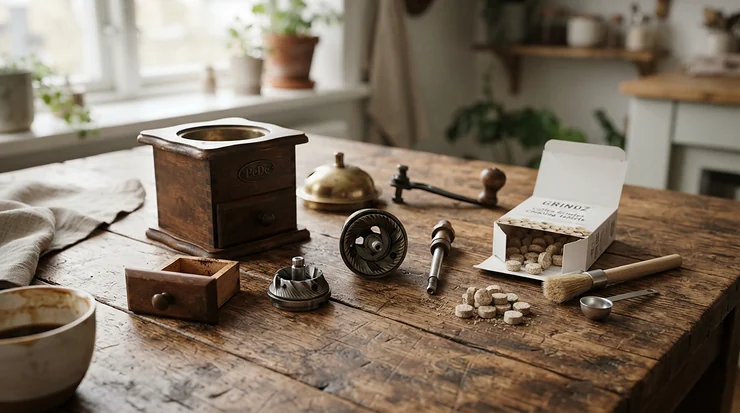
Britain has been wrestling with this problem for a while. The first coffee grinder was reportedly made by an English blacksmith from Birmingham, Richard Dearmann, in 1799, and I’d wager his customers never cleaned theirs either.
One honest note before we dive in. I haven’t personally tested any of these products, and I won’t pretend otherwise. What follows is analysis built from published specifications, manufacturers’ directions and the themes reviewers repeat across retailer listings. Where I couldn’t verify something, I’ll say so.
What Are Grinder Cleaning Tablets?
Grinder cleaning tablets are small, bean-shaped pellets made from food-safe grains or seeds that you run through a grinder in place of coffee. As they pass between the burrs, they absorb stale coffee oils and dislodge trapped fines, so you can clean the grinding path without taking the machine apart.
Grinder Cleaning Tablets Quick Comparison
Short on time? This table puts all seven side by side. Prices are ballpark ranges only, so always check the current price before you buy.
| Product | Format | Pack | Built-in grinders? | Ballpark price | Best For |
|---|---|---|---|---|---|
| Urnex Grindz | Bean-shaped tablets | 430g tub | No, standalone only | £20-£30 | Everyday home and café use |
| Urnex Grindz Sachets | Tablets | 3 × 35g | No, standalone only | Low outlay, check price | First-timers and single-dose users |
| Urnex Full Circle | Pellets | 3 packets | No, burr grinders | Check current price | Eco-minded buyers |
| Urnex Puro | Plant-based tablets | 430g tub | No, professional grinders | £25-£35 | Busy cafés |
| Urnex SuperGrindz | Hydrophobic tablets | 330g jar | Yes | £25-£35 | Bean-to-cup machines |
| Cafetto GC2 | Seed-based pellets | 450g jar | No, standalone only | £15-£25 | Budget-conscious buyers |
| Puly Grind Crystals | Crystals | 10 × 15g sachets | Built-in grinder-doser | Check current price | Machine-integrated grinders |
Looking at the comparison above, the real dividing line isn’t brand or price. It’s whether your burrs sit in a standalone grinder or inside a bean-to-cup machine. Urnex Grindz and Cafetto GC2 suit standalone grinders, while Urnex SuperGrindz and Puly Grind Crystals are pitched at machines with built-in grinders. If you’re unsure which camp you’re in, check your manual before you buy anything.
💬 Just one click — help others make better buying decisions too!😊
Top 7 Grinder Cleaning Tablets: Expert Analysis
1. Urnex Grindz — the benchmark for everyday home use
The 430g tub is the format most home baristas end up with, and it’s the yardstick other grinder cleaning tablets get measured against.
The manufacturer’s directions call for one capful (35-40g) in an espresso grinder, or two capfuls (70-80g) in a shop grinder, ground on a medium setting. In practice, a 427g tub gives you roughly ten to twelve single-capful cleans. That’s about a year of monthly upkeep with a few spare for switching between flavoured beans.
Based on the spec comparison, this is the safest default for a standalone burr grinder. The formula is described as all natural, food-safe and gluten-free, and one European retailer notes that grinder makers including Mahlkönig and Baratza recommend it. What the spec sheet says in smaller print is that it’s for standalone grinders only, never the integrated grinder inside a bean-to-cup machine.
Reviewers consistently describe it as easy to use and effective on burrs, and one buyer says their grinder’s manufacturer recommended it. The maker itself warns that some dust is normal and harmless but needs wiping from the hopper, spout and doser.
Pros:
- ✅ Simple one-capful dosing for most home grinders
- ✅ Food-safe, gluten-free formula
- ✅ Large tub covers a year of monthly cleans
Cons:
- ❌ Not suitable for integrated bean-to-cup grinders
- ❌ Leaves fine dust to wipe away
Expect roughly £20-£30 depending on the retailer (check current price). At around £2-£3 per clean, it’s strong value.
2. Urnex Grindz Sachets — best low-commitment trial
If you’ve never cleaned a grinder in your life and aren’t sure you’ll stick with it, this three-sachet box is the gentle on-ramp.
Each sachet is a pre-measured 35g single-use dose of the same bean-shaped tablets. One US retailer’s directions say to grind through the sachet, then discard coffee until no specks remain, roughly 70g of beans. That removes the guesswork of the capful and the temptation to “eyeball it” with a heavy hand.
On paper, the sachets make most sense for single-dose grinder owners with tiny hoppers, where a 70-80g tub dose would be overkill. They also suit gifting, because a box of three is far less intimidating than a tub. The trade-off is cost per clean, which will be higher than the tub.
I couldn’t find a large, separate review pool for the sachet box, so treat the sentiment as shared with the tub: easy, effective, no disassembly.
Pros:
- ✅ Pre-measured doses remove all guesswork
- ✅ Compact box suits small kitchens
- ✅ Same formula as the popular tub
Cons:
- ❌ Only three cleans per box
- ❌ Higher cost per clean than the tub
A low-outlay purchase at the time of research (check current price). It’s a smart trial, but graduate to the tub if you’re hooked.
3. Urnex Full Circle — best for eco-minded buyers
For anyone who reads ingredient lists the way others read football results, Urnex Full Circle speaks your language.
It’s described as a biodegradable formula whose ingredients are all found in food or derived from plants, designed specifically for burr grinders. The directions are simple: empty the hopper, add one packet, run on a medium setting, then purge with roughly 35g of coffee. The packet format keeps the dose consistent, which matters because over-dosing wastes product and under-dosing wastes your time.
My analytical take: the environmental credentials are the selling point, not the cleaning action, which is similar in principle to the other tablets here. One US retailer notes the pellets are wheat-based, so anyone avoiding gluten should read the label carefully. UK stockists vary, so check availability.
Reviewers report smoother, faster grinding after a clean, including one long-term owner of a Baratza burr grinder. A common gripe is the price relative to its sister product, Urnex Grindz, and one buyer spotted leftover bits in the hopper afterwards. The lesson is to purge properly.
Pros:
- ✅ Plant-derived, biodegradable ingredients
- ✅ Pre-dosed packets for consistency
- ✅ Reviewers report smoother grinding afterwards
Cons:
- ❌ Pricier per clean than the tub, reviewers say
- ❌ Wheat-based, so unsuitable for gluten avoiders
Price varies by stockist (check current price). It’s a good-value choice only if the eco angle matters to you.
4. Urnex Puro — plant-based pick for busy cafés
Think of Urnex Puro as the café-counter cousin of the tub you’d buy for a home setup.
It comes in a 430g jar and is pitched as plant-based and phosphate-free, for professional grinders rather than bean-to-cup machines. A UK retailer’s listing is explicit on that last point, which is the detail buyers most often miss.
Here’s what to weigh: the format and capacity mirror the Urnex Grindz tub, so the practical benefit is mostly about ingredient positioning. If your café markets itself on sustainability, “plant-based and phosphate-free” is a talking point. If you just want a clean burr, you’re paying for a label as much as a mechanism. I’d frame it as a sensible option for volume users rather than a must-have for home kitchens.
I couldn’t verify a meaningful pool of customer reviews for this specific product, so I won’t summarise sentiment I can’t see. Check recent buyer feedback on the listing yourself.
Pros:
- ✅ Plant-based, phosphate-free positioning
- ✅ Tub size suits frequent professional cleaning
- ✅ Familiar tablet format and workflow
Cons:
- ❌ Not for bean-to-cup grinders
- ❌ Few verifiable reviews available
Around £25-£35 on a UK retailer listing (check current price). Worth it for cafés, but home users can save with the tub.
5. Urnex SuperGrindz — made for bean-to-cup grinders
Most grinder cleaners politely tell you to keep away from integrated grinders. Urnex SuperGrindz is the one built to say yes.
The tablets use a hydrophobic formula designed to be safe in superautomatic machines as well as standalone espresso and shop grinders. The routine is more involved: remove the beans, brew two large cups to empty the grinding chamber, add 26g (one capful), add 78g of coffee, then brew five large cups until the pucks show no trace of yellow tablets.
Based on the spec comparison, that extra process is the price of safety. A bean-to-cup grinder funnels grounds into a brew unit, so a regular cleaner could jam the works. For anyone whose grinder is welded inside a machine, this is the purpose-built route.
Reviewers include owners of Jura machines who’ve used it for years, and one says the built-in grinder seemed to spin faster afterwards. Another calls it pricey but notes you need very little.
Pros:
- ✅ Designed for integrated bean-to-cup grinders
- ✅ Small 26g capful dose
- ✅ Also safe in standalone grinders
Cons:
- ❌ Costs more than standard tubs
- ❌ Process burns through several cups of coffee
Roughly £25-£35 (check current price). Expensive per gram, but cheap against a service call.
6. Cafetto GC2 — natural seed-based budget pick
Cafetto GC2 is the dark horse for anyone who wants a natural formula without a premium price tag.
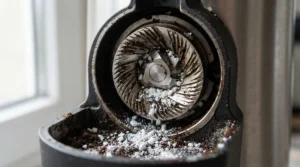
The product is described as a natural, seed-based formula with no binders or chemicals. The pellets measure about 4mm in diameter and 10mm in height, and the maker says their hardness distribution is similar to a roasted coffee bean. That claim matters because a cleaner much harder than a bean would wear burrs faster. It’s the manufacturer’s assertion rather than independent testing, but it’s the right thing to check.
On the analysis side, the 450g jar and European pricing suggest good value per gram, though UK stock and pricing vary, so confirm before buying. One note for allergy-conscious households: Cafetto points gluten-free buyers to its separate Grinder Clean product, which suggests GC2 isn’t the gluten-free option.
Reviewers on specialist retailer pages praise it, including one owner of a Eureka Mignon Specialita who says it worked very well, and another who cleans every three to four weeks. European shop reviews are positive but short.
Pros:
- ✅ Natural, binder-free seed-based formula
- ✅ Bean-like hardness claimed, gentler on burrs
- ✅ Generous 450g jar for the money
Cons:
- ❌ Not the gluten-free option in Cafetto’s range
- ❌ UK availability varies by retailer
Around £15-£25 where stocked (check current price). A strong value pick if you can find it in stock.
7. Puly Grind Crystals — crystals for machine-integrated grinders
Let’s be upfront: Puly Grind Crystals are crystals, not tablets, so they’re the outlier in this round-up. I’ve included them because plenty of people searching for grinder cleaning tablets actually own a machine with a built-in grinder-doser.
A UK retailer sells it as a box of ten 15g sachets, positioned for superautomatic machines with a built-in grinder-doser. The instructions say to pour one or two sachets directly over the burrs, run the grinder until it’s empty, and leave the grinder setting alone. The brand has deep roots, too: Puly’s parent company was founded in 1890 and the cleaning range launched in 1960, according to a UK stockist.
Here’s what to weigh: pre-measured sachets are tidy, and not touching the grind setting is a genuine convenience. But always follow your machine maker’s guidance first, since integrated grinders vary. I couldn’t verify a solid review pool, so I’m not summarising sentiment.
Pros:
- ✅ Pre-measured sachets keep dosing simple
- ✅ No need to alter grinder settings
- ✅ Established espresso-cleaning brand
Cons:
- ❌ Crystals rather than bean-shaped tablets
- ❌ Few verifiable reviews found
Price varies (check current price). It’s a decent niche option for machine-integrated grinders.
How to Use Grinder Cleaning Tablets for Burrs, Step by Step
Using grinder cleaning tablets for burrs takes about five minutes, but the order matters. Follow your chosen product’s label first, then use this routine as your framework.
- Note your grind setting. Photograph the dial or write down the number. You’ll change it for the clean and want to return to the exact spot.
- Empty the hopper and run the grinder dry. Clear every bean from the chamber and chute.
- Dose the tablets. For Urnex Grindz, that’s one capful (35-40g) for an espresso grinder. Follow your product’s own dose.
- Grind on a medium setting. Run it until no tablets remain.
- Purge with coffee. Sacrifice a couple of small doses of cheap beans to clear residue, then discard them.
- Brush the dust away. A dual-ended tool like the Pallo Grindminder reaches the chute and the counter. One reviewer says its grinder-side bristles cleaned the top burr of their Breville better than the brush supplied with it, though another found the brush end a little wide for the chute.
- Restore your setting and taste. Pull a test shot or brew and adjust.
One firm rule: never use water on the motor or burrs, as it can cause rust. Tablets clean dry, which is exactly their charm.

Real-World Scenarios: Matching Grinder Cleaning Tablets to Your Setup
Specs are tidy; kitchens are messy. Here are three profiles and the products that fit them.
The weekend moka-pot household. You grind about 100g a week on a conical burr grinder and are cost-conscious. A 450g jar of Cafetto GC2 or a tub of Urnex Grindz covers a year of monthly cleans for the price of a decent takeaway coffee order. The monthly cadence is the sensible target for home burr grinder cleaning tablets.
The single-dose espresso tinkerer. You grind 18g at a time, switch beans weekly and notice flavour carry-over. Here the Urnex Grindz Sachets make sense because you don’t want 70g of cleaner clogging a micro-hopper. Between bean switches, a lighter touch with a brush matters as much as the tablets.
The small office with a bean-to-cup machine. Twenty cups a day, one frazzled office manager. Use Urnex SuperGrindz, since standard tablets aren’t designed for integrated grinders. Schedule the clean for a quiet Friday afternoon, because the five-cup routine takes time and sacrifices some coffee. A café grinding kilos should look at Urnex Puro or the 430g Urnex Grindz tub and clean weekly.
Problem → Solution: Fixing Bitter Cups and Sluggish Grinding
Each of these symptoms points to dirty burrs, and each has a practical fix.
Problem 1: Bitter, dull cups even with fresh beans. Experts quoted by Woman & Home flag unusually bitter or dull coffee as a sign your grinder needs cleaning. Solution: run a full tablet cycle, purge, and retest before blaming the roaster.
Problem 2: Inconsistent grinding or clumping. The same source lists uneven grinding and clumped grounds as warning signs. Solution: clean with tablets, brush the chute, and check whether burr wear is the real cause.
Problem 3: Flavoured-bean ghosts. The Urnex Grindz listing says it removes flavoured coffee odours. Solution: clean immediately after any flavoured batch.
Problem 4: Bits of tablet left behind. One Urnex Full Circle reviewer spotted leftover pieces in the hopper. Solution: purge with two extra small coffee doses and wipe the hopper.
Problem 5: Gluten worries. Solution: check labels; Urnex Grindz is described as gluten-free, while Urnex Full Circle is described as wheat-based.
Burr Build-Up and Stale Coffee Oils: What’s Really Happening
Every grind leaves a whisper of residue. Over weeks, that residue becomes burr build-up: a layer of fines and oils packed into the burr grooves and chute. It’s invisible until the cup tastes wrong.
The science is straightforward. The Specialty Coffee Association’s staling review explains that grinding raises surface area, which accelerates staling, and that rancidity comes from lipid degradation. Translate that to your grinder and it means stale coffee oils clinging to burrs oxidise, then flavour every fresh dose that follows. Grinder cleaning tablets work because they scrub and absorb that layer mechanically, which is why the burr build-up shows up as bitterness first.
Burr Grinder Cleaning Tablets: Flat vs Conical
Retailer guides commonly report that flat burrs retain more grounds than conical ones, which suggests flat-burr owners may need to clean more often. Burr grinder cleaning tablets suit both types, but conical-burr grinders tend to have a lower retention rate, so a monthly routine is usually adequate for home use. Treat that as a general trend rather than a guarantee.
How to Choose Grinder Cleaning Tablets
- Confirm your grinder type. Standalone grinders suit Urnex Grindz and Cafetto GC2, while integrated bean-to-cup grinders need something like Urnex SuperGrindz. Getting this wrong is the costliest mistake.
- Check the ingredients. If gluten matters, choose carefully, because formulas differ.
- Match the pack size to your frequency. Monthly home use suits a 430-450g tub, while occasional users might prefer sachets.
- Look for a clear dose. A defined capful or sachet beats guesswork.
- Consider hardness claims. A cleaner similar in hardness to a roasted bean, as Cafetto GC2 claims, is gentler on burrs in principle.
- Read the manual. Some grinder makers recommend specific cleaners and warn against others.
Features That Actually Matter (And Those That Don’t)
What matters:
- ✅ Compatibility with your grinder type. A coffee grinder cleaner that’s wrong for integrated grinders can cause blockages.
- ✅ A clear dosing instruction.
- ✅ A food-safe formula, since coffee passes through the same path afterwards.
What doesn’t:
- ❌ The word “patented” on the label. It tells you about the formula’s legal status, not your burrs’ cleanliness.
- ❌ Scent. The Urnex Grindz retailer data lists it as unperfumed, and a cleaner shouldn’t smell like anything anyway.
- ❌ Marketing superlatives like “best coffee grinder cleaner”. Look at ingredients, dosing and compatibility instead.
Burr grinder cleaning tablets all work on similar principles, so the differences come down to formula, format and fit rather than miracle ingredients.
Grinder Cleaning Tablets vs Rice, Brushes and Other Methods
Is a coffee grinder cleaner really necessary when rice is in the cupboard? The table below sets the options side by side.
| Method | Effort | Burr risk | Best For |
|---|---|---|---|
| Grinder cleaning tablets (e.g. Urnex Grindz, Cafetto GC2) | Low, about five minutes | Low when used as directed | Monthly upkeep |
| Raw rice | Low | Higher, as it’s harder than coffee beans | Not recommended |
| Brush only (e.g. Pallo Grindminder) | Medium | None | Weekly tidy |
| Full disassembly | High | Low if careful | Quarterly deep clean |
| Bean-to-cup tablets (Urnex SuperGrindz) | Low, but several cups | Designed for it | Integrated grinders |
Rice is the controversial one. One retailer’s guide warns it’s much harder than coffee beans and can chip or crack burrs, especially conical ones, while another source notes it may void a grinder’s warranty. Brushes can’t reach everywhere, and disassembly takes time. Tablets sit in the sweet spot: quick, repeatable and designed for the job. For stubborn grime, though, combine tablets with an occasional deep clean.
Grinder Maintenance Schedule: What to Do and How Often
Good grinder maintenance is a rhythm, not a rescue mission.
- Weekly: Brush the burrs, chute and hopper. Wipe oily surfaces dry.
- Monthly (home use): Run grinder cleaning tablets for burrs. Cafetto suggests monthly for home grinders, while cafés should clean weekly.
- Every 3-6 months: Remove the upper burr if your grinder allows, brush thoroughly, and inspect for wear. One burr-grinder guide notes burrs don’t last forever.
Why not wait longer? Research on ground roasted coffee from the University of Navarra tracked free-fatty-acid changes over 180 days of storage, even in vacuum packaging, showing that coffee lipids keep changing and oxidising over time. Residue clinging to your burrs isn’t vacuum-packed. Consistent grinder maintenance prevents that chemistry from happening inside your machine.
Long-Term Cost & Maintenance: Are Grinder Cleaning Tablets Worth It?
| Product | Pack | Approx. cleans per pack | Value note |
|---|---|---|---|
| Urnex Grindz | 430g | About 10-12 (one capful each) | Best all-round value |
| Urnex Grindz Sachets | 3 × 35g | 3 | Trial, higher cost per clean |
| Urnex Full Circle | 3 packets | 3 | Premium for eco credentials |
| Urnex Puro | 430g | Check label | Café-focused |
| Urnex SuperGrindz | 330g | About 12 (26g each) | Specialist, worth it for bean-to-cup |
| Cafetto GC2 | 450g | Check capful size | Strong value if in stock |
| Puly Grind Crystals | 10 × 15g | 5-10 | Niche, check price |
The tub formats win on cost per clean, while the sachet boxes win on convenience and low commitment. For a typical household cleaning monthly, a single tub of Urnex Grindz might last a year, which makes the annual cost of burr protection very modest. Remember to factor in replacement burrs: regular cleaning won’t make them immortal, but it removes one avoidable source of wear and bad flavour.
Common Mistakes When Buying and Using Grinder Cleaning Tablets
- Using standalone tablets in a bean-to-cup grinder. Urnex Grindz states it’s only for standalone grinders. Choose Urnex SuperGrindz or follow your machine maker’s guidance.
- Skipping the purge. One Urnex Full Circle reviewer saw bits left in the hopper. Always run coffee through afterwards.
- Reaching for rice. It’s the internet’s favourite hack and some sources’ least favourite for burrs.
- Washing burrs with water. It invites rust.
- Forgetting the dial. Note your grind setting before you change it.
- Cleaning only when it tastes wrong. By then you’ve been drinking stale coffee oils for weeks.
- Ignoring wear. Cleaning doesn’t fix blunt burrs.
Safety, Allergens and Labelling: A UK Buyer’s Guide
Safety here is mostly sensible label-reading. Start with ingredients. Urnex Grindz is described as gluten-free and food-safe, Urnex Full Circle is described as wheat-based, and Cafetto GC2 is described as seed-based, with Cafetto steering gluten-free buyers to a different product. If anyone in your household has coeliac disease or a wheat allergy, check the current label rather than relying on a blog, including this one.
Next, remember these are cleaning products, not snacks. A retailer FAQ for Urnex Grindz notes the tablets are designed for cleaning equipment, not for consumption. Keep them out of reach of children and pets.
Finally, check your grinder’s manual. Some makers recommend particular cleaners, and warranty terms can differ. For professional use, a COSHH safety data sheet for Urnex Grindz is available from Urnex.co.uk, according to a UK retailer, which helps café owners with workplace paperwork.

Frequently Asked Questions
❓ Can I use grinder cleaning tablets in a bean-to-cup machine?
❓ Do grinder cleaning tablets change the taste of my coffee?
❓ Are grinder cleaning tablets gluten-free?
❓ What's the best coffee grinder cleaner for a home espresso grinder?
❓ How much do grinder cleaning tablets cost per clean?
Conclusion
Stale coffee oils don’t announce themselves. They creep, then one morning your favourite beans taste like regret. The good news is that grinder cleaning tablets are one of the cheapest, quickest fixes in coffee.
My honest shortlist, based on specs and the review themes I could verify: for most home kitchens, Urnex Grindz is the safe benchmark. If you want a trial run, start with Urnex Grindz Sachets. For eco-minded buyers, Urnex Full Circle fits. Cafés should weigh Urnex Puro or the tub. Urnex SuperGrindz is the purpose-built answer for bean-to-cup machines, Cafetto GC2 is the natural budget contender, and Puly Grind Crystals is the niche option for machine-integrated grinders.
Whatever you pick, pair it with a brush, a monthly routine and a glance at your grinder’s manual. Clean burrs make every bag of beans taste like the roaster intended.
✨ Ready to Taste the Difference?
☕ Pick the cleaner that matches your grinder, click through to check current pricing and availability, and give your burrs the reset they deserve. Your next cup will thank you!
Recommended for You
- Backflush Detergent For Espresso Machines: 7 Proven Picks (2026)
- Milk Frother Cleaning Solution: 7 Best Picks For UK Homes (2026)
- Group Head Brush For Espresso Machine: 7 Best UK Picks (2026)
Disclaimer: This article contains affiliate links. As an Amazon Associate, I earn from qualifying purchases. If you purchase products through these links, we may earn a small commission at no additional cost to you.
✨ Found this helpful? Share it with your friends! 💬🤗
