
In This Article
There’s a particular kind of heartbreak reserved for coffee lovers: you’ve bought the good beans, dialled in the grind, warmed the kettle to exactly the right temperature — and the cup still tastes flat, papery, or vaguely of cardboard. Nine times out of ten, nobody blames the filter paper. Everybody should. V60 filter papers are the thin, cone-shaped sheets of pulp that sit between your grounds and your cup, and they quietly decide how much oil, sediment and bitterness makes it into your final brew. Get the wrong one and even brilliant beans taste muddy; get the right one and a middling bag of supermarket coffee can taste bright and clean.
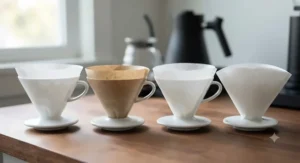
So what is a V60 filter paper, exactly? It’s a cone-shaped disposable paper filter, sized 01, 02 or 03, designed to fit inside a Hario V60 dripper (or compatible cone-shaped brewers), separating brewed coffee from grounds and oils while shaping flow rate and clarity in the cup. That last part — flow rate — is where most of the differences between brands actually live, and it’s also where the health angle gets interesting: unfiltered or boiled coffee is known to contain two cholesterol-raising compounds, cafestol and kahweol, whereas properly paper-filtered coffee carries almost none of the cafestol responsible for that effect, according to BBC Science Focus’s coverage of recent cardiovascular research. In other words, the humble filter paper isn’t just a flavour decision — it’s doing genuine chemistry.
This guide walks through seven real, currently available V60 filter papers on Amazon UK, spanning Hario’s own range, CAFEC’s specialty options and a Kono alternative, plus the practical know-how — thickness, tabbed versus untabbed, pour-over technique — that actually changes what lands in your mug.
Quick Comparison Table
Before the deep dive, here’s the lay of the land. All seven are cone-shaped filters compatible with the V60 dripper family (or, in Kono’s case, directly compatible with it), so the differences come down to material, thickness and flow speed rather than fit.
| Filter Paper | Type | Best For |
|---|---|---|
| Hario V60 02 White (Tabbed) | Bleached, tabbed | Everyday brewing, beginners |
| Hario V60 02 Natural (Misarashi) | Unbleached, tabbed | Purists who dislike bleached paper |
| Hario V60 01 White | Bleached, tabbed, smaller cone | Solo brewers, 1–2 cups |
| CAFEC Abaca+ | Abaca fibre, fast-flow | Baristas who want pour control |
| CAFEC Medium Roast Specialty | Roast-matched density | Medium-roast filter coffee fans |
| Hario x Project Waterfall | Bleached, tabbed, charity edition | Eco-conscious gifting |
| Kono MD-45 | Rougher pulp, quick draw | Experimenting beyond Hario’s house style |
Looking across the table, the real split isn’t Hario versus everyone else — it’s flow speed versus flow control. Hario V60 02 White (Tabbed) and Hario V60 01 White are the dependable, forgiving middle ground that most UK V60 owners start with, while CAFEC Abaca+ and Kono MD-45 trade some of that forgiveness for a faster, more barista-controlled drawdown. If you’re brewing solo, Hario V60 01 White is sized correctly rather than forcing you to use a 02 cone with too little coffee rattling around inside it.
💬 Just one click — help others make better buying decisions too!😊
Top 7 V60 Filter Papers: Expert Analysis
1. Hario V60 02 White (Tabbed) — the default choice for a reason
That little folded tab on the seam isn’t decorative — it makes lifting a soaked, hot filter out of the dripper genuinely painless, which matters more than it sounds once you’re doing it at 6am. Made from 100% oxygen-bleached paper pulp and produced to Hario’s own Japanese manufacturing standard, this size 02 cone is rated for one to four cups, making it the most flexible size for a household that sometimes brews for one and sometimes for guests. On paper comparisons, the bleaching process strips the pulp’s natural tannins, which is why bleached filters generally produce a slightly cleaner, more neutral-tasting cup than unbleached alternatives — useful if you want the bean’s flavour to do the talking rather than the paper. Reviewers consistently report reliable, consistent drawdown across batches, and this listing carries one of the largest, highest-rated review pools of any coffee filter on Amazon UK, which is a meaningful trust signal in a category where “does it actually fit properly” varies more than you’d expect between brands.
Pros:
- ✅ Huge, consistently high-rated UK review base
- ✅ Tabbed seam makes removal simple and mess-free
- ✅ Neutral, bleached pulp suits most roast styles
Cons:
- ❌ Some stock ships from EU distribution rather than Japan
- ❌ Bleached paper benefits from a proper rinse before brewing
Typically available in the £6–£9 range for a 100-count box, this remains the sensible default — check current price before ordering, as packaging and pack size vary by listing.

2. Hario V60 02 Natural (Misarashi) — for the bleach-averse purist
“Misarashi” simply translates from Japanese as unbleached or undyed, and that’s precisely the pitch here: no oxygen bleaching, no dye, just pulp processed as close to its raw state as Hario’s quality control allows. What most buyers overlook about unbleached filters is that the manufacturing difference isn’t purely aesthetic — skipping the bleaching stage means slightly more of the paper’s natural fibre character can carry through into the cup if you skip the rinse step, which is exactly why the brown-paper camp insists on a thorough pre-wet before brewing. Once rinsed, the difference in taste between this and the white version is genuinely subtle for most drinkers, but the manufacturing footprint is smaller, and the aesthetic — brown cone, visible fibre texture — has become something of a specialty-coffee-shop signifier in its own right. Aggregated Amazon UK reviews for Hario’s natural papers sit close to the bleached version’s ratings, with the recurring theme being reliability rather than a dramatic taste transformation.
Pros:
- ✅ No bleach or dye used in production
- ✅ Popular with drinkers chasing a lower-processing filter
- ✅ Same trusted Hario tabbed fit and thickness
Cons:
- ❌ Needs a thorough rinse to avoid a papery edge
- ❌ Brown pulp can look inconsistent between packs
At a similar £6–£9 price bracket to the white version, this is less an upgrade than a lateral move for anyone who prefers the idea of unbleached paper.
3. Hario V60 01 White — right-sized for the solo brewer
Buying a 02 cone when you only ever brew one cup is a bit like buying a Le Creuset stockpot to boil a single egg — it works, but it’s overkill, and V60 geometry actually performs better when the coffee bed sits at the correct height for the cone size. The 01 is Hario’s smaller cone, built for one to two cups, with the same tabbed, oxygen-bleached construction as its larger sibling. Based on the spec comparison with the 02, the main practical difference is bed depth: a correctly sized 01 filter keeps your grounds from spreading too thin against the cone walls, which helps maintain even extraction when you’re only using 15–20g of coffee. This is the pick most commonly recommended to newcomers buying their first V60 dripper for personal use, since starter dripper bundles are frequently sold in the 01 size.
Pros:
- ✅ Correctly proportioned for 1–2 cup brews
- ✅ Same reliable tabbed Hario construction
- ✅ Widely stocked, easy to reorder
Cons:
- ❌ Capped at roughly two cups per brew
- ❌ Not interchangeable with 02 or 03 drippers
Expect a price broadly similar to the 02 range, generally under £8 for a 100-pack, with the usual caveat to check current price at checkout.
4. CAFEC Abaca+ — the professional’s flow-control filter
CAFEC’s Abaca+ swaps standard wood pulp for Abaca fibre, derived from Manila hemp plant stems rather than trees, and the result is a filter engineered around a “two-side crepe” texture that speeds water flow noticeably compared with single-side-creped papers. Here’s what to weigh: faster flow isn’t automatically better — it shifts more responsibility onto your pour technique, rewarding a controlled, steady kettle hand with a brighter, more defined cup, while punishing a rushed pour with under-extraction. It’s FSC-certified, meaning the Abaca fibre is verified as sustainably sourced, and CAFEC states the pulp is produced with no bleach, glue or added chemicals. This is squarely a filter aimed at people who already know their pour-over basics and want to fine-tune drawdown speed rather than have it decided for them.
Pros:
- ✅ FSC-certified Abaca (Manila hemp) fibre, genuinely low-impact
- ✅ Two-side crepe engineering speeds and evens flow
- ✅ No bleach, glue or chemical additives used
Cons:
- ❌ Costs more per sheet than mainstream Hario packs
- ❌ Fast flow punishes an inconsistent pour
Typically sitting in the £8–£12 range for a 100-pack, this is a considered upgrade rather than an everyday swap.
5. CAFEC Medium Roast Specialty Paper — filters engineered by roast level
This is the filter that surprises most people the first time they hear about it: CAFEC produces separate paper densities matched to light, medium and dark roast profiles, on the logic that different roast levels release oils and gases at different rates during brewing, so the ideal filter density genuinely shifts with roast. The Medium Roast (Cup 4) version is tuned for the density most UK specialty roasters lean towards, aiming to slow extraction just enough to avoid the muddiness that a generic filter can let through with oilier medium roasts. On coffee enthusiast forums, longtime V60 users switching from tabbed Hario papers to CAFEC’s roast-matched range describe noticeably steadier drawdown times, even with an aggressive swirl technique — a small but telling signal that paper engineering is doing real work here, not just marketing. It’s a niche pick, admittedly, and only worth the premium if you’re brewing the same roast style consistently.
Pros:
- ✅ Density specifically tuned for medium-roast beans
- ✅ Reduces muddy, over-extracted notes reported by users
- ✅ Encourages steadier, more even drawdown
Cons:
- ❌ Roast-specific design isn’t a universal one-paper solution
- ❌ Harder to find on UK high-street coffee shelves
Price generally lands in the £8–£12 bracket for 100 sheets, positioning it alongside CAFEC’s Abaca+ rather than Hario’s everyday range.
6. Hario x Project Waterfall V60 02 — the filter with a conscience
Same Hario cone, same tabbed convenience, but built as a bespoke collaboration with Project Waterfall, a charity focused on clean water access in coffee-growing communities. Reviewers consistently note that the brewing performance is functionally identical to Hario’s standard white 02 paper — which makes sense, since the underlying filter construction hasn’t changed — meaning the value-add here is entirely about where a portion of proceeds goes rather than a taste transformation. What most buyers overlook is the neat symmetry: coffee farming communities often lack reliable clean water access, and a filter paper designed to clean up your coffee is, in this case, also funding water access for the people who grew the beans in your bag. It’s a genuinely nice gift for a coffee-obsessed friend, or a way to make an unavoidable, recurring purchase (you will always need more filters) do a little more good.
Pros:
- ✅ Proceeds support Project Waterfall’s clean water projects
- ✅ Identical reliable fit and tabbed design to standard Hario
- ✅ A distinctive, giftable talking point for coffee lovers
Cons:
- ❌ Limited-run packaging means stock availability is inconsistent
- ❌ Usually priced above Hario’s standard boxed pack
Expect a modest premium over standard Hario papers, generally in the £8–£11 range, subject to availability.
7. Kono MD-45 Paper Filter — the alternative worth trying once
Kono built the MD-45 for its own Meimon dripper, but it also fits the Hario V60 02 and Origami M cones, which makes it one of the more interesting “outsider” options for V60 owners who’ve only ever used Hario. The paper itself is rougher and more porous than Hario’s tabbed filters, and that texture translates directly into a quicker drawdown — reviewers and coffee community members describe a noticeably faster brew time even without changing grind size, which suggests the paper’s own resistance is doing more of the flow-shaping work than with smoother Hario pulp. This is genuinely useful information if you’ve ever felt your V60 brews run slow no matter what you try — sometimes it’s not your grind, it’s your filter. It’s less widely stocked than Hario across mainstream UK retailers, so sourcing takes slightly more effort, but for anyone chasing a different flavour signature from the same dripper, it’s a legitimate, low-cost experiment.
Pros:
- ✅ Noticeably faster, more porous drawdown than Hario papers
- ✅ Genuinely compatible with V60 02 and Origami M cones
- ✅ A cheap way to test a different flavour profile
Cons:
- ❌ Less widely stocked in mainstream UK retailers
- ❌ Faster flow can under-extract with a coarse grind
Pricing generally sits in the £7–£10 range for 100 sheets, with availability the bigger variable than cost.
Practical Usage Guide: Pour-Over Technique From Rinse to Recycling
Buying the right V60 filter paper is only half the job — how you use it changes the cup just as much as which brand you picked. Start every single brew, regardless of filter type, with a proper rinse: pour near-boiling water through the empty filter for a good 10–15 seconds, let it drain fully, then discard that water before adding grounds. This does two things at once — it washes away any residual papery taste, and it preheats your dripper and server, which stops the brew losing temperature the moment water hits the grounds. When it comes to pour-over technique itself, the goal with any V60 filter is a steady, controlled pour: a slow initial “bloom” pour of roughly double your coffee’s weight in water, a 30–45 second rest to let the grounds degas, then subsequent pours in a gentle spiral working from the centre outward. Filters with faster flow, like the CAFEC Abaca+ or Kono MD-45, reward a slightly slower, more deliberate pour rhythm to compensate for the paper letting water through more quickly.
Common first-30-days mistakes are almost always the same three: skipping the rinse (papery taste every time), pouring too fast and flooding the cone (uneven extraction, bitterness), and reusing a bent or torn tabbed seam that lets grounds bypass the filter entirely. Once brewed, used filters and their grounds are genuinely useful — the paper is fully compostable, and coffee grounds themselves make excellent garden compost or an acidic mulch for plants that like it.
✨ Don’t Miss These Exclusive Deals!
🔍 Take your V60 filter papers shopping to the next level with these carefully selected products above. Click on any highlighted item to check current pricing and availability. These small paper cones make a genuinely bigger difference to your cup than most people expect!
Real-World Scenarios: Which V60 Filter Papers Suit You?
If you’re a university student brewing one cup before an early lecture, budget and simplicity matter more than nuance — Hario V60 01 White paired with a cheap kettle covers the basics without fuss, and a 100-pack lasts months at typical student brewing frequency. If you’re working from home and brewing two or three cups a day for yourself and a partner, the flexibility of Hario V60 02 White (Tabbed) makes more sense, since it comfortably scales between one and four cups without switching gear. If you’re the household’s self-appointed coffee obsessive who’s already dialled in grind size and pour rate and wants to chase incremental improvements, CAFEC Medium Roast Specialty Paper or CAFEC Abaca+ are where the real experimentation lives — these are filters for people who’ve already solved the basics and are now optimising for roast-matched clarity. And if you’re buying a gift for someone who has everything coffee-related already, Hario x Project Waterfall V60 02 solves the “what do you get the person who owns three V60 drippers” problem neatly, since it’s a genuinely fresh angle on a purchase they’ll make regardless.
Your Buyer’s Decision Framework
If you’re brewing solo and want the simplest possible setup, choose Hario V60 01 White because it’s correctly sized and universally stocked. If you’re brewing for a household that varies between one and four cups, choose Hario V60 02 White (Tabbed) because its flexibility removes the need to buy two different filter sizes. If you already know your pour-over technique and want more control over extraction speed, choose CAFEC Abaca+ because its engineered flow rewards precision. If you’re specifically brewing medium-roast beans and chasing clarity, choose CAFEC Medium Roast Specialty Paper because its density is matched to that roast profile. If sustainability credentials or gifting matter as much as brewing performance, choose Hario x Project Waterfall V60 02. And if your V60 has always brewed slower than you’d like, try Kono MD-45 before assuming your grinder is the problem.
What Are V60 Filter Papers?
V60 filter papers are cone-shaped, single-use paper filters designed to fit inside a Hario V60 dripper or compatible conical brewers, sized 01 (1–2 cups), 02 (1–4 cups) or 03 (larger batches). They separate coffee oils, fine sediment and grounds from the finished brew, while the paper’s thickness and texture shape how quickly water flows through — directly affecting clarity, body and bitterness in the cup. This filtration effect isn’t purely about taste, either: research from Uppsala University found that boiled coffee contains high levels of cholesterol-elevating diterpenes, and that levels varied considerably depending on brewing method, with the university’s own press release on the study noting that well-filtered coffee is consistently the safer choice for people watching their cholesterol. Every filter reviewed in this guide performs that same basic filtration job — the differences between them are in speed, texture and how much of the paper’s own character reaches your cup.
How to Choose V60 Filter Papers: 6-Step Framework
- Match the size to your dripper. A 02 filter will not sit correctly in a 01 dripper, and vice versa — check your dripper’s size stamp before ordering.
- Decide between bleached and unbleached. Bleached (white) papers give a cleaner, more neutral cup; unbleached (natural/brown) papers appeal to buyers who prefer less-processed pulp, provided you rinse thoroughly.
- Consider flow speed for your skill level. Beginners generally get more consistent results from standard Hario-thickness papers; experienced brewers can experiment with faster CAFEC or Kono options.
- Check for tabs. A tabbed seam makes removing hot, wet filters significantly easier and reduces the chance of tearing.
- Think about pack size versus brewing frequency. A 40-pack suits occasional brewers; a 100-pack suits daily drinkers and works out cheaper per cup.
- Factor in sustainability credentials if they matter to you. FSC-certified Abaca pulp or charity-linked editions add a genuine ethical dimension without sacrificing performance.
Running through this checklist takes less time than the kettle needs to boil, and it’s the difference between a filter that fights your technique and one that supports it.
V60 Filter Papers vs Reusable Metal Filters
| Factor | Paper Filters (e.g. Hario V60 02 White) | Reusable Metal Filters |
|---|---|---|
| Cup clarity | Clean, sediment-free | More body, some sediment passes through |
| Oils retained | Mostly filtered out | Oils pass through freely |
| Ongoing cost | Small, recurring per-cup cost | One-off purchase, no repeat cost |
| Cleanup | Bin the used filter | Requires washing after every brew |
| Waste produced | Compostable paper waste each brew | Minimal ongoing waste |
The honest answer here is that paper and metal filters aren’t really competing for the same drinker. Paper, including every option reviewed above, produces the clean, tea-like clarity most people associate with V60 brewing, while filtering out the majority of coffee oils and the diterpenes discussed earlier. Metal filters let more oil and fine sediment through, producing a heavier-bodied, more full-flavoured cup that some drinkers genuinely prefer — but at the cost of a slightly muddier mouthfeel and the health trade-off of more unfiltered oils reaching your cup. Long-term cost also favours metal filters on paper (no pun intended), since a reusable filter pays for itself within a few months of regular use — but for anyone who’s already invested in a V60 specifically for its clean cup profile, sticking with paper is the choice that actually delivers what the dripper was designed to do.
Filter Paper Thickness Explained: What It Does to Your Cup
Thickness is the most underrated spec in the entire V60 filter paper category, and manufacturers rarely put a number on the packaging, which is exactly why nobody talks about it. Thicker paper — generally what you get from Hario’s standard bleached and unbleached ranges — slows water flow, extends contact time between water and grounds, and produces a cleaner, more tea-like cup with fewer oils passing through. Thinner or more porous paper, like Kono’s MD-45 or CAFEC’s Abaca+, speeds up drawdown, shortens contact time, and tends to produce a slightly brighter, more acidic-forward cup that some specialty coffee drinkers prefer for lighter roasts. Here’s what the spec sheet won’t tell you: thickness and crepe pattern (the ridged texture inside the cone) work together, not separately — a thick paper with shallow crepe can still drain quickly, while a thinner paper with deep two-side crepe can drain slowly. If your V60 brews consistently taste weak or watery, a thicker filter is often a cheaper first fix than buying a new grinder; if they taste consistently muddy or bitter despite a correct grind, a faster-draining thinner filter is worth testing before you blame the beans.
Tabbed V60 Filters vs Untabbed: Which Should You Buy?
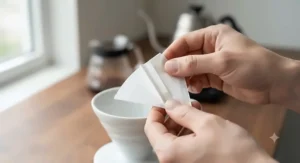
The “tab” is the small folded flap on a V60 filter’s seam, and while it looks like a minor manufacturing detail, it solves a genuinely annoying problem: lifting a scalding, saturated paper cone out of a dripper without it collapsing, tearing or dripping grounds onto your counter. Every product in this guide from Hario and CAFEC ships tabbed as standard, which reflects how thoroughly the tabbed design has become the market norm — historically, coffee filter papers were a fully untabbed, fold-and-seal design, a format still occasionally seen in older cone filter listings on Wikipedia’s coffee filter overview. Untabbed filters aren’t inherently worse at brewing — the tab has no effect on flow rate or flavour — but they’re noticeably fiddlier to remove cleanly, and more prone to tearing if you’re rushing on a weekday morning. For nearly every UK buyer, a tabbed filter like Hario V60 02 White (Tabbed) or Hario x Project Waterfall V60 02 is simply the more practical daily choice, and it’s worth actively checking listings for the word “tabbed” before ordering, since some third-party cone filters still ship without one.
Common Mistakes When Buying V60 Filter Papers
Most V60 filter paper mistakes happen at the checkout, not the brew bar. The first is buying the wrong size — a surprisingly common error given how similar 01 and 02 boxes look at a glance, so always cross-check against your dripper’s stamped size number. The second is assuming all cone filters are interchangeable; while Kono’s MD-45 genuinely fits a Hario V60 02, plenty of generic “universal” cone filters on Amazon are cut for a shallower angle and sit loosely, letting water channel down the sides instead of through the grounds. The third mistake is chasing thickness or brand hype without matching it to skill level — buying CAFEC’s fast-flow Abaca+ as a first-ever filter, before you’ve learned to control your pour rate, often produces worse results than sticking with standard Hario paper. Finally, plenty of buyers overlook pack size economics entirely: a 40-pack looks cheaper at the till but almost always costs more per filter than a 100-pack, so daily drinkers should default to the larger box unless storage space is genuinely tight.
Safety, Compliance & Sustainability of Paper Filters
Every filter paper covered here is food-contact safe pulp, produced without the added chemicals that would raise any UK food safety concern, and CAFEC explicitly states its Abaca+ range skips bleach, glue and dye entirely. Used V60 filter papers are compostable, and under England’s updated household recycling rules, gov.uk’s guidance on Simpler Recycling confirms that food waste caddy liners used to hold food waste are collected as part of standard household food waste collections, and used coffee filters with their spent grounds are a natural fit for the same brown bin or home compost heap, since both the paper and the grounds break down readily. If you’re choosing between FSC-certified options, CAFEC Abaca+ carries independently verified sustainable sourcing for its Manila hemp fibre, which is a genuine step up from generic wood-pulp filters if forestry sourcing matters to your buying decision. None of this should be read as a claim that any filter here is “better for you” in a medical sense beyond the well-established filtration effect discussed earlier — it’s simply worth knowing that the paper itself isn’t an environmental afterthought once your coffee is made.
FAQ
❓ What size V60 filter paper do I need?
❓ Are Hario V60 papers the same as generic cone filters?
❓ Do V60 filter papers need rinsing before brewing?
❓ What's the difference between white and brown V60 filter papers?
❓ Can I use V60 filter papers in a different brand of dripper?
Conclusion
The gap between a forgettable pour-over and a genuinely great one is smaller and cheaper to close than most people assume — it’s rarely the beans, and it’s often the filter paper you’ve been grabbing on autopilot. Hario V60 02 White (Tabbed) remains the sensible everyday default for good reason, but as this guide has hopefully shown, CAFEC Abaca+, CAFEC Medium Roast Specialty Paper and Kono MD-45 all offer genuinely different flow characteristics worth experimenting with once you’ve nailed the basics, while Hario V60 01 White and Hario x Project Waterfall V60 02 cover the solo-brewer and gifting scenarios respectively. Thickness, tabs and pour-over technique all matter more than the marketing usually lets on, and now you’ve got the framework to match a filter to your actual brewing habits rather than whatever happened to be on the shelf. Whichever you choose, rinse it properly, pour steadily, and let the paper do the quiet chemistry it’s actually built for.
Recommended for You
- Coffee Filter Papers Under £10: 7 Best Value Picks for 2026
- 7 Best Probe Thermometer for Coffee Roasting
- Digital Coffee Thermometer: 7 Best Picks for Perfect Brews in 2026
Disclaimer: This article contains affiliate links. As an Amazon Associate, I earn from qualifying purchases. If you purchase products through these links, we may earn a small commission at no additional cost to you.
✨ Found this helpful? Share it with your friends! 💬🤗
