
In This Article
Stand in front of any UK kitchenware aisle for more than thirty seconds and you’ll spot the same argument playing out on the shelf: a wall of clear, clinking glass jars on one side, a row of brushed, businesslike tins on the other. glass coffee jar vs stainless steel canister isn’t really a fight between two containers — it’s a fight between two priorities, looks versus longevity, and most of us have quietly been losing it for years without realising. If your beans keep tasting flat by day ten, or your countertop looks like a display cabinet but your coffee doesn’t taste like it belongs in one, the jar might be the culprit.
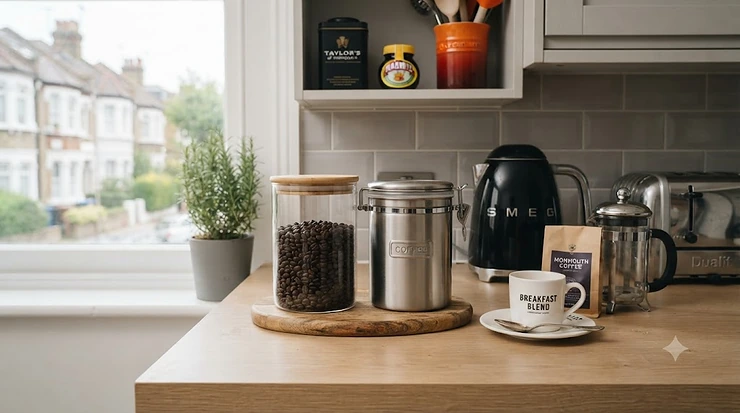
Here’s the short version, because you shouldn’t have to read six paragraphs to get an answer: a glass coffee jar is a see-through vessel, typically with a clip-top, screw-top or vacuum seal, prized for its looks but vulnerable to light unless it’s tinted or kept in a cupboard. A stainless steel canister is an opaque metal container, usually fitted with a CO2 valve or vacuum lid, built specifically to block light and slow oxidation, at the cost of not being able to see how much coffee is left. Both can be genuinely airtight. Only one blocks UV light by default.
That distinction matters more than most buying guides let on. Coffee isn’t inert — it’s a porous, oily, hygroscopic product that starts degrading the moment it leaves the roaster, and the container you choose either slows that process or quietly accelerates it every single morning. Below, we’ve pulled together seven real products sold in the UK, spanning budget clip-top jars through to vacuum-sealed premium canisters, so you can weigh genuine trade-offs rather than guesswork. We’ll cover jar seal type, UV light exposure, kitchen aesthetics, and where a decorative coffee storage jar earns its shelf space versus where a light-blocking coffee canister is simply the smarter call.
What Is the Difference Between a Glass Coffee Jar and a Stainless Steel Canister?
A glass coffee jar is a transparent storage vessel — usually soda-lime or borosilicate glass — sealed with a rubber-gasket clip, a screw lid or a vacuum mechanism, chosen mainly for visibility and worktop appeal. A stainless steel canister is an opaque metal vessel, almost always 18/8 or 304-grade steel, sealed with a CO2 valve, push-button or vacuum lid, chosen primarily to block light and slow oxidation for longer-lasting freshness.
Neither material is inherently “better” in the abstract. The honest answer depends on how fast you drink your coffee, where the jar will actually sit, and whether you’re storing whole beans (more forgiving) or pre-ground coffee (far less forgiving, because grinding multiplies the surface area exposed to air and light). We’ll unpack all of that as we go.
Quick Comparison Table
| Factor | Glass Coffee Jar | Stainless Steel Canister |
|---|---|---|
| UV light protection | Poor unless tinted or cupboard-stored | Excellent — fully opaque |
| Visibility of contents | Excellent | Poor to none (unless windowed) |
| Typical seal types | Clip-top, screw-top, vacuum | CO2 valve, push-button, vacuum/plunger |
| Durability (drops) | Fragile — can chip or shatter | Very durable, dents rather than breaks |
| Best for | Display, short-term use, decor | Long-term freshness, daily grinders |
| Typical price range | Under £6 to around £15 | Around £13 to £45+ |
Reading the table straight through, the pattern is fairly stark: glass wins on aesthetics and losing streak on light protection, while stainless steel flips that exact trade-off. If your coffee routine means finishing a bag within a week, a glass coffee jar’s UV exposure barely has time to do damage — but if beans sit around for three or four weeks, that “pretty on the counter” jar is quietly working against you. The seal type matters almost as much as the material itself, which is why we’ve dedicated a full section to jar seal type further down.
💬 Just one click — help others make better buying decisions too!😊
Top 7 Coffee Jars and Canisters: Expert Analysis
We’ve researched real, currently listed products across amazon.co.uk, covering budget, mid-range and premium options in both materials, plus a couple of lesser-known picks that do specific jobs particularly well. Prices fluctuate constantly on Amazon, so treat every figure below as a guide rather than gospel — always check current price before buying.
1. Kilner Clip Top Round Glass Jar (1 Litre) — the classic clip-seal jar every UK kitchen recognises
The clip-top mechanism on this jar — a rubber gasket clamped by a stainless steel wire clip — is the design Kilner jar has been refining since the Yorkshire glassworks that gave the style its name first opened in the 1840s, and it remains one of the most recognisable pieces of British kitchenware going.
Specs-wise, you’re looking at soda-lime glass, a 1-litre capacity, and a clip seal rated genuinely airtight when the gasket is fresh. In practice that means it holds its own against moisture and insects even if it can’t do anything about UV. Based on the spec comparison with dedicated coffee canisters, this jar excels at short-term storage and shines hardest as a display piece for guests, but it was never engineered with light-blocking in mind — that’s simply not what clip-top glass preserving jars were built to solve.
Reviewers consistently report the seal holding tight for years with occasional gasket replacement, and a common theme in feedback is how satisfying the clip mechanism feels compared with cheaper screw-top alternatives. Several buyers do note the glass is heavier than expected, which some read as reassuring solidity and others as an annoyance when refilling one-handed.
Pros:
- ✅ Genuinely airtight clip seal, tried and tested for decades
- ✅ Dishwasher safe and easy to inspect for cleanliness
- ✅ Iconic look that suits both rustic and modern kitchens
Cons:
- ❌ No UV protection — needs a dark cupboard for longer storage
- ❌ Glass can chip on the rim with heavy daily use
Typically priced under £6 for the single 1-litre jar, this is about as low-risk an entry point as coffee storage gets — solid value if you’re using it as a decorative coffee storage jar rather than your sole long-term canister.
2. T&G Woodware Large Lattice Glass Jar — decorative glass built for open shelving
If kitchen aesthetics are genuinely your priority, this is the product this whole category exists for. The copper-finish lattice detailing and rounded glass body are designed to sit proudly on open shelving rather than hide in a cupboard, which is honestly rare among coffee storage — most manufacturers treat looks as an afterthought.
The jar holds roughly 1.2 litres, uses a simple friction-fit or cork-style lid depending on the exact listing, and is made from moulded glass rather than the thicker preserving-jar glass Kilner uses. What most buyers overlook about decorative jars like this is that the looser-fitting lid usually isn’t rated fully airtight in the way a clip-top or vacuum seal is, so it’s genuinely a display-first, freshness-second product — and that’s fine, provided you know that going in.
Aggregated review sentiment for T&G’s glass range skews strongly positive on styling and build quality, with buyers frequently mentioning it as a gifting choice or as the “hero jar” on a coffee station shelf. Some reviewers do flag that without a rubber gasket, dust and stale kitchen air can creep in faster than with a purpose-built airtight jar.
Pros:
- ✅ Genuinely distinctive design, not a generic clear cylinder
- ✅ Works beautifully for open shelving and coffee bar setups
- ✅ Reasonably priced for a design-led glass jar
Cons:
- ❌ Seal is looser than clip-top or vacuum alternatives
- ❌ Full UV exposure if kept on a sunlit windowsill
Expect a price in the roughly £8-£12 range. The value verdict here is straightforward: buy it for the display shelf, decant only a few days’ worth of beans into it, and keep your working stock somewhere darker.
3. Kilner Fresh Storage Jar with Vacuum Seal Lid (1 Litre) — glass jar with genuine vacuum suction
This is Kilner’s answer to the “glass looks good but doesn’t protect coffee” problem, and on paper it’s a clever middle ground. The lid uses a manual pump or pull mechanism to draw air out of the jar, creating a genuine partial vacuum rather than relying purely on a gasket seal — a meaningfully different mechanism from the brand’s traditional clip-top range.
The vacuum seal measurably slows oxidation compared with a standard clip-top, which matters because oxygen — not light alone — is the dominant driver of coffee staling according to peer-reviewed research summarised in the Specialty Coffee Association’s literature review on coffee staling. What the spec sheet won’t tell you, but the physics implies, is that this jar still does nothing to stop UV light doing its slower, separate damage — vacuum and light-blocking are two different jobs, and this jar only solves one of them.
Reviewers who’ve compared it directly with basic clip-top jars report a noticeably slower drop-off in aroma over the first two weeks, though a handful mention the pump mechanism needing a firm push to fully seal and occasionally losing suction if the rubber isn’t seated correctly.
Pros:
- ✅ Actual vacuum mechanism, not just a passive gasket
- ✅ Genuinely extends freshness versus basic clip-top glass
- ✅ Still transparent, so you keep the visual appeal
Cons:
- ❌ No light protection despite the improved seal
- ❌ Pump mechanism adds a moving part that can wear out
Typically sitting in the roughly £10-£15 range, it’s a sensible pick if you want glass but refuse to fully compromise on freshness — just remember it still belongs in a cupboard, not a sunny windowsill.
4. Coffee Gator Stainless Steel Canister (1300ml) — best-selling steel with a built-in date dial
Coffee Gator’s canister range is one of the most reviewed coffee storage products on the entire UK site, and the reasons are fairly easy to spot once you look past the marketing. The 304-grade stainless steel body is fully opaque, the lid houses a genuine one-way CO2 valve, and a rotating dial on top lets you log the date you opened the bag — a small feature that quietly solves the “how long has this actually been open” problem glass jars can’t touch.
The CO2 valve matters more than it sounds: freshly roasted beans continue releasing carbon dioxide for days after roasting, and a valve lets that gas escape without letting oxygen back in, which a simple clip-top or screw lid can’t replicate. Based on the spec comparison, this is meaningfully more technical engineering than most glass jars offer at a similar price point.
Aggregated customer-review sentiment is strongly positive, with reviewers consistently praising the included scoop and the snug, genuinely airtight lid; a recurring minor complaint is that the see-through window some versions include is small enough that you still end up opening the lid to judge quantity.
Pros:
- ✅ One-way CO2 valve genuinely extends bean freshness
- ✅ Fully opaque steel blocks UV light completely
- ✅ Date-tracker dial removes the guesswork on freshness
Cons:
- ❌ Can’t glance inside to check remaining quantity
- ❌ Steel shows fingerprints more than a matte finish would
Prices for this canister frequently move with Amazon promotions, generally landing somewhere in the £13-£20 range depending on size and colour. For buyers who want the single best-value light-blocking coffee canister on this list, this is very hard to beat.
5. OXO Steel Coffee POP Container (1.6 Litre) — steel body engineered to block UV light
OXO’s POP range built its reputation on a satisfying one-touch button seal, and the steel Coffee POP variant takes that same mechanism and wraps it in an opaque body specifically marketed around blocking light — OXO’s own literature states the container blocks over 99% of UV rays, which is about as directly as a manufacturer gets to admitting light exposure is a real problem worth engineering around.
The push-button lid compresses a silicone gasket every time you press it, creating an audible, confidence-inspiring seal rather than relying purely on a screw thread. Reviewers consistently note how satisfying and genuinely airtight that click feels compared with twist lids, and the stackable body shape is a practical win if your cupboard space is tight — something none of the round jars on this list can match.
What most buyers overlook is that the button doubles as the carry handle, and OXO is explicit that you shouldn’t lift the container by the lid alone when it’s full; a few review threads mention cracked seals from buyers who ignored that guidance.
Pros:
- ✅ One-touch button seal is fast and genuinely airtight
- ✅ Stackable rectangular shape saves real cupboard space
- ✅ Steel construction blocks UV light almost entirely
Cons:
- ❌ No visible window to check bean levels
- ❌ Premium pricing versus comparable steel canisters
Expect to pay somewhere in the roughly £20-£30 range for the steel version at this capacity. It’s a strong pick specifically for buyers who’ve read this far and decided UV light exposure is the deciding factor.
6. Planetary Design Airscape Stainless Steel Canister (Medium) — patented plunger that pushes out air
This is the canister serious home baristas tend to graduate towards, and the mechanism explains why. Rather than relying on a valve to let gas escape passively, the Airscape’s inner plunger lid is physically pressed down until it sits flush against the coffee, mechanically expelling the air above the beans before the outer lid clicks shut — genuinely different engineering from every other product on this list.
That matters because oxygen trapped in the headspace above your beans is doing damage the whole time the jar sits closed; pushing that air out mechanically, rather than just sealing it in, is a meaningfully different approach to the same problem the Coffee Gator’s valve solves passively. The medium size holds around 500g of whole beans, comfortably covering most households’ fortnightly shop.
Reviewers frequently describe an audible “whoosh” of air escaping as the plunger seats — genuinely satisfying feedback that the mechanism is working, and something no valve-only canister offers. A minority of reviews mention the plunger requiring a firmer push than expected on a completely full jar, and the finish is hand-wash only rather than dishwasher-safe.
Pros:
- ✅ Mechanically pushes air out rather than just sealing it in
- ✅ Fully opaque steel with a matte, fingerprint-resistant finish
- ✅ Stackable, sturdy build that feels genuinely premium
Cons:
- ❌ Hand-wash only — not dishwasher safe
- ❌ Noticeably pricier than valve-style steel canisters
Typically priced in the £30-£40 range, this sits toward the top of the market — justified, in our honest analysis, if you’re buying whole beans in bulk and want the closest thing to lab-grade freshness control on a kitchen counter.
7. Fellow Atmos Vacuum Canister (0.7 Litre) — twist-seal vacuum tech from a specialty-coffee brand
Fellow built its name on precision brewing gear, and the Atmos canister brings that same design language to storage. Twisting the lid back and forth draws air out through a genuine vacuum mechanism, rather than a valve or gasket alone, with Fellow’s own testing claiming the process can extend coffee’s usable shelf life by up to 50% compared with an unsealed container.
The steel body is fully opaque and available in a couple of matte finishes, and the twist mechanism is arguably the most tactile seal method on this entire list — reviewers consistently describe it as satisfying in a way that makes you actually want to reseal the jar properly every time, which, frankly, is half the battle with any coffee storage habit. Here’s what to weigh: at 0.7 litres it’s on the smaller side, better suited to a single steady drinker than a household getting through kilos a month.
Aggregated feedback is generally strong on build quality and the twist mechanism, though a recurring theme is that the smaller size feels tight if you buy beans in 1kg bags rather than the more common 250g-500g UK retail bags.
Pros:
- ✅ Genuine vacuum mechanism via a satisfying twist action
- ✅ Compact footprint suits smaller kitchens well
- ✅ Specialty-coffee brand reputation and design pedigree
Cons:
- ❌ Smaller capacity than most rivals on this list
- ❌ Premium price for the size on offer
Prices generally land in the £35-£45 range, putting it at the top of this list on cost per litre — worth it mainly if you value the ritual of the seal as much as the freshness it delivers.
How to Choose Between a Glass Coffee Jar and a Stainless Steel Canister
- Work out how fast you actually drink coffee. If a bag rarely survives past ten days in your house, light exposure barely gets time to do damage, and a glass coffee jar is perfectly viable.
- Decide where the jar will physically live. A worktop that catches morning sun rules out glass almost immediately, whereas a shaded cupboard neutralises glass’s biggest weakness entirely.
- Check the jar seal type, not just the material. A steel canister with a loose-fitting lid can underperform a glass jar with a proper vacuum seal — seal quality and material aren’t the same variable.
- Weigh whole beans against ground coffee. Ground coffee stales dramatically faster due to its exposed surface area, so anyone storing ground coffee should prioritise opacity and a tight seal over looks.
- Consider your household’s coffee volume. Bulk buyers benefit from larger steel canisters with CO2 valves; single drinkers with small bags may never need more than a well-sealed glass jar.
- Be honest about maintenance habits. Vacuum and plunger mechanisms need a little more care and occasional cleaning than a simple clip-top or screw lid.
- Budget for the whole setup, not just one jar. Many coffee-serious households genuinely run two containers — a decorative glass jar for display and a working stainless steel canister doing the real preservation work.
Glass Coffee Jar vs Stainless Steel Canister: The Full Breakdown
Put simply, glass wins on presentation and loses on protection, while stainless steel does the reverse — but that framing undersells a few nuances worth spelling out properly.
On UV light exposure, the difference isn’t marginal. Coffee scientists and industry researchers have documented that light accelerates the same lipid oxidation reactions responsible for staling, and that ultraviolet light specifically degrades roasted coffee faster than ambient indoor lighting alone. A stainless steel canister sidesteps that problem entirely by being fully opaque; a glass coffee jar only avoids it if you’re disciplined about keeping it out of direct light, which — if we’re honest — most of us aren’t, because the whole point of buying a pretty jar is putting it somewhere you’ll see it.
On seal performance, it’s genuinely closer than the light-blocking comparison suggests. A quality clip-top or vacuum-lidded glass jar can match a mid-range steel canister’s airtightness; the gap only widens at the premium end, where mechanisms like the Airscape’s plunger or the Atmos’s vacuum twist actively remove air rather than merely containing it.
On durability, steel is the clear winner — it survives drops that would shatter glass, and it doesn’t develop the hairline chips around the rim that eventually compromise a clip-top jar’s seal. On resale value and longevity of appearance, though, glass ages more gracefully; steel can pick up scratches and fingerprint smudging that make it look tired faster than glass does.
The honest conclusion most buyers reach, once they’ve weighed all of this, is that the “versus” framing is slightly artificial. The strongest coffee storage setups we found in our research tend to combine both: a working canister that does the heavy lifting on freshness, and a smaller decorative jar for whatever’s being used within the next day or two.

UV Light Exposure and Why It Matters More Than You Think
UV light exposure is consistently underrated in coffee storage advice, mostly because oxygen gets top billing as coffee’s primary enemy — and it is the dominant factor. But light runs a close second, working through a process called photodegradation that accelerates the breakdown of the same aromatic oils responsible for a coffee’s flavour and smell.
Coffee industry researchers note that light speeds up lipid oxidation in a mechanism comparable to what happens with wine and cheese left in bright conditions, and that both UVA and UVB wavelengths measurably reduce coffee quality over time. Reviewers consistently report a noticeable “gone flat” taste in beans left in clear jars on sunlit windowsills within a week or two — well before the same beans would show similar decline in an opaque container.
Practically, this means the jar’s location matters almost as much as its material. A glass jar tucked into a shaded cupboard performs reasonably well; the same jar on a south-facing windowsill is actively working against your coffee every single day. If your kitchen genuinely doesn’t have a suitable dark spot, that’s the single strongest practical argument for choosing steel over glass, regardless of how the rest of your kitchen looks.
Light-Blocking Coffee Canisters: Do You Need One?
A light-blocking coffee canister isn’t just marketing language for “made of metal” — the better products in this category, like the OXO Steel Coffee POP Container above, are specifically engineered and tested against measurable UV transmission, with some brands publishing block-rate percentages rather than vague claims.
You genuinely need one if any of the following apply: your kitchen worktop receives direct sunlight for part of the day, you buy coffee in larger batches that take three weeks or more to finish, you store pre-ground coffee rather than whole beans, or you simply don’t trust yourself to keep a glass jar tucked away from light consistently. If none of those apply — say, you buy small 250g bags weekly and keep them in a shaded cupboard regardless of container — the light-blocking benefit becomes largely theoretical, and you’re free to choose based on looks and budget instead.
Reviewers who’ve switched from clear jars to opaque canisters specifically for this reason report the difference is most obvious with darker roasts, which contain more surface oil and are correspondingly more vulnerable to photodegradation than lighter roasts.
Decorative Coffee Storage Jars: Balancing Kitchen Aesthetics With Freshness
A decorative coffee storage jar earns real value when it’s treated as exactly that — decoration — rather than as your sole line of defence against staling. Kitchen aesthetics genuinely matter to most people shopping this category; a coffee station is one of the few kitchen zones people deliberately style, and a handsome glass jar does real work there that a matte steel tin simply can’t.
The trick, based on honest analysis of how these jars actually perform, is decanting only what you’ll use in the next few days into the decorative jar, while keeping your working stock in a properly sealed, opaque container elsewhere. This two-tier approach lets you have genuinely attractive open shelving without exposing your entire supply to UV light and daily air exchange every time the jar gets opened.
Products like the T&G Woodware Lattice Glass Jar profiled above exist specifically to serve this display role well, with styling that a purely functional canister rarely bothers with. Reviewers buying decorative jars overwhelmingly cite appearance and gifting as their primary motivation, which suggests most buyers already intuitively understand this jar’s job description — even if they haven’t paired it with a proper storage canister yet.
Setting Up Your Coffee Storage Station: A 30-Day Practical Guide
Getting a new jar or canister is the easy part; using it properly for the first month is where most of the freshness benefit is actually won or lost.
Day one: wash and thoroughly dry the container before first use — any residual moisture will condense against warm beans and encourage staleness far faster than an empty, bone-dry jar. Week one: resist the urge to decant your entire bag at once if you’re using a smaller decorative jar; top it up every few days from a sealed working canister instead. Weeks two to three: get into the habit of checking the seal — clip-top gaskets can shift slightly after repeated opening, and vacuum pumps occasionally need a second push to fully seat. By day thirty: most whole-bean coffee stored properly will already be past its flavour peak, so treat the container as a freshness-extender rather than a guarantee of indefinite shelf life.
A few optimisation tricks worth knowing that Amazon listings rarely mention: store the container away from the oven, hob, dishwasher and any south-facing window, since heat and light both accelerate staling; avoid transferring coffee back and forth between the fridge and room temperature, which introduces condensation; and if you’re using a valve-equipped canister, don’t press or block the valve while cleaning, since a damaged valve compromises the entire seal. Common first-month mistakes include leaving the lid slightly ajar after scooping, storing ground and whole bean coffee in the same jar without washing between batches, and buying a jar too large for how quickly the household actually gets through coffee, which leaves more headspace — and more air — sitting above the beans than necessary.

Real-World Scenarios: Matching the Right Container to Your Coffee Habit
The weekday commuter, drinking alone. If you’re getting through a single 250g bag every ten to fourteen days and keeping it in a shaded cupboard, a budget clip-top glass jar like the Kilner is genuinely sufficient — the light exposure risk simply doesn’t have time to materialise before the bag’s finished.
The family kitchen, bulk-buying beans. Households working through a kilogram or more a month, often storing beans on an open worktop where the coffee machine lives, are the clearest case for a proper light-blocking coffee canister — something like the Coffee Gator or the Airscape earns its keep here through sheer volume and exposure time.
The specialty-coffee enthusiast with a display shelf. If your coffee setup is part of the kitchen’s personality — grinder, scales, a nice pour-over dripper all on show — the two-tier approach makes the most sense: a T&G-style decorative jar holding a few days’ worth of beans up front, and a Fellow Atmos or Airscape doing the serious preservation work out of sight in a cupboard.
Common Mistakes When Buying Coffee Storage
The single most common mistake, based on the review patterns across every product researched for this piece, is buyers assuming “airtight” automatically means “light-proof” — the two properties are entirely separate, and a beautifully sealed glass jar still lets UV light straight through. A second frequent error is buying based purely on capacity without checking the seal type; a large jar with a loose lid performs worse than a smaller one with a genuine vacuum or clip seal.
Buyers also commonly overlook dishwasher compatibility before purchase — several premium canisters, including the Airscape, are hand-wash only, which is an unwelcome surprise for anyone who assumed otherwise. Research summarised by coffee-industry bodies consistently identifies oxygen exposure as the single largest driver of staling, ahead of light, heat or moisture individually — a fact worth remembering before over-indexing purely on UV protection at the expense of overall seal quality.
Finally, a genuinely underrated mistake is buying one large container instead of two smaller ones. Splitting a bulk bag between a smaller everyday jar and a sealed reserve canister means the bulk of your coffee experiences far less air exchange than a single large jar opened multiple times daily.
Long-Term Cost & Maintenance: Is a Premium Canister Worth It?
Run the numbers and the picture is more nuanced than “expensive equals better.” A budget clip-top glass jar costing under £6 will comfortably last years with nothing more than an occasional gasket replacement costing a few pounds — genuinely excellent value per year of ownership. A premium vacuum canister in the £35-£45 range needs to justify that gap through measurably extended freshness, easier daily use, or simply the satisfaction of the mechanism itself.
Where the maths clearly favours premium steel is high-volume households buying beans in bulk, where even a modest reduction in wasted, stale coffee pays back the price difference within months. Where it doesn’t is light, occasional coffee drinkers finishing small bags quickly — for that use case, a £4 clip-top jar and a dark cupboard genuinely deliver most of the same practical outcome as a £40 vacuum canister, and the difference shows up more in the ritual and the mechanism than in the cup.
Maintenance costs differ too: steel canisters with CO2 valves occasionally need the valve replaced or cleaned, while glass jars mostly need gasket or rubber-seal replacements. Neither is expensive, but steel generally proves more forgiving of accidental drops, which is a real long-term cost consideration in busy kitchens.
Safety, Food-Contact Regulations & Compliance in the UK
Both materials are well covered by UK food safety law. Stainless steel used in food storage products sold in the UK must comply with the Food Standards Agency’s food contact materials regulations, which govern which materials and finishes are permitted to come into direct contact with food and ensure they don’t transfer harmful substances into what’s stored inside them. Reputable 18/8 or 304-grade steel, used across every canister profiled in this piece, is designed specifically to meet these corrosion-resistance and non-reactivity standards.
Glass, being naturally inert and non-porous, has an even longer regulatory track record as a food-safe material and carries essentially no chemical migration risk, provided the glass itself isn’t cracked or chipped in a way that could shed fragments. The practical safety takeaway for buyers is straightforward: inspect any glass jar’s rim regularly for chips, replace rubber gaskets and silicone seals once they lose flexibility rather than pushing on with a compromised seal, and avoid unbranded steel containers with no stated grade, since genuine food-grade stainless steel is specifically formulated to resist leaching under normal kitchen use.
FAQ
❓ Is a glass coffee jar or stainless steel canister better for keeping coffee fresh?
❓ Does light really affect coffee beans that much?
❓ What is the best seal type for a coffee canister?
❓ Can I use a decorative glass jar for daily coffee storage?
❓ How often should I replace the seal on a coffee jar or canister?
Conclusion
There’s no single winner in the glass coffee jar vs stainless steel canister debate, and honestly, anyone promising you one is oversimplifying. Glass earns its place through pure kitchen aesthetics and short-term convenience — pick something like the Kilner Clip Top Round Glass Jar or the T&G Woodware Large Lattice Glass Jar if your coffee rarely survives a fortnight or your worktop lives in shade. Stainless steel earns its place through genuine light-blocking performance and mechanical sophistication — the Coffee Gator Stainless Steel Canister, OXO Steel Coffee POP Container, Planetary Design Airscape Stainless Steel Canister and Fellow Atmos Vacuum Canister all solve UV light exposure and oxidation more thoroughly than any glass jar can.
If you take one thing away from this whole comparison, let it be this: match the container to your actual coffee habit rather than to whichever jar photographs better. A fast-drinking household in a shaded kitchen loses almost nothing by choosing glass; a bulk-buying household with a sunlit counter loses real flavour by sticking with it out of habit. Whichever camp you’re in, every product profiled above is a genuine, currently available option worth checking out properly before you decide.
✨ Don’t Miss These Exclusive Deals!
🔍 Take your coffee storage setup to the next level with these carefully selected picks. Click on any highlighted item to check current pricing and availability. These jars and canisters will help you keep every cup tasting the way your roaster actually intended!
Recommended for You
- Stainless Steel Coffee Canister: 7 Best UK Picks (2026)
- Vacuum Sealed Coffee Container: 7 Best Picks Tested (2026)
- Airtight Coffee Canister: 7 Best Picks to Keep Beans Fresh (2026)
Disclaimer: This article contains affiliate links. As an Amazon Associate, I earn from qualifying purchases. If you purchase products through these links, we may earn a small commission at no additional cost to you.
✨ Found this helpful? Share it with your friends! 💬🤗
