
In This Article
There’s a small, specific tragedy that plays out in kitchens across Britain every single day: someone spends good money on decent beans, tips them straight into a cupboard in the bag they came in, folds the top over with a peg, and then wonders three weeks later why their morning coffee tastes like cardboard. An airtight coffee canister exists to stop exactly that. It’s not a fancy gadget or a kitchen ornament — it’s a genuinely simple bit of engineering that keeps oxygen, light and moisture away from your beans between the moment you open the bag and the moment you grind them.
This guide is built on real product research, not vague recommendations. We’ve compared seven actual coffee canisters you can buy right now, spanning budget glass jars, mid-range stainless steel classics, and one genuinely clever premium design with a plunger-style lid. Along the way, we’ll get properly nerdy about why coffee goes stale in the first place, what a one-way valve is actually doing, and whether a date tracker is a useful feature or just a sticker that looks good in product photos. None of this requires spending a fortune — but understanding the difference between a good coffee canister and a glorified jam jar will noticeably change how your coffee tastes.
What Is an Airtight Coffee Canister (And Why Does Bean Freshness Matter)?
An airtight coffee canister is a storage container designed specifically to seal out air, light and moisture while allowing built-up carbon dioxide to escape — usually via a gasket-sealed lid and, on most models, a small one-way valve. The goal is simple: slow down the natural staling process that starts the moment a coffee bean leaves the roaster.
Bean freshness matters more than most casual coffee drinkers realise. Freshly roasted beans are packed with volatile aromatic compounds — the stuff that makes a good coffee smell as good as it tastes — and those compounds begin dissipating within days of roasting, faster still once the bag is opened and exposed to air. A proper airtight coffee canister won’t stop that process entirely (nothing will), but it will slow it dramatically compared with a folded bag, a clipped-shut packet, or an “airtight” supermarket jar that isn’t really airtight at all.
Quick Comparison Table: Which Type of Coffee Canister Suits You?
| Canister Type | Best Feature | Typical Price Range | Best For |
|---|---|---|---|
| Stainless steel with CO2 valve | Blocks all light, durable | £12–£25 | Everyday use, most buyers |
| Borosilicate glass with CO2 valve | See remaining stock at a glance | £10–£16 | Small households, single-origin fans |
| Premium plunger-lid steel | Physically pushes air out | £28–£38 | Serious home baristas |
Stainless steel dominates this category for good reason — it blocks 100% of light, which glass simply can’t do, and it’s tough enough to survive years of daily scooping. Glass earns its place for anyone who likes glancing at remaining stock without opening the lid, at the minor cost of needing to keep it somewhere shaded. The premium plunger-lid design goes a step further than a simple gasket seal, mechanically expelling air above the beans rather than just sealing it in — a genuine upgrade if you’re chasing the last few percent of freshness.
💬 Just one click — help others make better buying decisions too!😊
Top 7 Airtight Coffee Canisters: Expert Analysis
We’ve mixed budget, mid-range and genuinely premium options here, across stainless steel and glass, so there’s a sensible pick whatever your kitchen and your coffee habit actually look like.
1. Coffee Gator Stainless Steel Coffee Canister — most trusted name for a reliable one-way CO2 valve
Coffee Gator is the brand most coffee enthusiasts land on eventually, and the reputation is earned rather than marketed. The one-way CO2 valve here is doing real, measurable work rather than existing as a box-ticking feature.
Specs are straightforward: 304 food-safe stainless steel construction, a choice of roughly 16oz or 22oz capacity, a BPA-free silicone gasket seal, a rotating date-tracker wheel built into the lid, and a magnetic scoop that clips neatly to the side. What most buyers overlook about the valve specifically is that it’s doing two jobs at once — venting the CO2 that freshly roasted beans naturally release, while simultaneously preventing outside air from flowing back in. Get that balance wrong, as cheaper unsealed containers often do, and you either trap gas that disrupts brewing or let oxygen creep in and stale the beans.
Aggregated review sentiment is consistently strong on build quality and the tightness of the seal, with the most common complaint being that the date-tracker wheel is fiddly to turn with wet or oily fingers straight after grinding.
Pros:
- ✅ Genuinely effective one-way CO2 valve, not just decorative
- ✅ Opaque stainless steel fully blocks light exposure
- ✅ Well-established brand with strong review history
Cons:
- ❌ Date-tracker wheel can be fiddly to adjust
- ❌ Capacity choices are fairly fixed rather than flexible
At around £12-£20 depending on size and retailer, this is a sensible first purchase for anyone upgrading from a clipped-shut bag. Check current price before buying, as retailer promotions shift regularly.
2. ROCKY&CHAO 1800ML Airtight Coffee Canister — clearest viewing window without sacrificing airtightness
The ROCKY&CHAO 1800ML Airtight Coffee Canister solves a genuine tension in this category: most buyers want to see how much coffee is left without constantly popping the lid, but most opaque stainless canisters make that impossible.
The 1800ml capacity holds around a kilogram of beans, with a stainless steel body, a transparent viewing window built into one side, a date-tracker lid, four CO2 valve points, and an included 30ml measuring scoop. Based on the spec comparison with fully opaque rivals, the small transparent panel is a clever compromise — you get a quick visual check on stock levels without exposing the whole canister to light the way a fully glass container does.
Reviewers consistently note the generous capacity as a highlight for households that buy coffee in bulk, though a handful mention the window can fog slightly with humidity changes, which is a cosmetic quirk rather than a functional flaw.
Pros:
- ✅ Large 1800ml capacity suits bulk buyers
- ✅ Viewing window balances visibility with light protection
- ✅ Includes date tracker and matching scoop
Cons:
- ❌ Viewing window can fog slightly in humid kitchens
- ❌ Bulkier footprint than smaller canisters
Typically priced around £15-£20, this is the pick for anyone who buys coffee in kilo bags and wants to actually see when a refill is due.
3. Airscape Stainless Steel Coffee Canister (Small) — the only pick with a genuine air-expelling plunger lid
Where every other canister on this list relies on a static gasket seal, the Airscape Stainless Steel Coffee Canister does something mechanically different, and it’s the reason it costs noticeably more.
Instead of just sealing the lid down, Airscape’s patented inner disc is pressed down by hand after filling, physically pushing the air out from above the beans before the outer lid clicks shut. The small size holds roughly 250g of beans, in restaurant-grade stainless steel that resists staining and odour retention over years of use. Here’s what the spec sheet won’t tell you, but user reports suggest: the plunger mechanism takes a little getting used to on first use, and some buyers note the inner seal isn’t flawless out of the box, though it tightens up with a few uses.
What most buyers overlook about this design is that it doesn’t rely on a valve at all — there’s simply far less air trapped inside to begin with, which is a genuinely different approach to the same problem the CO2-valve canisters are solving.
Pros:
- ✅ Physically expels air rather than just sealing it in
- ✅ Restaurant-grade stainless steel build quality
- ✅ Reusable design suited to refilling from any roaster’s bag
Cons:
- ❌ Noticeably pricier than valve-based alternatives
- ❌ Plunger mechanism has a slight learning curve
At roughly £28-£38 depending on colour and size, this is the pick for anyone who’s already fussy about roast dates and grind freshness and wants the closest thing to lab-grade storage on a kitchen counter.
4. MICHIHOMIE 1700ML Borosilicate Glass Canister — see-through storage without going fully transparent on function
For anyone who simply prefers glass, the MICHIHOMIE 1700ML Airtight Coffee Canister delivers the CO2-valve functionality of the stainless steel options above in a fully see-through body.
Built from borosilicate glass with a wide-mouth opening, a one-way CO2 valve, and an integrated date tracker on the lid, it holds roughly 1kg of beans and works equally well for tea, sugar or nuts if your coffee habit ever takes a back seat. Based on the spec comparison with opaque rivals, the obvious trade-off is light exposure — glass simply lets more light through than steel, which matters more for long-term storage than for beans you’ll get through within a couple of weeks.
Reviewers consistently praise the satisfying weight and clarity of the borosilicate glass over cheaper soda-lime alternatives, which tend to scratch and cloud with repeated dishwasher cycles.
Pros:
- ✅ Full visibility of remaining beans and grind level
- ✅ Genuine borosilicate glass resists scratching and clouding
- ✅ Wide mouth makes scooping and refilling easy
Cons:
- ❌ Glass allows more light exposure than steel
- ❌ Heavier and more fragile than stainless steel equivalents
Priced around £13-£16 at the time of research, this is the pick for anyone who wants to keep beans somewhere shaded and simply prefers watching their coffee stock rather than guessing.
5. Enjoyaa 500ML Borosilicate Glass Canister — smallest footprint for single-origin bags and quick turnover
The Enjoyaa 500ML Airtight Coffee Canister is built for a specific kind of coffee drinker: the one who buys smaller bags from different roasters and gets through them quickly rather than stockpiling.
At 500ml, it holds roughly 250-300g of beans, with the same one-way CO2 valve and borosilicate glass construction as its larger MICHIHOMIE sibling above, just scaled down. What most buyers overlook about smaller canisters like this is that capacity itself is a freshness tool — a half-full 1.8-litre tin has far more trapped air relative to the beans inside than a nearly-full 500ml jar, so matching canister size to your actual buying habits genuinely matters more than headline capacity.
Aggregated sentiment for compact glass canisters in this style tends to highlight the neat countertop footprint, with the occasional note that the smaller opening is slightly less convenient for a large scoop than the wide-mouth options above.
Pros:
- ✅ Ideal size for smaller households or frequent bean rotation
- ✅ Minimal trapped air relative to bean volume when kept topped up
- ✅ Compact enough for a small kitchen counter
Cons:
- ❌ Narrower opening than wide-mouth alternatives
- ❌ Too small for anyone buying beans in bulk
At around £10-£14, this is a low-risk pick for anyone whose coffee habit involves frequent small bags rather than one big kilo tin.
6. ROCKY&CHAO 2800ML Airtight Coffee Canister — largest capacity for bulk buyers and shared offices
Scaling right up, the ROCKY&CHAO 2800ML Airtight Coffee Canister is built for households, offices, or anyone who buys coffee by the kilo bag rather than the pouch.
The 2.8-litre stainless steel body comfortably holds over a kilogram of beans, carrying over the same transparent viewing window, date tracker, four-point CO2 valve, and included scoop as the smaller 1800ml model above. Based on the spec comparison, the main consideration with any large-capacity canister is the trapped-air issue mentioned earlier — this size only makes sense if you’re genuinely getting through that much coffee at a steady pace, rather than leaving it half-empty for weeks at a time.
Reviewers consistently flag this as the pick for shared office kitchens or larger households, where multiple people drawing from one canister daily keeps stock levels moving briskly enough to avoid the “too much trapped air” problem entirely.
Pros:
- ✅ Largest capacity of any pick on this list
- ✅ Same reliable valve and window design as the 1800ml version
- ✅ Genuinely practical for offices and larger households
Cons:
- ❌ Overkill (and less fresh) for single-person households
- ❌ Takes up significantly more cupboard space
Typically priced around £17-£25, this is the sensible large-format pick for anyone whose coffee consumption actually justifies buying in bulk.
7. 2-Pack Airtight Stainless Steel Coffee Canisters (1.8L) — best value for stocking two pantry staples at once
Rounding out the list, this 2-Pack Airtight Coffee Canister set is the value play for anyone who wants proper storage for coffee and another pantry staple — tea, sugar, flour — without buying two separate premium canisters.
Each 1.8-litre stainless steel canister in the pair includes a 30ml measuring scoop, a date-tracker lid, and a CO2 valve, essentially matching the spec sheet of the single ROCKY&CHAO 1800ml canister above at a lower per-unit cost. What the spec sheet won’t tell you, but user reports suggest: build quality across a two-for-one bundle like this is generally a small step down from single premium canisters, with slightly thinner steel and a marginally less precise lid seal — acceptable at this price, but noticeably so if you’ve used a Coffee Gator or Airscape canister beforehand.
This is honestly a smart choice for anyone furnishing a kitchen from scratch or buying gifts, where “good enough, twice” beats “excellent, once” for the same total spend.
Pros:
- ✅ Two full-size canisters for less than one premium option
- ✅ Same core feature set: valve, date tracker, scoop
- ✅ Useful for coffee plus a second pantry staple
Cons:
- ❌ Slightly thinner steel than premium single canisters
- ❌ Lid seal is a small step down in precision
At around £18-£22 for the pair, this is the best-value entry point if you need two canisters rather than one.
Top 7 Products: Specs and Price at a Glance
| Product | Material | Capacity | Price Range | Best For |
|---|---|---|---|---|
| Coffee Gator Stainless Steel Canister | Stainless steel | 16oz–22oz | £12–£20 | Reliable everyday storage |
| ROCKY&CHAO 1800ML Canister | Stainless steel + window | 1800ml (~1kg beans) | £15–£20 | Bulk buyers who want visibility |
| Airscape Stainless Steel Canister | Stainless steel | ~250g beans | £28–£38 | Serious home baristas |
| MICHIHOMIE 1700ML Glass Canister | Borosilicate glass | 1700ml (~1kg beans) | £13–£16 | Glass lovers, quick-turnover buyers |
| Enjoyaa 500ML Glass Canister | Borosilicate glass | 500ml (~250-300g) | £10–£14 | Small households, single-origin fans |
| ROCKY&CHAO 2800ML Canister | Stainless steel + window | 2800ml (1kg+) | £17–£25 | Offices, larger households |
| 2-Pack Stainless Steel Canisters | Stainless steel | 1.8L each | £18–£22 (pair) | Best value for two pantry items |
Looking at the table as a whole, capacity is the variable most buyers underweight when shopping. Coffee Gator and the MICHIHOMIE 1700ML Glass Canister represent the strongest everyday all-rounders, while the Airscape Stainless Steel Canister exists specifically for buyers who’ve already optimised everything else about their coffee routine and want one more genuine step up.
How a One-Way Valve Actually Works
The phrase “one-way valve” gets thrown around a lot on packaging, so it’s worth being precise about what it actually does inside an airtight coffee canister.
Freshly roasted beans continue releasing carbon dioxide for days, sometimes weeks, after roasting — a natural by-product of the roasting process itself. If that gas has nowhere to go, pressure builds inside a fully sealed container, which can distort the lid seal or, in extreme cases, pop it open entirely. A one-way valve is a small, spring-loaded or membrane-based fitting in the lid that lets CO2 escape outward while mechanically blocking air from flowing back in the other direction. It’s genuinely clever engineering for something so small and cheap to produce.
What most buyers overlook is that a one-way valve matters far more for freshly roasted beans bought directly from a roaster than for supermarket coffee, which has typically already finished most of its degassing by the time it reaches shelves. If you exclusively buy beans that were roasted weeks or months ago, the valve is doing less active work — though it still helps on the “keeping air out” side of the equation regardless of roast date.
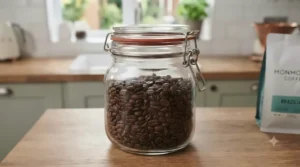
Oxidation: The Real Enemy of Your Coffee Beans
If a one-way valve deals with gas escaping the bean, oxidation is the opposite problem — oxygen getting in and actively degrading it, and it’s arguably the bigger long-term threat to flavour.
Oxidation is fundamentally a chemical reaction: oxygen molecules interact with the oils and aromatic compounds inside roasted coffee, gradually breaking them down into duller, flatter-tasting versions of themselves. Research on this exact question, comparing different coffee storage methods and how quickly beans lose their aroma after opening, consistently finds that limiting oxygen exposure is the single biggest factor separating well-preserved coffee from stale coffee days after the bag is first opened. A broader review of the underlying staling research from the specialty coffee industry points to the same conclusion: even beans stored under reduced oxygen can still show some lipid oxidation over time, which is really an argument for buying smaller amounts more often rather than expecting any canister to work miracles.
What this means practically is that an airtight coffee canister isn’t fighting a single battle — it’s managing both gas release (via the valve) and oxygen exclusion (via the seal) simultaneously, which is exactly why a genuinely well-made canister costs a bit more than an ordinary storage jar with a clip-shut lid.
How to Choose a Coffee Canister for Keeping Beans Fresh
Cutting through the marketing, here’s the practical checklist that actually predicts how well a canister will perform.
- Check for a genuine one-way valve, not just an “airtight” claim on the box — the two aren’t automatically the same thing.
- Match capacity to your actual buying habits. A canister that’s always nearly full traps less air than one that’s routinely half-empty.
- Prioritise opaque materials for long-term storage. Stainless steel blocks light entirely; glass looks lovely but only suits beans you’ll use within a couple of weeks.
- Look for a proper gasket seal, not just a snap-fit lid — run a finger around the rim to check for a visible silicone ring.
- Consider a date tracker a genuine convenience, not a gimmick. It removes the guesswork of “how long has this actually been open?”
- Factor in the scoop. A clip-on or magnetic scoop sounds trivial until you’re rummaging through a drawer with coffee-dusted hands.
- Buy the size you’ll actually use up within a month, rather than the biggest one on the shelf.
Coffee Bean Storage Container: Stainless Steel vs Glass vs Ceramic
Material choice matters more than most buyers assume when picking a coffee bean storage container, so it’s worth a direct, honest comparison rather than defaulting to whichever looks nicest on a shelf.
| Material | Light Protection | Durability | Typical Price | Best For |
|---|---|---|---|---|
| Stainless steel | Excellent (fully opaque) | Very durable, dent-resistant | £12–£38 | Long-term storage, daily use |
| Borosilicate glass | Poor (fully transparent) | Durable but breakable | £10–£16 | Short-term storage, visual tracking |
| Ceramic | Excellent (fully opaque) | Heavy, chip-prone | £15–£30 | Aesthetic kitchens, careful handling |
Stainless steel wins on the two factors that matter most for freshness — total light exclusion and physical durability — which is exactly why five of the seven picks above use it. Glass earns its keep purely on visibility, and remains a perfectly sensible choice as long as you store it away from direct sunlight and accept slightly faster staling on beans left sitting for weeks. Ceramic splits the difference aesthetically but rarely beats stainless steel on practical grounds, since it’s heavier, more fragile, and typically costs more for the same functional seal.
Airtight Coffee Canister with Date Tracker: Worth the Extra Feature?
A date tracker is the small rotating dial or sliding marker built into most canister lids, letting you note the day you opened the bag or set the roast date at a glance. It sounds almost too simple to matter, but reviewers consistently flag it as one of the most-used features across this entire product category — more so than premium materials or extra capacity.
What most buyers overlook is that the value isn’t really about strict food safety, since roasted coffee doesn’t “go off” in a dangerous sense the way perishables do — it’s about avoiding the slow, easy-to-miss decline in flavour that happens when a canister quietly sits half-forgotten for six weeks instead of two. A date tracker turns a vague “is this still good?” question into a simple visual check, which genuinely changes buying and brewing habits for the better over time.
Not every canister needs one to function well — the Airscape Stainless Steel Canister skips it entirely in favour of its plunger mechanism — but for anyone juggling multiple bags of beans or a household where more than one person tops up the same canister, it’s a small feature that earns its keep daily.
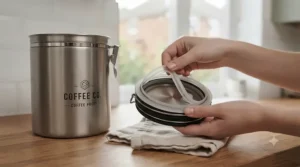
Setup and Daily Use Guide: Getting the Most From Your Canister
Buying a good airtight coffee canister is only half the job; using it properly is what actually delivers the freshness gains.
Transfer beans as soon as you open a new bag rather than leaving them in the original packaging “for now” — every day spent in a folded, unsealed bag is lost freshness a canister could have prevented. Set the date tracker immediately on filling, using either the roast date from the bag or the day you opened it, so you always know at a glance how long that batch has been in circulation. Keep the canister in a cool, dark cupboard rather than on a sunny windowsill, even if it’s stainless steel — heat accelerates staling regardless of how well the lid seals.
For the first 30 days with a new canister: avoid topping up old beans on top of new ones, since mixing roast dates makes the date tracker meaningless and muddles flavour consistency. Give the canister a quick wipe-out between refills to clear any oily residue that builds up on the interior walls over repeated use, particularly with darker roasts. This lines up with general UK food storage best practice, which recommends clean, airtight, cool and dry storage for dry pantry goods generally — coffee included.
Pros:
- ✅ Immediate transfer preserves far more freshness than delayed storage
- ✅ Setting the date tracker takes seconds and removes all guesswork
- ✅ Cool, dark storage works even with opaque materials
Cons:
- ❌ Requires a small habit change if you’re used to leaving bags open
- ❌ Mixing old and new beans undermines the whole system
Small habits here matter more than the canister’s price tag — a £12 canister used properly will outperform a £30 one left open on the counter every time.
Real-World Scenario: Who Actually Needs a Dedicated Coffee Canister
If you’re a single-person household who buys one 250g bag every couple of weeks and drinks it down quickly, something compact like the Enjoyaa 500ML Glass Canister matches your actual consumption far better than a large tin that’s perpetually half-empty.
If you’re a family or shared household getting through a kilo bag every fortnight, the ROCKY&CHAO 1800ML or 2800ML Airtight Coffee Canister makes far more practical sense, since the higher turnover keeps trapped air to a minimum even at larger capacities.
If you’re the kind of coffee drinker who already grinds fresh, weighs shots, and knows your roaster’s exact release schedule, the Airscape Stainless Steel Canister is built for exactly that level of attentiveness — it’s a genuine upgrade for someone already optimising every other variable in their cup.
Common Problems With Coffee Canisters (And Fixes)
Even good canisters run into the same handful of avoidable issues. Here’s how to solve the ones that actually matter.
Problem: Coffee still tastes stale despite using a canister. This is almost always a mismatch between canister size and actual consumption — a large canister left half-full traps proportionally more air than a smaller one kept nearly topped up. Downsize, or buy smaller bags more often.
Problem: The lid seal feels loose after a few months. Silicone gaskets can pick up oily residue from coffee that reduces their grip over time. A quick wipe with a damp cloth every few refills usually restores the seal.
Problem: Glass canisters develop a slightly stale smell. This is typically light exposure speeding up oxidation rather than a fault with the canister itself. Reposition it away from windows or direct kitchen lighting.
Problem: The date tracker wheel is stiff or hard to turn. Coffee oil residue is again the usual culprit; a soft brush or cloth around the dial mechanism generally frees it back up.
Problem: CO2 valve seems to be letting air in rather than out. Genuinely faulty valves are rare but do happen — check the valve isn’t clogged with coffee dust first, and contact the retailer if the issue persists on an otherwise new unit.
Common Mistakes When Buying an Airtight Coffee Canister
The single most common mistake isn’t picking the “wrong” canister — it’s buying one significantly larger than actual coffee consumption justifies, purely because it looked like better value per litre on the listing page.
A second frequent error is assuming “airtight” claims on cheap, unbranded listings are automatically backed by a real gasket seal and valve system. Reviewers consistently note that some budget canisters marketed as airtight rely on nothing more than a snug-fitting lid, which is a meaningfully weaker seal than a proper silicone gasket plus one-way valve combination.
Finally, plenty of buyers choose glass purely for looks and then store it somewhere bright, undermining much of the benefit. If you genuinely want the visual appeal of glass, position it in a shaded spot rather than a sunny counter, or accept that you’re trading some freshness for aesthetics — both are reasonable choices, but only one is being made knowingly most of the time.
Features That Actually Matter (And Those That Don’t)
Coffee canister listings are prone to the same feature-stuffing as most kitchenware, so it’s worth separating genuine value from marketing padding.
A genuine one-way CO2 valve matters, as does a real silicone gasket seal rather than a simple snap-fit lid — these two features are doing almost all of the practical work. Opaque, food-safe material (stainless steel or ceramic) matters for anything you’re storing longer than a couple of weeks. A date tracker matters more than its simplicity suggests, purely because it changes buying and usage habits for the better.
What matters far less: elaborate exterior finishes, colour options, and oversized capacity beyond what you’ll realistically use within a month. A clip-on scoop is a genuine convenience but not a dealbreaker if you already own a decent one. None of these secondary features meaningfully change how fresh your coffee tastes — they’re comfort features layered on top of the core seal-and-valve mechanism that actually does the work.
Long-Term Cost and Value: Is an Airtight Canister Worth It?
An airtight coffee canister is a genuinely low-cost, one-time purchase compared with the ongoing cost of the coffee it’s protecting, so it’s worth putting real numbers on the comparison.
| Price Tier | Typical Spend | What You Get |
|---|---|---|
| Budget | £10–£15 | Solid valve, gasket seal, basic finish |
| Mid-range | £15–£25 | Better build, date tracker, scoop included |
| Premium | £28–£38 | Plunger mechanism or restaurant-grade steel |
Even at the premium end, a single canister typically costs less than two or three bags of specialty-grade beans, and unlike the coffee itself, it doesn’t need repurchasing every few weeks. The real return on investment isn’t really financial — it’s flavour preservation on every single bag you buy afterward, which compounds meaningfully over a year of regular coffee drinking. For most households, a mid-range stainless steel option with a genuine valve and gasket seal represents the sweet spot between cost and performance, with premium picks reserved for buyers who are already fussy about every other variable in their cup.
Frequently Asked Questions
❓ Does an airtight coffee canister actually keep coffee fresher than the bag it came in?
❓ How long do coffee beans really last in an airtight canister?
❓ Should I choose a canister with a one-way valve or without?
❓ Is glass or stainless steel better for storing coffee beans?
❓ Do I need to write the date every time I refill my canister?
Conclusion
A good airtight coffee canister isn’t a luxury purchase — it’s a small, one-off cost that genuinely changes how your coffee tastes for as long as you own it. The right pick really does come down to your actual habits rather than which canister looks best on the counter: stainless steel options like Coffee Gator or the ROCKY&CHAO canisters for most everyday buyers, glass picks like MICHIHOMIE or Enjoyaa if you like watching your stock levels, and the Airscape Stainless Steel Canister if you’re already chasing every last bit of freshness elsewhere in your routine.
Whichever you choose, match the size to how quickly you actually get through beans, keep it somewhere cool and dark, and set that date tracker every time you refill. Do that consistently, and even the most modest canister on this list will noticeably outperform a folded bag on a cupboard shelf.
Recommended for You
- Cloth Coffee Filter: 7 Best Reusable Picks for UK Brewers (2026)
- Gold-Tone Coffee Filter: 7 Best UK Picks for Richer Brews (2026)
- Metal Filter vs Paper Filter for Coffee: 7 Best Picks (2026)
Disclaimer: This article contains affiliate links. As an Amazon Associate, I earn from qualifying purchases. If you purchase products through these links, we may earn a small commission at no additional cost to you.
✨ Found this helpful? Share it with your friends! 💬🤗
