
In This Article
Backflush detergent for espresso machines is an alkaline cleaning compound, sold as powder, tablets or sachets, that dissolves coffee oils and residue when it is pushed backwards through the group head. It only works on machines with a three-way valve. You fit a blind basket so the cleaning solution circulates behind the shower screen.

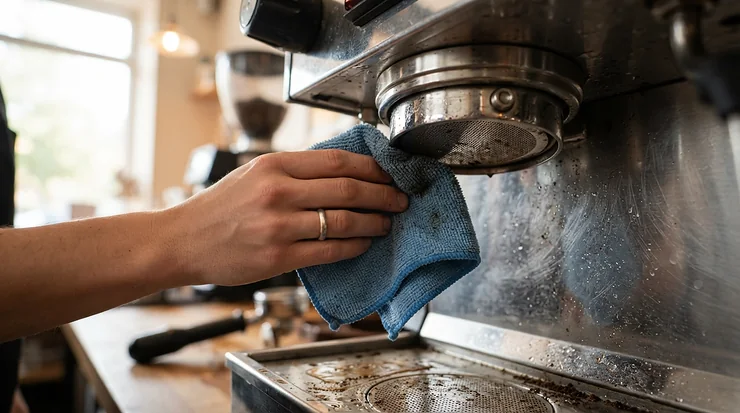
Now the uncomfortable bit. Every shot you pull leaves a thin film of oils and fine particles on the shower screen, in the group and inside the valve. It goes rancid quietly, and you taste it as bitterness. Plain water won’t shift it. That’s the job of coffee machine backflushing detergent, and it’s why a cheap tub of espresso backflush powder often improves a shot more than a new grinder burr would.
Which? makes a similar point: machines that are rarely cleaned are more prone to leaks and blockages, and traditional espresso machines need the brew head and portafilter cleaning regularly. That is the case for a short weekly maintenance routine over an annual panic.
This guide covers seven real products, from Urnex Cafiza to Puly Caff Plus and Cafetto. I haven’t hand-tested any of them, and this isn’t a review based on ownership. It is an analysis built from published specs, dosing instructions, UK retailer listings and aggregated reviewer sentiment. Where I couldn’t verify something, such as a current UK price or review count, I say so. You’ll also get a decision framework, a step-by-step routine and a plain-English explanation of why group head oils matter.
Backflush Detergent for Espresso Machines at a Glance
Here is the quick version before the detail. Prices are ranges drawn from UK retailer listings at the time of research. Always check the current price on Amazon UK.
| Product | Format | Pack | Best For |
|---|---|---|---|
| Urnex Cafiza Espresso Machine Cleaning Powder | Powder | 566g tub | All-round home use |
| Urnex Cafiza2 Espresso Machine Cleaning Powder | Powder | 900g tub | Heavy users, small offices |
| Urnex Cafiza E16 Cleaning Tablets | Tablets | 100 × 1.2g | Mess-free dosing |
| Urnex Cafiza E31 Cleaning Tablets | Tablets | 100 × 2g | Mixed manual and bean-to-cup households |
| Puly Caff Plus Powder | Powder | 900g tub | Enthusiasts wanting a pro-grade formula |
| Puly Caff Plus Tablets | Tablets | 100 × 1g | Single-dose convenience |
| Cafetto Espresso Clean | Powder, sachets or tablets | Various | Buyers who prioritise certification |
Powders win on cost per clean. Tablets win on tidiness and consistency. If you backflush weekly on a manual machine, either route works, so the real question is whether you’d rather measure or pay for the convenience of not measuring. Cafiza powder and Cafiza E16 tablets show that trade-off clearly, and the cost section below puts numbers on it.
💬 Just one click — help others make better buying decisions too!😊
Top 7 Backflush Detergent for Espresso Machines: Expert Analysis
Each pick below gets the same treatment: what the spec means in practice, who it suits, what reviewers say and what the value looks like. None of this is lifted from a product listing.
1. Urnex Cafiza Espresso Machine Cleaning Powder (566g) — the industry-standard workhorse
Cafiza is the name baristas reach for by reflex, and its reputation is the main reason it tops this list.
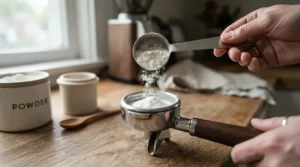
The label dose is up to half a teaspoon (about 3g) in a blind basket. You run ten seconds on, ten seconds off, five times. You rinse, repeat, then discard a shot. At 3g a go, a 566g tub covers roughly 180-plus backflushes, so one tub lasts a typical household for years. UK retailer listings describe the powder as NSF-certified, and the maker also recommends it for soaking portafilters and baskets.
On paper this suits almost anyone with a three-way valve machine. The powder lets you scale the dose up or down, which tablets can’t. A tub sold on the US Amazon marketplace carried a rating of about 4.8 from over 4,500 reviews, according to a deal-tracking page. That is a different marketplace from amazon.co.uk, so treat it as indicative only. Reviewers there mention monthly backflushing plus soaking the portafilter and shower screen, and several favour it over costlier branded cleaners.
Pros:
- ✅ Very low cost per backflush
- ✅ Adjustable dose for light or heavy cleans
- ✅ Doubles as a soak for baskets and portafilters
Cons:
- ❌ Needs measuring, and powder can be messy
- ❌ Not a descaler, so limescale needs separate treatment
At the time of research, UK retailers listed it in roughly the £9-£15 range. Check the current price. Verdict: the best value starting point.
2. Urnex Cafiza2 Espresso Machine Cleaning Powder (900g) — updated formula in a bigger tub
Cafiza2 is the refreshed formulation of the original, and its standout is the larger tub.
Listings describe it as targeting coffee oils, tannins and internal residue, with the same foam-versus-solubility balance as the original. The retailer dosing guidance mirrors the original’s: up to about 3g per group. Practically, that makes it a drop-in replacement. You change nothing about your routine, and you stock a tub that lasts roughly 300 backflushes.
Based on the spec comparison, the audience is narrower than for the 566g tub. A café, a small office or a household that backflushes several times a week will feel the saving. Someone cleaning once a week might still be scooping the same tub in 2030, and powders do clump if stored badly. For the occasional user, the smaller tub is the sensible buy.
I couldn’t verify meaningful UK review data for this updated formulation, so I won’t pretend to summarise it. Retailer listings advise rubber gloves and eye protection and note that COSHH safety data sheets are available from the supplier. That is useful for anyone using it in a workplace.
Pros:
- ✅ Larger tub lowers cost per clean at heavy use
- ✅ Updated formulation from a proven brand
- ✅ Same dosing routine as the original
Cons:
- ❌ Overkill for once-a-week home users
- ❌ Limited independent review history on the newer formula
I couldn’t confirm a reliable UK price band, so check the live listing and divide by grams. Verdict: strong value for heavy users only.
3. Urnex Cafiza E16 Cleaning Tablets (100 × 1.2g) — the tidy, pre-measured option
Cafiza E16 removes the one thing most people dislike about espresso backflush powder: the measuring.
Each 1.2g tablet is one dose. You drop it into a blind basket, lock in the portafilter and run the same ten-on, ten-off cycle five times. Retailer listings say the same tablet suits automatic machines by following the manufacturer’s cleaning instructions. A jar of 100 therefore gives you about 100 weekly backflushes, close to two years of routine care.
What the spec sheet won’t tell you is the psychology. A pre-measured tablet is a much easier habit to keep than a scoop and a spoon, and a habit you keep beats a formula you don’t use. Reviewers of tablet-format cleaners generally praise exactly this convenience, though I couldn’t verify UK-specific review counts for this size.
The trade-off is cost per clean. Tablets run noticeably dearer than powder, and you lose the ability to tweak strength.
Pros:
- ✅ No measuring or powder spills
- ✅ Consistent dose every time
- ✅ Compact jar stores easily
Cons:
- ❌ Higher cost per clean than bulk powder
- ❌ No flexibility to adjust cleaning strength
UK retailers listed it at roughly £10-£14 including VAT. Verdict: worth the premium if convenience keeps you consistent.
4. Urnex Cafiza E31 Cleaning Tablets (100 × 2g) — one jar for both manual and bean-to-cup
Cafiza E31 is the tablet for households that own more than one type of machine.
Each tablet weighs 2g and is about 15mm across, and the jar holds 100. The ingredients include sodium carbonate, sodium percarbonate and ethoxylated alcohols, which is a standard oxygen-based alkaline blend. Listings describe it as NSF- and Kosher (pareve)-certified. One US retailer is explicit that it is not a decalcifier and must never go into the water reservoir or boiler, which is a warning worth repeating.
On the analysis side, the stronger 2g tablet is the right call if you also run a bean-to-cup machine through its cleaning programme. Retailer compatibility lists name brands such as De’Longhi, Gaggia, Jura and Saeco. Check the size against your machine’s tablet slot, and follow the manual, not the jar.
I couldn’t verify UK review sentiment for this specific jar. Treat the compatibility list as a starting point, not a guarantee.
Pros:
- ✅ Covers manual and automatic machines per listings
- ✅ Can also make a soaking solution for parts
- ✅ NSF-certified formulation
Cons:
- ❌ Dearer per clean than powder
- ❌ Tablet size must match your machine’s slot
I couldn’t confirm a dependable UK price range, so check the current price. Verdict: smart for mixed-machine homes.
5. Puly Caff Plus Powder (900g) — the Italian pro formula built around the three-way valve
Puly Caff Plus is a crystallised powder made in Italy, and listings position it specifically for backflushing the brew group, three-way solenoid valve and portafilter.
It is formulated to strip oxidised coffee oils and fine particles from the brewing circuit, and an NSF-version safety data sheet is available. For a home user, the spec matters because it is designed around the valve that does the dirty work. Retailers sell it in 900g and smaller tubs, and a UK specialist listed 900g at around £14.
Aggregated reviewer sentiment is warm. Buyers on a US-facing listing talk about ten years of use, using it on E61 group machines and following their manufacturer’s cleaning advice. They also suggest discarding the first espresso afterwards to re-season the machine. Frequency guidance varies between UK retailers: some say weekly, one says every three months, and another says daily for commercial use. Follow your own machine’s manual rather than a single retailer’s advice.
Pros:
- ✅ Formulated specifically for backflush cleaning
- ✅ Trusted by professionals and long-term home users
- ✅ Large tub suits regular cleaning
Cons:
- ❌ Useless on machines with no three-way valve
- ❌ Retailer dosing advice is inconsistent
Roughly £12-£16 range. Verdict: a good value pick for serious enthusiasts.
6. Puly Caff Plus Tablets (100 × 1g) — single-dose convenience in the Puly family
Puly Caff Plus Tablets bring the Puly chemistry in a one-gram tablet that suits both manual and automatic machines, according to listings.
At 1g, each tablet is the smallest on this list. For a manual machine the instruction is simple: put one tablet in the blind basket and run the backflush cycle as the label directs. For an automatic, you follow your machine’s cleaning cycle. Listings describe daily cleaning of the portafilter arm as the recommended habit, which suits a café. A home user would scale this back.
My take: the tablet format shines where several people share a machine and you want a foolproof single dose. The small size could mean using more than one when soaking baskets, though I’d check the label rather than assume. I couldn’t verify UK reviews or a firm price band, so that part is left honestly open.
Pros:
- ✅ Tiny pre-measured tablet
- ✅ Suits manual and automatic machines per listings
- ✅ Same brand chemistry as the powder
Cons:
- ❌ UK pricing and reviews are hard to verify
- ❌ Soaking parts may need several tablets
Check current price and availability. Verdict: a good fit for shared machines.
7. Cafetto Espresso Clean — the certified free-rinsing choice
Cafetto Espresso Clean is the pick for buyers who care about certification and rinsing.
The brand says it is tested to NSF protocol P152, which covers whether a cleaner taints coffee or corrodes the machine. It sells as a tub with a scoop, an 18-sachet box of 5g and as tablets. The daily instruction is one level scoop (two if cleaning less often), a ten-second run, a ten-second rest, five cycles, then a long rinse of ten short cycles. Soaking filters takes two teaspoons in 500ml of hot water for ten minutes. The brand says it is safe on brass, stainless steel and copper.
From the spec comparison, the scoop is the clever bit, because it removes the teaspoon guesswork that powders usually bring. Its limitation is availability, since I found most listings were Australian rather than UK-based. Check UK stock and the current price on Amazon UK before planning a switch.
Pros:
- ✅ Independent NSF P152 certification claim
- ✅ Free-rinsing, odour-free formulation
- ✅ Powder, sachets and tablets to choose from
Cons:
- ❌ UK availability is less consistent
- ❌ Fewer UK reviews to lean on
I couldn’t verify a UK price range. Verdict: excellent if you can find it in stock.
Top 7 Specs and Price Ranges Compared
| Product | Dose per backflush | Format | Price range (UK, at research) | Best For |
|---|---|---|---|---|
| Urnex Cafiza | Up to 3g | Powder | Around £9-£15 | Best overall value |
| Urnex Cafiza2 | Up to 3g | Powder | Check current price | Heavy users |
| Urnex Cafiza E16 | 1 tablet (1.2g) | Tablet | Around £10-£14 | Tidy routine |
| Urnex Cafiza E31 | 1 tablet (2g) | Tablet | Check current price | Mixed machines |
| Puly Caff Plus Powder | Per label | Powder | Around £12-£16 | Enthusiasts |
| Puly Caff Plus Tablets | Per label | Tablet | Check current price | Shared machines |
| Cafetto Espresso Clean | 1 scoop or 1 tablet | Powder or tablet | Check current price | Certification fans |
The table makes the pattern obvious. Cafiza wins on proven value, Puly Caff Plus Powder matches it for enthusiasts and Cafiza E16 is the easy-habit pick. If your machine supports it, Cafetto Espresso Clean is the one to chase for certification. I couldn’t verify star ratings for UK listings, so I haven’t printed any.
How to Choose Backflush Detergent for Espresso Machines
Choosing well comes down to seven checks. Work through them in order and the decision usually makes itself.
- Confirm your machine has a three-way valve. The espresso machine design that backflushes uses a solenoid to release pressure after brewing. If your manual doesn’t mention backflushing, don’t do it.
- Check what your manufacturer recommends. Some brands specify their own cleaner. Following the manual protects your warranty.
- Pick powder or tablets. Powder is cheaper per clean and adjustable. Tablets are tidier and consistent.
- Look for certification. NSF marks suggest independent testing for taste taint and corrosion, which matters on brass and copper parts.
- Match the pack size to your frequency. A weekly user needs about 50 doses a year, so a giant tub is a poor buy.
- Check rinsing behaviour. Free-rinsing formulas shorten the rinse cycle and reduce the risk of a soapy first shot.
- Read the safety information. Gloves and eye protection are standard advice, and suppliers can provide data sheets.
The best coffee machine backflushing detergent is the one that matches your machine and your habits. Skip the fancy extras, and don’t buy a descaler thinking it will do this job.
Your Weekly Maintenance Routine, Step by Step
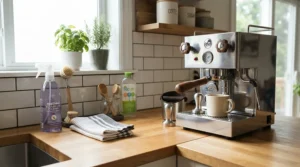
Weekly maintenance is where all of this pays off. Here is a routine that adapts the label procedures from the Cafiza and Cafetto Espresso Clean instructions. Always defer to your own manual.
Before you start: fit a blind basket or rubber disc, and wear gloves and eye protection.
- Dose the detergent. Add up to 3g of Cafiza powder, one level scoop of Cafetto Espresso Clean or one tablet.
- Run the cycle. Lock the portafilter in, run for ten seconds, pause for ten seconds, and repeat five times.
- Rinse the portafilter. Remove it and rinse under the stream of water from the group.
- Flush again. Reinsert the blind basket and repeat the cycle five times.
- Soak the parts. Dissolve about 6g of Cafiza per litre of hot water and soak baskets and the metal portafilter for around 30 minutes, then rinse.
- Re-season. Pull a single espresso, discard it and wipe down the group.
Between detergent runs, a plain-water backflush at the end of each day helps clear loose grounds. Over time, it keeps group head oils from baking onto the screen.
One practical tip: use a timer on your phone. The ten-and-ten rhythm is easy to lose, and shortened cycles are the commonest reason a backflush underperforms. Make the routine boring, and you’ll keep doing it.
Real-World Scenarios: Which Detergent Fits Your Life?
Three profiles show how the analysis plays out. These are illustrative buyer types, not real customers.
Scenario 1: the weekend enthusiast. You make four to six drinks a day, backflush weekly and own a prosumer machine. Cafiza powder is the sensible default, and Puly Caff Plus Powder is a close alternative if you like the Italian pedigree. A 566g tub should last for years, which makes the cost trivial.
Scenario 2: the busy household. Two adults, two shift patterns, one machine. The risk is that nobody does the weekly clean. Cafiza E16 tablets turn it into a ten-second job, and the premium per clean is small compared with a skipped routine. If the household also has a bean-to-cup machine, Cafiza E31 earns its place.
Scenario 3: the small office. Ten or more users, daily drinks, machine used on weekdays only. The larger Cafiza2 tub starts to make sense here, as does Puly Caff Plus Tablets for shared use. Add a laminated cleaning card and a rota. Check COSHH obligations if the cleaner is used in a workplace.
The point is that detergent choice follows behaviour. Buy for the person who will actually do the cleaning, and match the format to how that person works. A tidy tablet beats a better powder that never leaves the cupboard.
Problem → Solution: Fixing Common Backflush Headaches
Backflushing can go wrong in small, irritating ways. These are the usual culprits.
Problem: shots taste bitter or stale even after cleaning. Solution: you may be skipping the rinse cycles. Repeat the five-second-on, two-second-off rinse with the blind basket until the water runs clear, then discard a shot. If you’re using a free-rinsing option like Cafetto Espresso Clean, this is quicker.
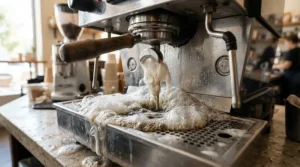
Problem: soapy taste or foam. Solution: too much detergent. Stick to the label dose, because more isn’t better. Cafiza is formulated to balance foam and solubility, but overdosing undermines that.
Problem: water drains slowly from the portafilter after backflushing. Solution: a blocked or worn three-way valve may need professional service, not more chemistry. Cleaning can’t fix a failed part.
Problem: powder clumps in the tub. Solution: store it airtight and dry, and use a dry scoop. Switching to Cafiza E16 tablets avoids the issue.
Problem: limescale on the group. Solution: backflush detergent isn’t a descaler. Descale separately, following your manufacturer’s advice, and never add detergent to the water reservoir.
Most issues come down to dose, rinse or part wear. If a clean-looking machine still tastes off after two full cycles, call a technician rather than escalating the chemistry.
Three-Way Valve Explained: Can Your Machine Backflush?
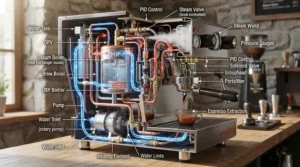
The three-way valve is the reason backflushing works at all. When you stop the shot, the valve releases the pressure in the group and sends the water to the drip tray. During a backflush it pushes cleaning solution up behind the shower screen and through the valve, then drains it.
A solenoid valve is simply an electrically controlled valve, and the three-way version is what gives you the dry, drainable puck after a shot. If your machine has one, a blind basket forces the solution to circulate. If it doesn’t, backflushing could push cleaner somewhere it shouldn’t go.
How can you tell? Check the manual for the words “backflush”, “blind basket” or “three-way solenoid”. Many entry-level and pod machines have no such valve, and one UK retailer notes that very few domestic machines can be backflushed at all. In that case, soak the portafilter and basket and scrub the shower screen and gasket instead.
If you’re unsure, ask the manufacturer. This is the one decision where guessing is expensive. Backflush detergent and a three-way valve are a partnership, and if your machine isn’t built for it, the best detergent in the world won’t help.

Espresso Backflush Powder vs Backflush Cleaning Tablets (and Alternatives)
Is espresso backflush powder better than backflush cleaning tablets? Neither wins outright. Powder gives flexibility and the lowest cost per clean. Tablets give consistency and tidiness. The surprise is how little the chemistry differs: many tablets use similar alkaline, oxygen-based ingredients to their powders.
| Method | Removes coffee oils | Removes limescale | Where it goes | Best For |
|---|---|---|---|---|
| Detergent backflush (powder or tablet) | Yes | Not designed to | Blind basket in group | Weekly oil removal |
| Water-only backflush | Loose grounds only | No | Blind basket in group | Daily rinse |
| Descaler | No | Yes | Water reservoir or boiler, per manual | Scale control |
Looking at the table, the three methods do different jobs and shouldn’t be swapped. Detergent clears group head oils, water keeps the daily routine honest and descaler handles minerals. Treat them as a toolkit, not rivals, and most machines will stay in good shape.
On the powder-versus-tablet question, I’d argue the right answer is the one you’ll repeat. If you enjoy the ritual, Cafiza powder is hard to beat. If you don’t, Cafiza E16 or Puly Caff Plus Tablets remove the friction.
Long-Term Cost and Maintenance: What Backflushing Really Costs
Backflushing costs pennies. That’s the headline. Based on the label dose of up to 3g, a 566g tub of Cafiza gives roughly 180-plus cleans, so cost per backflush works out at around 5-8p at typical UK retailer prices.
| Option | Approx. cost per clean | Notes |
|---|---|---|
| Cafiza powder (566g) | Around 5-8p | Cheapest per clean |
| Cafiza E16 tablets | Around 10-14p | Pre-measured |
| Cafiza2, Puly Caff Plus, Cafetto Espresso Clean | Divide tub price by grams, multiply by dose | Prices vary |
The numbers say that powder is cheapest, tablets roughly double it, and both are tiny next to a repair. A worn three-way valve or clogged group can cost far more than years of detergent. Over two years of weekly cleans, the difference between powder and tablets is a few pounds.
Total cost of ownership also includes your time. A routine that takes ten minutes weekly is cheap insurance for a machine that may have cost hundreds. Add a basket-soak monthly and a descale on your manufacturer’s schedule, and you’ve covered the essentials.
Common Mistakes When Buying and Using Backflush Detergent
A handful of mistakes crop up repeatedly.
Buying without checking the machine. No three-way valve, no backflush. Read the manual first.
Confusing detergent with descaler. They solve different problems. One UK-facing listing for Cafiza E31 is explicit that it is not a decalcifier.
Skipping the rinse. Residue is the main route to a soapy first shot. Complete every rinse cycle, then discard a shot.
Ignoring safety. Manufacturer instructions recommend rubber gloves and eye protection. If you use these products at work, the HSE’s COSHH guidance explains employer duties around hazardous substances, and suppliers can provide safety data sheets.
Over-buying. A huge tub for a once-a-week user is a false economy, as powders absorb moisture. Match tub size to your frequency.
Overdosing. More detergent doesn’t mean more clean. Stick to label doses such as the 3g for Cafiza or one level scoop for Cafetto Espresso Clean.
Treating retailer advice as gospel. As we saw with Puly Caff Plus, frequency advice ranges from daily to quarterly. Your manual and your usage should decide.
Avoid these seven slips and you’ll be ahead of most owners.
Frequently Asked Questions
❓ How often should I use backflush detergent for espresso machines?
❓ Can I use espresso backflush powder on a machine without a three-way valve?
❓ Does coffee machine backflushing detergent also descale my machine?
❓ Are backflush cleaning tablets cheaper than powder?
❓ Do I need to rinse after using backflush detergent?
Conclusion
The best backflush detergent for espresso machines is the one that suits your machine and your habits, and the three-way valve question comes first. If your machine has one, Urnex Cafiza powder is the safest value pick, Puly Caff Plus Powder is the enthusiast alternative, and Cafiza2 suits heavy users. If you’d rather not measure, Cafiza E16 and Puly Caff Plus Tablets make the routine effortless, while Cafiza E31 helps if you also own a bean-to-cup machine. Cafetto Espresso Clean is worth chasing for its certification if you can find it in stock.
Whatever you choose, remember what the cleaner is really fighting: group head oils that quietly turn every shot bitter. A short weekly maintenance routine, a full rinse and a discarded first shot will protect both your coffee and your machine. Keep descaling separate, follow your manual and wear the gloves.
I couldn’t verify every UK price or review count, and I’ve said so where it matters. Check the current price and availability on Amazon UK before you buy.
✨ Ready for cleaner, sweeter shots?
🔍 Pick the format that fits your routine, click a highlighted product to check the current price and start your weekly backflush this weekend. Your next espresso will taste the difference! ☕
Recommended for You
- Milk Frother Cleaning Solution: 7 Best Picks For UK Homes (2026)
- Group Head Brush For Espresso Machine: 7 Best UK Picks (2026)
- Espresso Machine Cleaning Tablets: 7 Essential UK Picks (2026)
Disclaimer: This article contains affiliate links. As an Amazon Associate, I earn from qualifying purchases. If you purchase products through these links, we may earn a small commission at no additional cost to you.
✨ Found this helpful? Share it with your friends! 💬🤗
