

In This Article
Picture a flat kitchen where the worktop is the size of a chopping board and the kettle already has squatter’s rights. The espresso machine you once dreamed of owning would need its own postcode. That is the daily maths of small-flat life, and it is why a stovetop espresso maker for small flat kitchens is having a moment. There is no plug, no drip tray and no cupboard-hogging box. You need a metal pot, a hob and about five minutes.
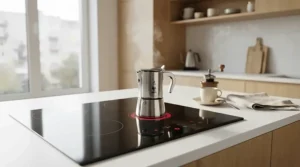
The idea isn’t new. The moka pot has been around since Alfonso Bialetti popularised it in 1933, and the principle hasn’t changed: steam pressure pushes hot water up through ground coffee. What has changed is the hob underneath it. Induction is increasingly common in modern flats, and the classic aluminium pot that ruled Italian kitchens for decades won’t heat on it. You probably also want one cup rather than six. A quick search then throws up a muddle of capacities, materials and “induction-ready” claims.
That muddle is what this guide untangles. I compared seven real pots, from a budget aluminium classic to a design-museum showpiece, using manufacturer specs, retailer data and the genuine themes in published reviews. I haven’t brewed with any of them and won’t pretend otherwise. You’ll get honest analysis of what the numbers mean in a tiny kitchen. We’ll cover the stovetop espresso maker for induction hob question and how to choose a small moka pot for one cup. We’ll also look at the safety valve, rubber gasket replacement and the fine grind setting that trips up most beginners.
Prices are ranges because they shift constantly. Always check the current price before you buy.
Quick Comparison: Stovetop Espresso Maker for Small Flat Picks at a Glance
Here is the whole shortlist on one screen. Capacities follow each maker’s own “cup” sizing, which is smaller than a UK mug.
| Pick | Size as sold | Induction? | Price range | Best For |
|---|---|---|---|---|
| Bialetti Moka Express 1-Cup | about 60ml | Only with an adapter plate | mid-£20s to low-£30s | Solo espresso on gas, electric or ceramic |
| Bialetti Moka Induction 2-Cup | about 80-100ml | Yes | £30-£50 | One or two small coffees on induction |
| Bialetti Venus 4-Cup | about 170ml | Yes (4-cup and up) | £30-£50 | Low-maintenance stainless, mug-ish yield |
| Alessi Pulcina Induction 3-Cup | about 150ml | Yes | from around £90 | Design lovers with a visible hob |
| La Cafetière Stainless Steel Espresso Maker 3-Cup | about 200ml | Yes | around the £60 mark | Durable all-hob stainless |
| Ilsa Carmencita Pop 2-Cup | 2-cup (check listing) | Induction base, borderline size | check current price | Colour on a budget, with caveats |
| ProCook Stovetop Espresso Maker 3-Cup | about 160ml | No | under £20 | Cheap gas or electric brewing |
Looking at the comparison above, the Bialetti Moka Induction 2-Cup is the cleanest answer for induction renters who want one small coffee. The Bialetti Moka Express 1-Cup wins on sheer compactness if your hob is gas, electric or ceramic. Mug drinkers should look at the three-cup stainless options: the Alessi Pulcina Induction 3-Cup if design matters, the La Cafetière Stainless Steel Espresso Maker 3-Cup if durability does. The ProCook Stovetop Espresso Maker 3-Cup is cheapest precisely because it skips induction support.
💬 Just one click — help others make better buying decisions too!😊
Top 7 Stovetop Espresso Maker for Small Flat Picks: Expert Analysis
Every pick below is judged on what matters in a compact kitchen: footprint, hob compatibility, realistic yield and upkeep. Spec figures come from maker and retailer listings, and the review comments are aggregated themes, not personal testing.
1. Bialetti Moka Express 1-Cup — the pocket-sized original
The Bialetti Moka Express 1-Cup is the idea in its purest form: one octagonal aluminium pot making one small coffee. Retailer specs put it at about 13cm tall, with a base around 6cm wide and a fill capacity near 60ml. That is a single proper espresso and a footprint small enough to hide behind a toaster.
The narrow base is also the catch. Most induction hobs ignore pans below a minimum diameter, and aluminium doesn’t respond to induction anyway. Bialetti sells a separate adapter plate for pots up to six cups, so induction owners buy and store two items. Based on the spec comparison, this is a gas, electric or ceramic pick first.
Reviewer sentiment splits predictably. People love the simplicity, while buyers expecting a mug-sized yield are disappointed. One comment on a retailer listing called the size “useless” for not filling a full cup. That is a mismatch of expectations rather than a fault, so treat 60ml as exactly what it is.
Pros:
- ✅ Roughly 13cm height stores almost anywhere
- ✅ Original design with widely stocked spare parts
- ✅ Cheapest route to genuine moka flavour
Cons:
- ❌ Needs an adapter plate on induction hobs
- ❌ 60ml yield disappoints mug drinkers
Price range: mid-£20s to low-£30s at the time of research, which is fair value on non-induction hobs. Check the current price.
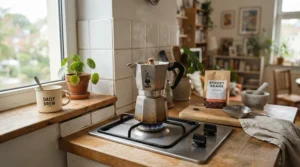
2. Bialetti Moka Induction 2-Cup — the classic, made induction-ready
The Bialetti Moka Induction 2-Cup keeps the familiar eight-sided silhouette but gives it a bi-layer base. Listings describe an aluminium core wrapped in stainless steel, which lets the pot work on every hob type. Brewed volume is quoted anywhere between roughly 80ml and 100ml depending on the retailer. It also carries Bialetti’s patented safety valve and a heat-resistant handle.
Pay attention to the base width. Stockists quote about 9-9.5cm for the 2-cup, which sits close to the minimum pan size on many induction zones. Check your hob manual before ordering. If your zone is fussy, the 4-cup sibling has roughly a centimetre more margin.
Buyer comments on retailer listings praise the solid build and strong coffee. The recurring grumble is that the upper chamber is still aluminium, so it isn’t dishwasher-friendly. Expert Reviews named the 4-cup version its best induction moka pot, which suggests the range is respected. In my view this is the pick most induction-hob renters should start with.
Pros:
- ✅ Works on gas, electric, ceramic and induction
- ✅ Familiar Bialetti brewing behaviour and parts
- ✅ Sensible 2-cup size for a solo drinker
Cons:
- ❌ Base sits near some hobs’ detection limit
- ❌ Aluminium upper chamber needs hand washing
Price range: roughly £30-£50 depending on colour and retailer. Good value for induction compatibility. Check the current price.
3. Bialetti Venus 4-Cup — all-stainless and easy to live with
The Bialetti Venus 4-Cup swaps aluminium for 18/10 stainless steel. That means no dark patina to manage and no adapter plate on induction. Stockist copy mentions an inspection safety valve and a thicker boiler wall. Homes & Gardens ranks the Venus as its best moka pot for induction, but warns that the smaller 2-cup size isn’t induction-friendly. That is why this review focuses on the 4-cup.
The trade-off is speed and size. Stainless generally heats more slowly than aluminium, though it cleans up easily, which suits a flat with a tiny sink. At roughly 170ml on Bialetti’s sizing, the 4-cup is more than a solo espresso drinker needs. It suits someone who wants a small Americano or a milky coffee.
Reviewer themes are positive on durability. One UK round-up says the Venus produces the same cup as the Bialetti Moka Express 1-Cup family. A long-term owner on a coffee forum reports years of use on the original gasket. I wouldn’t copy that, since gaskets do age.
Pros:
- ✅ Stainless body works on every hob
- ✅ Easier cleaning than aluminium pots
- ✅ No patina or discolouration worries
Cons:
- ❌ Too large for strict one-cup brewing
- ❌ Slower to heat than aluminium
Price range: typically in the same £30-£50 neighbourhood as the Bialetti Moka Induction 2-Cup, though size and colour swing it. Check the current price.
4. Alessi Pulcina Induction 3-Cup — the sculptural showpiece
The Alessi Pulcina Induction 3-Cup was designed by Michele De Lucchi in collaboration with illy, and it looks like a small architectural model. It has a cast-aluminium body and a magnetic steel base for induction. Alessi’s induction versions come in 3-cup and 6-cup sizes. The 1-cup Pulcina is the non-induction model, so don’t confuse them.
The 3-cup holds about 15cl and stands roughly 20cm tall. Retailers highlight a drip-free pouring spout. For a small flat the real advantage is that it looks good enough to live permanently on the hob, so it never needs hiding in a cupboard.
I couldn’t verify a robust pool of UK buyer reviews for the induction version. The praise for this pot is mostly editorial design acclaim rather than buyer consensus. One US round-up notes the induction Pulcina costs noticeably more than the standard model.
Pros:
- ✅ Striking design doubles as kitchen decor
- ✅ Induction-ready magnetic steel base
- ✅ Drip-free pouring spout
Cons:
- ❌ Premium price for what is still a moka pot
- ❌ Larger yield than a true single cup
Price range: from around £90 on Alessi’s UK site, and often higher. Choose it for design, not for brewing advantage. Check the current price.
5. La Cafetière Stainless Steel Espresso Maker 3-Cup — the durable all-hob workhorse
The La Cafetière Stainless Steel Espresso Maker 3-Cup is a 200ml pot in polished stainless steel with a copper-coloured finish. Listings describe a brushed steel lid and water tank and a double-walled build. The double wall is meant to keep coffee warm in the pot. It is rated for induction, gas, electric and AGA-style range cookers.
Its strength is that it asks very little of you. Full stainless means no seasoning and an easy wipe-down. Retail listings also cite a 10-year guarantee, though you should read the terms before relying on it. Based on the spec comparison, this suits someone who wants to buy once and forget about it.
The honest caveat is review depth. The ratings I found were a four-star average from only five votes on one retailer page, which is too thin to draw conclusions. A reviewer of a larger pot in the same brand family advised tempering build expectations against pricier makers. Treat the durability promise as a claim to check, not a proven fact.
Pros:
- ✅ Induction-safe stainless throughout
- ✅ Double-walled body for warmer coffee
- ✅ Long guarantee cited by listings
Cons:
- ❌ Priciest of the everyday-style pots
- ❌ Very few verifiable buyer reviews
Price range: around the £60 mark on department-store listings. A reasonable buy-it-for-life bet if the guarantee holds. Check the current price.
6. Ilsa Carmencita Pop 2-Cup — colourful, with a small-diameter caveat
The Ilsa Carmencita Pop 2-Cup descends from the Carmencita design that Marco Zanuso created in 1979 with Lavazza. It has a satin-finish aluminium body, a soft-touch nylon handle and knob, and an “induction bottom”. It is not dishwasher safe.
The catch comes from the retailer’s own notes. Pots with a diameter under 9cm may not register on some induction hobs, and the 2- and 3-cup pots are small enough to risk it. The same listing advises keeping induction power at or below 60 per cent. For a small flat that is useful guidance. A compact pot on an induction zone needs a gentle setting and a hob that will actually detect it.
Buyers on a Finnish retailer page praise the looks and the taste. I couldn’t confirm UK Amazon availability or pricing. This one is for people who like the colour and have checked their hob’s minimum pan size.
Pros:
- ✅ Cheerful colour options
- ✅ Induction base on the aluminium body
- ✅ Familiar Italian moka brewing
Cons:
- ❌ Small diameter may not register on some hobs
- ❌ UK pricing and stock are hard to verify
Price range: I couldn’t pin down a reliable UK figure, so check the current price. Treat it as a gamble until you’ve checked your hob manual.
7. ProCook Stovetop Espresso Maker 3-Cup — the budget gas-or-electric pick
The ProCook Stovetop Espresso Maker 3-Cup is polished aluminium with a soft-touch handle. Retail specs put it at about 160ml, roughly 9cm wide and 15cm tall, and a light 272g. That weight and size make it easy to tuck into a cupboard. It unscrews for cleaning, comes with a one-year guarantee, and, crucially, is not for induction.
If you cook on gas or a ceramic hob and want a no-frills three-cup pot, this is the cheapest listing I found. Expert Reviews picked ProCook’s 9-cup sibling as its best large moka pot, praising its light weight. That doesn’t prove the 3-cup is equally good, but it suggests the brand’s aluminium pots are sound.
ProCook’s own site shows a pool of about 98 reviews, shared with the 6-cup version. I couldn’t reliably split the sentiment by size, so treat it as a general vote of confidence rather than a verdict on this model.
Pros:
- ✅ Lowest upfront cost on this list
- ✅ Light and compact for tight cupboards
- ✅ Simple unscrew-and-wash design
Cons:
- ❌ Not compatible with induction hobs
- ❌ Only a one-year guarantee
Price range: under £20 at the time of research. Excellent value if your hob suits it. Check the current price.
Spec Check: How the Seven Compare
| Pick | Body | Base and hob note | Care | Best For |
|---|---|---|---|---|
| Bialetti Moka Express 1-Cup | Cast aluminium | About 6cm base; needs adapter on induction | Hand wash | Tiny kitchens, non-induction |
| Bialetti Moka Induction 2-Cup | Aluminium with stainless bi-layer base | About 9-9.5cm base | Hand wash | Induction renters |
| Bialetti Venus 4-Cup | 18/10 stainless | Check listing for base | Easier cleaning | Low-maintenance upkeep |
| Alessi Pulcina Induction 3-Cup | Cast aluminium, magnetic steel base | Induction-rated | Hand wash | Design-led kitchens |
| La Cafetière Stainless Steel Espresso Maker 3-Cup | Double-walled stainless | Induction, gas, electric | Easy wipe-down | Buy-once buyers |
| Ilsa Carmencita Pop 2-Cup | Satin aluminium, induction base | Under 9cm may not register | Hand wash | Colour lovers who’ve checked hob specs |
| ProCook Stovetop Espresso Maker 3-Cup | Polished aluminium | About 9cm wide; no induction | Not dishwasher safe | Budget gas or ceramic users |
Notice that base width keeps surfacing as the hidden spec. The two stainless options sidestep most of the material worries, while the aluminium pots trade convenience for lighter weight and lower cost. If your induction zone is picky, the Bialetti Moka Induction 2-Cup and Ilsa Carmencita Pop 2-Cup need the most checking, whereas the stainless La Cafetière Stainless Steel Espresso Maker 3-Cup and Bialetti Venus 4-Cup leave less to chance.
Setting Up Your First Moka Pot: A 30-Day Practical Guide
A good pot still needs a decent first month. Here’s a practical routine that Amazon listings rarely spell out.
Week one: the shake-down.
- Wash all parts in warm water. Skip washing-up liquid on aluminium pots.
- Many owners brew a few batches and discard them to condition a new pot. Check your maker’s instructions for the exact number.
- Fill the base with water up to just below the safety valve. Never above it.
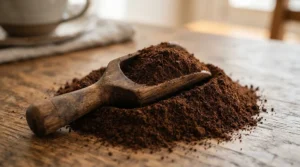
- Fill the funnel level with coffee and don’t tamp. Use a medium-fine fine grind setting, finer than filter but coarser than a café machine.
- Heat gently with the lid open. Expect a brew time of roughly four to five minutes. On induction, Ilsa’s guidance suggests staying at or below 60 per cent power.
Weeks two to four: building the habit.
- Rinse everything after each brew and dry it fully before storing.
- Once a month, lift out the gasket and filter plate and clear the funnel and the safety valve.
- Note how the coffee tastes. A weak or sputtery cup usually points to a pressure problem, not the beans.
Common mistakes in the first 30 days: overfilling past the safety valve, blasting the heat, tamping the grounds, and leaving the pot on the hob after the gurgle. One buyer of a spare gasket set mentioned scorching the rubber ring by doing exactly that. A pot that’s dried and stored sensibly will pay you back in flavour.
Real-World Scenarios: Which Pot Fits Which Flat?
Specs only matter once they meet a real kitchen. Here are three profiles to match picks to circumstances.
The studio renter on induction. She brews once a day, every weekday, drinks it black, and has a hob with a small zone. The Bialetti Moka Induction 2-Cup fits both the hob and the habit. Budget: about £30-£50. The one thing to check is the 9cm-ish base against her zone’s minimum.
The student with a shared ceramic hob. He wants one espresso after lectures and has under £30 to spend. The Bialetti Moka Express 1-Cup is the leanest choice and fits a cramped shelf in a shared kitchen. If housemates will use it too, the ProCook Stovetop Espresso Maker 3-Cup gives a bigger yield for less than £20.
The couple in a one-bed with an induction hob. They make two mugs most weekends, often with milk. A single-cup pot would be laborious. The Alessi Pulcina Induction 3-Cup works if the pot sits on the hob as decor, while the La Cafetière Stainless Steel Espresso Maker 3-Cup works if they want something they won’t have to think about. Expect to spend £60-£100 or more.
Notice that none of these profiles needed a machine. That’s the quiet appeal of a small moka pot for one cup, or two: it fits the life you actually have.
Problem → Solution Guide: Leaks, Sputtering and Sour Cups
Most moka pot troubles come down to five culprits, and each has a straightforward fix.
1. Steam or water leaks at the waist. The usual causes are a loose join, grounds on the threads, or a worn gasket. Tighten firmly, wipe the threads clean, and if it persists, plan a rubber gasket replacement.
2. The hob won’t recognise the pot. On induction, the problem is usually base diameter or position. Centre the pot, check your hob manual for the minimum size, and consider a larger cup size or an adapter plate for aluminium pots such as the Bialetti Moka Express 1-Cup.
3. Bitter or burnt flavour. Blame excessive heat, too fine a grind or leaving the pot to cook after the gurgle. Lower the heat and ease back to a medium-fine fine grind setting.
4. Gritty coffee. Check the filter plate for worn holes and clean the funnel. Replacement gasket-and-filter kits are inexpensive.
5. Little or no coffee rises. The funnel may be blocked, the safety valve sticky, or the water level wrong. Descale the valve and check you haven’t packed the coffee too tight.
If you see a crack in the boiler or the valve stays stuck after cleaning, stop using the pot. That is a safety issue, not a flavour issue.
What Is a Stovetop Espresso Maker for Small Flat Kitchens?
A stovetop espresso maker for small flat living is a compact moka pot that sits on your hob and uses steam pressure to push hot water through ground coffee, producing a strong, espresso-style cup. It needs no plug or counter space, but it must match your hob type, especially if you cook on induction.
The mechanics are simple. Water in the lower chamber heats and builds pressure. The pressure forces it up through a funnel of ground coffee and into the top chamber. Unlike a percolator, the brewed coffee never passes back through the grounds. The result is concentrated and rich, though technically not true espresso, because a moka pot works at lower pressure than a café machine.
For small flats the appeal is practical. The pot stores in a drawer, uses the heat source you already own and costs a fraction of a machine. The best ones are sized for one or two drinkers rather than a dinner party.
How to Choose a Stovetop Espresso Maker for Small Flat Living
Work through these six steps in order, and you’ll avoid the commonest regrets.
- Identify your hob. Gas, electric and ceramic hobs accept aluminium. Induction needs stainless, a bi-layer base or a magnetic steel base.
- Check the base diameter against your hob manual. Many induction zones ignore pots below a minimum width, so this single number can make or break a purchase.
- Pick a realistic capacity. Expert Reviews’ moka pot guide notes that for one or two drinkers a three-cup pot is usually about right. A true single cup is only about 60ml.
- Weigh the material. Aluminium is light and heats quickly. Stainless is easier to clean and works on any hob, but heats more slowly.
- Look for an accessible safety valve and available spares. A pot whose gasket and filter are easy to buy will outlast one that’s a pain to maintain.
- Measure your storage. Height and handle length decide whether it fits the cupboard you actually have.
Stovetop Espresso Maker for Induction Hob: What Actually Works
A stovetop espresso maker for induction hob use has to solve a physics problem: induction heats magnetic metal. Standard aluminium moka pots don’t, so manufacturers have found four workarounds.
- All-stainless bodies, like the Bialetti Venus 4-Cup and the La Cafetière Stainless Steel Espresso Maker 3-Cup, work directly on induction.
- Bi-layer bases, as in the Bialetti Moka Induction 2-Cup, keep an aluminium interior with a steel exterior.
- Aluminium bodies with magnetic bases, such as the Alessi Pulcina Induction 3-Cup and the Ilsa Carmencita Pop 2-Cup, pair aluminium with a steel disc.
- Adapter plates let an aluminium pot like the Bialetti Moka Express 1-Cup work on induction, at the cost of an extra object and slower heat-up.
Before buying, try the fridge-magnet test from this Livingetc explainer: if a magnet sticks firmly to the base, it should work. Then read your hob manual for its minimum pan size. Siemens notes that each hotplate has a lower detection limit, and one hob manufacturer warns that small pans with thin or laminated bases can be hard to detect. If you struggle, a larger pot or a different zone is the usual cure, not a stronger setting.
Small Moka Pot for One Cup: A Capacity Reality Check
The phrase “small moka pot for one cup” is slippery because moka “cups” are espresso cups. Borough Kitchen’s Bialetti Moka Express listing gives the sizes: 1 cup is 60ml, 2 cups 90ml, 3 cups 130ml, 4 cups 185ml and 6 cups 250ml.
So a true one-cup pot makes roughly 60ml, a single espresso. If your usual coffee is a mug, you want the 3-cup size, perhaps topped up with hot water for an Americano. A rule of thumb that holds across the guides I found is to size the pot to the fill you’ll actually use. Running a large pot half-empty tends to disappoint, because pressure and brew time both depend on a properly filled chamber.
For small flats, the 1-cup and 2-cup sizes win on storage, while the 3-cup wins on flexibility. If you drink milky coffees, don’t be tempted by the tiny size just because it looks neat on the shelf.
Moka Pot vs Alternatives for Small Flats
| Option | Worktop footprint | Needs mains power? | Flavour character | Best For |
|---|---|---|---|---|
| Moka pot | Small, stores in a cupboard | No (uses the hob) | Strong, concentrated, espresso-style | Hob owners wanting rich coffee |
| Cafetière | Small | No (kettle only) | Fuller-bodied, less intense | Larger, milder brews |
| Capsule machine | Medium | Yes | Consistent, convenient | Speed over character |
| Compact espresso machine | Medium to large | Yes | Closest to café espresso | Enthusiasts with a spare worktop |
Looking at the comparison above, a moka pot wins on footprint and running simplicity, and costs the least to start. It loses to a machine on convenience and to a cafetière on sheer volume. If you have a hob and a few minutes, it’s the best space-for-flavour trade a small flat offers.
Safety Valve Checks and Rubber Gasket Replacement
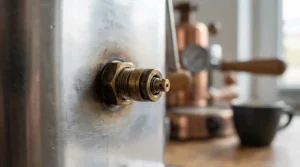
The safety valve is a small spring-loaded part on the side of the boiler that releases excess pressure. It is a critical component, so don’t obstruct or tamper with it. Never fill the boiler above it, and press the valve while rinsing to check it moves freely. If it sticks after descaling, replace the valve or the pot.
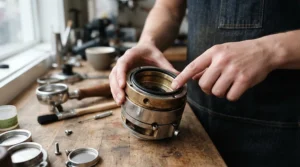
Rubber gasket replacement is the other routine job. Bialetti’s guidance for at least one model recommends replacing the gasket at least once a year, while some independent guides suggest sooner for daily brewers. Signs it’s due include steam escaping at the waist, a hardened or cracked ring, or a pot that sputters. Use a spare that matches your model and size. Sets of gaskets with a replacement strainer are sold for specific Bialetti sizes.
Handle pots with care. Homes & Gardens’ best moka pots guide notes a staff member snapped the handle of an aluminium Moka Express while trying to unscrew it. Let the pot cool before unscrewing, and don’t force it.
Long-Term Cost & Maintenance: Price Range & Value Analysis
Upfront price is only part of the story. A moka pot’s running costs are coffee, a yearly gasket and the occasional filter. With sensible care the pot itself can last for years.
| Tier | Example pick | Upfront range | Ongoing parts | Value verdict |
|---|---|---|---|---|
| Budget | ProCook Stovetop Espresso Maker 3-Cup | under £20 | Gasket yearly | Great if your hob suits it |
| Classic | Bialetti Moka Express 1-Cup | mid-£20s to low-£30s | Gasket yearly | Excellent for gas, electric or ceramic |
| Induction mid-range | Bialetti Moka Induction 2-Cup, Bialetti Venus 4-Cup | £30-£50 | Gasket yearly | Strong all-rounders |
| Premium | Alessi Pulcina Induction 3-Cup | from around £90 | Gasket yearly | Design premium, not brewing advantage |
Looking at the table, the real saving lies in picking the right hob compatibility first time. A £20 pot that doesn’t work on your induction zone is more expensive than a £40 pot that does. At typical high-street prices, even the mid-range pots pay for themselves against a few weeks of daily café espressos. The premium pick is a purchase for pleasure, not payback.
FAQ
❓ What is the best stovetop espresso maker for small flat kitchens?
❓ Where can I buy a rubber gasket replacement for my moka pot?
❓ Is stainless steel worth it in a stovetop espresso maker for induction hob cooking?
❓ Do I need a special fine grind setting for a moka pot?
❓ Is a small moka pot for one cup cheaper than café espresso?
Conclusion
The best stovetop espresso maker for small flat life is the one that fits your hob first and your cup size second. If you cook on induction and want one small coffee, the Bialetti Moka Induction 2-Cup is the safest all-rounder in this lineup. If you’re on gas, electric or ceramic and want the tiniest, cheapest classic, the Bialetti Moka Express 1-Cup is hard to beat. Stainless fans will like the Bialetti Venus 4-Cup and the La Cafetière Stainless Steel Espresso Maker 3-Cup, and design lovers can splash out on the Alessi Pulcina Induction 3-Cup. The ProCook Stovetop Espresso Maker 3-Cup remains the budget pick for non-induction hobs, while the Ilsa Carmencita Pop 2-Cup is one for colour lovers who’ve checked their hob’s minimum pan size.
Whichever you choose, look after the safety valve, plan a yearly rubber gasket replacement and treat the fine grind setting as your main flavour dial. Do that and a small moka pot for one cup will give you a ritual worth waking up for, in a kitchen too small for anything bigger.
Recommended for You
- Affordable Travel Coffee Mug: 7 Best Budget Picks UK (2026)
- Leak-Proof Travel Mug: 7 Best Picks Your Bag Can Trust (2026)
- KeepCup Vs Reusable Coffee Cup: 7 Best UK Picks Compared (2026)
Disclaimer: This article contains affiliate links. As an Amazon Associate, I earn from qualifying purchases. If you purchase products through these links, we may earn a small commission at no additional cost to you.
✨ Found this helpful? Share it with your friends! 💬🤗
