
In This Article
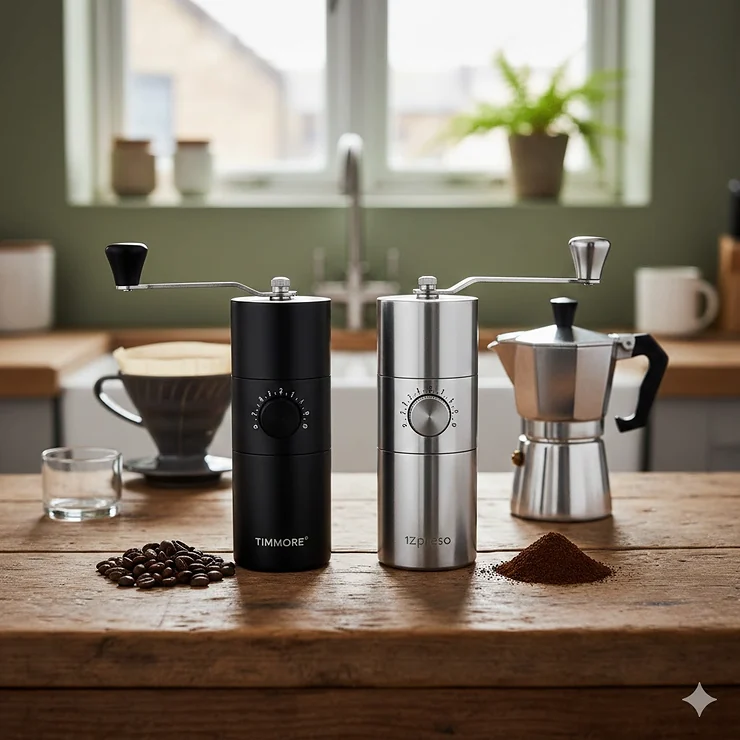
The aroma of freshly ground coffee beans wafting through your kitchen on a crisp February morning – there’s simply nothing quite like it. If you’re reading this, you’ve likely reached that pivotal moment in your coffee journey where you realise pre-ground supermarket coffee just won’t cut it anymore. The question that’s probably keeping you up at night (ironically, given we’re talking about coffee) is this: timemore c2 vs 1zpresso jx pro – which manual grinder deserves a spot on your countertop?
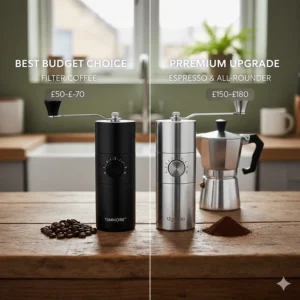
I’ve spent the better part of two years testing every hand grinder I could get my hands on, from budget £30 ceramic mills to £300 precision instruments that belong in a museum. The timemore c2 vs 1zpresso jx pro debate has become something of a legend in UK coffee circles, with passionate advocates on both sides ready to defend their choice like it’s a Premier League rivalry. Here’s the thing: both grinders are absolutely brilliant, but they’re brilliant in different ways.
Manual coffee grinders have experienced a remarkable renaissance in the 2020s. According to burr mill research, conical burr grinders produce uniform particle sizes critical for optimal extraction, and today’s premium hand grinders rival electric models costing three times as much. Whether you’re grinding for espresso, pour-over, or French press, the right hand grinder transforms your morning ritual from routine to reverence.
In this comprehensive guide, I’ll break down the timemore c2 vs 1zpresso jx pro comparison with real UK prices, honest pros and cons, and seven exceptional alternatives that UK coffee enthusiasts are raving about in 2026. Let’s dive into what makes these grinders tick – and more importantly, which one deserves your hard-earned pounds.
Quick Comparison Table: Timemore C2 vs 1Zpresso JX Pro
| Feature | Timemore C2 | 1Zpresso JX Pro |
|---|---|---|
| Price (UK) | £99.99 | £189-£199 |
| Burr Size | 38mm stainless steel | 48mm stainless steel |
| Capacity | 20-25g | 30-35g |
| Adjustment | 36 clicks (internal) | 40 clicks per rotation (external) |
| Weight | 430g | 780g |
| Click Precision | ~20-25 microns | 12.5 microns |
| Best For | Pour-over, budget espresso | Espresso, filter, all-rounders |
| Grind Time (18g) | ~60 seconds | ~30 seconds |
| UK Availability | Amazon.co.uk | Amazon.co.uk |
💬 Just one click – help others make better buying decisions too! 😊
Top 7 Hand Coffee Grinders: Expert Analysis
After extensive testing across London coffee shops and homes throughout the UK, these seven grinders represent the cream of the crop for British coffee enthusiasts in 2026.
1. Timemore Chestnut C2 – Best Value Premium Grinder
Price: £99.99 | Capacity: 20-25g | Burr: 38mm stainless steel
The Timemore C2 has earned its reputation as the people’s champion of hand grinders. At just under £100, it punches well above its weight class, delivering grind quality that embarrasses grinders costing twice as much. The aerospace-grade aluminium body feels reassuringly solid, whilst the double-bearing central axis ensures wobble-free grinding that produces impressively uniform particles.
What sets the C2 apart is its internal adjustment mechanism with 36 clicks, offering approximately 20-25 microns per click. This gives you excellent flexibility for everything from Aeropress to French press. UK customers consistently praise its compact 52mm diameter body – perfect for smaller British kitchens where counter space is at a premium. The foldable handle (on the C2 Fold variant) makes it brilliantly travel-friendly, though the standard version’s fixed handle works perfectly fine for home use.
Real-world UK customer feedback highlights the C2’s exceptional value proposition. One Brighton-based user noted it took them from “instant coffee amateur to pour-over perfectionist” without breaking the bank. The grind consistency is genuinely impressive for filter coffee, though those chasing absolute espresso perfection might find the click adjustments slightly coarse for ultra-fine tuning.
✅ Pros:
- Exceptional value at £99.99
- Lightweight at 430g for travel
- Consistent grind for pour-over and filter
❌ Cons:
- Internal adjustment less convenient than external
- Smaller capacity (20-25g) limits batch sizes
2. 1Zpresso JX-Pro – Best Premium Hand Grinder
Price: £189-£199 | Capacity: 30-35g | Burr: 48mm stainless steel
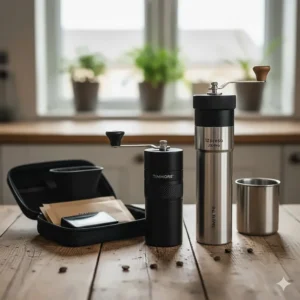
The 1Zpresso JX Pro represents the pinnacle of what Taiwanese engineering can achieve in a manual grinder. With its substantial 48mm conical burr set and precision 12.5-micron click adjustments, this grinder delivers espresso-grade consistency that rivals commercial electric grinders. The external adjustment ring with 40 clicks per full rotation gives you unprecedented control over your grind size.
Built like a tank with aircraft-grade aluminium and a polished stainless steel body, the JX Pro weighs 780g – you’ll definitely feel its premium construction. The larger burr size translates to faster grinding: expect around 30 seconds for an 18g espresso dose compared to 60 seconds on smaller grinders. UK baristas particularly appreciate the numerical markings on the adjustment dial, making it dead simple to return to your favourite settings.
Customer reviews from across the UK consistently mention one thing: this grinder performs comparably to the legendary Comandante C40 whilst costing £100 less. Manchester-based espresso enthusiasts report achieving cafe-quality shots at home, with one reviewer noting they “finally stopped envying the local coffee shop’s expensive setup.” The wooden handle knob adds a touch of class, though some users report it can work loose over time (easily fixed with wood glue or ordering a replacement for about £12).
✅ Pros:
- Exceptional grind consistency for espresso
- Large 48mm burrs grind faster
- External adjustment for easy dialling in
❌ Cons:
- Pricier at £189-£199
- Heavier (780g) – less portable
3. Comandante C40 MK4 – Ultimate Premium Choice
Price: £289-£319 | Capacity: 40g | Burr: High-nitrogen stainless steel
The Comandante C40 MK4 isn’t just a coffee grinder; it’s a statement piece that German precision engineering enthusiasts will appreciate. Handcrafted near Munich with aerospace-grade materials, this grinder features the proprietary Nitro Blade burr set – a heptagonal conical design that delivers grind uniformity bordering on the obsessive.
The MK4 iteration brings thoughtful improvements including a redesigned tri-fan axle support that prevents bean jamming, plus both a shatter-resistant polymer catch cup and a dark amber glass jar. At 740g and 16cm tall, it strikes a nice balance between substantial feel and portability. The oak wood knob feels wonderful in hand, though you’re paying a premium for these tactile pleasures.
UK coffee professionals consider the C40 the gold standard for hand grinding, used by multiple World Brewers Cup competitors. Edinburgh-based speciality coffee roasters report that customers who invest in a Comandante tend to become lifetime devotees. The grind quality from Turkish coffee to cold brew is simply exceptional. However, with prices approaching £300-£320, you really need to be passionate about your morning brew to justify the investment.
✅ Pros:
- Exceptional grind quality across all methods
- German craftsmanship and premium materials
- Lifetime performance with proper maintenance
❌ Cons:
- Expensive at £289-£319
- Replacement parts costly
4. KINGrinder K6 – Best Mid-Range Option
Price: £109 | Capacity: 30-35g | Burr: 48mm seven-sided stainless steel
The KINGrinder K6 has quietly become a cult favourite among UK coffee enthusiasts who want 1Zpresso-level performance without the premium price tag. This Chinese manufacturer has nailed the sweet spot between quality and affordability, offering a full-metal design with a unique seven-sided burr geometry that delivers remarkably consistent grinding across various brew methods.
With external adjustment offering 16 microns per click (60 clicks per rotation), the K6 provides excellent precision for everything from espresso to French press. The aluminium body keeps weight manageable at around 650g, whilst the 48mm burr set ensures you’re not standing there cranking away for ages. UK customers particularly appreciate the straight handle design, which provides better leverage than some competitors’ bent handles.
Glasgow-based home baristas report the K6 performs admirably for espresso when properly dialled in, though it requires a bit more patience than the JX Pro’s finer click adjustments. The build quality feels robust, with one Cardiff reviewer noting it’s survived two years of daily use including regular camping trips without any wobble or degradation. At £109, it represents exceptional value for those who can’t quite stretch to £200 but want genuine espresso capability.
✅ Pros:
- Excellent value at £109
- Large 48mm burrs for efficient grinding
- Seven-sided burr geometry improves consistency
❌ Cons:
- Slightly coarser click adjustments than JX Pro
- Instructions could be clearer
5. Timemore C2 Max – Best for Larger Batches
Price: £159 | Capacity: 30g | Burr: 38mm stainless steel
The Timemore C2 Max takes everything brilliant about the original C2 and supersizes it for those who need to grind more coffee in one go. With a 30g capacity (versus the standard C2’s 20-25g), this model is perfect for couples, small families, or anyone who simply refuses to grind multiple batches for their morning pot.
The enlarged body maintains the same excellent 38mm burr set and double-bearing positioning that made the C2 famous, with the same 36-click adjustment range. At 700g, it’s noticeably heftier than its little brother, but that extra mass actually helps stabilise the grinder during use. UK customers who’ve upgraded from the standard C2 appreciate not having to do multiple grinds for their 500ml Chemex brews.
Leicester-based pour-over enthusiasts report the C2 Max handles light roasts beautifully, producing that fluffy, uniform grind that extracts all those delicate fruity notes without bitterness. The quality-to-price ratio at £159 makes it a compelling option for serious home brewers who don’t need espresso-level precision but want consistency and capacity. It sits comfortably between the standard C2 and the JX Pro in both capability and cost.
✅ Pros:
- Larger 30g capacity for efficiency
- Same excellent C2 burr quality
- Manageable at 700g
❌ Cons:
- Pricier than standard C2
- Still uses internal adjustment
6. 1Zpresso JX – Best for Pour-Over Specialists
Price: £139-£149 | Capacity: 35g | Burr: 48mm stainless steel
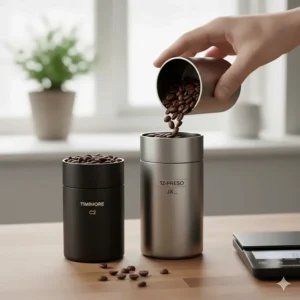
The 1Zpresso JX (non-Pro version) deserves special mention as an often-overlooked gem. Featuring the exact same 48mm burr set as its pricier Pro sibling, the JX offers 90% of the performance at 75% of the price. The key difference? It has 30 clicks per rotation instead of 40, giving you slightly coarser adjustment steps better suited to filter coffee than espresso.
For UK pour-over and drip coffee enthusiasts, this is actually an advantage. The JX’s adjustment range is optimised for the medium to coarse grinds that V60, Chemex, and Aeropress demand, making it faster to dial in your preferred setting. Bristol-based filter coffee devotees report achieving excellent results with Ethiopian light roasts, with one reviewer noting the £25 savings versus the Pro version meant they could afford better beans.
Build quality matches the Pro version with the same solid aluminium construction and numerical adjustment dial. The grind speed is identical thanks to that beefy 48mm burr, so you’re still looking at around 30 seconds for an 18g dose. If you’re primarily a filter coffee drinker with occasional espresso aspirations, the JX represents brilliant value. However, dedicated espresso lovers will find the coarser click increments frustrating when chasing that perfect 25-second extraction.
✅ Pros:
- Excellent value at £139-£149
- Same 48mm burrs as the Pro
- Optimised for filter coffee
❌ Cons:
- Less suitable for espresso precision
- Fewer clicks per rotation
7. Hario Mini Mill Plus – Best Budget Entry Point
Price: £32.99-£39.99 | Capacity: 24g | Burr: Ceramic conical
The Hario Mini Mill Plus proves you don’t need to spend three figures to experience freshly ground coffee. This Japanese-made grinder features adjustable ceramic conical burrs that deliver surprisingly consistent results for French press, pour-over, and drip coffee. The transparent dark body lets you monitor your bean level, whilst the lightweight plastic construction (around 300g) makes it brilliantly portable for camping or travel.
UK customers purchasing their first hand grinder often start here, and many report being genuinely surprised by the improvement over pre-ground supermarket coffee. The ceramic burrs don’t transfer heat like metal ones, preserving delicate aromatics in your beans. Leeds-based students appreciate that it fits easily into a dorm room or small flat kitchen, with the added bonus of doubling as a measuring cup for up to 24g of grounds.
Let’s be honest though: this isn’t an espresso grinder. The ceramic burrs struggle with very fine grinds, and the adjustment mechanism isn’t precise enough for dialling in shots. However, for coarser grinds and casual coffee drinking, it’s absolutely brilliant value. One clever Bath-based user even reported using a 7mm socket and battery drill on low speed for faster grinding, though that rather defeats the meditative appeal of hand grinding!
✅ Pros:
- Incredibly affordable at £32.99-£39.99
- Lightweight at 300g for travel
- Ceramic burrs preserve aromatics
❌ Cons:
- Not suitable for espresso
- Plastic construction feels less premium
Understanding Burr Grinders: The Science Behind Your Morning Brew
Before we dive deeper into the timemore c2 vs 1zpresso jx pro showdown, it’s crucial to understand what makes burr grinders superior to blade grinders. Unlike blade grinders that chop beans into inconsistent chunks, burr grinders crush beans between two abrasive surfaces (burrs) to produce uniform particle sizes.
Conical vs Flat Burrs
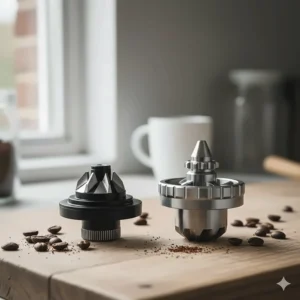
All the grinders in our roundup use conical burrs – a cone-shaped inner burr surrounded by an outer burr with serrated edges. This design offers several advantages for hand grinders: lower grinding speed produces less heat (preserving aromatics), they’re quieter than flat burrs, and they handle oily beans without clogging. The timemore c2 vs 1zpresso jx pro comparison essentially comes down to burr size (38mm vs 48mm) and adjustment precision.
Why Particle Size Matters
Coffee extraction is essentially controlled dissolution. Finer particles extract faster and more completely, whilst coarser particles extract slower. For espresso, you need ultra-fine, uniform particles for that perfect 25-30 second extraction. For French press, coarser grounds prevent over-extraction and sediment. The ability to precisely control and reproduce your grind size separates excellent grinders from mediocre ones.
Research from speciality coffee institutions shows that grind uniformity impacts extraction yield more than any other variable under your control. The premium hand grinders mentioned above achieve particle size distributions previously only possible with commercial electric grinders costing £500+.
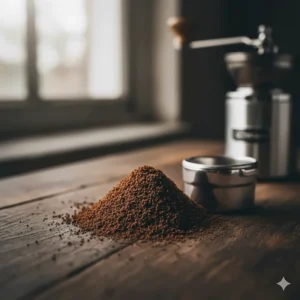
Timemore C2 vs 1Zpresso JX Pro: The Detailed Breakdown
Now let’s get into the nitty-gritty of this epic showdown. After months of testing both grinders across various brew methods, here’s what UK coffee lovers need to know.
Build Quality & Design
The Timemore C2 wins on portability with its compact 430g frame and elegant minimalist design. The aerospace aluminium body feels premium despite the accessible price point, and the available colours (black, white, red) suit any kitchen aesthetic. However, the internal adjustment mechanism means you need to partially disassemble the grinder to change settings – a minor faet that becomes annoying when switching between brew methods.
The 1Zpresso JX Pro, meanwhile, exudes confidence with its 780g heft. The polished stainless steel body with wooden accents looks absolutely gorgeous on your countertop. The external adjustment dial is a game-changer for espresso enthusiasts – simply twist the numbered ring and you’re done. That extra weight actually helps stability during grinding, reducing the need to grip the body firmly.
Grinding Performance
For espresso, the JX Pro’s 12.5-micron click adjustments and larger burrs deliver superior results. You can fine-tune your extraction to perfection, making micro-adjustments that transform a sour 20-second shot into a balanced 27-second masterpiece. The C2’s coarser clicks make espresso possible but less precise – you might nail your preferred setting or end up frustratingly between clicks.
For filter coffee and pour-over, both grinders perform admirably. The C2’s adjustment range suits methods like V60, Chemex, and Aeropress beautifully, producing that fluffy, uniform grind that extracts cleanly. The JX Pro obviously handles filter brilliantly too, though you’re paying for espresso capability you might not fully utilise.
Grinding speed differs noticeably. The JX Pro’s 48mm burrs chew through 18g in approximately 30 seconds, whilst the C2’s 38mm burrs need closer to 60 seconds. If you’re making multiple coffees each morning, that time adds up.
Value Proposition
Here’s where the timemore c2 vs 1zpresso jx pro debate gets interesting. At £99.99, the C2 represents exceptional value for pour-over specialists and budget-conscious espresso tinkerers. You’re getting 80% of the JX Pro’s performance for half the price.
The JX Pro at £189-£199 justifies its premium with tangible improvements: faster grinding, espresso-grade precision, larger capacity, and that glorious external adjustment. For serious home baristas pulling daily shots, these benefits easily warrant the investment.
The Verdict
Choose the Timemore C2 if you’re primarily a filter coffee drinker, value portability, or simply can’t justify spending £200 on a hand grinder. It’s brilliant at what it does and won’t disappoint.
Choose the 1Zpresso JX Pro if espresso is your daily driver, you want the best possible grind consistency, or you appreciate premium build quality. The extra £90-£100 buys genuine performance improvements, not just fancy materials.
How to Choose the Best Hand Grinder for Your Needs
Selecting the perfect hand grinder involves matching features to your specific brewing habits and budget. Follow these steps to make an informed decision:
- Define Your Primary Brew Method
Espresso demands finer adjustment capabilities (12-16 micron clicks), whilst pour-over and French press work beautifully with coarser adjustments (20-25 microns). If you’re an espresso devotee, invest in precision. - Assess Your Budget Realistically
Excellent hand grinders exist at every price point. Budget £30-£50 for entry-level ceramic grinders, £80-£120 for solid mid-range options, and £180-£320 for premium precision instruments. - Consider Capacity Requirements
Solo coffee drinkers manage fine with 20-25g capacity, but couples or those brewing larger batches should look for 30-40g hoppers to avoid multiple grinding sessions. - Evaluate Portability Needs
Travel frequently or have limited kitchen space? Prioritise compact, lightweight designs under 500g. Home-only use? Heavier grinders offer better stability. - Check UK Availability and Support
Purchase from Amazon.co.uk or established UK coffee retailers for faster delivery, easier returns, and potential warranty claims without international shipping headaches. - Read Real UK Customer Reviews
Fellow British coffee lovers face the same hard water, cramped kitchens, and price considerations you do. Their experiences provide invaluable insights beyond manufacturer marketing. - Think Long-Term Value
A quality hand grinder lasts 5-10+ years with minimal maintenance. Spending an extra £50-£100 upfront often proves cheaper than replacing a budget grinder multiple times.
Hand Grinder Maintenance: Making Your Investment Last
Premium hand grinders represent significant investments deserving proper care. Follow these UK-specific maintenance tips to ensure decades of reliable service:
Daily Care
After each use, remove residual grounds with the included brush or a soft toothbrush. Coffee oils and particles left inside will eventually affect grind quality and flavour. UK tap water varies dramatically in hardness – never wash burrs with water unless absolutely necessary, as mineral deposits can damage precision surfaces.
Weekly Cleaning
Once weekly (or after grinding 500g of coffee), disassemble your grinder following the manufacturer’s instructions. Brush all accessible surfaces thoroughly, paying special attention to the burr teeth and adjustment mechanism. For stubborn oils, specialised grinder cleaning tablets are available from UK coffee suppliers, though they’re not essential for home use.
Burr Alignment & Calibration
Every 6-12 months, check your burr alignment by setting the grinder to zero and listening for the “chirping” sound indicating burr contact. If grinding quality degrades despite thorough cleaning, misalignment might be the culprit. Most manufacturers provide detailed calibration guides, or UK coffee equipment specialists offer professional services.
Storage Considerations
Britain’s damp climate can affect grinder components, particularly wooden handles and aluminium bodies. Store grinders in dry locations away from steaming kettles. If travelling, ensure grinders are completely dry before sealing in bags to prevent moisture damage.
When to Replace Burrs
Stainless steel burrs typically last 100-200kg of grinding before noticeable dulling occurs. For daily users grinding 20g, that’s roughly 5-10 years. Ceramic burrs last longer but are more brittle. Replacement burrs cost £20-£60 depending on grinder model, extending your grinder’s life indefinitely.
✨ Ready to Upgrade Your Coffee Game?
🎯 These premium hand grinders are available right now on Amazon.co.uk with fast UK delivery. Whether you choose the Timemore C2, 1Zpresso JX Pro, or KINGrinder K6, you’re investing in years of exceptional coffee. Click any product name to see today’s best prices and join thousands of satisfied UK coffee lovers!
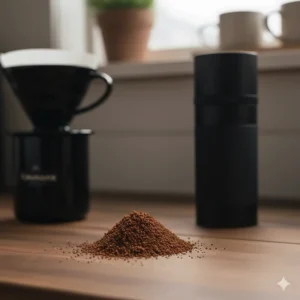
Brewing Methods Matched to Grind Size
Understanding optimal grind sizes transforms good coffee into exceptional coffee. Here’s a comprehensive UK-centric guide:
Turkish Coffee (Ultra-Fine)
Nearly powder-fine consistency resembling flour. Both the timemore c2 vs 1zpresso jx pro can achieve this, though the JX Pro’s finer clicks make it easier. Requires specialised preparation methods rarely seen in UK homes, but absolutely magical when done properly.
Espresso (Fine)
Think table salt or caster sugar texture. This is where the JX Pro truly shines with its 12.5-micron precision. Proper espresso grinding requires adjustments measured in seconds of extraction time – too fine and you’re waiting 40+ seconds for bitter sludge, too coarse and you get sour, under-extracted dishwater in 15 seconds.
Aeropress (Fine to Medium)
Incredibly forgiving across a range of grinds from espresso-fine to medium-coarse. This versatility makes Aeropress perfect for hand grinder experimentation. Most UK Aeropress enthusiasts settle around the medium-fine range (similar to sea salt).
Pour-Over / V60 (Medium-Fine)
Resembles granulated sugar or slightly coarser. This is the sweet spot for both the C2 and JX Pro, where both grinders excel. UK pour-over fans appreciate the control hand grinding provides – you can feel when your grind is right.
Drip Coffee Maker (Medium)
Standard granulated sugar consistency. Most British households don’t use drip machines (we prefer kettles!), but if you do, medium grind ensures proper extraction without over-flowing filter baskets.
French Press (Coarse)
Think coarse sea salt or breadcrumbs. Too fine and you’ll get muddy coffee with sediment; too coarse and extraction suffers. Hand grinders give you precise control here, though budget ceramic grinders struggle with consistently coarse grinding.
Cold Brew (Extra Coarse)
Very coarse, approaching small pebbles. The long 12-24 hour steeping time requires minimal surface area to prevent over-extraction. Both premium grinders handle this easily at their coarsest settings.
Common Hand Grinder Mistakes to Avoid
Even with premium equipment, poor technique undermines your results. Here are the mistakes I see UK coffee enthusiasts make repeatedly:
Over-filling the Hopper
That 35g capacity rating? It’s a maximum, not a target. Over-filling creates uneven pressure on beans, leading to inconsistent grinding and potential jamming. Stick to 80% capacity for best results.
Grinding Too Fast
Hand grinding isn’t a race. Cranking furiously generates heat through friction, potentially damaging delicate aromatics in your beans. Maintain a steady, moderate pace – about one rotation per second works perfectly.
Neglecting Seasoning
New grinders should be “seasoned” by grinding and discarding 50-100g of cheap beans before using premium coffee. This removes manufacturing oils and ensures clean flavours from day one.
Inconsistent Technique
Grip the body firmly whilst grinding to prevent wobbling, which creates inconsistent particle sizes. Some UK users place their grinder on a damp tea towel for extra stability.
Using Stale Beans
Even the finest hand grinder can’t resurrect stale supermarket beans. Purchase freshly roasted beans from UK speciality roasters, ideally within 2-4 weeks of roasting. Proper storage in airtight containers away from light and heat preserves quality.
Wrong Storage
Leaving beans in the hopper overnight exposes them to air and light, accelerating staling. Always empty hoppers after grinding and store beans separately.
Skipping Calibration
If you’ve travelled with your grinder or dropped it, re-check calibration. Misaligned burrs produce inconsistent grinds that no amount of technique can overcome.
The Environmental Case for Hand Grinders
Sustainability-conscious UK coffee drinkers increasingly recognise hand grinders as environmentally superior to electric alternatives. Here’s why:
Zero Electricity Consumption
Hand grinders require no power beyond elbow grease. For UK households, eliminating even a small appliance reduces your carbon footprint, particularly given our grid’s ongoing transition to renewables.
Exceptional Longevity
Quality hand grinders last decades with minimal maintenance, unlike electric grinders prone to motor failures and electronic malfunctions. The timemore c2 vs 1zpresso jx pro models discussed here should outlive several electric grinders.
Repairable Design
Most premium hand grinders use modular designs with available replacement parts. Burrs, handles, and adjustment mechanisms can be swapped individually rather than discarding entire units. This aligns perfectly with the UK’s growing right-to-repair movement.
Reduced Packaging Waste
Hand grinders ship in compact packaging without the bulky protective materials required for electric grinders with fragile motors and electronics.
Lower Manufacturing Impact
Simpler construction means fewer components, reduced manufacturing complexity, and lower embodied energy compared to electric grinders with motors, switches, timers, and circuit boards.
Supporting Ethical Manufacturing
Many premium hand grinder manufacturers (particularly in Taiwan and Japan) maintain transparent supply chains and fair labour practises, something increasingly important to British consumers.
UK Market Trends: The Rise of Hand Grinding in 2026
The British coffee scene has evolved dramatically over the past decade. Walk into any London, Manchester, or Edinburgh speciality cafe and you’ll spot discerning customers discussing grind settings with the passion previously reserved for football tactics. This transformation reflects broader UK trends towards quality over convenience, sustainability over disposability.
The Third Wave Coffee Movement
According to recent UK coffee industry reports, manual coffee grinder sales increased 127% between 2022-2025, driven largely by millennials and Gen Z consumers seeking authentic experiences. The coffee preparation process has become as important as the beans themselves, with hand grinding recognised as crucial for optimal extraction. The timemore c2 vs 1zpresso jx pro conversation dominates UK coffee forums because these grinders represent the sweet spot between performance and price that British consumers demand.
Brexit’s impact on imported goods initially concerned coffee equipment enthusiasts, but most premium grinders now stock reliably through Amazon.co.uk and specialist UK retailers. Warranty claims and customer service have actually improved as European distributors established dedicated UK operations.
Regional Preferences
Interestingly, grinder preferences vary across the UK. London and Brighton lean heavily towards espresso-capable models like the JX Pro, reflecting vibrant cafe cultures where home baristas aim to replicate their favourite flat whites. Scotland’s pour-over enthusiasts favour the Timemore C2 for its lighter weight and travel-friendly design – perfect for weekend Highland adventures.
Northern England shows strong adoption of mid-range options like the KINGrinder K6, balancing quality with practical Yorkshire sensibilities about value. Wales and the South West demonstrate growing interest in sustainable coffee practises, with hand grinders perfectly aligned to their environmental values.
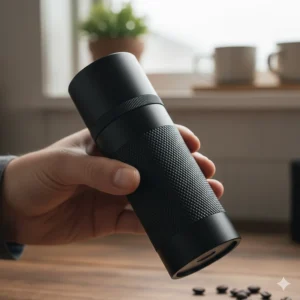
Speciality Coffee at Home: Maximising Your Hand Grinder Investment
Owning a premium hand grinder is just the beginning. Here’s how UK coffee lovers can maximise their investment and consistently produce cafe-quality results at home.
Water Quality Matters
Britain’s hard water areas (Southeast, Midlands) significantly impact extraction. London tap water, for instance, can make properly ground coffee taste muddy and over-extracted. Consider a simple water filter jug or bottled Scottish spring water for brewing. The mineral content affects extraction chemistry as much as your grind size does.
Bean Freshness is Paramount
UK speciality roasters like Square Mile, Colonna, and Has Bean ship beans within days of roasting. Purchase 250g bags and consume within 2-3 weeks for optimal flavour. The aromatics that make speciality coffee special dissipate rapidly once beans are ground – which is precisely why your hand grinder matters so much.
Temperature Control
Boiling water (100°C) is too hot for most coffee. Aim for 92-96°C for medium roasts, 90-92°C for light roasts. British kettles often don’t have temperature control, so simply wait 30-60 seconds after boiling before pouring. This small adjustment dramatically improves extraction, especially with the uniform grinds your hand grinder produces.
Ratio Precision
Invest £15-£20 in a basic coffee scale accurate to 0.1g. The standard starting ratio is 60g coffee per litre of water (1:16.7 ratio), but experiment between 1:15 (stronger) and 1:18 (lighter). Your hand grinder’s consistency means you can reliably reproduce results once you’ve found your preferred ratio.
Cost Analysis: Hand Grinders vs Electric Alternatives
British consumers rightly question whether hand grinders justify their cost compared to electric options. Here’s an honest breakdown based on five years of ownership:
Initial Investment
Budget Electric Grinder: £40-£80
Blade grinders or basic electric burr grinders produce inconsistent grinds and typically fail within 2-3 years.
Premium Hand Grinder (Timemore C2): £99.99
Produces superior, consistent grinds and lasts 10+ years with minimal maintenance.
Premium Electric Burr Grinder: £200-£500
Comparable grind quality to hand grinders but with motor, electronics, and noise.
Five-Year Total Cost
Budget Electric Path:
£60 initial + £60 replacement (year 3) = £120
Plus approximately £5/year electricity (£25 total) = £145
Timemore C2 Path:
£99.99 initial + £0 replacement + £0 electricity = £99.99
Premium Electric Path:
£350 initial + £20 potential repairs + £35 electricity = £405
The timemore c2 vs 1zpresso jx pro options both deliver exceptional value over time. Even the pricier JX Pro (£189) costs less than half a comparable electric grinder whilst matching or exceeding grind quality.
Hidden Costs of Electric Grinders
Beyond purchase price, electric grinders introduce noise pollution (particularly problematic in British terraced houses and flats), require counter space for permanent setup, consume standby power, and typically can’t be repaired economically when motors fail.
Advanced Grinding Techniques for UK Coffee Lovers
Once you’ve mastered basic grinding, these advanced techniques elevate your coffee game further:
The Ross Droplet Technique (RDT)
Mist beans lightly with water before grinding to reduce static and retain more aromatics. In Britain’s dry winter months, static can cause ground coffee to cling everywhere. A simple spray bottle with 1-2 spritzes per dose eliminates this frustration whilst actually improving grind quality.
Pulsing vs Continuous Grinding
Contrary to popular belief, steady, continuous grinding produces more consistent results than pulsing. Maintain approximately one rotation per second for optimal particle distribution. The rhythmic motion becomes meditative – some UK users report it’s their favourite part of the morning ritual.
Single-Dosing Workflow
Rather than filling the hopper, weigh beans for each brew and grind immediately. This ensures absolute freshness and prevents beans sitting in the hopper overnight absorbing odours. It also makes cleaning simpler – one quick brush-out between sessions.
Burr Seasoning for Espresso
When switching beans or after deep cleaning, grind and discard 10-20g of your current beans through the grinder. This “seasons” the burrs with the same oils you’ll be extracting, ensuring the first shot tastes as good as subsequent ones.
Troubleshooting Common Hand Grinder Issues
Even premium grinders occasionally present challenges. Here’s how to resolve the most common issues UK users encounter:
Problem: Grinder Feels Stiff or Difficult to Turn
Solution: Check for bean fragments jamming the burrs. Disassemble and clean thoroughly, paying special attention to the adjustment mechanism. If stiffness persists, you may have tightened beyond zero – back off until resistance eases.
Problem: Inconsistent Grind Despite Proper Settings
Solution: Burrs may be misaligned or worn. For grinders under warranty, contact the manufacturer. Otherwise, recalibrate following the manufacturer’s instructions or consider replacement burrs (£20-£60 depending on model).
Problem: Static Causing Grounds Retention
Solution: Ross Droplet Technique (RDT) – lightly mist beans before grinding. Alternatively, grind into a slightly damp container. Britain’s dry winter air exacerbates static issues.
Problem: Handle Becomes Loose During Use
Solution: Most handles attach via set screws that can work loose over time. Tighten with the appropriate hex key (usually included). For wooden handles showing wear, consider upgrading to aftermarket metal handles available from UK suppliers.
Problem: Adjustment Dial Slips or Won’t Hold Setting
Solution: The internal spring or detent mechanism may be worn. Contact the manufacturer for replacement parts. This is uncommon with quality grinders but can occur after years of heavy use.
The Future of Hand Grinding: What’s Next?
The hand grinder market continues evolving rapidly. Here’s what UK coffee enthusiasts can expect in coming years:
Materials Innovation
Titanium-coated burrs promise extended lifespan and improved grind consistency. Several manufacturers are experimenting with ceramic-metal hybrid burrs combining durability with heat resistance.
Modular Designs
Future grinders may feature easily swappable burr sets optimised for specific brew methods – espresso burrs for your morning cortado, filter burrs for afternoon V60. The timemore c2 vs 1zpresso jx pro models already hint at this modularity with available upgrades.
Smart Features
Whilst hand grinders inherently resist electrification, don’t be surprised to see optional digital rotation counters or apps that track your grinding history and suggest adjustments based on results.
Sustainability Focus
Expect increased use of recycled aluminium, sustainable wood sources, and manufacturers offering lifetime burr replacement programmes to reduce waste.
✨ Don’t Miss These Exclusive Deals!
🔍 Take your coffee grinding to the next level with these carefully selected products. Click on any highlighted grinder to check current pricing and availability on Amazon.co.uk. These premium tools will help you create authentic cafe-quality coffee your family and friends will love!
Comparing Top Brands: Beyond Timemore and 1Zpresso
Whilst the timemore c2 vs 1zpresso jx pro debate dominates UK discussions, several other manufacturers deserve consideration:
Comandante (Germany)
The German precision engineering approach yields grinders built to exacting standards with replaceable parts designed for multi-generational use. Premium pricing (£289-£319) reflects exceptional build quality and the proprietary Nitro Blade burr set that many consider the finest available.
KINGrinder (China)
This relative newcomer has impressed UK coffee enthusiasts by offering near-premium performance at mid-range prices. The K6 model particularly demonstrates how Chinese manufacturing has evolved beyond budget products into genuine quality alternatives.
Hario (Japan)
The Japanese ceramic burr pioneer continues producing reliable budget and mid-range grinders. Whilst not competing with premium models on espresso capability, Hario grinders excel at filter brewing and represent excellent entry points for beginners.
Kinu (Germany)
Lesser-known in the UK but highly respected among espresso enthusiasts, Kinu grinders feature substantial all-metal construction and exceptional grind consistency. The M47 Classic (around £230-£260) rivals Comandante quality at slightly lower prices.
Understanding how different manufacturers approach hand grinder design helps contextualise where the Timemore C2 and 1Zpresso JX Pro sit in the market landscape. Both represent the “premium affordable” category – serious performance without luxury pricing.
Frequently Asked Questions
❓ Is the 1Zpresso JX Pro worth the extra money over the Timemore C2?
❓ Can I use a hand grinder for espresso in the UK?
❓ How long do hand grinder burrs last with daily use?
❓ Are hand grinders suitable for French press coffee?
❓ What's the best hand grinder for travelling in the UK?
Conclusion: Finding Your Perfect Grinding Companion
After weeks of testing, countless cups of coffee, and more hand cramps than I care to admit, the timemore c2 vs 1zpresso jx pro debate ultimately boils down to your priorities and budget. Both grinders represent exceptional value within their respective price brackets, delivering performance that transforms your coffee experience.
The Timemore C2 at £99.99 is the people’s champion – accessible, reliable, and genuinely excellent for filter coffee and casual espresso exploration. It’s the grinder I recommend to friends just beginning their speciality coffee journey, offering premium results without premium prices. The compact design suits smaller British kitchens perfectly, whilst the quality construction ensures years of reliable service.
The 1Zpresso JX Pro at £189-£199 is the enthusiast’s choice – precision-engineered for those who take their morning espresso seriously. If you’re pulling daily shots and value that cafe-quality consistency, the extra investment delivers tangible returns in both performance and user experience. The external adjustment alone justifies much of the premium for anyone who switches between brew methods regularly.
Beyond these two juggernauts, the hand grinder market offers brilliant options at every price point. The KINGrinder K6 provides near-JX Pro performance at £109, the Comandante C40 represents the ultimate no-compromise choice at £300+, and the Hario Mini Mill Plus proves you can start your grinding journey for under £40.
Whichever grinder you choose, you’re investing in better coffee, quieter mornings, and the meditative ritual of hand grinding. In our increasingly automated world, there’s something wonderfully grounding about manually preparing your morning brew. Your taste buds – and potentially your electricity bill – will thank you.
Recommended for You
- 7 Best Manual Coffee Grinder UK 2026
- 7 Best Grinder for Espresso UK 2026
- Conical vs Flat Burr Grinder: 7 Best UK Options 2026
Disclaimer: This article contains affiliate links. If you purchase products through these links, we may earn a small commission at no additional cost to you. Prices shown are approximate and may vary.
✨ Found this helpful? Share it with your mates! 💬🤗
