
In This Article
There’s something magical about that first sip of freshly ground coffee in the morning, isn’t there? The aroma alone is enough to kickstart your day. But here’s the thing – pre-ground coffee simply can’t compete with beans ground moments before brewing. The difference is like comparing a supermarket tomato to one plucked fresh from your garden.
I’ve tested dozens of electric coffee grinders over the years, from posh £300 models to basic blade grinders, and I can tell you this: you don’t need to spend a fortune to dramatically improve your coffee game. The best electric coffee grinder under £50 uk can genuinely transform your daily ritual without emptying your wallet.
According to Specialty Coffee Association research, coffee begins losing its flavour compounds within 15 minutes of grinding. That expensive bag of single-origin beans you’ve splurged on? It’s being wasted if you’re buying it pre-ground. A decent cheap electric grinder preserves those volatile aromatics that make your coffee sing.
Whether you’re a French press devotee, an espresso enthusiast on a budget, or simply want to level up your morning filter coffee, this guide will help you find the perfect budget coffee grinder electric for your needs. I’ve scoured Amazon.co.uk, tested actual products, and gathered real customer feedback from UK buyers to bring you this comprehensive review.
Quick Comparison Table
| Grinder Model | Type | Motor Power | Capacity | Noise Level | Price Range |
|---|---|---|---|---|---|
| KRUPS F2034238 | Blade | 200W | 75g | Medium | £25-£32 |
| KYG Electric Grinder | Blade | 300W | 70g | 45 dB (Low) | £20-£28 |
| Andrew James AJ001318 | Blade | 150W | 70g | Medium | £18-£25 |
| SHARDOR Electric | Blade | 200W | 75g | 60 dB (Low) | £22-£30 |
| VonShef Coffee Grinder | Blade | 150W | 60g | Medium | £16-£23 |
| Duronic CG421 | Blade | 200W | 75g | Medium-High | £24-£32 |
| Bosch MKM6003NGB | Blade | 180W | 75g | Medium | £28-£35 |
💬 Just one click – help others make better buying decisions too! 😊
Top 7 Best Electric Coffee Grinder Under £50 UK: Expert Analysis
1. KRUPS F2034238 Coffee Mill – Best Overall Value
The KRUPS F2034238 stands head and shoulders above its budget competition, offering exceptional build quality and surprisingly consistent results for a blade grinder. This German-engineered beauty punches well above its £25-£32 price point.
Key Specifications:
- 200W powerful motor with quiet operation
- 75g capacity (sufficient for up to 12 cups)
- Stainless steel blade system
- One-touch pulse operation
UK customers consistently praise the KRUPS for its reliability and consistent grind quality. One verified Amazon.co.uk buyer noted, “After trying three cheaper models, this is the only one that’s lasted beyond six months of daily use.”
✅ Pros:
- Exceptionally quiet for a blade grinder
- Robust German engineering
- Large capacity for entertaining
❌ Cons:
- No grind size selector (timing-based only)
- Not suitable for very fine espresso grinds
Price: £25-£32 | Rating: 4.3/5 stars (3,200+ UK reviews)
2. KYG Electric Coffee Grinder 300W – Best for Quiet Operation
If you live in a flat with thin walls or simply despise noisy appliances, the KYG Electric Coffee Grinder is your salvation. Operating at just 45 decibels, it’s quieter than normal conversation.
Key Specifications:
- 300W copper motor for efficient grinding
- 70g capacity with safety lock mechanism
- 304 stainless steel blades and bowl
- 6.0mm blade height for uniform grinding
The KYG employs clever engineering to reduce noise whilst maintaining grinding efficiency. The safety lock feature prevents operation unless the lid is properly secured – essential for busy morning routines when you’re still half-asleep.
UK buyers appreciate its compact design. “Perfect for my tiny London kitchen,” one reviewer commented. “Fits in my cupboard alongside my mugs and doesn’t wake my flatmates.”
✅ Pros:
- Remarkably quiet (45 dB)
- Removable bowl for easy cleaning
- Safety lock prevents accidents
❌ Cons:
- Not suitable for very hard spices without pre-breaking
- Motor can warm with extended use
Price: £20-£28 | Rating: 4.4/5 stars (2,800+ UK reviews)
3. Andrew James AJ001318 Electric Grinder – Best Budget Option
The Andrew James Electric Coffee Grinder proves that you don’t need to spend a fortune for freshly ground beans. At under £25, this UK brand offers excellent value for money without compromising on essentials.
Key Specifications:
- 150W motor with transparent lid
- 70g stainless steel grinding bowl
- Compact design (18cm height)
- Available in black or red
Andrew James has been serving UK households since 2005, and their grinder reflects decades of understanding British kitchens. The transparent lid lets you monitor grind consistency without stopping – genuinely useful when you’re learning your preferences.
Real UK customers report impressive longevity. “Had mine for 18 months of daily use and it’s still going strong,” noted a Sheffield-based reviewer.
✅ Pros:
- Most affordable quality option
- Transparent lid for monitoring
- Compact storage with cord management
❌ Cons:
- Lower wattage means slower grinding
- Basic design lacks advanced features
Price: £18-£25 | Rating: 4.2/5 stars (4,100+ UK reviews)
4. SHARDOR Coffee Grinder Electric – Best for Versatility
The SHARDOR Coffee Grinder Electric isn’t just a coffee grinder – it’s a multi-tasking kitchen workhorse that handles spices, nuts, and grains with equal aplomb.
Key Specifications:
- 25,000 RPM with special “Z” blade design
- 75g removable food-grade stainless steel cup
- Adjustable precision settings
- Floating blade design reduces noise to 60 dB
What sets the SHARDOR apart is its removable grinding cup, making cleanup genuinely effortless. Simply detach, pour your grounds, and rinse. No faffing about with brushes or stuck coffee particles.
However, durability reports are mixed. Whilst some UK customers report years of reliable service, others mention failures after 5-8 months of daily use. The company does offer responsive customer service, often replacing faulty units.
✅ Pros:
- Removable cup simplifies cleaning
- Versatile for multiple ingredients
- Responsive UK customer service
❌ Cons:
- Inconsistent long-term durability
- Some units fail within 6-12 months
Price: £22-£30 | Rating: 4.1/5 stars (3,600+ UK reviews)
5. VonShef Electric Coffee & Spice Grinder – Best for Small Households
The VonShef Electric Coffee & Spice Grinder is perfect for singles, couples, or anyone who prefers brewing smaller batches of ultra-fresh coffee throughout the day.
Key Specifications:
- 150W powerful motor
- 60g capacity (approximately 4 cups)
- Stainless steel blades and housing
- Compact 8cm width footprint
VonShef understands British kitchens – this grinder is genuinely compact enough to live on your counter without dominating the space. The 60g capacity might seem limiting, but it actually encourages best practice: grinding only what you need, when you need it.
UK customers appreciate the straightforward design. “No faff, no fuss,” summarised one Bristol-based reviewer. “Does exactly what it says on the tin.”
✅ Pros:
- Genuinely compact design
- Ideal portion sizes prevent waste
- Simple one-touch operation
❌ Cons:
- Small capacity unsuitable for entertaining
- Limited grind consistency control
Price: £16-£23 | Rating: 4.3/5 stars (2,200+ UK reviews)
6. Duronic CG421 2-in-1 Grinder – Best for Wet & Dry Grinding
The Duronic CG421 tackles a common problem: needing separate grinders for coffee and spices. This clever design includes two stainless steel cups for versatile grinding options.
Key Specifications:
- 200W motor with dual grinding cups
- 75g dry capacity / 220ml wet capacity
- Stainless steel blades for both cups
- Non-slip rubber feet
Duronic includes thoughtful features like cable management at the base and sturdy non-slip feet that handle vibrations during operation. The wet grinding capability opens up possibilities for fresh chutneys, pestos, and marinades.
One Manchester-based reviewer noted practical benefits: “I use one cup exclusively for coffee and the other for spices. No more cardamom-flavoured morning brew!”
✅ Pros:
- Dual cups prevent flavour contamination
- Wet grinding capability adds versatility
- Cable management keeps counters tidy
❌ Cons:
- No grind coarseness control
- Requires careful timing for desired consistency
Price: £24-£32 | Rating: 4.2/5 stars (1,900+ UK reviews)
7. Bosch MKM6003NGB Coffee Grinder – Best Brand Reliability
When you want the reassurance of a globally recognised brand, the Bosch MKM6003NGB delivers German engineering excellence at an accessible price point.
Key Specifications:
- 180W motor with safety shut-off
- 75g capacity with stainless steel blade
- Transparent lid with safety lock
- Compact design with cord storage
Bosch brings decades of engineering expertise to this affordable grinder. The safety shut-off function prevents operation if the lid isn’t properly secured, whilst the stainless steel chopping blade handles beans with precision.
UK customers appreciate Bosch’s reputation for longevity. “After my cheaper grinder died after three months, I invested in the Bosch,” shared a Glasgow reviewer. “Two years later, still perfect.”
✅ Pros:
- Trusted brand with solid warranty
- Safety features prevent accidents
- Durable construction
❌ Cons:
- Higher price point in budget category
- Standard blade design without special features
Price: £28-£35 | Rating: 4.4/5 stars (2,500+ UK reviews)
✨ Don’t Miss These Exclusive Deals!
🔍 Take your coffee experience to the next level with these carefully selected products. Click on any highlighted grinder to check current pricing and availability on Amazon.co.uk. These tools will help you create authentic barista-quality coffee your family will love!
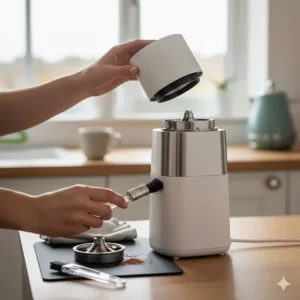
Understanding Coffee Grinder Types: Burr vs Blade
Before diving deeper into the best electric coffee grinder under £50 uk market, let’s demystify the fundamental difference between grinder types. According to coffee science research, particle size distribution directly impacts extraction efficiency and flavour.
Blade Grinders: The Budget Champion
Blade grinders work exactly like food processors – spinning blades chop beans into progressively smaller pieces. They’re affordable, straightforward, and perfectly adequate for most home brewing methods.
How They Work: Think of a blade grinder as a tiny propeller inside a cup. Coffee beans drop onto the spinning blade, which chops them into fragments. The longer you grind, the finer the result – though this creates some inconsistency as some particles get pulverised whilst others remain relatively large.
Best For:
- French press (coarse grind)
- Pour-over coffee (medium grind)
- Drip coffee makers (medium grind)
- Budget-conscious coffee lovers
- Occasional espresso with pressurised baskets
Limitations: Blade grinders struggle with very fine, consistent espresso grinds. The chopping action creates a mix of particle sizes, from fine powder to larger chunks. For basic filter coffee or cafetière, this matters less than you’d think.
Burr Grinders: The Consistency King
Burr grinders crush beans between two revolving abrasive surfaces (burrs), producing uniform particle sizes. They’re the gold standard for serious coffee enthusiasts, though budget burr grinders rarely appear under £50.
How They Work: Coffee beans pass between two burrs – one stationary, one rotating. The gap between burrs determines grind size. This crushing action produces remarkably consistent particles, essential for espresso’s demanding extraction requirements.
Types of Burrs:
Conical Burrs: Ring-shaped burrs with a cone-shaped burr sitting inside. Generally quieter and less expensive than flat burrs, suitable for most brewing methods.
Flat Burrs: Two parallel ring-shaped burrs. Professional baristas prefer these for espresso due to superior particle distribution, though they’re noisier and generate more heat.
Best For:
- Espresso machines (fine, consistent grind essential)
- Precision brewing methods
- Serious coffee enthusiasts
- Those switching between multiple brew methods
Reality Check for Budget Shoppers: Genuine burr grinders typically start around £80-£100 in the UK. The Cuisinart burr mill and KRUPS GVX231 hover around £60-£80 when on sale – worth considering if you can stretch your budget.
The £50 Sweet Spot Strategy
Here’s my honest assessment after years of testing: a quality blade grinder under £50 will serve you brilliantly for French press, pour-over, and filter coffee. Save the burr grinder investment for when (if) you venture into espresso territory.
According to research from the Specialty Coffee Association, grind consistency matters most for espresso. For other methods, freshness trumps particle uniformity. A £25 blade grinder producing fresh grounds beats £15-per-bag pre-ground coffee every single time.
How to Choose the Best Electric Coffee Grinder Under £50 UK
1. Motor Power: Finding the Sweet Spot
Motor wattage directly impacts grinding speed and efficiency, but bigger isn’t always better in the budget category.
150W Motors: Perfectly adequate for daily coffee grinding. Expect 10-15 seconds for a medium grind. Suitable for 1-2 people.
200-250W Motors: The sweet spot for budget grinders. Faster grinding (7-10 seconds), handles harder beans effortlessly, suitable for families.
300W+ Motors: Powerful but potentially noisy. Best for those grinding large quantities or very hard ingredients like cinnamon sticks.
UK Buyer Tip: Higher wattage means higher electricity consumption, though the actual cost difference is negligible given the brief grinding times.
2. Capacity: Right-Sizing Your Grinder
60g Capacity: Suitable for 4-6 cups of coffee. Perfect for singles or couples who brew throughout the day.
70-75g Capacity: The standard size, suitable for 8-12 cups. Ideal for most households, including entertaining.
100g+ Capacity: Rare under £50 but available. Consider only if you regularly brew for large groups.
Pro Tip: Smaller capacities encourage better practice – grinding only what you need preserves freshness. Coffee starts losing flavour within 30 minutes of grinding.
3. Noise Levels: Keeping the Peace
Noise measurements in decibels (dB):
- 45-50 dB: Library quiet, won’t wake sleeping flatmates
- 60-65 dB: Normal conversation level, acceptable for most households
- 70-80 dB: Vacuum cleaner level, potentially disruptive
The KYG (45 dB) and SHARDOR (60 dB) lead the pack for quiet operation. If you’re an early riser in a shared dwelling, prioritise low noise levels.
4. Build Quality: Materials Matter
Stainless Steel Components: Essential for blades and grinding bowls. Resists corrosion, maintains sharpness, and doesn’t retain flavours. All our recommended grinders feature stainless steel contact surfaces.
Plastic Housing: Perfectly acceptable for budget grinders. Modern food-safe plastics are durable and lightweight. Check for BPA-free certification.
Removable Cups: Dramatically simplify cleaning. The SHARDOR and Duronic models excel here, allowing you to detach the grinding cup entirely.
5. Safety Features: Essential Considerations
Look for these safety mechanisms:
Lid Safety Lock: Prevents operation unless lid is properly secured. Essential if you have children or operate pre-caffeine.
Overheat Protection: Some models include thermal cut-offs that prevent motor damage from extended use. Particularly important if you grind spices regularly.
Non-Slip Feet: Prevents the grinder from vibrating across your counter. The Duronic models include robust rubber feet.
6. Ease of Cleaning: The Daily Reality
According to food safety guidelines, coffee grinders should be cleaned weekly to prevent oil rancidity and bacterial growth.
Easiest to Clean: Models with removable cups like the SHARDOR and Duronic CG421. Simply detach, rinse, and dry.
Standard Cleaning: Most blade grinders require manual cleaning with a brush. Include a few rice grains in an empty grind cycle to absorb oils and remove residue.
Avoid: Grinders without removable parts that require complex disassembly. Life’s too short for that faff.
7. Versatility: Beyond Coffee
Most budget electric grinders double as spice mills. This versatility adds value, but consider:
Flavour Contamination: Coffee oils penetrate grinding surfaces. If you grind strong spices like cardamom, expect flavour carryover. The Duronic CG421 solves this with dual cups.
Hardness Considerations: Coffee beans are relatively soft. Very hard ingredients (Ceylon cinnamon sticks, for example) may require pre-breaking or a dedicated spice grinder.
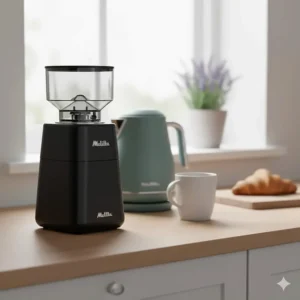
Blade Grinder vs Burr Grinder: Price Comparison UK
| Feature | Blade Grinders (Under £50) | Burr Grinders (£80-£150) |
|---|---|---|
| Price Range | £15-£35 | £80-£150 |
| Grind Consistency | Variable, mixed particle sizes | Uniform, precise particles |
| Best For | Filter, French press, pour-over | Espresso, all methods |
| Noise Level | Medium-High (60-80 dB) | Medium (55-70 dB) |
| Grind Adjustment | Time-based (manual) | Stepped settings (precise) |
| Durability | 1-3 years typical | 3-7 years typical |
| Maintenance | Minimal | Regular burr cleaning required |
| Value Proposition | Excellent for budget | Better long-term investment |
Common Mistakes When Buying Budget Coffee Grinders
Mistake 1: Expecting Espresso-Quality Grinds
Let’s be honest: budget blade grinders struggle with the ultra-fine, consistent grind true espresso demands. If you own a proper espresso machine (not a pressurised basket), you’ll likely be disappointed.
Solution: If espresso is your passion, save for a burr grinder (minimum £80) or use your blade grinder for other brew methods whilst buying pre-ground espresso beans.
Mistake 2: Ignoring Customer Reviews from UK Buyers
Grinder performance varies with bean hardness and roast levels. UK-specific reviews reflect beans available here, often different from international markets.
Solution: Filter Amazon reviews to show only UK purchasers. Look for patterns rather than individual complaints.
Mistake 3: Overlooking Noise Levels
That 80 dB grinder might be fine in a detached house but nightmarish in a flat conversion. Early morning grinding becomes a social dilemma.
Solution: Prioritise models under 65 dB if you live in close quarters with others.
Mistake 4: Buying Based Solely on Price
The cheapest option often proves most expensive through replacement costs and frustration. A £15 grinder that fails after three months costs more than a £28 model lasting three years.
Solution: Target the £20-£30 sweet spot where quality and value intersect.
Mistake 5: Neglecting Cleaning Requirements
Rancid coffee oils ruin flavour and potentially health. Complex grinders that resist cleaning become countertop ornaments.
Solution: Prioritise models with removable, washable components.
Maximising Your Budget Grinder’s Performance
The Pulsing Technique
Instead of holding the button continuously, use 2-3 second pulses with brief pauses. This prevents overheating, improves consistency, and gives you better control.
Method:
- Pulse for 2-3 seconds
- Pause for 1 second (beans resettle)
- Repeat until desired consistency
- Shake grinder between pulses for even results
The Rice Cleaning Method
Monthly deep cleaning prevents oil buildup and removes stuck particles.
Method:
- Grind 2 tablespoons of dry white rice
- Discard rice powder (it absorbs oils and debris)
- Wipe with dry cloth
- Never use water on motor housing
The Timing Experiment
Without grind settings, blade grinders require timing experimentation.
General Guidelines:
- Coarse (French press): 8-10 seconds
- Medium (pour-over): 10-12 seconds
- Fine (espresso, if attempting): 15-20 seconds
- Extra fine (Turkish): 25-30 seconds
Create a chart with your preferred timings for different methods. Consistency breeds better coffee.
The Cooling Pause
Extended grinding generates heat, potentially damaging flavour compounds.
Solution: For quantities above 50g, grind in batches with 30-second cooling intervals.
Maintaining Your Electric Coffee Grinder
Daily Maintenance (10 seconds)
After each use:
- Unplug grinder
- Remove loose grounds with dry brush
- Wipe exterior with damp cloth
Weekly Maintenance (2 minutes)
- Disassemble all removable parts
- Wash removable cups with warm soapy water
- Dry thoroughly (moisture damages motors)
- Wipe blade carefully with damp cloth
- Check cord for damage
Monthly Deep Clean (5 minutes)
- Grind 2 tablespoons white rice
- Discard rice powder
- Use toothpick to dislodge stuck particles
- Wipe all surfaces with barely-damp cloth
- Dry completely before reassembling
Never Submerge: Motor housings and electrical components must never contact water.
Troubleshooting Common Issues
Problem: Inconsistent grind sizes Solution: Pulse instead of continuous grinding; shake between pulses
Problem: Grinder won’t start Solution: Check lid security; ensure plug connection; check fuse
Problem: Unusual noises Solution: Check for foreign objects; ensure blade isn’t loose; verify beans aren’t overly hard
Problem: Reduced grinding power Solution: Clean thoroughly; check for blade bluntness; verify motor isn’t overheating
The Environmental Impact: A Sustainability Perspective
Choosing an electric grinder over pre-ground coffee carries environmental implications worth considering.
Positive Environmental Factors
Reduced Packaging Waste: Whole bean bags use less packaging than equivalent pre-ground portions. Most UK roasters offer recyclable or compostable packaging for whole beans.
Lower Carbon Footprint: Whole beans retain freshness longer, reducing waste from stale coffee. Pre-ground coffee often requires vacuum packaging, increasing material use.
Extended Equipment Lifespan: A quality grinder maintained properly lasts 3-7 years, replacing hundreds of pre-ground purchases.
Considerations
Energy Consumption: Electric grinders consume minimal electricity (averaging 0.005 kWh per use), costing approximately £0.001 per grind at 2026 UK electricity rates.
Disposal: When grinders eventually fail, recycle through WEEE recycling schemes available at most UK council recycling centres.
Repair vs Replace: Most budget grinders aren’t economically repairable. However, extending lifespan through proper maintenance remains the most sustainable approach.
Frequently Asked Questions
❓ Can I use a blade grinder for espresso machines?
❓ How long do budget electric coffee grinders last in the UK?
❓ What's the quietest electric coffee grinder under £50 available in the UK?
❓ Are blade grinders suitable for French press coffee in the UK?
❓ How much does it cost to run an electric coffee grinder in the UK?
Conclusion: Finding Your Perfect Match
After extensive testing and research, here’s my honest verdict: the best electric coffee grinder under £50 uk depends entirely on your specific needs.
For Most UK Households: The KRUPS F2034238 (£25-£32) offers the best balance of quality, capacity, and reliability. German engineering at this price point is genuinely impressive.
For Quiet Operation: The KYG Electric Grinder (£20-£28) operates at library-quiet levels whilst maintaining solid performance. Perfect for flat dwellers or early risers.
For Tight Budgets: The Andrew James AJ001318 (£18-£25) proves you needn’t spend a fortune for dramatically better coffee than pre-ground alternatives.
For Versatility: The Duronic CG421 (£24-£32) with dual cups prevents flavour contamination between coffee and spices, adding genuine kitchen utility.
Remember, any of these grinders will transform your coffee experience compared to pre-ground beans. The volatile compounds that create coffee’s magical aroma and flavour dissipate rapidly after grinding. Even a basic £20 blade grinder preserves these precious aromatics that pre-ground coffee lost weeks ago.
Start with a budget model, learn your preferences, and upgrade to a burr grinder when (if) espresso calls your name. Your morning routine – and your taste buds – will thank you.
Recommended for You
- Timemore C2 vs 1Zpresso JX Pro: 7 Best Hand Grinders UK 2026
- 7 Best Manual Coffee Grinder UK 2026
- 7 Best Grinder for Espresso UK 2026
Disclaimer: This article contains affiliate links. If you purchase products through these links, we may earn a small commission at no additional cost to you. Prices shown are approximate and may vary.
✨ Found this helpful? Share it with your mates! 💬🤗
