

In This Article
Somewhere between “just tamp it and hope” and full barista-competition puck prep lies a genuinely useful rabbit hole: the distribution tool vs WDT tool espresso debate. If you’ve recently upgraded your home setup with a decent grinder and a naked portafilter, you’ve probably already seen the problem the moment you pulled a shot — a thin jet of water spraying sideways out of the basket while the rest of the puck sits there doing nothing useful. That’s channelling, and it’s usually a distribution problem, not a grinder or bean problem.
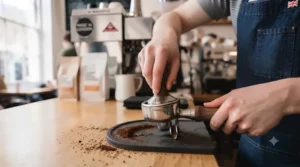
This guide compares seven real, currently available puck prep tools sold on amazon.co.uk, spanning both categories: needle-based WDT tools that stir and de-clump grounds, and paddle-style distribution (levelling) tools that flatten the bed before tamping. We researched real specs, gathered aggregated customer sentiment, and worked out which tool suits which kind of home or café setup — because despite what a lot of listings imply, these aren’t interchangeable products solving the same problem.
In short: a WDT tool uses fine needles to break up clumps and fluff loosely packed grounds into an even density throughout the basket, while a distribution tool uses a flat rotating base to level an already-loose bed before tamping. Most industry explainers agree on the underlying goal: a genuinely flat, even bed before tamping, with the better tools offering adjustable depth to suit different dose weights. Most serious home baristas eventually use both, in sequence, rather than picking one over the other permanently.
Quick Comparison Table
| # | Product | Type | Key Spec | Price Range |
|---|---|---|---|---|
| 1 | APTSPADE WDT Tool | WDT | 0.3mm, 7 needles, with stand | Under £15 |
| 2 | Dewlawn Espresso Coffee Distributor | WDT | 0.35mm, 6 needles, walnut handle | £13-£17 |
| 3 | MHW-3BOMBER 58mm Espresso Distributor | Distribution | Height adjustable, non-slip base | £18-£24 |
| 4 | IKAPE Mantis WDT Distribution Tool | WDT | Dosing funnel + stand, adjustable height | £17-£22 |
| 5 | Apexstone 58mm Coffee Distributor | Distribution | Tool-free height adjustment | £16-£21 |
| 6 | Normcore WDT Distribution Tool V3 | WDT | Dual 0.25mm/0.3mm needles, magnetic stand | £24-£30 |
| 7 | MATOW 53mm Coffee Distributor and Tamper | Combo | Dual-head leveller and tamper | £22-£28 |
Reading across the table, the split is clear from the start: needle tools (WDT) and paddle tools (distributors/levellers) solve different halves of the same problem. A needle tool fixes uneven density and clumping deep in the bed; a paddle tool fixes an uneven top surface before the final tamp. Buying only one and expecting it to fix both symptoms is the single most common reason people feel underwhelmed after their first purchase.
💬 Just one click — help others make better buying decisions too!😊
Top 7 Espresso Puck Prep Tools: Expert Analysis
Below is the full lineup, spanning genuine WDT needle tools and paddle-style distributors, at budget, mid-range and premium price points, followed by individual breakdowns of each.
1. APTSPADE WDT Tool — best budget entry into needle distribution
The standout here is accessibility: a genuine 7-needle, 0.3mm stainless steel WDT tool with a stand and three replacement needles included, at a price that makes it an easy first purchase for anyone curious whether WDT actually changes their shots. It’s a straightforward single-piece handle design rather than anything modular.
Specs-wise, the 0.3mm needle gauge sits in the commonly recommended range for home use — thin enough to break up clumps without tearing large channels through the bed, which matters more than it sounds, since overly thick needles can actually create the exact channelling problem WDT is meant to prevent. The included stand keeps the needles off the counter between uses, a small but genuinely appreciated detail at this price point.
Who it’s for: anyone who’s read about the Weiss Distribution Technique and wants to test it properly before spending on a premium tool. Reviewers consistently note that the difference in shot consistency is noticeable within the first few uses, with a recurring theme in feedback that the plastic handle feels a step below metal-bodied competitors but performs the actual job just as well.
Pros:
- ✅ Very low entry price for genuine WDT stirring
- ✅ 0.3mm needles suit most home grind sizes
- ✅ Comes with a stand and spare needles
Cons:
- ❌ Plastic handle feels basic next to metal rivals
- ❌ No funnel included for spill-free stirring
At under £15, this is the sensible starting point if you’re still deciding whether the distribution tool vs WDT tool espresso question even matters for your setup — it removes the cost barrier to finding out.

2. Dewlawn Espresso Coffee Distributor — best character on a budget
What stands out immediately is the walnut handle — a genuine wood-and-steel build that feels noticeably nicer in the hand than the all-plastic budget options, without pushing into premium pricing. It’s a 6-needle, 0.35mm WDT tool that comes with its own stand.
The slightly thicker 0.35mm needle gauge trades a touch of finesse for durability, meaning it’s marginally less prone to bending during vigorous stirring than the thinnest 0.25mm needles found on premium tools, at the cost of being a fraction less gentle on delicate light-roast grinds. In practice, that means it performs excellently on medium-to-dark roasts and holds up well to daily use without needle fatigue.
Honest analytical take: this suits buyers who want their kit to look and feel intentional on the counter, not just functional — the wood handle genuinely changes how the whole prep routine feels, even though the mechanical result is comparable to cheaper plastic tools. Aggregated customer sentiment tends to praise the tactile quality of the handle, with occasional notes that the wood requires keeping dry to avoid long-term wear.
Pros:
- ✅ Genuine walnut handle for a premium feel
- ✅ Durable 0.35mm needles resist bending
- ✅ Includes a stand for tidy storage
Cons:
- ❌ Wood handle needs keeping away from water
- ❌ Slightly less precise on very fine light-roast grinds
Priced around £13-£17, it’s a strong pick for anyone who wants their espresso prep tools explained aesthetic to match a nicer home setup without stretching to premium metal builds.
3. MHW-3BOMBER 58mm Espresso Distributor — best dedicated levelling paddle
The standout feature is what it isn’t: this is a pure distribution (levelling) tool, not a WDT needle stirrer, with a flat non-slip base that spins against the coffee bed to create an even surface before tamping. Height is adjustable via a simple screw mechanism, meaning one tool adapts to different dose weights without swapping parts.
Compatible with 58mm/58.3mm/58.5mm portafilters, the non-slip pattern on the base grips the loose grounds as it rotates rather than sliding across the top layer, which is the detail that separates a genuinely effective leveller from a token accessory. Based on the spec comparison with needle tools, this solves a different problem entirely — it won’t break up deep clumps the way a WDT tool does, but it will guarantee a flat, level bed immediately before tamping.
Who should care: buyers who already run a good grinder with minimal clumping and mainly want to eliminate the small doming or lopsidedness that throws off an even tamp. A common theme in aggregated feedback is praise for how quickly it speeds up the prep routine in busier settings, with some reviewers noting it works best as a finishing step after a WDT pass rather than as a total replacement for one.
Pros:
- ✅ Genuinely effective flat, even levelling
- ✅ Tool-free height adjustment via screw mechanism
- ✅ Fits the vast majority of 58mm portafilters
Cons:
- ❌ Does not break up clumps like a needle tool
- ❌ Best used alongside, not instead of, WDT
At around £18-£24, this earns its place as the go-to answer when the question is specifically “how do I get a level bed fast,” rather than “how do I fix clumpy grounds.”
4. IKAPE Mantis WDT Distribution Tool — best all-in-one workflow
The headline feature is the combo: a WDT needle tool built with an integrated dosing funnel and stand, meaning the messy grind-into-basket step, the stirring step, and the storage step are all handled by one purchase rather than three separate accessories. The needle height is adjustable by unscrewing the handle.
Specs-wise, it uses the classic thin-needle WDT approach for breaking up clumps, but the funnel attachment is the genuinely clever addition — it sits above the portafilter during grinding to catch stray grounds, then doubles as a guide for keeping the WDT stir contained rather than flinging fine coffee dust across the counter. That’s a small workflow win that saves cleanup time on every single shot.
Honest take: this is the pick for anyone who wants fewer separate gadgets cluttering the bench. Reviewers consistently mention the funnel-plus-stand combo as the standout reason to choose it over a plain needle tool, with a fair caveat that the funnel adds a bit of bulk compared with the slimmest standalone WDT options.
Pros:
- ✅ Integrated funnel reduces mess during grinding
- ✅ Adjustable needle height for different baskets
- ✅ One purchase covers funnel, stirrer and stand
Cons:
- ❌ Bulkier footprint than a standalone needle tool
- ❌ Funnel needs occasional cleaning of its own
Typically priced in the £17-£22 range, it’s our pick for best overall because it genuinely reduces the number of separate espresso prep tools you need on the counter, without compromising on the core WDT function.
5. Apexstone 58mm Coffee Distributor — best simple, no-fuss leveller
The standout is straightforward usability: a solid 304 stainless steel base with an anti-slip aluminium handle, height-adjustable by a screw mechanism with no shims or extra tools required, designed to work across most standard 58mm baskets and machines. It’s built as a low-profile design for comfortable, close-to-90-degree tamping straight after.
What that means in practice: the flat base evenly redistributes coffee using the palm of your hand in a rotating motion, and the anti-rust stainless construction is genuinely durable for daily use rather than needing careful handling. It disassembles for cleaning, which matters given how quickly fine coffee dust builds up in the threads of any adjustable tool.
Who it’s for: buyers who specifically want a pure levelling tool without the added cost of needle stirring functionality — often paired with their own separate WDT tool or a grinder they trust to minimise clumping already. A recurring theme in feedback is that this feels sturdier than its price suggests, with occasional mentions that the handle grip could be slightly more textured for wet hands.
Pros:
- ✅ Solid stainless steel construction at a fair price
- ✅ Tool-free height adjustment for various doses
- ✅ Disassembles easily for thorough cleaning
Cons:
- ❌ No stirring function, so clumps aren’t addressed
- ❌ Handle grip could be more textured
At roughly £16-£21, this is a smart, no-nonsense pick if levelling — not de-clumping — is the specific gap in your current puck preparation workflow.
6. Normcore WDT Distribution Tool V3 — best premium precision
The standout feature is genuine configurability: this WDT tool ships with both 0.25mm and 0.3mm needle sets, for a total of 9 needle positions, letting you switch needle thickness depending on grind fineness and roast style rather than being locked into one gauge. The CNC-machined anodised aluminium body and magnetic stand round out a genuinely premium build.
In practical terms, the finer 0.25mm needles suit delicate, fine-ground light roasts where you want minimal disturbance to the bed structure, while the 0.3mm set handles coarser or clumpier grinds with slightly more assertive stirring. Based on the spec comparison across this whole list, this is the only tool here offering that level of tunability, which genuinely matters for anyone dialling in multiple different coffees rather than running one bag on repeat.
Who should care: enthusiast home baristas and small cafés who’ve already identified that grind consistency varies noticeably between beans, and want a tool that adapts rather than compromises. Aggregated customer sentiment consistently highlights the tactile quality of the anodised handle and the convenience of the magnetic stand, with the fair trade-off that this sits well above the budget WDT tools in price.
Pros:
- ✅ Two needle thicknesses for different grinds
- ✅ Premium CNC anodised aluminium build
- ✅ Magnetic stand keeps the bench tidy
Cons:
- ❌ Noticeably pricier than basic WDT tools
- ❌ Needle swapping adds a small extra step
At around £24-£30, this is the pick for buyers treating puck prep as a genuine craft rather than a quick daily chore — the tunability is a real, usable feature, not just a marketing line.
7. MATOW 53mm Coffee Distributor and Tamper — best 2-in-1 for smaller baskets
The standout is efficiency: a dual-head design combining a levelling distributor on one end and a tamper on the other, built specifically to suit Breville’s 54mm portafilter and similar 53-54mm prosumer baskets. One tool handles both the final levelling pass and the compaction step that follows it.
Specs-wise, the depth is adjustable to accommodate different dose weights, and the dual-head format means you’re not switching between two separate handles mid-routine — a genuinely practical space-saver for smaller kitchens or compact espresso stations. It’s worth noting this is a distribution-and-tamp combo, not a WDT needle tool, so it doesn’t address deep clumping on its own.
Who it’s for: Breville Barista Express, Barista Pro and similar 54mm-basket owners who want to consolidate their counter tools, plus anyone who prioritises workflow speed over having the widest possible tool range. A common theme in aggregated feedback is appreciation for how well it matches Breville’s specific basket depth out of the box, with some buyers noting they still keep a separate cheap WDT tool on hand for stubborn clumps.
Pros:
- ✅ Combines levelling and tamping in one tool
- ✅ Sized specifically for Breville-style 54mm baskets
- ✅ Adjustable depth suits varying dose weights
Cons:
- ❌ No needle stirring, so pairs best with a separate WDT tool
- ❌ Less universal fit than standard 58mm tools
Priced around £22-£28, this is the pick for anyone running a Breville-style prosumer machine who wants fewer separate gadgets without giving up a proper levelling and tamping routine.
Puck Preparation Workflow: Step-by-Step Guide
A genuinely effective puck preparation workflow follows a consistent order, and skipping steps is where most inconsistency creeps in. Start by grinding directly into the portafilter basket with a dosing funnel attached, if you have one — this alone prevents the mess and static-driven spillover that makes everything after it harder to judge accurately.
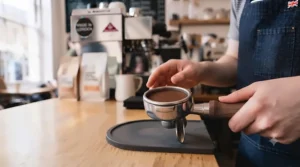
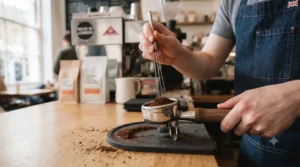
Next comes the WDT pass, if you’re using a needle tool: insert the needles close to the base of the grounds and stir in a gentle, deliberate spiral, gradually lifting toward the surface as you go, rather than staying at one depth the whole time. The goal is breaking up clumps from the bottom up, not just fluffing the top layer, since clumps sitting deep in the basket cause channelling just as readily as surface ones.
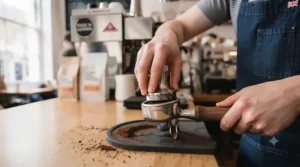
After stirring, give the portafilter a firm, level tap or two on a solid surface to help the loosened grounds settle and collapse any remaining air pockets — this is where a dedicated distribution tool comes in if you have one, spinning across the surface to leave a genuinely flat bed. Finally, tamp with firm, even, straight-down pressure; contrary to popular belief, more force doesn’t meaningfully improve extraction once the grounds are compacted — consistency of pressure and levelness matters far more than raw strength.
Real-World Scenarios: Which Tool Suits Your Setup
The new home barista testing the waters. Someone who’s just bought their first proper espresso machine and grinder, and has read about channelling online, doesn’t need to spend big to find out if WDT genuinely helps. The APTSPADE WDT Tool or Dewlawn Espresso Coffee Distributor both offer a low-risk way to test the technique properly before committing to a premium tool.
The Breville prosumer owner wanting fewer gadgets. Anyone running a Barista Express, Barista Pro or Breville-adjacent 54mm setup, and short on counter space, benefits most from consolidation. The MATOW 53mm Coffee Distributor and Tamper covers levelling and tamping in one handle, sized specifically for that basket depth.
The enthusiast dialling in multiple beans. If your shelf has more than one bag on rotation and you’re chasing consistency across genuinely different roast levels and grind settings, needle flexibility starts to matter. The Normcore WDT Distribution Tool V3‘s dual needle thickness is built precisely for this — swap to the finer set for delicate light roasts, the coarser set for clumpier, oilier dark roasts.
The small café focused on speed without sacrificing quality. A busy bar can’t afford a slow, fussy prep routine per shot. The MHW-3BOMBER 58mm Espresso Distributor‘s quick, tool-free height adjustment and fast rotating levelling motion suit a high-volume workflow where every second behind the machine counts.
Espresso Troubleshooting: Common Puck Prep Problems and Fixes
Problem: a naked portafilter shows thin, fast jets spraying sideways. This is classic channelling, almost always caused by clumps or an uneven bed rather than the beans themselves. Solution: add a proper WDT pass before tamping — the IKAPE Mantis WDT Distribution Tool or APTSPADE WDT Tool both address this directly.
Problem: shots taste sour and under-extracted despite a “correct” recipe. Under-extraction from channelling often masquerades as a grind-too-coarse problem, sending people the wrong direction on their grinder. Solution: before adjusting grind size, rule out distribution issues first with a proper stir-and-level routine — it’s the cheaper, faster fix to try.
Problem: the tamped surface looks lopsided or domed rather than flat. This is a levelling issue, not a clumping issue, and a needle tool alone won’t fully fix it. Solution: add a dedicated paddle-style distributor, such as the MHW-3BOMBER 58mm Espresso Distributor or Apexstone 58mm Coffee Distributor, as the final step before tamping.
Problem: WDT needles keep bending or snapping. Thinner needle gauges (0.25mm) are more prone to this under vigorous or careless stirring. Solution: use gentler, more deliberate motions, or step up to a slightly thicker gauge such as the 0.35mm needles on the Dewlawn Espresso Coffee Distributor, which resist bending better under daily use.
Problem: prep routine feels slow and adds too much time to each shot. Solution: a combo tool removes a handle-swap step from the routine — the MATOW 53mm Coffee Distributor and Tamper or the funnel-equipped IKAPE Mantis WDT Distribution Tool both streamline this without cutting corners on quality.
Espresso Puck Preparation Tools Explained: What Is a Distribution Tool? What Is a WDT Tool?
A distribution tool, in the strict sense, is a flat-based paddle that rotates against loose coffee grounds to create a level, even surface before tamping — its job is purely about flattening, not de-clumping. A WDT tool, by contrast, is a set of thin needles used to stir and agitate grounds throughout the whole depth of the basket, breaking up clumps and evening out density before any levelling or tamping happens at all.
The confusion between the two is understandable, since many retailers market both under the umbrella term “espresso distribution tool.” A genuine distribution tool is really a levelling paddle — a flat base, usually depth-adjustable, that spins across the surface of the grounds to leave them level before tamping. That’s a fundamentally different mechanism from a needle-based WDT tool, even though both ultimately aim at the same outcome: a more even, predictable extraction. According to the Wikipedia entry on espresso, consistent extraction depends heavily on uniform resistance through the coffee bed, which is precisely what both tool categories are trying to engineer from two different angles.
Distribution Tool vs WDT Tool: How to Choose
- Identify your actual symptom first. Sideways jets and sour, uneven shots point to clumping — start with a WDT needle tool. A domed or lopsided tamped surface with otherwise decent extraction points to a levelling problem — start with a distribution paddle.
- Check your grinder’s clump tendency. Cheaper or older grinders tend to produce more static and clumping, making a WDT tool close to essential; higher-end grinders with good RDT (ruhlman dosing technique) or anti-static features may need only occasional stirring.
- Match needle gauge to your typical grind. Finer needles (0.25mm) suit delicate light roasts; slightly thicker needles (0.3-0.35mm) handle coarser, oilier dark roasts with less bending.
- Consider your basket size before buying. 58mm is the most common home and café standard, but Breville-style machines typically use 53-54mm baskets — check compatibility rather than assuming universal fit.
- Decide whether you want a combined or separate workflow. Combo tools like the MATOW 53mm Coffee Distributor and Tamper save space; separate needle and paddle tools give more granular control over each individual step.
- Factor in cleaning and maintenance effort. Funnels and stands add convenience but also more surfaces to keep clean; a simple standalone needle tool is the lowest-maintenance option.
- Set a realistic budget band rather than chasing the cheapest listing. As the comparison table above shows, mid-range tools often add genuinely useful features — funnels, adjustable depth, dual needle sets — for a modest step up in price over the cheapest options.
Do You Need a Distribution Tool or a WDT Tool?
The honest answer for most home baristas is both, used in sequence, but if budget or counter space forces a single choice, the decision comes down to what’s actually causing your inconsistency. If you’re seeing visible channelling on a naked portafilter — sideways jets, uneven colour in the crema, sour and bitter notes in the same shot — that’s a clumping problem, and a WDT tool addresses it directly at the root.
If your shots taste reasonably balanced but you notice the tamped surface looks uneven, or extraction seems to favour one side of the basket, that’s more likely a levelling issue that a dedicated distribution tool solves more effectively than stirring alone ever could. Perfect Daily Grind’s coverage of professional puck prep practice makes a similar point from the café side: good distribution and tamping kit lets baristas work faster and more consistently without cutting corners on quality — which is really the underlying logic for owning either tool at home: consistency, not novelty.
For anyone still undecided, starting with a budget WDT tool such as the APTSPADE WDT Tool is the lower-cost way to test whether clumping is genuinely your issue, before spending more on a dedicated paddle distributor if the problem turns out to be levelling instead.
✨ Don’t Miss These Exclusive Deals!
🔍 Take your espresso prep to the next levelTake your puck preparation workflow to the next level with these carefully selected distribution and WDT tools. Click on any highlighted product name above to check current pricing and availability. These small, precise accessories genuinely change the consistency of every shot you pull. ☕
Common Mistakes When Buying Espresso Prep Tools
The most common mistake is buying a WDT tool expecting it to also fix an uneven surface, or buying a distribution paddle expecting it to fix deep clumping — as covered above, they solve genuinely different halves of the same problem, and shoppers are frequently disappointed simply because they bought the wrong half.
A second mistake is ignoring basket compatibility, particularly for Breville and other 53-54mm prosumer machines. Assuming every “espresso distribution tool” fits every portafilter leads to buying a 58mm tool that simply doesn’t sit flush in a smaller basket, wasting money on a return or exchange.
A third, subtler mistake is over-stirring with a WDT tool, using aggressive, forceful motions rather than gentle spirals. Excessive agitation can actually create new unevenness and even push grounds toward the basket walls, ironically increasing the risk of channelling rather than reducing it — the technique matters just as much as the tool itself.
Coffee Channelling Prevention: How These Tools Actually Work
Channelling happens when water finds a path of least resistance through the coffee bed rather than flowing evenly through the whole puck, and it’s the single biggest cause of inconsistent home espresso. Academic research into extraction uniformity backs this up directly: a peer-reviewed modelling study from the University of Limerick and University of Huddersfield found that uneven flow through a coffee bed causes meaningful swings in local extraction levels, confirming what baristas have long suspected through taste alone — uneven structure genuinely produces uneven extraction, not just uneven-tasting shots by coincidence.
WDT tools prevent channelling by physically breaking up the clumps that create those low-resistance paths before water ever reaches them, while distribution paddles prevent it by removing surface unevenness that would otherwise cause water to enter the puck at uneven depths from the very first moment of contact. Barista Hustle’s technical explainer on the Weiss Distribution Technique describes the mechanism plainly: stirring breaks up clumps and evens out density throughout the puck, which is what actually drives the reduction in channelling. Used together, the two tool types address channelling from both directions — depth and surface — which is why combining them tends to outperform relying on either alone.
What to Expect: Real-World Performance
Spec sheets promise consistency, so it helps to translate that into what you’ll actually notice. With a proper WDT pass from a tool like the APTSPADE WDT Tool or Normcore WDT Distribution Tool V3, the most immediate change is visual: pulling a shot through a naked portafilter, you’ll typically see multiple even streams rather than one or two aggressive jets, and crema tends to look more uniform in colour across the whole surface.
Adding a dedicated levelling pass with something like the MHW-3BOMBER 58mm Espresso Distributor or Apexstone 58mm Coffee Distributor tends to show up less dramatically in the visual stream pattern and more in shot-to-shot repeatability — pulling the same recipe five times in a row and getting genuinely similar extraction times and taste each time, rather than one good shot followed by two disappointing ones.
Taste-wise, the realistic expectation is a reduction in sourness and bitterness appearing in the same cup, since that combination is a classic sign of simultaneous under- and over-extraction happening in different parts of an unevenly prepared puck. It’s worth being honest that these tools won’t rescue genuinely stale beans or a poorly calibrated grinder — they refine an already reasonable setup rather than fixing fundamentally different problems.
Espresso Prep Tools for Different Baristas
For complete beginners, simplicity matters more than precision — a single, inexpensive WDT tool such as the APTSPADE WDT Tool teaches the core technique without overwhelming a new routine with too many extra steps or accessories to manage.
For enthusiasts running multiple bean types, tunable needle gauges genuinely earn their keep, making the Normcore WDT Distribution Tool V3 a sensible step up once you notice different roasts behaving differently under the same stirring technique.
For small café or commercial settings, speed and repeatability across a full shift outrank fine-tuning, favouring a fast, tool-free paddle like the MHW-3BOMBER 58mm Espresso Distributor, potentially paired with a simple, durable WDT tool for busy service.
For Breville and similar prosumer machine owners, basket-specific fit removes guesswork, making the MATOW 53mm Coffee Distributor and Tamper a practical, space-saving choice that’s sized correctly from the outset rather than requiring adapters.
Long-Term Cost & Maintenance
Espresso prep tools are inexpensive to buy but not entirely maintenance-free — WDT needles can bend or, rarely, snap with rough handling over time, which is why most manufacturers include spare needles in the box, and it’s worth checking that before buying a tool that doesn’t. A tool like the APTSPADE WDT Tool, which ships with replacement needles included, effectively buys a longer working lifespan for a similar upfront price to needle sets sold without spares.
Distribution paddles have fewer wear parts overall, since there’s no needle to bend, but the threaded height-adjustment mechanism on tools like the Apexstone 58mm Coffee Distributor can gather fine coffee dust over time if not disassembled and cleaned periodically, which is worth building into a weekly cleaning routine rather than an occasional one.
Cost-per-use is genuinely negligible for either tool type — there’s no consumable involved beyond the occasional spare needle — so the real total cost of ownership comparison comes down almost entirely to upfront price versus how much daily wear the mechanism can tolerate before it needs replacing. A £14 budget tool used carefully can easily outlast a premium option handled roughly, which is a fair reminder that technique protects your investment as much as build quality does.
Distribution Tools vs Traditional Tamping-Only Prep
| Factor | WDT + Distribution Tool | Tamp-Only (No Distribution) | Blind Shaker Method |
|---|---|---|---|
| Clump reduction | Excellent — needles reach full depth | Poor — clumps remain compacted in | Moderate — shaking breaks some clumps |
| Surface levelling | Excellent with paddle distributor | Depends entirely on tamping skill | Moderate, still needs a level tamp |
| Channelling risk | Low | High, especially with clumpy grinders | Reduced versus tamp-only |
| Time per shot | Adds 10-20 seconds | Fastest | Adds a few seconds |
| Best For | Consistency-focused home and café use | Very well-behaved grinders only | Quick improvement without buying tools |
The table makes the trade-off obvious: skipping distribution entirely is the fastest option, but it leans entirely on your grinder producing near-perfect, clump-free grounds, which few home grinders genuinely achieve. Blind shaking — physically shaking the portafilter to redistribute grounds — is a reasonable free alternative, and detailed comparisons of the two approaches generally conclude that WDT edges out blind shaking on precision and control, while blind shaking remains a faster, still meaningfully better option than skipping distribution altogether. In practice, most serious home setups land on WDT plus a distribution paddle as the most consistent combination available without moving into commercial-grade equipment.
Price Range & Value Analysis
Across the seven products reviewed, price tracks build material and included accessories rather than brand prestige alone. Budget WDT tools like the APTSPADE WDT Tool and Dewlawn Espresso Coffee Distributor sit under £17, mid-range paddle distributors and funnel-equipped WDT tools land in the high-teens to low-£20s, and premium options like the Normcore WDT Distribution Tool V3 push into the mid-to-high £20s. Prices may vary by retailer and stock levels, so always check current price before buying rather than relying on any figure quoted here.
Value, in our analysis, peaks in the mid-range tier — the IKAPE Mantis WDT Distribution Tool and MHW-3BOMBER 58mm Espresso Distributor both deliver genuinely useful extra functionality (funnel integration, tool-free height adjustment) over the cheapest options for a modest price increase. The premium tier is worth the extra outlay specifically for needle tunability and build longevity, not because it dramatically outperforms mid-range tools on a single shot — buyers chasing pure value should look to the mid-range first, and step up to premium only if fine-tuning across different beans genuinely matters to their routine.
Frequently Asked Questions
❓ Do I need a distribution tool or WDT tool for my espresso setup?
❓ What's the actual difference between a distribution tool and a WDT tool?
❓ How often should I replace WDT needles?
❓ Can a distribution tool fully prevent coffee channelling on its own?
❓ Are cheap WDT tools as effective as premium ones for home use?
Conclusion
The distribution tool vs WDT tool espresso question isn’t really an either-or decision once you understand what each tool actually does — a WDT needle tool fixes clumping deep in the bed, while a distribution paddle fixes an uneven surface right before tamping, and the two work best together rather than as substitutes for each other. If you’re just starting out, the APTSPADE WDT Tool is a low-risk way to test whether needle stirring genuinely improves your shots. If levelling is your specific gap, the MHW-3BOMBER 58mm Espresso Distributor or Apexstone 58mm Coffee Distributor solve that directly.
For buyers wanting one tool that does more of the job, the IKAPE Mantis WDT Distribution Tool‘s funnel-and-stand combo earns its place as our overall pick, while Breville and prosumer 54mm owners are better served by the purpose-built MATOW 53mm Coffee Distributor and Tamper. Whichever route you take, the underlying goal stays the same: a level, evenly distributed puck that lets water flow uniformly through the grounds, rather than finding the easiest path out — which, ultimately, is what separates a genuinely consistent home espresso setup from one that’s just getting lucky some mornings and not others.
Recommended for You
- Best Small Knock Box for Espresso 2026: 7 Compact Picks
- Best Knock Box UK 2026: 7 Top Picks Compared & Rated
- Tamping Mat for Sage Barista Express: 7 Picks Tested for 2026
Disclaimer: This article contains affiliate links. As an Amazon Associate, I earn from qualifying purchases. If you purchase products through these links, we may earn a small commission at no additional cost to you.
✨ Found this helpful? Share it with your friends! 💬🤗
