
In This Article
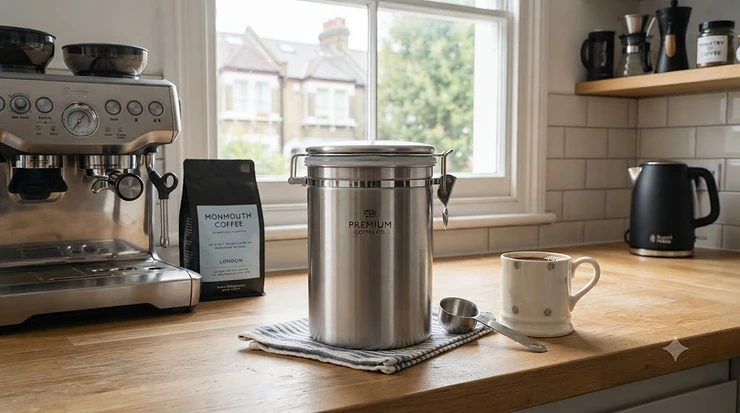
There’s a particular kind of kitchen heartbreak that only coffee drinkers understand: you finally splash out on a proper bag of single-origin beans, forget to reseal it properly, and a fortnight later you’re brewing something that tastes vaguely of cardboard and regret. A stainless steel coffee canister is, in short, a sealed metal storage container — usually brushed or matte finished, sized between 0.4 and 2.8 litres — designed to keep coffee beans or grounds away from the air, light and moisture that wreck their flavour. It’s a small purchase that solves a surprisingly common problem. Across the UK, more people are buying beans in bulk from independent roasters, and the flimsy paper bag they arrive in was never built for the long haul.
This guide digs into seven real, currently available options — from budget-friendly tins under £20 to vacuum-sealed premium canisters that specialty roasters actually recommend. We’ll look at genuine specifications, aggregated customer sentiment where it’s verifiable, and the honest trade-offs between a mirror-polished stainless coffee tin and a brushed steel coffee canister with a proper CO2 valve. Along the way we’ll cover rust resistance, matte finish durability, and how to fit a stainless coffee storage for kitchen counter setup into even the smallest worktop. According to the Food Standards Agency, transferring dry goods into sealed, pest-proof containers is standard good practice for keeping perishables fresh and free from contamination — and that’s exactly the job these canisters are built for.
Whether you’re chasing the longest possible shelf life for £40 whole-bean bags or you just want your worktop storage to stop looking like a jumble sale, there’s a genuinely useful pick below. Let’s get into it.
Quick Comparison: Stainless Steel Coffee Canisters at a Glance
Before the deep dive, here’s how the seven canisters stack up on the essentials that actually affect your morning coffee.
| Product | Capacity | Finish | Best For |
|---|---|---|---|
| Fellow Atmos Vacuum Canister | 0.4L–1.2L | Matte black/white stainless | Serious freshness obsessives |
| Airscape Kilo | 1kg (2.2lb) beans | Brushed steel | Bulk buyers, large households |
| Coffee Gator Canister | 1.3L | Brushed stainless | Best all-round value |
| KC Kitchen & Co Canister | 1L | Matte black | Compact worktops |
| Tower Cavaletto Set of 3 | 1.3L each | Matte with rose gold | Tea, coffee and sugar together |
| Esilihom Airtight Canister | 1.8L | Polished stainless | Budget bulk storage |
| Premier Housewares Chai Set | Set of 3, varied | Mirror-polished | Classic worktop storage look |
Looking at the spread above, what stands out is how differently “stainless steel coffee canister” gets interpreted across brands — from a genuinely engineered vacuum system in the Fellow Atmos Vacuum Canister down to a straightforward wipe-clean tin in the Premier Housewares Chai Set. If you drink through a bag of beans within two to three weeks, the extra engineering in a vacuum canister matters less than it sounds; if you buy in bulk or go through beans slowly, it starts to matter a great deal, which is exactly what the individual write-ups below unpack.
💬 Just one click — help others make better buying decisions too!😊
Top 7 Stainless Steel Coffee Canisters: Expert Analysis
1. Fellow Atmos Vacuum Canister — best for active vacuum-sealing
The standout here is the built-in vacuum pump, which is a genuinely different approach from the passive “airtight” seal most competitors rely on. Twisting the lid back and forth manually draws air out of the canister, and a small indicator dot drops to show when a vacuum lock has been achieved. The body is made from food-safe 304 18/8 stainless steel in the matte black and white colourways (a clear borosilicate glass version is also sold under the same name, so it’s worth checking which you’re buying), and it comes in three sizes — 0.4L, 0.7L and 1.2L — holding roughly 170g, 285g and 450g of beans respectively.
Based on the spec comparison with passive-seal canisters, the active vacuum mechanism genuinely earns its higher price for anyone buying beans they intend to keep for more than two or three weeks; removing oxygen mechanically does more than a static rubber gasket ever can. This is squarely a canister for people who buy larger bags or roast-to-order subscriptions and want to stretch every gram. Aggregated UK retail listings for the matte black 1.2L version show a rating around 4.6 out of 5 from over 200 reviewers at the time of research, with reviewers consistently noting the satisfying “click” of the vacuum lock as reassurance the seal has worked. A recurring theme in feedback is that the twist mechanism needs re-locking every four to five days as the vacuum naturally equalises — not a fault, just something to build into your routine.
Pros:
- ✅ Active vacuum pump genuinely removes oxygen, not just seals it in
- ✅ Vacuum lock indicator shows at a glance when it’s sealed
- ✅ Food-safe 304 stainless steel body resists staining
Cons:
- ❌ Requires manual re-locking every few days to maintain vacuum
- ❌ Hand wash only, and sits at the pricier end of this list
Prices for the Fellow Atmos Vacuum Canister typically sit in the £30–£45 range depending on size, which is a fair ask given the mechanism inside — this isn’t just a tin with a nicer badge.
2. Airscape Kilo — best for bulk bean buyers
The standout feature is capacity: this is built specifically for a full kilogram bag, which is exactly the size most Italian and specialty import coffees come in. The body stands 8 inches tall in brushed or matte stainless steel, and inside sits Planetary Design’s patented inner lid, which you push down by hand to force excess air out before sealing — it makes an audible “swoosh” as it works, which is oddly satisfying and doubles as confirmation the seal has engaged.
What most buyers overlook about this model is that the visible push-lid mechanism means you can literally see and hear the air being expelled every time, unlike sealed systems where you’re trusting the process blind. It’s aimed squarely at households or small offices that buy coffee in bulk rather than 200g bags, and the restaurant-grade steel construction reflects that commercial lineage. Reviewers on manufacturer and retail listings consistently report that the exterior resists staining and doesn’t retain odours even after years of daily use, though a handful note that some finishes use a painted rather than bare-metal exterior, so it’s worth checking the specific listing if a fully uncoated steel surface matters to you.
Pros:
- ✅ Full 1kg capacity suits bulk-buying households
- ✅ Visible, audible push-lid confirms the seal is working
- ✅ Restaurant-grade steel resists staining and odour retention
Cons:
- ❌ Tall 8-inch footprint needs decent cupboard or worktop clearance
- ❌ Painted finish on some colourways, not bare stainless throughout
Expect the Airscape Kilo to sit in the £28–£35 range at the time of research, which is reasonable value once you factor in how much coffee it’s actually designed to hold.
3. Coffee Gator Canister — best all-round value
The standout feature here is the one-way CO2 release valve paired with a genuinely useful calendar dial, both included at a price that undercuts most of this list. The stainless steel body holds 1.3 litres (a smaller 900ml version also exists), and the lid lets naturally occurring carbon dioxide escape from freshly roasted beans without letting oxygen back in — a detail cheaper canisters often skip entirely.
Here’s what the spec sheet won’t tell you outright: that CO2 valve matters disproportionately if you buy from roasters who ship beans within a day or two of roasting, since freshly roasted coffee off-gasses heavily for the first week or so, and a fully sealed container without a valve can actually bulge or struggle to reseal properly. This makes the Coffee Gator Canister a smart pick for anyone supporting independent UK roasters rather than buying pre-rested supermarket bags. It ships with a matching scoop that clips neatly inside the lid, which sounds minor until you’ve lost the third scoop this year to the back of a cutlery drawer.
Pros:
- ✅ CO2 valve handles freshly roasted beans properly
- ✅ Included scoop stores inside the lid, hard to misplace
- ✅ Genuinely competitive price for the feature set
Cons:
- ❌ 1.3L size can feel large once beans run low
- ❌ Date-tracker wheel is a manual dial, easy to forget to set
At under £20 in most UK listings, the Coffee Gator Canister is difficult to beat on pure value, and it’s a sensible starting point if this is your first purpose-built coffee canister.
4. KC Kitchen & Co Canister — best matte finish pick for small worktops
The standout feature is the compact 1L / 250g-bean footprint paired with a genuinely matte black finish that doesn’t show fingerprints the way polished steel does. It uses a vacuum lid with an aroma seal rather than an active pump, meaning it’s a simpler mechanism than the Fellow Atmos Vacuum Canister but noticeably tidier-looking than most budget tins.
What most buyers overlook about a matte finish specifically is that it’s more forgiving day-to-day than mirror-polished stainless — smudges and light scuffs are far less visible, which matters if the canister lives permanently next to your kettle rather than tucked in a cupboard. This is a strong shout for anyone with limited worktop storage who still wants something that looks considered rather than purely functional. Genuinely verifiable aggregated review data here is a real strength: the listing shows a rating of 4.7 out of 5 from over 2,600 UK ratings at the time of research, with reviewers repeatedly praising the seal quality and the fact it holds a standard 250g bag without excess empty headspace.
Pros:
- ✅ Matte black finish hides fingerprints and light scuffs well
- ✅ Sized to match a standard 250g bag with minimal empty air
- ✅ Strong, verifiable aggregated rating from thousands of UK buyers
Cons:
- ❌ 1L capacity is too small for anyone buying in bulk
- ❌ Vacuum lid seal, not an active pump, so less aggressive than Atmos
Priced around £15–£20 in most UK listings, the KC Kitchen & Co Canister earns its place through sheer consistency of feedback rather than flashy extras.
5. Tower Cavaletto Set of 3 — best for coordinated worktop storage
The standout feature is that you get three matching canisters — for coffee, tea and sugar — in one purchase, each with a 1.3-litre capacity and the same matte finish with rose gold accents across the set. In fairness to accuracy here: Tower’s own listings describe the material as carbon or alloy steel with a rustproof coating rather than the 18/8 food-grade stainless used in most of this list, so it sits slightly apart from a strict “stainless steel coffee canister” definition, but it’s included because it’s genuinely popular for exactly this use case and worth understanding honestly rather than ignoring.
Based on the spec comparison, this set is really about kitchen aesthetics and worktop storage coordination rather than maximum coffee freshness performance — the removable lids aren’t built around an active seal mechanism the way the Coffee Gator Canister or Fellow Atmos Vacuum Canister are. Reviewers on UK retail sites consistently praise the look of the set and how well it photographs on an open shelf, with a recurring aggregated rating around 4.5 out of 5, though a minority of reviews flag that one canister in a set occasionally doesn’t close quite as snugly as the other two.
Pros:
- ✅ Matching three-piece set covers coffee, tea and sugar in one look
- ✅ Rustproof coated finish suits an open, visible worktop display
- ✅ Wipe-clean maintenance, no special care needed
Cons:
- ❌ Coated carbon steel, not solid 18/8 stainless like most entries here
- ❌ Lid seal is basic, not designed for long-term bean freshness
The full Tower Cavaletto Set of 3 typically runs £20–£30, which is sensible if you want a cohesive worktop look more than lab-grade freshness retention.
6. Esilihom Airtight Canister — best budget bulk option
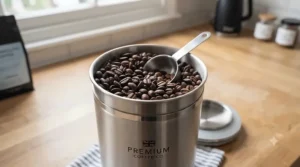
The standout feature is sheer capacity for the price: 1.8 litres of stainless steel storage, complete with a CO2 release valve, a rotating date-tracker dial and an included measuring scoop, all sold well under £20 in most UK listings. It’s available in black, silver and beige, so it’s easier to match to existing kitchenware than some of the single-colourway options above.
What the spec sheet won’t tell you, but the price point implies, is that build tolerances here are noticeably looser than the premium picks — the lid seal is effective but not vacuum-grade, and it’s a container built to a budget rather than engineered from the ground up. That’s a fair trade-off for a 1.8L canister at this price, and it’s genuinely useful for households that buy 1kg bags but don’t want to spend £30-plus on the Airscape Kilo. Because verified individual customer reviews specific to this exact listing were limited at the time of research, it’s worth relying on the specification sheet itself — CO2 valve, date wheel, scoop — rather than anecdotal claims, and treating it as a capable budget option rather than a premium one.
Pros:
- ✅ Large 1.8L capacity at a genuinely budget price
- ✅ Includes CO2 valve, date wheel and scoop as standard
- ✅ Available in multiple finishes to match existing kitchenware
Cons:
- ❌ Build tolerances looser than premium vacuum-sealed options
- ❌ Limited verified UK review data at time of research
At £15–£20 in most UK listings, the Esilihom Airtight Canister is a sensible pick if capacity and price matter more to you than precision engineering.
7. Premier Housewares Chai Set — best classic mirror-polish look
The standout feature is the traditional mirror-polished stainless steel finish and dabba-style silhouette — a set of three canisters in graduated sizes, sold as a coordinated silver set rather than a single unit. It’s a more classic aesthetic than the matte finishes elsewhere on this list, closer to the stainless coffee tin look many people associate with traditional kitchenware.
Here’s what’s worth weighing honestly: mirror-polished steel looks genuinely striking when new, but it shows fingerprints, water spots and light scratches far more readily than a matte or brushed finish, so it demands more frequent wiping if it lives permanently on an open worktop. That’s not a flaw exactly — it’s a genuine trade-off between visual impact and low-maintenance living, and one that beginners often don’t anticipate until they’ve owned it a few weeks. This set suits buyers prioritising a classic look and coordinated worktop storage for tea, coffee and sugar together over any single canister’s coffee-specific features like CO2 valves. Verifiable individual customer review data for this specific set was limited during research, so treat the maintenance point above as the key consideration rather than any invented star rating.
Pros:
- ✅ Classic mirror-polished look suits traditional kitchen styling
- ✅ Set of three covers coffee, tea and sugar in one purchase
- ✅ Graduated sizes make efficient use of worktop space
Cons:
- ❌ Mirror finish shows fingerprints and water spots easily
- ❌ No CO2 valve or vacuum seal for serious bean freshness
The Premier Housewares Chai Set generally sits in the £15–£25 range, making it a reasonable budget pick for anyone prioritising looks and coordinated storage over technical freshness features.
Setting Up and Maintaining Your Canister: A Practical Guide
Getting a new stainless steel coffee canister home is the easy part — getting the most out of it over the following year takes a few habits most product listings never mention. Start by hand-washing it before first use, even though it looks spotless out of the box; manufacturing residue and factory oils are common on stainless kitchenware and won’t show up visually. Dry it completely before adding coffee, since any dampness left inside undoes the entire point of an airtight seal from day one.
In the first month, avoid the temptation to top up an old container’s leftover beans on top of a fresh batch — it mixes staling coffee with fresh, which drags the whole canister’s flavour down faster than either would decline alone. Instead, finish or discard the old beans first, give the canister a quick wipe, then load the fresh bag. For canisters with a CO2 valve, like the Coffee Gator Canister or Esilihom Airtight Canister, resist poking or blocking the valve to “test” it; these are one-way by design and forcing air backwards can damage the seal permanently.
Long-term maintenance is refreshingly low-effort for genuine stainless steel: a monthly wipe with a soft, slightly damp cloth keeps matte finishes looking uniform, while mirror-polished options like the Premier Housewares Chai Set benefit from a dedicated stainless steel polish every few weeks if fingerprints bother you. Avoid abrasive scourers on any of these finishes — they’ll dull a matte coating and scratch a polished one permanently. If a lid seal ever feels less snug than when new, most manufacturers sell replacement silicone gaskets separately rather than requiring a whole new canister, which is worth checking before writing off an otherwise sound unit.
Real-World Scenarios: Matching the Canister to Your Coffee Habit
Picture three different UK kitchens. First, a flat-sharing pair in Manchester who buy a 250g bag of beans roughly every ten days from a local roaster and go through it quickly — for them, the compact KC Kitchen & Co Canister is nearly perfectly sized, since a half-empty 1.8L tin just means more wasted air space accelerating staling. Second, a family of four in a Surrey suburb who buy 1kg bags monthly to keep costs down and drink two or three pots a day between them — the Airscape Kilo genuinely suits this rhythm, holding a full bag with room to visibly track how much is left through the clear top lid.
Third, a home barista in Edinburgh who subscribes to a rotating specialty coffee box and treats freshness as close to a hobby in itself — the Fellow Atmos Vacuum Canister fits this use case specifically, because the active vacuum mechanism extracts genuinely more value from beans that arrive within days of roasting and are meant to be savoured slowly rather than rushed through. None of these three is objectively “best” in isolation; each is matched to a buying pattern and consumption speed that a one-size-fits-all recommendation would miss entirely. If your own habits sit somewhere between these profiles, the Coffee Gator Canister is a sensible middle-ground pick that doesn’t over- or under-serve any particular pace of coffee drinking.
Problem → Solution: Fixing Common Coffee Storage Mistakes
Problem: Beans taste stale within a week of opening. This is almost always an air exposure issue rather than a bad batch. According to specialty coffee industry analysis, ground coffee oxidises dramatically faster than whole beans because grinding exposes far more surface area to oxygen, so the fix is twofold: buy whole beans where possible, and switch to a genuinely airtight canister rather than the original bag’s fold-over seal.
Problem: Condensation appears inside the lid. This usually happens when beans go straight from a cold cupboard or fridge into a room-temperature kitchen, or when a damp scoop is returned to the canister. Never refrigerate or freeze beans you’ll use within a few weeks — let any chilled coffee reach room temperature in its original sealed bag before transferring it.
Problem: The lid won’t seal as tightly as it used to. Silicone gaskets degrade with repeated handling and washing over a year or two. Most brands, including Fellow and Coffee Gator, sell replacement seals separately, which is far cheaper than replacing the whole canister.
Problem: A freshly opened bag makes the canister lid bulge or hiss when opened. This is completely normal and simply means your beans are very fresh and still actively releasing CO2. A canister with a proper one-way valve, like the Coffee Gator Canister or Esilihom Airtight Canister, handles this automatically; without one, just open the lid briefly once a day for the first week to release pressure.
Problem: Worktop space is too tight for a tall canister. The KC Kitchen & Co Canister‘s compact 1L footprint or a single unit from the Tower Cavaletto Set of 3 solves this more comfortably than a tall Kilo-sized option ever will.
How to Choose a Stainless Steel Coffee Canister
- Match capacity to your buying habit. A 1.8L canister for a 250g bag leaves excessive air inside, which accelerates staling — buy the size that closely matches how much coffee you typically have on hand.
- Decide between active and passive sealing. Vacuum-pump systems like the Fellow Atmos Vacuum Canister actively remove air; passive rubber-gasket seals simply block new air from entering. The former suits slow drinkers of premium beans; the latter is fine for anyone working through a bag within two or three weeks.
- Check for a CO2 release valve. If you buy from roasters who ship within days of roasting, a valve prevents pressure build-up and lets you seal freshly roasted beans safely.
- Consider the finish for your kitchen’s traffic. Matte finishes hide fingerprints on a permanently visible worktop; mirror-polished steel looks sharper but needs more frequent wiping.
- Factor in maintenance realism. Hand-wash-only canisters are common at every price point here — if you want something dishwasher-safe, check the specific listing carefully rather than assuming stainless steel always means dishwasher friendly.
- Think about coordinated storage. Sets like the Tower Cavaletto Set of 3 or Premier Housewares Chai Set solve tea, coffee and sugar storage together, which single-canister options don’t.
- Weigh genuine stainless steel against coated alternatives. Not every “steel” canister is 18/8 food-grade stainless — some, like the Tower Cavaletto Set of 3, use coated carbon steel, which is a legitimate but different material worth knowing before you buy.
Common Mistakes When Buying a Stainless Steel Coffee Canister
The single most common mistake is buying based on looks alone and ignoring capacity entirely — a beautiful canister that’s twice the size of your typical bag purchase actively works against freshness by trapping more air around fewer beans. A close second is assuming “stainless steel” always means the same food-grade 18/8 alloy; as the Tower Cavaletto Set of 3 demonstrates, some popular canisters use coated carbon steel instead, which is a perfectly reasonable material but not identical in composition or long-term corrosion behaviour.
Buyers also frequently overlook lid mechanism differences, assuming any “airtight” claim performs the same as an active vacuum system — it doesn’t, and the price gap between passive and active sealing usually reflects a genuine engineering difference rather than pure branding. Finally, many people skip checking whether a canister is opaque or partially clear; the Airscape Kilo and several budget tins use a clear top lid for visibility, which is convenient for checking stock levels but does let in more light than a fully opaque body, a trade-off worth knowing about rather than discovering by accident.
Stainless Steel Coffee Canister vs Glass and Ceramic Storage
Glass and ceramic canisters remain popular for their good looks, but they lose to stainless steel on two practical fronts: light exposure and durability. Clear or lightly tinted glass lets UV light degrade coffee’s aromatic compounds over time, which is precisely why most serious stainless steel coffee canisters are deliberately opaque. Ceramic, meanwhile, is heavier and more fragile — a dropped ceramic canister is usually a write-off, where a dented stainless one keeps working perfectly well.
| Material | Light Protection | Durability | Best For |
|---|---|---|---|
| Stainless steel canister | Excellent (opaque) | Very high, dent-resistant | Daily-use worktop storage |
| Glass canister | Poor unless tinted | Fragile, can chip or crack | Display-focused storage |
| Ceramic canister | Excellent (opaque) | Fragile, heavy | Occasional or careful use |
The trade-off worth noting is that glass wins purely on visibility — you can see exactly how much coffee is left without opening the lid, which none of the stainless options here offer unless they include a clear top window like the Airscape Kilo. For anyone weighing looks against practicality, though, a genuinely opaque stainless steel coffee canister protects flavour more consistently across a typical month of daily use than either alternative.

Matte Finish vs Mirror Polish: Which Actually Performs Better?
Functionally, matte and mirror-polished stainless steel protect coffee identically — the finish is cosmetic and has no measurable effect on airtightness or freshness retention. Where they genuinely differ is daily livability. A matte finish, like the one on the KC Kitchen & Co Canister, diffuses light and largely hides fingerprints, light scuffs and water spots, making it far more forgiving on a permanently visible worktop that gets touched multiple times a day.
Mirror-polished steel, as seen on the Premier Housewares Chai Set, reflects light dramatically and looks genuinely striking when freshly wiped — but that same reflectivity means every fingerprint and water droplet shows immediately, demanding more frequent cleaning to maintain the look. Reviewers across both finish types consistently note this same pattern: matte options get described as “low-maintenance,” while mirror-polished sets more often mention needing “a quick polish now and then.” Neither is objectively better; it’s a genuine style-versus-upkeep decision worth making deliberately rather than by accident.
Rust Resistance and Food-Safe Stainless: What the Grades Mean
Not all stainless steel is created equal, and rust resistance is where that difference actually shows up over years of kitchen use. Most premium coffee canisters, including the Fellow Atmos Vacuum Canister and Airscape Kilo, use 304-grade (often labelled 18/8) stainless steel, which combines roughly 18% chromium and 8% nickel to form a self-repairing protective oxide layer on the surface. According to a peer-reviewed materials science study from the University of Trento, 304-grade stainless steel is widely used across food and beverage handling specifically because of this corrosion-resistant chromium oxide layer, though the same research notes it can still be vulnerable to pitting corrosion when repeatedly exposed to high chloride environments such as salty water or harsh cleaning chemicals.
For a coffee canister, that practical takeaway is reassuring: dry beans and grounds present essentially none of the chloride exposure that causes pitting, so genuine 304 stainless steel canisters resist rust extremely well under normal kitchen conditions for years. Where rust risk creeps in is with coated carbon steel alternatives, like the finish used on the Tower Cavaletto Set of 3 — the coating provides real protection, as manufacturers describe it, but a scratch that exposes bare metal underneath removes that protection locally, unlike solid stainless steel where the corrosion resistance runs through the entire thickness of the material. As the broader materials reference on stainless steel explains, this self-healing oxide layer is precisely what separates true stainless alloys from steel that merely has a protective surface finish.
Stainless Coffee Storage for Kitchen Counters and Small Worktops
Worktop space is at a premium in most UK kitchens, particularly in flats and older terraced houses where counter runs rarely stretch far. For genuinely tight spaces, the KC Kitchen & Co Canister‘s compact 1L footprint is the standout here — it sits comfortably beside a kettle without dominating the counter, and its matte black finish blends into most colour schemes rather than demanding attention. A single unit pulled from the Tower Cavaletto Set of 3 works similarly well if you’d rather match your sugar and tea storage at the same time.
For kitchens with a touch more room, taller options like the Airscape Kilo make better use of vertical space than horizontal, which is worth considering if your worktop is narrow but your wall cupboards sit high. One practical tip that rarely makes it into product listings: measure the gap under your wall cupboards before buying anything taller than about 20cm, since a canister that’s a centimetre too tall to fit under an overhead unit becomes a permanent obstruction rather than tidy storage. Grouping a canister set together on a small tray, rather than spreading three separate tins across the counter, is a simple trick that visually tidies worktop storage without spending anything extra.
Long-Term Cost and Value: Is a Premium Canister Worth It?
| Product | Price Range | Build Quality | Value Verdict |
|---|---|---|---|
| Fellow Atmos Vacuum Canister | £30–£45 | Precision vacuum mechanism | Worth it for slow-drinking premium beans |
| Airscape Kilo | £28–£35 | Restaurant-grade steel | Strong value for bulk buyers |
| Coffee Gator Canister | Under £20 | Solid mid-tier build | Best overall value on this list |
| Esilihom Airtight Canister | £15–£20 | Budget-tier tolerances | Good value if capacity matters most |
Looking at the table above, the real long-term cost consideration isn’t the canister’s purchase price at all — it’s wasted coffee. A £40 bag of specialty beans that stales two weeks early because of a poorly sealed budget tin has effectively cost you money the canister was supposed to save. On that basis, spending an extra £10–£15 upfront on a genuinely effective seal, whether that’s the Coffee Gator Canister‘s CO2 valve or the Fellow Atmos Vacuum Canister‘s active pump, tends to pay for itself within a few bags of coffee for anyone buying above supermarket-tier beans. For strictly budget supermarket coffee, the cost-per-cup difference is smaller, and a straightforward option like the Esilihom Airtight Canister is perfectly proportionate value.
✨ Don’t Miss These Exclusive Deals!
🔍 Take your coffee storage to the next level with these carefully selected canisters. Click on any highlighted item to check current pricing and availability. These picks will help you keep every bag of beans tasting the way your roaster intended!
Frequently Asked Questions
❓ Does a stainless steel coffee canister keep coffee fresher than the original bag?
❓ Can you put ground coffee and whole beans in the same canister?
❓ Is a stainless steel coffee tin dishwasher safe?
❓ Why does my coffee canister lid feel like it's under pressure when I open it?
❓ What size stainless steel coffee canister do I need for a 250g bag?
Conclusion
A stainless steel coffee canister is one of those unglamorous purchases that quietly pays for itself every time you make a decent cup rather than a stale one. Across this list, the honest verdict is that there’s no single best option — the Fellow Atmos Vacuum Canister genuinely suits anyone treating fresh beans seriously, the Coffee Gator Canister remains the sensible all-rounder for most UK kitchens, and budget-conscious buyers are well served by the Esilihom Airtight Canister or Premier Housewares Chai Set depending on whether capacity or looks matter more.
What matters most, based on everything covered here, is matching capacity and seal type to your actual buying and drinking habits rather than chasing the flashiest feature list. Get that right, and even a modestly priced canister will keep your coffee tasting the way the roaster intended for weeks longer than the bag it arrived in ever could.
Recommended for You
- Vacuum Sealed Coffee Container: 7 Best Picks Tested (2026)
- Airtight Coffee Canister: 7 Best Picks to Keep Beans Fresh (2026)
- Cloth Coffee Filter: 7 Best Reusable Picks for UK Brewers (2026)
Disclaimer: This article contains affiliate links. As an Amazon Associate, I earn from qualifying purchases. If you purchase products through these links, we may earn a small commission at no additional cost to you.
✨ Found this helpful? Share it with your friends! 💬🤗
