
In This Article
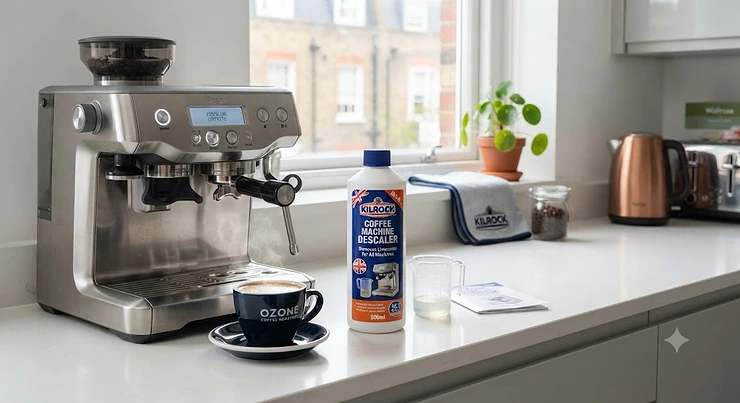
There’s a particular kind of heartbreak that only coffee people understand: you press the button, wait for that familiar hiss and gurgle, and instead you get a slow, apologetic dribble and a cup that tastes faintly of chalk. Nine times out of ten, the culprit isn’t your beans, your grind, or your technique. It’s limescale — a chalky, invisible saboteur living inside your machine’s boiler and pipework, quietly narrowing every channel it touches. A good coffee machine descaler is the unglamorous fix that undoes months of damage in under half an hour.
A coffee machine descaler is a citric-acid, sulphamic-acid, or lactic-acid-based solution designed to dissolve calcium carbonate deposits from a coffee machine’s internal water system, restoring flow, temperature accuracy, and flavour. It’s not optional maintenance — it’s the difference between a machine that lasts a decade and one that limps to its third birthday.
Britain, frustratingly, is not one country when it comes to water. If you’re topping up your machine from a London or Kent tap, you’re fighting a losing battle against some of the hardest water in Europe. If you’re in Glasgow or Cardiff, you’re mostly off the hook. Either way, this guide breaks down seven genuinely good descalers on the market, how to pick between them, and how to build a maintenance habit that actually protects your machine rather than just ticking a box. For a deeper dive into what limescale actually is chemically, Wikipedia’s entry on limescale is a solid starting point.
Quick Comparison Table
| Descaler | Best For | Formula | Price Range |
|---|---|---|---|
| De’Longhi EcoDecalk | Bean-to-cup and pod machines | Plant-based, biodegradable | £15-£20 |
| HG Coffee Machine Descaler | Budget-conscious buyers | Citric acid | £10-£13 |
| Essential Values Coffee Machine Descaler | Multi-brand households | Citric acid blend | £12-£16 |
| Ecozone Coffee Machine Cleaner and Descaler | Eco-conscious households | Plant-based, PETA-approved | £6-£9 |
| Durgol Swiss Espresso Descaler | Espresso machines with stubborn scale | Sulphamic acid | £11-£16 |
| Urnex Dezcal Coffee and Espresso Machine Descaler | Home baristas, frequent users | Activated citric acid | £14-£19 |
| Caffenu Sage & Breville Compatible Descaler | Sage and Breville owners | Citric acid, brand-matched | £15-£20 |
Looking across the table, the split isn’t really about which descaler is “best” in the abstract — it’s about matching chemistry to machine. The De’Longhi EcoDecalk and Caffenu Sage & Breville Compatible Descaler are formulated with specific machine internals in mind, which matters more on complex bean-to-cup systems with delicate seals. Budget picks like HG Coffee Machine Descaler and Ecozone Coffee Machine Cleaner and Descaler do the same basic job for less money, but you’ll want to check dosing carefully since they’re often designed as universal solutions rather than machine-specific ones.
💬 Just one click — help others make better buying decisions too!😊
Top 7 Coffee Machine Descalers: Expert Analysis
1. De’Longhi EcoDecalk — best all-rounder for bean-to-cup machines
De’Longhi EcoDecalk has become something of a default recommendation, and there’s a reason beyond brand loyalty. The plant-based, biodegradable formula is specifically engineered to be gentle on the seals, valves, and thin tubing found in fully automatic bean-to-cup machines — the exact components that cheaper acid blends can gradually degrade with repeated use. Each 500ml bottle delivers five decalcification doses, which for most households works out to roughly a year’s worth of maintenance depending on water hardness.
What most buyers overlook about this descaler is that it isn’t just a De’Longhi-branded citric acid solution rebadged for profit — the biodegradable formulation genuinely differs from the harsher industrial descalers sold for kettles and washing machines, which can leave a chemical aftertaste in coffee if over-dosed. Reviewers consistently report that it clears the “descale” warning light on De’Longhi bean-to-cup models within a single cycle, and a common thread in feedback is that the coffee tastes noticeably cleaner in the days immediately after treatment. A recurring complaint, however, is that non-De’Longhi owners sometimes find the dosing instructions unclear when adapting it to a different brand’s reservoir size.
Pros:
- ✅ Gentle plant-based formula protects seals and delicate tubing
- ✅ Five doses per bottle covers roughly a year of use
- ✅ Clears manufacturer descale warnings reliably in one cycle
Cons:
- ❌ Dosing instructions assume De’Longhi reservoir sizes
- ❌ Pricier per dose than generic citric acid alternatives
At around £15-£20 for 500ml, De’Longhi EcoDecalk sits in the mid-range, and for bean-to-cup owners specifically, it’s worth the premium over a generic descaler — the seal-friendly formula is the kind of detail that pays off in year four, not week one.
2. HG Coffee Machine Descaler — toughest scale removal on a budget
HG Coffee Machine Descaler built its reputation on industrial-strength cleaning products long before it turned to coffee machines, and that heritage shows. The citric-acid formula is unapologetically strong, designed to dissolve heavier, more stubborn limescale build-up that’s been left to accumulate for months rather than weeks — which, if we’re honest, describes most households’ actual descaling habits.
Based on the spec comparison with lighter formulas on this list, HG’s descaler works faster on genuinely bad build-up, which matters if you’ve just moved into a hard-water postcode and inherited a machine nobody’s touched in a year. Reviewers frequently mention that it’s effective even on machines that other descalers “failed” to fully clear, and it’s odour-free during the cycle — a small detail that matters more than you’d think when you’re running a descale cycle in a small kitchen. What the spec sheet won’t tell you, but user reports suggest, is that because it’s a genuinely potent formula, slightly overdosing it (easy to do if you’re eyeballing measurements) can leave a faint citric tang in your first coffee or two afterwards.
Pros:
- ✅ Strong citric acid formula tackles heavy, neglected build-up
- ✅ Odour-free cycle, pleasant to run indoors
- ✅ Works across espresso, pod, and filter machine types
Cons:
- ❌ Overdosing slightly can leave a faint aftertaste
- ❌ Less machine-specific than branded alternatives
At roughly £10-£13 for 500ml, HG Coffee Machine Descaler is one of the most cost-effective options here, and for anyone catching up on months of missed maintenance, its strength is genuinely an asset rather than overkill.
3. Essential Values Coffee Machine Descaler — best universal multi-brand pick
If your household runs more than one coffee machine — a Nespresso for quick mornings, a Sage for weekends — buying brand-specific descaler for each one gets expensive and confusing fast. Essential Values Coffee Machine Descaler solves that by being explicitly formulated to work across De’Longhi, Nespresso, Dolce Gusto, Sage, Lavazza, and most other major brands, with a single 473ml bottle providing four full treatments.
Here’s what to weigh: this isn’t the most specialised formula on the list, but that’s precisely the point. What most buyers overlook is that “universal” doesn’t mean “weaker” — the citric acid blend is calibrated to be strong enough for genuine descaling while staying mild enough not to void warranties across different machine types. Reviewers who own multiple machines consistently note the convenience of stocking one product rather than three, and the review volume behind this one — among the highest of any descaler on Amazon UK — suggests it’s become a genuine household staple rather than a niche pick. The trade-off reviewers mention most is that on particularly scale-heavy machines, it sometimes needs a repeat cycle to fully clear a stubborn warning light.
Pros:
- ✅ Compatible with nearly every major coffee machine brand
- ✅ One bottle covers four full descaling treatments
- ✅ Consistently high review volume signals genuine repeat purchasing
Cons:
- ❌ May need a second cycle on heavily scaled machines
- ❌ Not tailored to any single brand’s internal design
At around £12-£16 for 473ml, Essential Values Coffee Machine Descaler earns its place as the sensible pick for mixed-machine households who’d rather not manage a cupboard full of brand-specific bottles.
4. Ecozone Coffee Machine Cleaner and Descaler — greenest plant-based formula
For households that already read the back of every cleaning product before it goes in the trolley, Ecozone Coffee Machine Cleaner and Descaler is the obvious pick. It’s a plant-based, PETA-approved formula that avoids the harsher synthetic acids used in some budget descalers, and Ecozone has built its whole identity around allergy-friendly, biodegradable household products — this isn’t greenwashing bolted onto an existing product line.
What most buyers overlook about eco-formulated descalers is a fair assumption that “gentle” means “less effective” — but citric acid, the active ingredient here, is itself a naturally occurring plant compound and one of the more effective descaling agents available, gentle formulation doesn’t require sacrificing cleaning power. Aggregated reviews consistently highlight the lack of any chemical smell during the cycle, and allergy-conscious households specifically call out that it doesn’t trigger the skin or respiratory irritation some report with harsher industrial descalers. The main limitation reviewers flag is that at 500ml with five applications, per-dose cost isn’t dramatically cheaper than premium branded options, despite positioning itself as a budget-friendly choice.
Pros:
- ✅ Plant-based formula, PETA-approved and biodegradable
- ✅ No chemical odour or fumes during the cycle
- ✅ Well suited to allergy-conscious and sensitive households
Cons:
- ❌ Per-dose price isn’t dramatically cheaper than premium brands
- ❌ Less brand recognition than De’Longhi or Durgol
At roughly £6-£9 for 500ml, Ecozone Coffee Machine Cleaner and Descaler is genuinely one of the cheapest entries on this list, making the eco-credentials feel like a bonus rather than a premium you’re paying extra for.
5. Durgol Swiss Espresso Descaler — fastest-acting premium formula
Swiss manufacturing has a certain reputation for precision, and Durgol Swiss Espresso Descaler leans into it. Rather than citric acid, it’s formulated with sulphamic acid, which reacts faster and more aggressively with calcium carbonate deposits — the trade-off is a product that demands more careful handling but rewards you with a noticeably quicker descaling cycle.
Based on the spec comparison, Durgol’s two 125ml bottles are dosed for concentrated, single-use application rather than diluted multi-treatment bottles, which explains why the price per millilitre looks steep next to citric-acid competitors until you account for potency. Reviewers who run high-end espresso machines — the kind with narrow steam wands and precision-machined group heads — consistently praise how thoroughly it clears scale from tight internal passages that gentler formulas can struggle to reach. What the spec sheet won’t tell you, but user reports suggest, is that the stronger acid means you should follow the rinse cycle instructions to the letter; skipping a rinse step is more noticeable with sulphamic acid than with milder citric formulas.
Pros:
- ✅ Sulphamic acid formula clears scale significantly faster
- ✅ Reaches narrow steam wands and tight passages effectively
- ✅ Trusted by serious home espresso enthusiasts
Cons:
- ❌ Requires more careful rinsing than milder formulas
- ❌ Higher cost per millilitre than citric-based options
At around £8-£11 for two 125ml bottles, Durgol Swiss Espresso Descaler is a premium pick that earns its price tag if your machine sees daily, serious use.
6. Urnex Dezcal Coffee and Espresso Machine Descaler — professional-grade barista favourite
Urnex Dezcal Coffee and Espresso Machine Descaler is the name you’ll see behind the counter at independent coffee shops, and the 900g bottle size is a giveaway that this product wasn’t originally designed with a single home machine in mind. It’s an activated scale remover built around citric acid, but formulated at commercial-grade concentration, which means one bottle stretches across many, many home descaling cycles.
Here’s what to weigh: buying a professional-strength product for home use only makes sense if you actually use it often enough to justify the bulk size, or you’re willing to store the leftover. Reviewers consistently note that Urnex works fast even on machines with genuinely severe scale build-up — the kind picked up second-hand or inherited from a previous tenant with no maintenance history — and it’s odour-neutral, a detail baristas particularly value in enclosed commercial kitchens. A common thread in feedback is that home users occasionally find dosing math for smaller reservoirs fiddly, since the concentration and bottle size are pitched at commercial-scale usage rather than a single domestic machine.
Pros:
- ✅ Commercial-grade formula trusted by professional coffee shops
- ✅ Large bottle covers dozens of home descaling cycles
- ✅ Odour-neutral, fast-acting even on severe scale build-up
Cons:
- ❌ Dosing for small home reservoirs requires extra care
- ❌ Bulk size is impractical for occasional light users
At roughly £14-£19 for 900g, Urnex Dezcal represents genuinely excellent value per treatment for anyone running an espresso machine daily, though occasional users may find the bulk size more than they need.
7. Caffenu Sage & Breville Compatible Descaler — best brand-matched formula for Sage machines
Sage and Breville machines (the same company, different names either side of the Atlantic) have a loyal following, and Caffenu Sage & Breville Compatible Descaler was built specifically to work with their internal componentry rather than as a generic afterthought. The 400ml bottle delivers four uses, and Caffenu positions itself explicitly as a citric-acid alternative to the official Sage-branded descaling sachets.
What most buyers overlook is that Sage’s own machines are fairly particular about descaling solution compatibility — the brand’s automated descale programmes are calibrated around specific acid concentrations, and using an ill-matched generic descaler can occasionally trigger incomplete-cycle warnings. Caffenu’s formula is designed to sidestep that friction. Reviewers consistently report smoother, quieter operation post-treatment on Sage Barista and Oracle models specifically, alongside reports of hotter, more consistent extraction temperatures. A recurring theme in feedback, unsurprisingly, is that this isn’t the right pick if you don’t actually own a Sage or Breville machine — its brand-matched formulation is a strength for the right buyer and an unnecessary premium for anyone else.
Pros:
- ✅ Formulated specifically for Sage and Breville internal components
- ✅ Compatible with automated descale programme requirements
- ✅ Reviewers report improved extraction temperature after treatment
Cons:
- ❌ Premium pricing compared to universal descalers
- ❌ No advantage if you don’t own a Sage or Breville
At around £15-£20 for 400ml, Caffenu Sage & Breville Compatible Descaler is a targeted buy — skip it if you’re not in the Sage or Breville ecosystem, but prioritise it if you are.
Practical Usage Guide: How to Use a Coffee Machine Descaler Properly
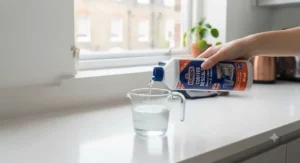
Buying the right descaling solution is only half the job — using it correctly is what actually protects your machine. Start by checking your machine’s manual for its recommended dilution ratio and cycle length; manufacturers calibrate these figures around their specific internal geometry, and eyeballing it “close enough” is one of the most common ways people under- or over-treat their machine. Always empty the water reservoir completely before adding the descaling solution, and remove any coffee pods, capsules, or ground coffee from the system first.
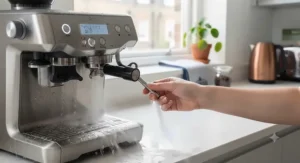
Most machines need the solution run through in stages rather than one continuous pour — many descale programmes automatically pause halfway to let the solution sit and dissolve stubborn deposits before continuing. Resist the urge to skip this pause; the “soak” period is doing more chemical work than the flow itself. Once the cycle finishes, always run at least two full rinse cycles with clean water before making coffee — residual descaling solution is the single biggest cause of that lingering chemical aftertaste people blame on the product itself, when it’s actually an incomplete rinse. Finally, set a recurring reminder rather than waiting for a warning light: by the time your machine tells you it needs descaling, damage has often already begun.
Real-World Scenarios: Matching the Right Descaler to Your Machine
Picture three households. First, a young professional in a Zone 2 London flat with a single De’Longhi bean-to-cup machine, making two flat whites a day before work. London’s notoriously hard water means this person should be descaling every four to six weeks, and De’Longhi EcoDecalk is the obvious fit — it’s formulated specifically for the seals in this exact machine category, and the moderate five-dose bottle matches a realistic usage cycle.
Second, a family in Kent running both a pod machine and a hand-me-down espresso machine, feeding a household of four coffee drinkers plus weekend guests. Buying two brand-specific descalers is wasteful here — Essential Values Coffee Machine Descaler‘s cross-brand compatibility means one bottle covers both machines, and Kent’s very hard water (among the hardest in the country) makes the four-treatment bottle a sensible three-month supply rather than a year’s stockpile.
Third, a home barista in Manchester (soft water territory) with a daily-use Sage Barista Express, treating espresso as a genuine hobby rather than a caffeine delivery system. Lower water hardness means less frequent descaling is needed, but when it does happen, precision matters more than frequency — Caffenu Sage & Breville Compatible Descaler‘s brand-matched formulation protects the machine’s more sophisticated internals, which is worth the premium for someone who’s already invested heavily in the equipment itself.
Problem → Solution: Common Limescale Build-Up Issues
Problem: Coffee is taking noticeably longer to brew. This is almost always restricted water flow from scale narrowing internal pipework. Run a full descaling cycle immediately rather than waiting for a warning light — by the time flow visibly slows, deposits are already substantial.
Problem: Visible white flecks floating in your coffee. This means limescale has broken loose and is passing straight into your cup. It’s not harmful in small quantities, but it signals significant internal build-up. A descale cycle followed by two rinse cycles should clear it; if flecks persist after treatment, the machine may need professional servicing.
Problem: Machine won’t reach full brewing temperature. Scale acts as an insulating layer on heating elements, meaning the element has to work harder to reach the same temperature — and often falls short. Regular descaling with a formula matched to your machine type, like Durgol Swiss Espresso Descaler for espresso machines with dedicated boilers, restores full heat transfer.
Problem: The machine’s steam wand has lost pressure. Narrow steam wand channels are particularly vulnerable to scale, since hot steam accelerates mineral deposition. A descaler formulated for tight passages, such as Urnex Dezcal Coffee and Espresso Machine Descaler, tends to clear this more thoroughly than milder formulas.
Problem: Descale warning light won’t clear after treatment. This usually means either the cycle wasn’t completed fully, or the machine’s internal sensor requires a specific concentration to reset. Repeat the full cycle exactly per the manual’s instructions, ensuring the solution runs through every stage without interruption.
How to Choose a Coffee Machine Descaler
- Check your machine’s manufacturer recommendation first. Some brands, particularly Sage and De’Longhi, calibrate their descale programmes around specific acid concentrations — deviating can trigger incomplete-cycle warnings even when the descaler works chemically.
- Match the formula strength to your descaling frequency. If you’re catching up on months of neglect, a stronger formula like HG Coffee Machine Descaler clears heavier build-up faster than a gentle one.
- Consider multi-brand compatibility if you own more than one machine. A universal descaler such as Essential Values Coffee Machine Descaler avoids cluttering your cupboard with single-use bottles.
- Weigh eco-credentials against your household priorities. If allergy sensitivity or biodegradability matters to you, Ecozone Coffee Machine Cleaner and Descaler offers genuine plant-based formulation without sacrificing effectiveness.
- Factor in your local water hardness. Hard water areas need more frequent, and sometimes stronger, treatment — soft water areas can often stretch treatments further with milder formulas.
- Calculate cost-per-treatment, not just bottle price. A bulk product like Urnex Dezcal looks expensive upfront but often works out cheapest per descaling cycle for frequent users.
- Don’t ignore machine-specific formulas if you own a premium machine. The seal-friendly chemistry in branded descalers like De’Longhi EcoDecalk or Caffenu Sage & Breville Compatible Descaler protects components that generic acid blends can gradually wear down.
Descaler for Bean-to-Cup Machine: What’s Different?
Bean-to-cup machines are mechanically the most complex coffee makers most people own — grinder, tamper, boiler, milk frother, and dispensing system all integrated into one unit, connected by narrow tubing and rubber seals that a simple filter machine simply doesn’t have. This complexity is exactly why a descaler for bean-to-cup machine use needs to be chosen more carefully than for a basic drip machine.
The seals in bean-to-cup systems are particularly vulnerable to harsh, high-concentration acid formulas, which can gradually degrade rubber over repeated exposure — something that matters far less in a simple kettle-style descaler. This is why manufacturer-specific formulas like De’Longhi EcoDecalk exist at all: the plant-based, lower-aggression formula is specifically tuned to clear scale from the boiler and internal tubing without accelerating seal wear. Reviewers who’ve owned bean-to-cup machines for several years consistently note that sticking with the manufacturer-recommended formula, rather than switching to whatever’s cheapest, correlates with fewer seal-related repairs down the line. If your bean-to-cup machine also has an integrated milk system, check whether it needs a separate milk-line cleaning cycle in addition to descaling — the two processes address entirely different residues and neither substitutes for the other.
Hard Water Areas and Why Your Postcode Matters
Water hardness in the UK isn’t evenly distributed — it follows the underlying geology, particularly chalk and limestone deposits, rather than any administrative boundary. According to the Drinking Water Inspectorate, water hardness is measured in milligrams of calcium carbonate per litre, with anything above 300mg/l classified as very hard. Broadly speaking, the south and east of England — London, Kent, Essex, Cambridgeshire, much of the Home Counties — sit firmly in “very hard” territory, while Scotland, Wales, Northern Ireland, and much of the north-west of England enjoy comparatively soft water.
This matters enormously for descaling frequency. A household in a very hard water postcode might need to descale their machine every three to four weeks to keep pace with mineral accumulation, while a household in Glasgow or Cardiff, drawing from naturally soft reservoirs, might comfortably stretch that to every two to three months. If you’re unsure which category your area falls into, your local water company can usually provide an exact hardness figure for your postcode — worth checking before you settle into a maintenance schedule based on guesswork. The practical upshot: buyers in hard water areas should lean toward multi-dose bottles like Essential Values Coffee Machine Descaler or HG Coffee Machine Descaler, simply because they’ll be working through treatments faster than someone in a soft water region.
Machine Lifespan: The Long-Term Cost of Skipping Descaling
It’s tempting to treat descaling as optional — a “when I remember” chore rather than genuine maintenance. The reality is blunter: limescale build-up is one of the leading causes of premature coffee machine failure, and it’s almost entirely preventable. Scale doesn’t just slow your brew; it insulates heating elements, forcing them to work harder and burn out faster, and it can eventually clog valves and pumps to the point of complete failure, which typically means an expensive repair or a full replacement rather than a simple fix.
Run the numbers and the case for regular descaling is straightforward: a mid-range bean-to-cup machine costing several hundred pounds, maintained with a £15-£20 bottle of descaler every couple of months, can reasonably be expected to last many years longer than the same machine left untreated. Total cost of ownership tips heavily in favour of consistent maintenance — a handful of descaling treatments across a machine’s life is a fraction of the cost of premature replacement. Beyond the hardware itself, neglected machines also lose efficiency gradually, meaning higher energy use per cup as heating elements compensate for scale insulation — a slow, invisible cost that rarely gets factored into the “am I bothered to descale today” calculation, but probably should.
Coffee Machine Descaler vs Traditional Alternatives
| Method | Effectiveness | Machine Safety | Best For |
|---|---|---|---|
| Purpose-made descaler | High — formulated for calcium carbonate | Safe when used as directed | Regular scheduled maintenance |
| White vinegar | Moderate — slower acting | Risk of seal damage over time, leaves odour | Emergency, one-off use only |
| Citric acid (DIY) | Moderate-high | Generally safe if machine tolerates acid | Budget-conscious, occasional use |
| No descaling | None | Severe long-term damage | Not recommended |
The comparison here is less about which method “works” in a lab sense and more about what’s sustainable and safe over years of repeated use. Purpose-made descalers like the seven featured above are formulated specifically around calcium carbonate chemistry and tested against real machine seals, which household vinegar simply wasn’t designed for — vinegar can leave a lingering odour and, with repeated use, gradually degrade rubber components that a proper descaler is engineered to protect. DIY citric acid sits in a reasonable middle ground, but dosing accuracy is harder to control without pre-measured sachets or bottles, which is where purpose-made products earn their price premium.
What to Expect: Real-World Performance
Specs and marketing copy only tell half the story — what actually changes day to day once you start descaling regularly? The most immediately noticeable shift is speed: machines that had slowed to a frustrating trickle typically return to their original brewing pace within one or two cycles. Temperature consistency improves too, often producing a genuinely different-tasting cup, since under-extracted coffee (a common result of scale-insulated heating elements running cool) tends to taste flat and sour rather than balanced.
Noise is an underrated indicator reviewers mention surprisingly often — heavily scaled pumps and boilers tend to run louder, and a proper descale frequently quietens a machine that’s been getting steadily noisier without anyone quite noticing the gradual change. On the flip side, don’t expect miracles from a single treatment if your machine has been neglected for a year or more; severe scale build-up sometimes needs two consecutive cycles before flow and temperature fully normalise, which is worth knowing so you don’t assume the product has failed after one round.
Safety, Storage and Handling Your Descaling Solution
Most coffee machine descalers use citric, sulphamic, or lactic acid at relatively low concentrations, which makes them safe for home use when the manufacturer’s instructions are followed, but they’re still chemical products and deserve sensible handling. Keep bottles out of reach of children and pets, store them away from direct sunlight and heat, and never mix different descaling products together, since combining acid formulas can produce unpredictable reactions. If solution contacts skin or eyes, rinse thoroughly with water, and always ensure your kitchen has reasonable ventilation during a descaling cycle, particularly with stronger sulphamic-acid formulas like Durgol Swiss Espresso Descaler.
It’s also worth checking your machine’s manual for any acid-tolerance warnings — a small number of machines, particularly older or specialist models, aren’t designed to handle acid-based descaling at all and require an alternative maintenance approach. When in doubt, the manufacturer’s own guidance always takes precedence over generic advice, including this article’s.
Common Mistakes When Buying and Using a Coffee Machine Descaler
The single most common mistake is buying based on price alone without checking machine compatibility — a cheap generic descaler that trips your machine’s built-in sensor into an “incomplete cycle” error isn’t actually cheap once you factor in the wasted bottle and repeated attempts. A close second is skipping the rinse cycles afterward, which leaves residual acid in the system and creates the chemical aftertaste people wrongly blame on the descaler’s formula rather than their own shortcut.
Another frequent error is waiting for a warning light before descaling at all, rather than working to a calendar-based schedule matched to local water hardness — by the time the machine flags a problem, meaningful scale build-up has typically already occurred. Finally, many buyers assume “universal” descalers are automatically weaker than brand-specific ones; as covered earlier, formulas like Essential Values Coffee Machine Descaler are calibrated to be genuinely effective across machine types, not diluted down to a lowest common denominator.
Frequently Asked Questions
❓ How often should I use a coffee machine descaler?
❓ Can I use vinegar instead of a proper limescale remover for coffee machine maintenance?
❓ Is a coffee machine descaler safe for bean-to-cup machines?
❓ What happens if I don't descale my coffee machine?
❓ Do hard water areas need a different type of descaling solution?
Conclusion
Descaling isn’t the most exciting part of owning a coffee machine, but it’s arguably the most consequential — it’s the difference between a machine that quietly serves you well for a decade and one that limps toward an early, expensive death. The right pick genuinely depends on what you own and where you live: bean-to-cup owners in hard water postcodes should lean toward seal-friendly, manufacturer-matched formulas like De’Longhi EcoDecalk, multi-machine households benefit from the flexibility of Essential Values Coffee Machine Descaler, and serious home baristas running daily espresso shots get genuine value from professional-grade options like Urnex Dezcal Coffee and Espresso Machine Descaler.
Whichever you choose, the habit matters more than the specific bottle — a calendar reminder, matched to your local water hardness, will do more for your machine’s longevity than any single “best” product ever could. For step-by-step descaling instructions specific to your machine brand, manufacturer sites like Bosch’s official descaling guide are worth bookmarking alongside whichever descaler you settle on.
Recommended for You
- Valve Coffee Bags For Freshness: 7 Best Picks for UK (2026)
- Resealable Coffee Bags: 7 Best Picks for UK Kitchens (2026)
- Affordable Coffee Storage Canister: 7 Best Budget Picks (2026)
Disclaimer: This article contains affiliate links. As an Amazon Associate, I earn from qualifying purchases. If you purchase products through these links, we may earn a small commission at no additional cost to you.
✨ Found this helpful? Share it with your friends! 💬🤗
