
In This Article
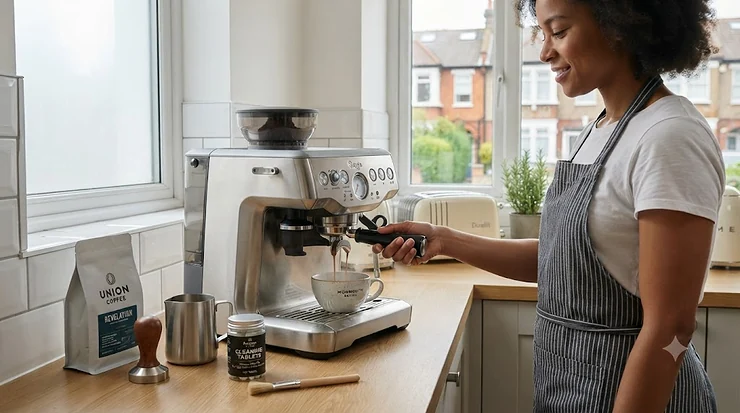
Your espresso is only as good as the pipework it travels through, and most of us never see it. Behind the drip tray and the shiny chrome sits a warm, damp maze that collects coffee oil the way a chip pan collects Sunday’s fat. Espresso machine cleaning tablets are the low-effort fix. They are pre-measured detergent pucks that dissolve into hot water and shift the greasy film a simple rinse never touches.
That’s the headline. The detail is where people slip. A tablet built for a Jura isn’t a casual swap for a Sage. The right dose for a backflush is different from what a bean-to-cup brew unit expects. And cleaning is not descaling, a mix-up I’ll keep flagging because it quietly ruins machines.
This guide pulls together manufacturer guidance, real specifications and published review signals for seven tablets UK owners can buy. It translates them into plain English. If you want the mechanics first, how an espresso machine actually works covers the portafilter, group head and pump. Along the way we’ll cover coffee machine cleaning tablets in general, the difference between an espresso machine cleaner tablets routine and a bean-to-cup one, brew group cleaning, oil residue, and the fiddly question of tablet dosage.
All prices below are ranges, so check current price before you buy.
Quick Comparison Table
| Tablet | Pack | Machine type | Best For |
|---|---|---|---|
| Cino Cleano | 8 tablets | Backflush machines, Sage/Breville-style cycles | Budget home baristas |
| Urnex Cafiza | 2 g tablets, blisters of 8 or larger jars | Backflush machines and super-automatics | Enthusiasts wanting one tablet for many jobs |
| Puly Caff Plus | 1 g × 100 or 2.5 g × 60 tubs | Espresso and bean-to-cup | Busy households and small offices |
| Melitta Perfect Clean | 4 × 1.8 g | Melitta bean-to-cup | Caffeo owners |
| Philips CA6704/10 | 6 × 1.6 g | Philips and Saeco automatics | Monthly brew group care |
| Siemens TZ80001A | 10 × 2.2 g | Siemens EQ and Bosch automatics | Set-and-forget prompts |
| Jura 3-Phase | 6 tablets | Jura automatics | Jura owners |
Read this table as a compatibility filter first and a price comparison second. Most of the tablets here are brand-specific in what their makers recommend, so the Jura 3-Phase, Melitta Perfect Clean and Philips CA6704/10 only make sense if your machine matches. The universal-leaning options, Urnex Cafiza, Puly Caff Plus and Cino Cleano, suit backflushing machines best. Pick your machine type before you think about brand loyalty.
💬 Just one click — help others make better buying decisions too!😊
Top 7 Espresso Machine Cleaning Tablets: Expert Analysis
One caveat before we start. Where I say “reviewers”, I mean published, verifiable customer feedback. Where I couldn’t verify any, I say so rather than dress up a guess.
1. Cino Cleano — budget backflush tablet for Sage-style machines
The appeal is simplicity: one tablet per clean, eight cleans per blister.
The maker cites precise dissolution timing, food-grade ingredients and a non-corrosive formula. Retail listings show the model number BEC250. Timed dissolving matters because a Sage-style built-in cycle only runs for about five minutes, so a tablet that lingers can leave a chalky cake behind.
Based on the specs, this suits home owners with a disc-and-tablet cleaning cycle, though it also works for manual backflushing. The official site announced a UK return after “limited availability”, so stock has been patchy. Some sellers list very broad brand compatibility, so treat that with caution and check your manual.
Review sentiment: one US stockist shows a large pool of reviews (8,708), and visible comments focus on convenience and pre-measured dosing. I couldn’t verify a UK star average.
Pros:
- ✅ Pre-measured single dose per clean
- ✅ Suits automated home backflush cycles
- ✅ Small pack, cheap to try
Cons:
- ❌ Only eight cleans per pack
- ❌ UK stock has been inconsistent
Price: under £10 per 8-pack at the time of research; check current price. Good value for occasional cleaners.
2. Urnex Cafiza — the NSF-certified backflush benchmark
Urnex Cafiza is the tablet other tablets get measured against.
The 2 g, 15 mm tablet suits backflushing: one tablet in the blind basket, ten seconds on and ten off, five times, then a water rinse. Because the dose is fixed, you can’t over-scoop. That matters on machines where residual detergent shows up as a soapy aftertaste.
The versatility is its real trick. The same tablet can go in a drip tray filled two-thirds with hot water for a half-hour soak, or dissolve at one tablet per roughly 470 ml for portafilters and baskets. Retailers say the Cafiza Home version can stand in for Saeco and Solis tablets, but confirm against your manual.
Review sentiment: I couldn’t verify a UK customer aggregate. What is checkable is the NSF certification and that one roundup site names it its top pick for professional use, which is editorial opinion, not customer feedback.
Pros:
- ✅ NSF-certified formulation
- ✅ Backflush, soak and drip-tray uses
- ✅ Fixed 2 g dose removes guesswork
Cons:
- ❌ Cleans only, no descaling
- ❌ Manual backflushing needs a three-way valve
Price: around £5-£7 for an 8-tablet blister on European listings; check current price. Strong value.
3. Puly Caff Plus — Italian pro detergent in big, cheap tubs
Puly Caff Plus is what many cafés reach for, and it scales down well for home.
It comes in two tablet sizes. The 1 g tub suits small domestic bean-to-cup brew units, while the 2.5 g tub suits larger super-automatics and 58 mm espresso machines. The makers say it’s NSF-certified and biodegradable. Big tubs are where the cost per clean collapses.
Dosing guidance varies by source. Puly’s commercial sheet points to one or two tablets per backflush, while UK retailers speak in 3-5 g of powder equivalent. So start at the low end and rinse well. This is the tablet dosage lesson in miniature: check the pack, not a forum.
Review sentiment: one UK forum thread shows an owner switching to Puly tablets over Sage’s pricing, using larger tablets and running the cycle a second time, without detergent, to rinse. That’s a single anecdote, not an aggregate.
Pros:
- ✅ Two sizes for different machine classes
- ✅ NSF-certified, biodegradable formula
- ✅ Very low cost per clean in tubs
Cons:
- ❌ Dosing advice varies between sources
- ❌ Tub is overkill for occasional users
Price: check current price. Higher upfront, cheapest per clean at volume.
4. Melitta Perfect Clean — gentle active-oxygen clean for bean-to-cup
Melitta Perfect Clean uses an active-oxygen formula rather than a brute-force detergent.
Each pack holds four individually wrapped 1.8 g tablets. Melitta’s manual asks for the integrated programme every two months or roughly 200 cups, and more often with dark, oily beans. The programme takes about 15 minutes. It also says to use only Melitta cleaning tabs.
For Caffeo owners it’s the default. For other bean-to-cup owners, retailers say it’s suitable, but your own manual has the final word. Four tablets last around eight months on the manual’s schedule, which is convenient but means reordering.
Review sentiment: I couldn’t find verifiable customer reviews of the tablet itself. Marketplace feedback scores I saw relate to sellers, not the product.
Pros:
- ✅ Gentle formula, designed for automatic programmes
- ✅ Individually wrapped tablets
- ✅ Clear two-monthly cadence from Melitta
Cons:
- ❌ Only four cleans per pack
- ❌ Manual insists on Melitta-only tablets
Price: around £4-£6 per 4-pack in marketplace listings; check current price. Fair value.
5. Philips CA6704/10 — brew group specialist for Philips and Saeco
Philips CA6704/10 is a coffee oil remover aimed squarely at the brew group.
The pack holds six 1.6 g tablets. Philips recommends cleaning at least monthly or after 500 cups. Compatibility spans the 800, 1200, 2200, 3200, 4300, 4400, 5400 and 5500 series, plus GranAroma, Xelsis and semi-auto models.
The clever part is the choice of methods. Machines with a Clean menu prompt you through it. Those with a pre-ground compartment take the tablet there. Models without either use a soak: dissolve one tablet in 150 ml of hot water, clean the brew group filter with a soft sponge, and rinse after 15 minutes. It’s an oil remover, not a descaler.
Review sentiment: I couldn’t verify a reliable customer aggregate.
Pros:
- ✅ Covers many Philips and Saeco series
- ✅ Three usage methods
- ✅ Small tablet dissolves readily
Cons:
- ❌ Six cleans equals six months
- ❌ Philips recommends Philips-only consumables
Price: check current price. Sensible for monthly users.
6. Siemens TZ80001A — 2-in-1 tablet for Siemens EQ and Bosch
Siemens TZ80001A is designed for the automatic cleaning programme in Siemens EQ machines and compatible Bosch models.
A pack contains ten 2.2 g tablets. The machine prompts after around 180 cups or 80 rinses, and retailers suggest at least monthly or every 200-250 servings. Where those disagree, follow your machine’s prompt. Tablet placement differs by model, usually in the brew group or ground-coffee container, so read the manual.
Ten cleans per pack is generous, so one box covers most households for roughly a year. Listings stress that these are cleaning tablets, not descaling tablets.
Review sentiment: an Amazon.de summary says customers are satisfied with cleaning performance, note easy dissolving with no residue, and 27 customers mention ease of use, all positively. That’s a German store, so treat it as indicative.
Pros:
- ✅ Ten cleans per pack
- ✅ Matched to the automatic programme
- ✅ Positive customer summary on Amazon.de
Cons:
- ❌ Brand-specific
- ❌ Placement varies by model
Price: check current price. Good value per clean.
7. Jura 3-Phase — clean-and-protect for Jura machines
Jura 3-Phase adds a protective layer after cleaning.
The six-pack removes coffee fats between brew unit and spout, then seals pipework to slow fat deposition, with complexing agents to resist mineral deposits. Jura prompts around 180 cups or 80 rinses. When the display says “Add Tablet”, drop it into the ground-coffee chute and don’t interrupt the roughly 10-15-minute cycle.
You’re paying for a programme built around the machine, and Jura says to use only its own products. A TÜV hygiene certification appears in retailer listings, but that is a manufacturer claim.
Review sentiment: I couldn’t verify customer reviews.
Pros:
- ✅ Extra protection phase after cleaning
- ✅ Prompt-led, hard to get wrong
- ✅ Designed around Jura’s programme
Cons:
- ❌ Jura-only
- ❌ Six tablets go quickly
Price: check current price. Fair for owners who value simplicity.
| Tablet | Count × weight | Typical cadence | Best For |
|---|---|---|---|
| Cino Cleano | 8 tablets | About every 200 cups (Sage) | Budget backflushers |
| Urnex Cafiza | 2 g tablets | Your routine | Flexible enthusiasts |
| Puly Caff Plus | 1 g or 2.5 g | Your routine | High volume |
| Melitta Perfect Clean | 4 × 1.8 g | Every two months | Caffeo owners |
| Philips CA6704/10 | 6 × 1.6 g | Monthly or 500 cups | Philips/Saeco |
| Siemens TZ80001A | 10 × 2.2 g | On prompt, about monthly | Siemens/Bosch |
| Jura 3-Phase | 6 tablets | About 180 cups | Jura owners |
Cadence is the hidden variable in this table. The Philips CA6704/10 and Melitta Perfect Clean want regular calendar-based cleaning, while the Jura 3-Phase and Siemens TZ80001A follow machine prompts. Backflush users with Urnex Cafiza or Puly Caff Plus set their own rhythm, so build one and stick to it.
What Are Espresso Machine Cleaning Tablets?
Espresso machine cleaning tablets are pre-dosed detergent pucks that dissolve in hot water to strip coffee oil, fine grounds and stale residue from a machine’s brew path. They’re used in backflush cycles, bean-to-cup cleaning programmes and parts soaks. They clean; they don’t descale, which needs an acid-based product.
Why tablets rather than powder? Precision. A powder needs a spoon and a steady hand, whereas a tablet is the dose. Coffee machine cleaning tablets and espresso machine cleaner tablets are the same product family under two names, so don’t let listing wording throw you.
The chemistry matters more than the name. Cleaners work on oils and fats, and descalers work on limescale. Swapping one for the other leaves both jobs half-done, and one guide flatly warns against using espresso detergent tablets for descaling.
How to Choose Espresso Machine Cleaning Tablets
- Match your machine type. Backflushing machines need a blind basket and a tablet that dissolves under pressure. Automatics need tablets designed for their programme.
- Read the manual’s brand rule. Jura, Melitta and Philips each tell owners to use their own tablets.
- Check tablet size. Sizes run from 1.6 g to 2.5 g, and the wrong size may not fit the chute or basket.
- Confirm it’s a cleaner, not a descaler. If the listing says “descale and clean”, check what your machine’s programme actually expects.
- Work out cost per clean. Tubs cost more upfront and less per clean, and blisters do the opposite.
- Look for certification. NSF appears on Urnex Cafiza and Puly Caff Plus, but treat certification as a tie-breaker, not a substitute for compatibility.
- Check stock. Some tablets go in and out of stock, so buy a spare pack before you need it.
Tablet Dosage: How Many, How Often
The rule is one tablet per cycle for nearly everything here. That covers the Sage manual, Cino Cleano, Urnex Cafiza, Siemens TZ80001A, Jura 3-Phase and Ninja machines. The exception is Puly Caff Plus, where the commercial sheet allows one or two.
More isn’t better. Extra detergent just means more rinsing, and Ninja-focused guides suggest running the cycle again without detergent, then pulling a couple of blank shots. Another guide advises checking that the tablet has fully dissolved and repeating the cycle if it hasn’t.
Typical cadence, per the sources I found:
- Sage Barista-style machines: the CLEAN ME light comes on around every 200 cups
- Jura and Siemens: about 180 cups or 80 rinses
- Melitta: every two months or around 200 cups
- Philips: monthly or after 500 cups
- Ninja Luxe Café: around every 200 shots when the CLEAN light appears
Heavy dark-roast users should lean towards the shorter end. The cleaning light is the minimum, not the ideal.
Practical Usage Guide: Run a Clean Without the Drama
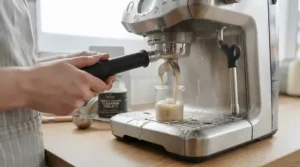
For backflush machines like the Barista Express, Sage’s own instruction book describes the routine. Insert the one-cup basket, then the cleaning disc, then one tablet. Hold the 1 CUP, 2 CUP and POWER buttons for about ten seconds, and the cycle runs for around five minutes. Afterwards, check the tablet has dissolved, and if it hasn’t, run it again.
For bean-to-cup machines, follow the on-screen prompts, drop the tablet in when asked, and don’t interrupt the cycle. Rinse the drip tray and grounds container afterwards.
Four mistakes cost people in the first 30 days:
- Using powder in a tablet-dependent cycle. Some machines expect a tablet to dissolve on cue.
- Skipping the rinse. Run a detergent-free cycle and pull blank shots.
- Turning the machine off at the wall. One guide notes this can reset the cleaning light, so set a calendar reminder instead.
- Forgetting descaling. Tablets clean. They don’t descale.
Real-World Scenarios
The flat-share. Two people, two shots a day each, on a Sage Barista Express. The light appears roughly every three months, so Cino Cleano in an 8-pack lasts around two years. Buy once, store it dry.
The busy family. A Philips automatic, several milky drinks a day, monthly cleaning. The Philips CA6704/10 six-pack covers six months, so reorder before the last tablet goes. If the model has no cleaning programme, use the 150 ml soak method.
The small office. Lots of cups, a semi-automatic, and someone who backflushes daily. A Puly Caff Plus tub wins on cost, and Urnex Cafiza is the fallback if you want fixed 2 g doses.
One aside for owners of the Ninja Luxe Café: Ninja Luxe Café cleaning tablets exist in an 8-pack, and some guides say a Puly or Cafiza equivalent works too. Check your manual first.
✨ Don’t Miss These Exclusive Deals!
🔍 Take your espresso routine to the next level with these carefully selected tablets. Click on any highlighted item to check current pricing and availability. These picks will help you keep every shot tasting clean and balanced!
Problem → Solution: Bitter Shots, Blocked Screens and the Blinking Light
Bitter or stale taste. That’s usually oil residue. Run a full tablet cycle, then a detergent-free rinse, then two blank shots.
The cleaning light won’t switch off. It usually clears once a cycle completes. If a tablet didn’t dissolve, repeat the cycle.
Still getting scale after cleaning. Tablets don’t descale. Your water matters here. England and Wales have the Drinking Water Inspectorate monitoring supply quality, and hardness varies enormously by postcode. Your water company can tell you yours, and it decides how often you need a proper descaler.
Soapy taste after cleaning. You’ve under-rinsed. Run another rinse cycle without detergent and pull blank shots.
Tablet won’t fit. Check the size. Puly Caff Plus comes in 1 g and 2.5 g for a reason, and the wrong one won’t sit in the chute or basket.
Brew Group Cleaning: What the Tablet Does Inside
In a bean-to-cup machine, the brew group is the removable unit that compresses grounds and pushes water through them. Philips describes its tablets as removing grease from the brew group filter. Melitta pairs a weekly hand rinse of the brewing unit with a chemical clean every two months.
Think of it as two tiers. Physical rinsing removes the visible grounds, and the tablet dissolves the oil film you can’t see or reach. For semi-automatics, brew group cleaning means the group head, shower screen and three-way valve, which is why backflushing with a blind basket matters.
Skip either tier and the other struggles. A tablet can’t fix a group clogged with wet grounds, and a rinse can’t dissolve oil.
Oil Residue: Why It Builds Up and What It Tastes Like
Beans carry oils that surface during roasting, and dark roasts are the greasiest. That oil coats hoppers, chutes, brew groups and pipework, then oxidises. The result is bitter, flat, slightly rancid coffee that no grinder tweak fixes.
Melitta advises cleaning more often with dark, oily beans, which is good practice whatever your brand. Puly also claims cleanliness-related issues cause most breakdowns, though that’s a manufacturer claim rather than independent data.
So how do you tell oil residue is your problem? Flavour drifts bitter over weeks, shots taste “dusty”, and a fresh bag doesn’t fix it. A tablet cycle plus rinse is the cheapest first test.
Espresso Machine Cleaning Tablets vs Alternatives
| Method | Dosing precision | Fits automated cycles | Watch-outs | Best For |
|---|---|---|---|---|
| Tablets | High | Yes | Slightly costlier per clean | Beginners with Cino Cleano or Urnex Cafiza |
| Backflush powder | Adjustable, spoon needed | No | Easy to overdose | Pros using Puly Caff Plus powder |
| White vinegar | None | No | Jura and Ninja guidance warns against it | Nobody with an espresso machine |
| Water-only backflush | n/a | No | Doesn’t dissolve oil fully | Weekly upkeep between tablet cleans |
Tablets win on repeatability, which is what most home owners need. Powder rewards experienced users who want to scale doses. Vinegar is the trap. It looks like a thrifty shortcut, but manufacturer-style advice says it can harm seals, so don’t gamble your machine on it.
Long-Term Cost & Maintenance
Cost per clean is the honest metric. Small blisters sit around £1-£1.50 per clean, tubs fall well below that, and brand-locked packs like Jura 3-Phase or Philips CA6704/10 cost more but remove guesswork. Assuming monthly cleaning where the maker doesn’t specify:
| Tablet | Cleans per pack | Packs per year (approx.) | Best For |
|---|---|---|---|
| Cino Cleano | 8 | 1.5 | Low-volume users |
| Urnex Cafiza | 8 (blister) | 1.5 | Flexible users |
| Puly Caff Plus | 60-100 (tub) | Under one | Volume users |
| Melitta Perfect Clean | 4 | 1.5 (two-monthly) | Caffeo owners |
| Philips CA6704/10 | 6 | 2 | Monthly cleaners |
| Siemens TZ80001A | 10 | About 1.2 | Set-and-forget |
| Jura 3-Phase | 6 | About 1 (prompt-led) | Jura owners |
The maths favours tubs for heavy users and bigger packs for prompt-led machines. Price is a small part of running a machine, so weigh it against replacement costs, not against the pennies per tablet. If in doubt, buy the smallest pack that matches your cadence and check current price at reorder time.
Safety, Compliance and Storage
Keep tablets in original packaging, dry, and away from children and pets. Follow the pack’s hazard labelling, and rinse until no detergent taste remains. Never mix tablets with descaler, because they’re different chemistries doing different jobs.
Certifications help, but read them carefully. NSF appears on Urnex Cafiza and Puly Caff Plus listings, while TÜV appears in Jura 3-Phase listings. Machines sold in the UK carry UKCA or CE marking, but that covers the machine, not the tablet. For the tablet, your manual and the pack label are the authority.
Brand-locked advice is worth respecting. Melitta’s UK cleaning guide lists its own tablets and milk-system cleaner, and Jura and Philips give similar guidance. Whether a third-party tablet affects your warranty is a question for the manufacturer, so ask before you swap.
Frequently Asked Questions
❓ Can I use espresso machine cleaning tablets in any bean-to-cup machine?
❓ How many bean-to-cup cleaning tablets will I need per year?
❓ Are coffee machine cleaning tablets the same as descaling tablets?
❓ Do espresso machine cleaner tablets affect my warranty?
❓ Where can I buy brew group cleaning tablets in the UK?
Conclusion
The best espresso machine cleaning tablets are the ones your machine is built to use. If you own a Jura, Melitta, Philips or Siemens, start with the maker’s own tablet. If you backflush a Sage-style or semi-automatic machine, Cino Cleano is the budget entry, Urnex Cafiza is the flexible benchmark, and Puly Caff Plus wins on volume.
Whichever you choose, the routine matters more than the brand. Follow one tablet per cycle unless your maker says otherwise, rinse properly, and treat cleaning and descaling as two separate jobs. Watch for oil residue in the cup, because bitterness is your machine’s way of asking for attention.
If you’re buying today, pick the smallest pack that matches your cadence, add a calendar reminder, and check current price when you reorder. It’s a small habit that protects a much bigger purchase.
✨ Ready to keep every shot tasting clean?
🔍 Click on any highlighted product above to check current pricing and availability. Your machine will thank you with better coffee and a longer life!
Recommended for You
- Descaling Solution vs Citric Acid For Coffee Machines: 7 Best Coffee Picks 2026
- Coffee Machine Descaler: 7 Best Picks For UK Homes (2026)
- Valve Coffee Bags For Freshness: 7 Best Picks for UK (2026)
Disclaimer: This article contains affiliate links. As an Amazon Associate, I earn from qualifying purchases. If you purchase products through these links, we may earn a small commission at no additional cost to you.
✨ Found this helpful? Share it with your friends! 💬🤗
