
In This Article
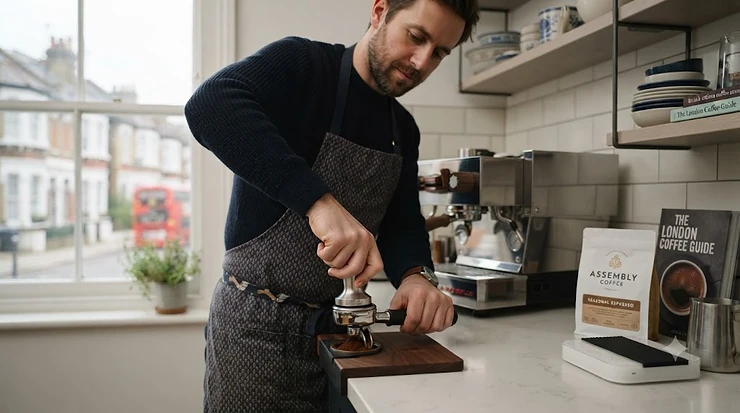
Here’s a confession most espresso guides won’t make: your tamping arm has been lying to you. One morning it presses with the confidence of a Victorian blacksmith, the next it barely nudges the grounds, and your espresso swings from bitter to sour without you touching the grinder. So, is a calibrated tamper worth it, or is it just another shiny accessory dreamed up to separate coffee obsessives from their money? A calibrated tamper is a spring-loaded or pressure-limited tool that stops compressing the coffee bed once a set force (commonly around 13.6kg, roughly 30lb) is reached, so every tamp lands at the same pressure regardless of who’s holding the handle. That single mechanical trick removes one of the biggest sources of shot-to-shot variation in a home setup. As the Wikipedia entry on espresso notes, the drink relies on forcing hot water through a tightly packed bed of grounds under pressure, which means the evenness of that bed matters enormously. This guide walks through seven genuine calibrated tampers currently sold on Amazon UK, compares them against ordinary tampers, and gets honest about when the upgrade actually earns its keep and when your money is better spent elsewhere.
Is a Calibrated Tamper Worth It? Quick Comparison Table
| Tamper | Base Size | Calibrated Pressure | Best For | Price Range |
|---|---|---|---|---|
| Generic 49mm Calibrated Tamper | 49-51mm | Fixed, ~13.6kg | Budget upgraders | Under £25 |
| MHW-3BOMBER 54mm Sound Feedback | 51/53.35/54/58mm | 15lb/30lb swap | Beginners wanting audible cues | £25-£40 |
| Normcore V4 | 45.5-58.5mm (multiple) | 15lb/25lb/30lb swap | Most home baristas | £40-£60 range |
| KNODOS Echo Tamper | 54/58mm | 30lb fixed | Style-conscious buyers | £35-£50 range |
| ESPRO Calibrated Tamper | 51/54/58mm | 30lb fixed | Quiet, no-fuss consistency | £45-£65 range |
| Decent Espresso Self-Levelling v2 | 58.4mm | 25lb minimum | Perfectionists chasing dead-level tamps | £55-£75 range |
| MHW-3BOMBER 58mm Multi-Base Set | 58mm, 4 bases | 15lb/30lb swap | Tinkerers who want options | £45-£65 range |
Looking at this table, the spread tells its own story: nobody needs to spend £75 to find out whether a calibrated tamper suits them, because a sub-£25 option exists that does the fundamentals correctly. What separates the tiers isn’t really “does it work” but how it feels in the hand, how many spring options you get, and whether the base fits your specific portafilter to the fraction of a millimetre. That last point turns out to matter more than most marketing copy admits, and we’ll come back to it in the mistakes section below.
💬 Just one click — help others make better buying decisions too!😊
Top 7 Calibrated Tampers: Expert Analysis
Right, let’s get into the actual hardware. We’ve grouped these across budget, mid-range and premium so there’s a sensible option whatever your machine and however deep your obsession runs.
1. Generic 49mm/51mm Calibrated Coffee Tamper — cheapest genuine entry point
This one won’t win any design awards, but it does the one job that matters: it stops pressing once you’ve hit the calibrated point, full stop. The stainless steel base is chrome-finished and paired with a wooden handle, and the spring inside is tuned for a consistent, pressure-sensitive compression rather than letting your wrist decide. Sizes run from 49mm through 51mm, which covers a huge chunk of the compact home machines like Gaggia’s smaller baskets and various De’Longhi models. Based on the spec comparison with pricier rivals, the mechanism here is functionally identical in principle: a spring, a shaft, a base. What most buyers overlook is that at this price, fit is doing more work than finish — measure your basket before ordering, because a loose base defeats the entire purpose. Reviewers consistently note that it “tamps evenly” and feels “solid and heavy” for the price, with one common thread being initial stiffness in the spring that eases with use. A few mention a slightly “cheap feeling” to the coating, though functionally it still delivers the promised consistent pressure. This is the tamper for someone who wants to test the calibrated-tamper theory without committing serious money.
Pros:
- ✅ Genuinely calibrated spring mechanism at entry-level price
- ✅ Solid, reassuring weight reported across reviews
- ✅ Fits a wide range of 49-51mm portafilter baskets
Cons:
- ❌ Coating feels basic compared with anodised rivals
- ❌ No swap-out springs if you want a firmer or lighter tamp
Price sits comfortably under £25, and for that money it’s hard to argue with the value if your goal is simply removing hand-pressure variability from the equation.
2. MHW-3BOMBER Espresso Tamper with Sound Feedback — audible click removes the guesswork
MHW-3BOMBER built its reputation on making espresso gear that talks back to you, and this tamper is a neat example. Instead of relying on feel alone, a three-spring design produces a distinct click the instant you hit 30lb of pressure, which — here’s what most buyers overlook — solves a very specific beginner problem: not knowing when to stop pressing. The wood-and-metal handle gives a warm, tactile grip, and the base is available in 51mm, 53.35mm and 58mm variants, so it plays nicely with Breville/Sage’s 54mm baskets as well as standard 58mm commercial-style portafilters. On paper this means less second-guessing during your first thirty days of ownership, which is exactly when bad tamping habits tend to form. Aggregated customer sentiment on Amazon UK for the MHW-3BOMBER range is broadly positive, with buyers repeatedly praising the click feedback as “eliminating the puzzle” of correct pressure, and describing the build as elegant and well-finished for a mid-budget accessory. A minority of reviewers found the click subtler than expected in a noisy kitchen. Still, for anyone whose main barrier to consistency is simply not knowing what “enough pressure” feels like, the audible confirmation is a genuinely practical touch that ordinary tampers can’t offer.
Pros:
- ✅ Audible click confirms correct pressure every time
- ✅ Multiple base sizes cover Breville, Sage and 58mm setups
- ✅ Comfortable wood-and-metal ergonomic handle
Cons:
- ❌ Click can be hard to hear in a loud kitchen
- ❌ Extra bases and springs sold separately push the price up
Expect to pay in the £25-£40 range depending on size and spring configuration, making it a sensible mid-budget pick.
3. Normcore V4 Coffee Tamper — the closest thing to an industry standard
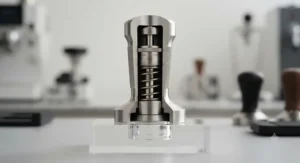
If there’s one name that comes up unprompted in home-barista forums, it’s Normcore, and the V4 is the reason why. The redesigned central shaft channels pressure from three interchangeable springs — 15lb, 25lb and 30lb — directly onto the flat base, and a levelling plate rests against the basket rim so the tamp comes out dead flat almost by accident. Base options span an unusually wide range, from 45.5mm for Flair manual machines right up to 58.5mm for commercial-style portafilters, with a dedicated 53.3mm size shaped specifically for Breville and Sage’s tapered baskets. What most buyers overlook about this model is that the swappable springs let you match tamping force to your grind and roast rather than being stuck with one setting for life — heavier for darker, oilier beans, lighter for delicate light roasts. Reviewers repeatedly describe it as “expensive but worth it,” citing the noticeable jump in shot-to-shot repeatability within days of switching. One recurring theme in aggregated feedback is that the presentation and build quality feel disproportionately premium next to cheaper alternatives, even if the improvement in cup quality plateaus once you’ve already nailed dose and grind.
Pros:
- ✅ Three swappable springs for genuine pressure flexibility
- ✅ Ten base sizes cover almost every home machine on the market
- ✅ Levelling plate design produces a consistently flat tamp
Cons:
- ❌ Sits at the top of the mid-range price bracket
- ❌ Manufacturer advises against dishwasher or soaking, so cleaning needs care
Typically found in the £40-£60 range, and reviewers who’ve tried cheaper alternatives first tend to be the ones most convinced it’s worth the jump.
4. KNODOS Echo Tamper — walnut styling with genuine 30lb calibration
KNODOS entered the calibrated tamper conversation more recently, and the Echo leans into a warm walnut handle that looks more like a piece of kitchen furniture than a tool. Underneath the aesthetics sits a proper spring-loaded mechanism rated to 30lb, with click feedback so you know precisely when the tamp is done, and a stainless steel base sized for both 54mm Sage/Breville baskets and 58mm portafilters. Here’s what the spec sheet won’t tell you, but the design implies: auto-levelling geometry like this is specifically aimed at buyers who’ve struggled with angled or lopsided tamps using a traditional flat-bottomed tool, since the mechanism physically won’t let the base tilt as you press. For anyone whose kitchen doubles as a design statement, the walnut-and-steel combination is a genuine point of difference against the mostly black, mostly plastic-handled competition. Because this is a newer entrant with a smaller review pool than Normcore or MHW-3BOMBER, we’d flag that aggregated sentiment is thinner and less battle-tested — worth weighing if you want years of crowd-sourced reliability data before buying.
Pros:
- ✅ Distinctive walnut handle that doubles as a display piece
- ✅ Auto-levelling design reduces angled tamping errors
- ✅ Click feedback confirms the full 30lb calibration point
Cons:
- ❌ Smaller, newer review base than more established brands
- ❌ Premium looks come with a premium-adjacent price tag
Sitting in the £35-£50 range, it’s a strong pick for buyers who want both function and a bit of visual flair on the countertop.
5. ESPRO Calibrated Tamper — quiet consistency for the no-fuss crowd
ESPRO’s tamper skips the audible click in favour of a subtler mechanical feel, which the brand frames as a deliberate choice: the spring resistance builds and releases without disturbing the grounds or risking channeling from vibration. Available in 51mm, 54mm and 58mm bases, it’s built from precision-machined stainless steel with an ergonomic handle designed to reduce wrist strain over repeated use — a detail that matters more than people assume once you’re pulling several shots a day. Reviewers consistently note the balanced weight and describe the tamping action as feeling “right” rather than mechanical, which is a fair summary of what a well-executed calibrated tamper should feel like: invisible in use, present only in the results. What most buyers overlook here is that ESPRO markets this as needing no recalibration over its lifetime, a claim aimed squarely at buyers who resent the idea of a “consumable” spring that loosens with age, in contrast to some budget models where reviewers note stiffness fading over time. For someone who wants the consistency benefit without a learning curve around interpreting clicks or feedback cues, this is arguably the most “just works” option on this list.
Pros:
- ✅ Subtle, vibration-free tamping action protects the puck
- ✅ Ergonomic grip designed to reduce wrist fatigue over time
- ✅ Built to avoid recalibration or spring degradation long-term
Cons:
- ❌ No audible confirmation, so beginners must trust the feel
- ❌ Fewer base-size options than Normcore’s ten-strong range
Priced in the £45-£65 range, it earns its keep with baristas who’ve already got the basics down and simply want reliability that fades into the background.
6. Decent Espresso Calibrated Tamper (Self-Levelling v2) — engineered for the perfectionist
Decent Espresso’s founder built this after concluding that pressure above roughly 25lb barely changes extraction, and that the real enemy is an uneven tamp rather than a weak one. The result is a self-levelling mechanism that doesn’t click at a threshold; instead, a spring guarantees at least 25lb of force while physically enforcing a level base regardless of how unevenly you press down. The 58.40mm base with a rounded bottom edge is designed to insert and remove smoothly from most 58mm baskets, including E61 group-head machines, and the grooved-base variant offers an even tighter basket fit for buyers chasing that last percentage point of consistency. On paper this means the Decent tamper is less forgiving of sloppy technique in one sense — it doesn’t let a lopsided push through — but more forgiving in another, since it corrects the tilt for you rather than punishing it. Aggregated review sentiment centres on trust in the engineering pedigree, since Decent built its name on precision espresso machines before branching into accessories, and buyers researching this product tend to already understand the mechanics of what “self-levelling” solves.
Pros:
- ✅ Self-levelling mechanism corrects tilt, not just pressure
- ✅ Rounded base edge designed for easy basket insertion/removal
- ✅ Backed by a brand built on precision espresso engineering
Cons:
- ❌ Among the pricier options covered in this guide
- ❌ 58mm-only fit means smaller-basket machines are excluded
Expect a price in the £55-£75 range, positioning it as the specialist’s choice rather than an impulse upgrade.
7. MHW-3BOMBER 58mm Coffee Tamper Set with Interchangeable Bases — the tinkerer’s option
Rounding out the list is a set rather than a single tool: MHW-3BOMBER’s 58mm kit ships with the calibrated tamper body plus three additional stainless steel bases — threaded, flat, curved and waffle-lattice — alongside a spare 15lb spring to complement the standard 30lb calibration. The pitch here is versatility: rather than buying separate accessories for different tamping textures or basket types, one handle swaps between profiles as your setup or mood changes. Reviewers who’ve compared traditional single-base tampers against this kit frequently mention the novelty of the waffle-lattice base for those experimenting with grind distribution, though the core calibrated mechanism is functionally the same click-feedback design found across MHW-3BOMBER’s range. What most buyers overlook about this set is that it’s arguably better value per accessory than buying a tamper and a separate distribution tool individually, since the included organiser pad and spare spring would otherwise be separate purchases. It’s a slightly niche pick, better suited to buyers who enjoy experimenting than those wanting a single “set and forget” tool.
Pros:
- ✅ Four interchangeable bases from one calibrated handle
- ✅ Includes spare spring and organiser pad in the box
- ✅ Better accessory value than buying pieces separately
Cons:
- ❌ More components to keep track of and clean
- ❌ Overkill for buyers who just want one reliable base
Bundle pricing typically lands in the £45-£65 range, which is competitive once you account for everything included.
Practical Usage Guide: Getting the Most From a Calibrated Tamper
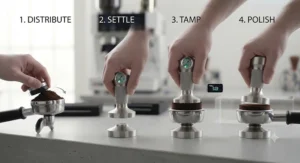
Buying the tamper is the easy part; using it well is where the actual espresso improvement lives. Start by measuring your portafilter basket’s internal diameter with a ruler before ordering — a base that’s even half a millimetre undersized leaves a ring of loose, uncompressed grounds around the edge, which channels water straight through it regardless of how calibrated the centre of your tamp was. Once it arrives, your tamping technique still matters: rest the portafilter on a stable, flat surface, keep your wrist straight rather than angled, and press directly downward until the spring engages or clicks, rather than grinding or twisting the tamper into the grounds. In the first thirty days, the most common mistake is over-correcting — pressing well past the calibration point out of habit, which achieves nothing since the mechanism has already stopped transmitting extra force to the puck. For maintenance, wipe the base after every use and avoid submerging spring-loaded tampers in water, since moisture can creep into the mechanism and affect long-term calibration accuracy. One optimisation trick that rarely appears on Amazon listings: tap the portafilter gently on the counter before tamping to settle grounds and eliminate air pockets, then do a single, decisive calibrated tamp rather than several light presses, which tends to compact unevenly.
Real-World Scenarios: Who Actually Benefits Most
Picture three different coffee drinkers and it becomes obvious that “is a calibrated tamper worth it” doesn’t have one universal answer. First, there’s the university student with a compact 51mm De’Longhi machine, making one strong coffee before a 9am lecture and caring more about not being late than about micro-adjusting extraction — for them, a budget calibrated tamper under £25 removes the worst inconsistency without adding complexity to an already rushed morning. Second, consider the home barista with a Sage Barista Express who’s invested in a proper burr grinder and weighs every dose to the gram; this is precisely the profile Normcore’s swappable-spring V4 was designed for, since they’ll actually notice and appreciate the difference between a 25lb and 30lb tamp on different roast levels. Third, imagine someone running a small pop-up coffee stall on weekends, where multiple pairs of hands pull shots across a shift — here, consistency between staff members matters more than any individual’s skill, making a calibrated tamper less a luxury and more a basic quality-control tool, similar in spirit to standardising scales and grind settings across a team.
Do I Need a Calibrated Tamper? A Buyer’s Decision Framework
Cutting through the marketing, here’s a simple way to decide. If you’re using pre-ground coffee or capsules, skip this purchase entirely — a calibrated tamper does nothing for pod machines or drip coffee, full stop. If you own a manual espresso machine and grind fresh but you’re new to the hobby, choose a budget calibrated tamper first, because building the habit of a consistent, level tamp matters more at this stage than fine-tuning exact pressure. If you already tamp confidently but notice your shots vary depending on your mood, tiredness or which hand you use, choose a mid-range option like Normcore or MHW-3BOMBER’s click-feedback range, because your problem is genuinely about pressure variability rather than technique. If you’ve already dialled in grind, dose and distribution and you’re chasing the last few percentage points of repeatability, choose a premium self-levelling option like the Decent Espresso tamper, since your remaining inconsistency is more likely tilt-related than force-related. And if you’re serving multiple people across a shift, whether commercially or just for a big family gathering, choose based on how many hands will be using it rather than how serious any one person is, since consistency across users is the actual goal.
✨ Ready to stop guessing and start tamping like you mean it?
🔍 Compare Today’s Top Calibrated TampersTake your espresso to the next level with a tamper that removes hand-pressure guesswork from every shot. Click through to check current pricing and availability, and start pulling more consistent espresso from your very next cup.
Self-Levelling Tamper vs Regular Tamper
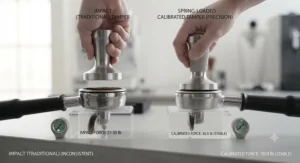
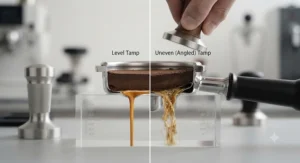
The core difference isn’t complicated, but it’s worth being precise about, because “self-levelling” and “calibrated” get used almost interchangeably online despite meaning slightly different things. A regular tamper is just a handle and a rigid base — pressure, angle and depth are entirely down to your hand, which is why two identical tampers used by two different people (or even the same person on two different mornings) can produce noticeably different pucks. A calibrated tamper adds a spring that limits how much force reaches the coffee, standardising pressure but not necessarily angle. A self-levelling tamper, like the Decent Espresso model covered above, goes a step further by mechanically correcting tilt as well, so even an unsteady or rushed press still lands flat. According to Expert Reviews UK’s testing of home coffee machines, consistency across variables like grind, dose and tamp is repeatedly flagged as more decisive for cup quality than any single premium component in isolation, which lines up with what we found comparing these seven products: the jump from “no calibration” to “calibrated” is where most of the improvement lives, while self-levelling adds a smaller, more specialist refinement on top.
| Factor | Regular Tamper | Calibrated Tamper | Self-Levelling Tamper |
|---|---|---|---|
| Pressure consistency | Depends on the user | Fixed by spring | Fixed by spring |
| Angle/tilt correction | None | None | Built-in |
| Learning curve | Steepest | Moderate | Lowest |
| Typical price | Under £15 | £20-£65 | £55-£75 |
| Best For | Confident, experienced hands | Most home baristas | Perfectionists and beginners alike |
Reading across that table, the honest takeaway is that a calibrated tamper solves the majority of the consistency problem for most people, and self-levelling is a genuine but smaller upgrade on top rather than a separate category of improvement.
How to Choose a Calibrated Tamper
Picking the right one comes down to a short checklist rather than guesswork:
- Measure your basket first. Get the internal diameter to within a fraction of a millimetre, since an ill-fitting base undoes every other benefit on this list.
- Decide if you want audible feedback. Beginners often benefit from a click; experienced hands may prefer the quieter, feel-based mechanisms like ESPRO’s.
- Check spring flexibility. If you switch between roast levels or beans often, a swappable-spring option like Normcore’s V4 pays for itself in adaptability.
- Consider handle material and grip. Wood, aluminium and steel all handle differently over long sessions, so weight and comfort matter if you’re tamping daily.
- Factor in maintenance requirements. Spring mechanisms generally shouldn’t be soaked or dishwashed, so check care instructions before buying if convenience matters to you.
- Match your budget to your actual use case. A £20 option and a £70 option both solve the pressure-consistency problem; the extra spend buys refinement, not a fundamentally different result.
- Read aggregated review themes, not star ratings alone. Look specifically for recurring mentions of fit, spring stiffness over time, and build quality rather than generic five-star praise.
Calibrated Tamper Espresso Improvement: What Actually Changes in the Cup
This is the question that matters most, and it deserves an honest answer rather than marketing enthusiasm. Recent research from the University of Warsaw, published in the journal Physics of Fluids and reported by phys.org, examined how pressure behaves as it moves through a compacted coffee bed and found that flow through the puck stops responding predictably once pressure climbs beyond a certain point — reinforcing what many baristas already suspected from experience, that the relationship between tamping force and shot quality plateaus rather than climbing indefinitely. In practice, this means the biggest improvement from switching to a calibrated tamper isn’t extra pressure at all; it’s eliminating the day-to-day, hand-to-hand variation that causes channeling, where water carves an easy path through a weak spot in the puck and leaves the rest under-extracted. What most buyers overlook about calibrated tamper espresso improvement is that the effect is more about repeatability than raw quality — your best shot with a regular tamper might already rival your best shot with a calibrated one, but your worst shot improves dramatically, because the floor is raised even if the ceiling stays roughly where it was. For anyone whose espresso quality currently swings wildly between excellent and disappointing depending on the morning, that narrowing of the range is precisely the improvement worth paying for.
Common Mistakes When Buying a Calibrated Tamper
The single biggest mistake is ordering by machine brand name rather than measured basket diameter — “fits Breville” and “fits Sage” sound reassuring, but different models within the same brand sometimes use different basket sizes, so a tamper that’s technically compatible with one Sage machine may sit loose in another. The second mistake is assuming a higher calibrated pressure automatically means better espresso; as the research above suggests, more force past a certain threshold does little beyond wearing out the spring faster. Third, buyers frequently skip checking maintenance requirements and then damage the mechanism by soaking it or running it through a dishwasher, voiding whatever consistency benefit they paid for. Fourth, some shoppers buy a fixed single-spring tamper when they regularly switch between very different roast levels, then find themselves wishing for adjustable pressure — Normcore’s interchangeable-spring approach specifically solves this, so it’s worth checking before committing to a fixed model. Finally, plenty of people buy a premium self-levelling tamper before they’ve nailed grind size and dosing consistency, which is a bit like buying racing tyres for a car that still needs its wheels aligned — genuinely excellent components, applied before the fundamentals are sorted.
Long-Term Cost & Maintenance
A calibrated tamper isn’t a subscription or a consumable in the way coffee beans are, but it’s worth thinking in terms of cost-per-shot rather than upfront price alone. A £45 Normcore tamper used daily for three years works out at roughly 4p per shot across a thousand-plus coffees, which is trivial next to the cost of the beans themselves, let alone a single coffee-shop espresso. Where ongoing cost creeps in is spare parts: replacement springs for adjustable models typically cost a few pounds each, and buyers who tamp aggressively or use their tool commercially may need a replacement spring every year or two as consistent compression gradually fatigues the metal. Cleaning costs nothing beyond a damp cloth and a few seconds after each use, though neglecting this can lead to residue building up inside the shaft mechanism over months, eventually affecting how smoothly the spring travels. Compared with the total cost of ownership of an espresso machine — descaling solution, replacement filters, occasional professional servicing — a calibrated tamper is genuinely one of the cheapest components in the whole setup relative to how much day-to-day consistency it delivers.
Features That Actually Matter (And Those That Don’t)
Marketing copy for these products loves to mention numbers that sound impressive but rarely change your actual results. A calibrated pressure rating of 30lb versus 25lb, for instance, matters far less than whether the base fits your basket precisely, yet it’s usually the headline spec on the packaging. Similarly, titanium coatings and anodised finishes look striking in product photos but contribute nothing to tamping consistency — they’re about durability and aesthetics, not extraction. What genuinely matters: base diameter accuracy (fit trumps almost everything else on this list), a level, flat pressing surface free of warping, a spring mechanism that doesn’t visibly degrade within months of regular use, and a handle shape that doesn’t strain your wrist across repeated daily use. Sound feedback and self-levelling both matter, but as refinements layered on top of the fundamentals rather than substitutes for them. If a listing leads with “commercial grade” or “professional” without specifying an actual measured base size, that’s a signal to look elsewhere rather than a genuine selling point.
Safety and Wrist Health When Tamping Daily
It’s easy to overlook, but repeated tamping with poor technique or an ill-fitting tool is a genuinely repetitive wrist action, and doing it daily for years is exactly the kind of pattern that can contribute to discomfort over time. The NHS guidance on repetitive strain injury notes that pain in the wrist, forearm or hand from repeated movement can develop gradually, and that keeping joints in a neutral position during repetitive tasks helps reduce risk. A calibrated tamper genuinely helps here, since it removes the need to grind or twist forcefully to “feel” for correct pressure — you simply press until the spring engages, which is a far gentler motion than manually judging resistance through brute force. Ergonomic handle shapes, like those on the ESPRO and Normcore models covered above, are designed specifically with this in mind. If you’re tamping multiple times a day, every day, it’s worth treating wrist comfort as a genuine feature to shop for rather than an afterthought, alongside the usual considerations of price and base fit.
Frequently Asked Questions
❓ Is a calibrated tamper worth it for a beginner?
❓ What is the difference between a self levelling tamper vs regular tamper?
❓ Do I need a calibrated tamper if I already tamp well?
❓ Does a calibrated tamper improve espresso taste immediately?
❓ Can a calibrated tamper fit any espresso machine?
Conclusion
So, is a calibrated tamper worth it? For the vast majority of home baristas grinding fresh coffee and pulling shots from a portafilter machine, yes — not because it transforms mediocre coffee into competition-grade espresso overnight, but because it removes one genuinely unpredictable variable from a process that already has plenty of others to manage. Budget options like the generic 49mm calibrated tamper prove the core benefit doesn’t require serious spending, while Normcore’s V4 and the Decent Espresso self-levelling model show what’s possible once you’re ready to refine further. What ties every product on this list together is honesty about what a calibrated tamper actually does: it standardises pressure, and in the case of self-levelling designs, angle too, rather than magically improving bean quality or grind size. Pair the right tamper with a decent grinder and consistent dosing, and the improvement in day-to-day reliability is genuinely noticeable. Buy based on your actual basket size, your budget, and how much refinement you personally want, and you’ll land on the right one from this list.
Recommended for You
- Best Calibrated Tamper: 7 Top Picks for UK Baristas 2026
- Best Espresso Tamper 2026: 7 Picks Every Home Barista Rates
- Bottomless vs Pressurised Portafilter: 7 Honest Picks for 2026
Disclaimer: This article contains affiliate links. As an Amazon Associate, I earn from qualifying purchases. If you purchase products through these links, we may earn a small commission at no additional cost to you.
✨ Found this helpful? Share it with your friends! 💬🤗
